Overview
“…your impressive MS thesis would be a dissertation in most places.” Dr. J. Don Murff, PhD, Texas A&M University, Retired geotechnical engineer, Exxon
“This thesis is skilfully written and a delight to experience. My respect and congratulations.” Dr. Deborah Arfken, Professor of Political Science and former Dean of the Graduate School, University of Tennessee at Chattanooga
“You did such an excellent work in this thesis!” Liu Chao, researcher.
When people speak of “using the wave equation” for their piling problems, they’re seldom referring to a formula but to a numerical method and usually a computer program and/or an instrumentation technique in the case of in situ tests. Yet, when the wave equation is studied in elementary differential equations, some kind of “equation” or formula can be derived. How it looks obviously depends on the boundary and initial conditions of the problem.
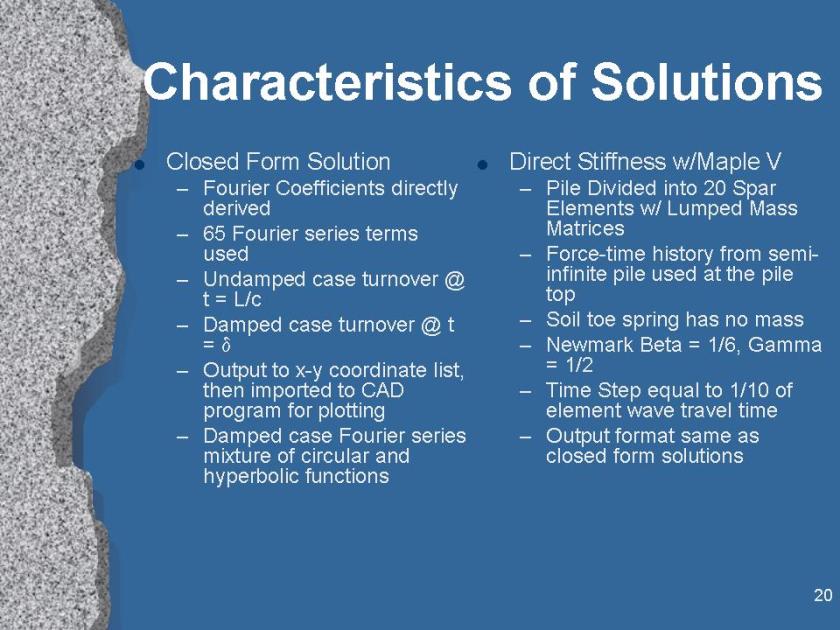
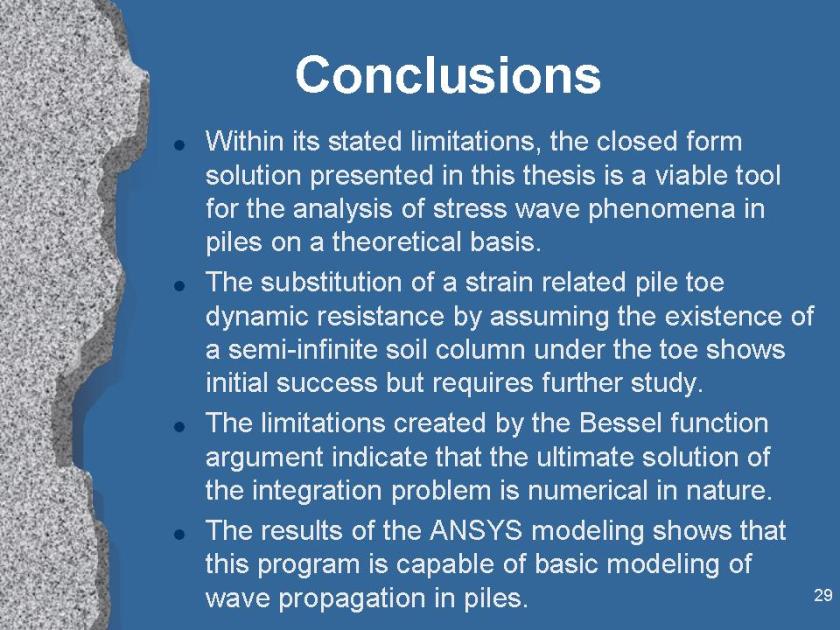
Such results are “closed form solutions.” While stress wave propagation in piles is a complex, non-linear problem, some useful information can be obtained from a closed form solution, if only to check the numerical methods for underlying problems.
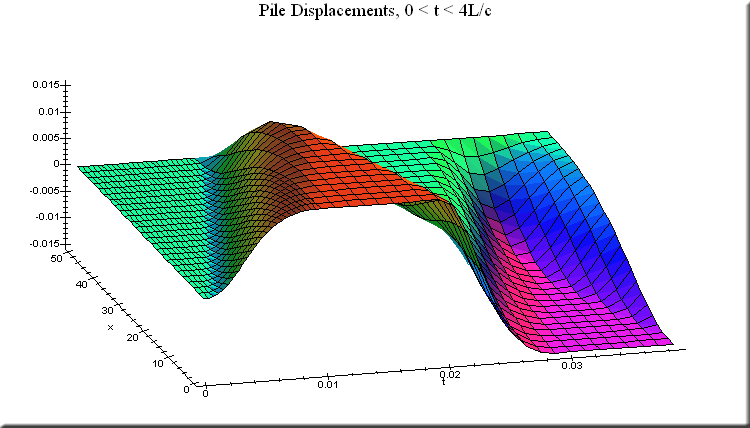
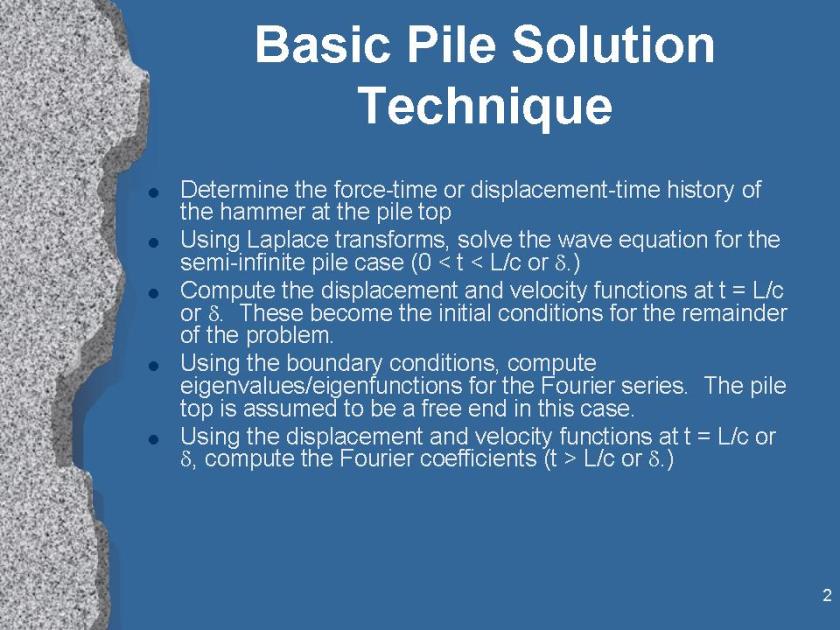
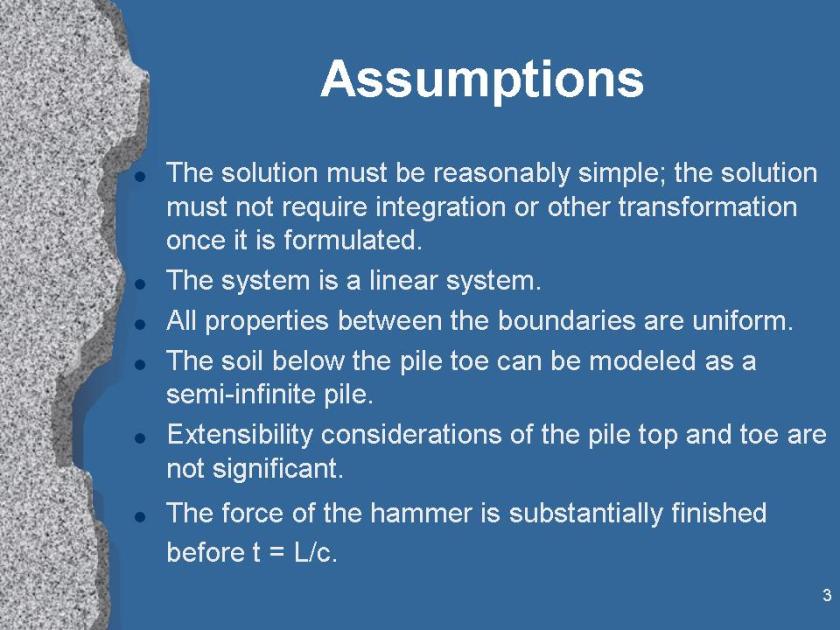
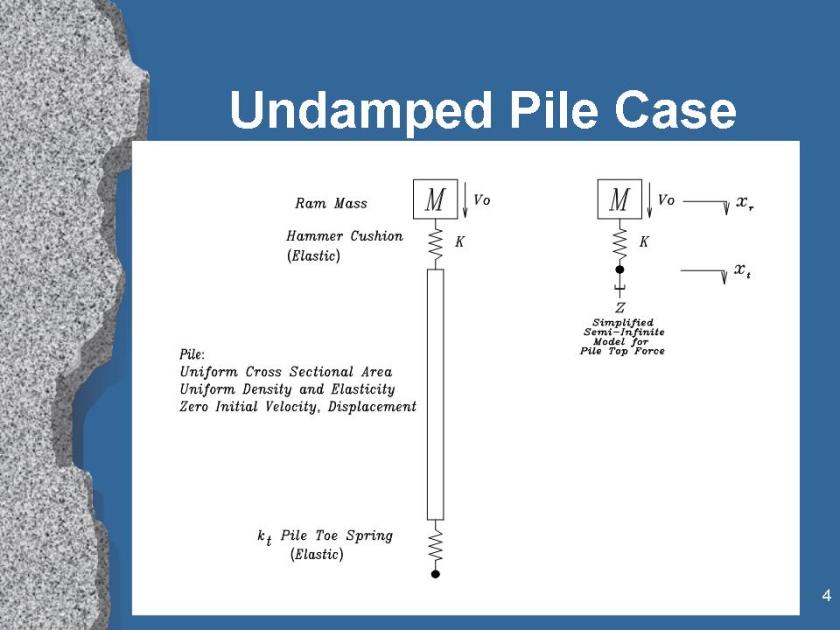
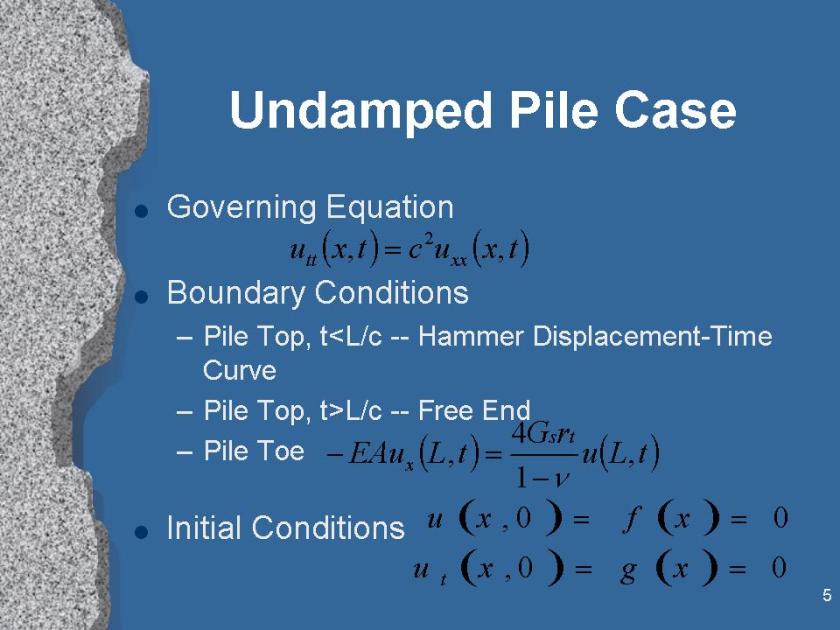
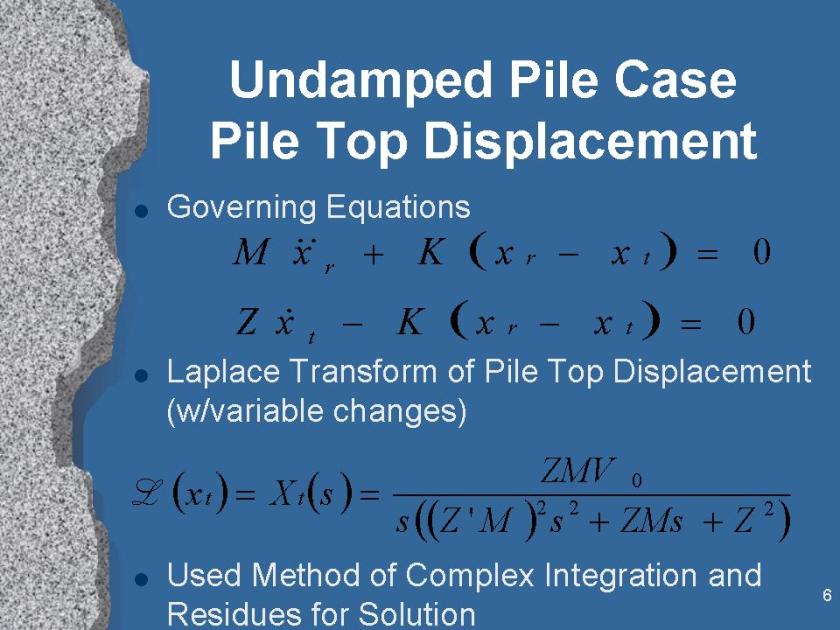
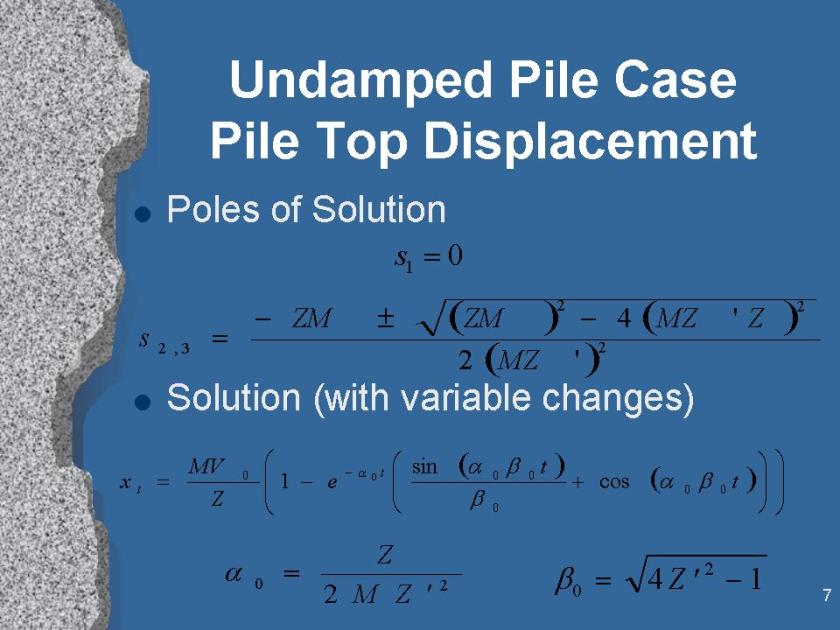
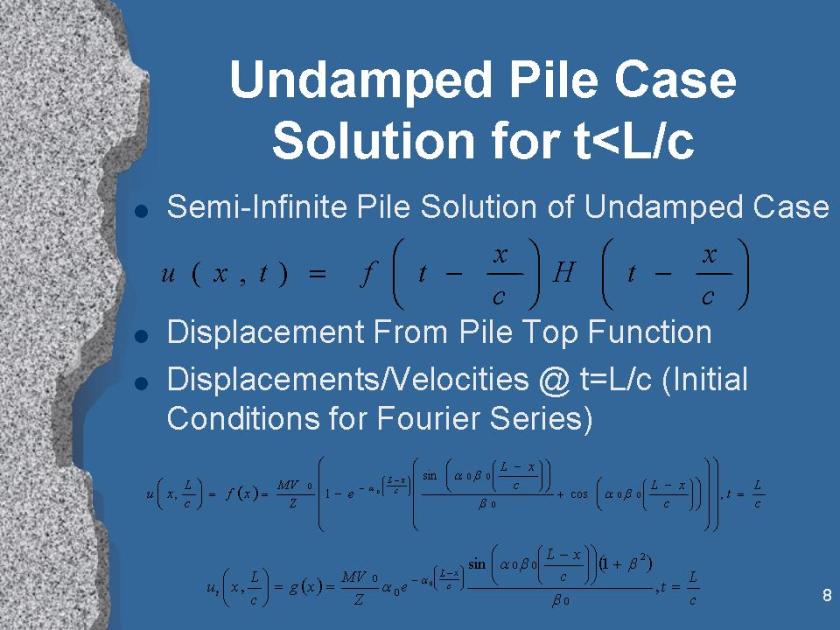
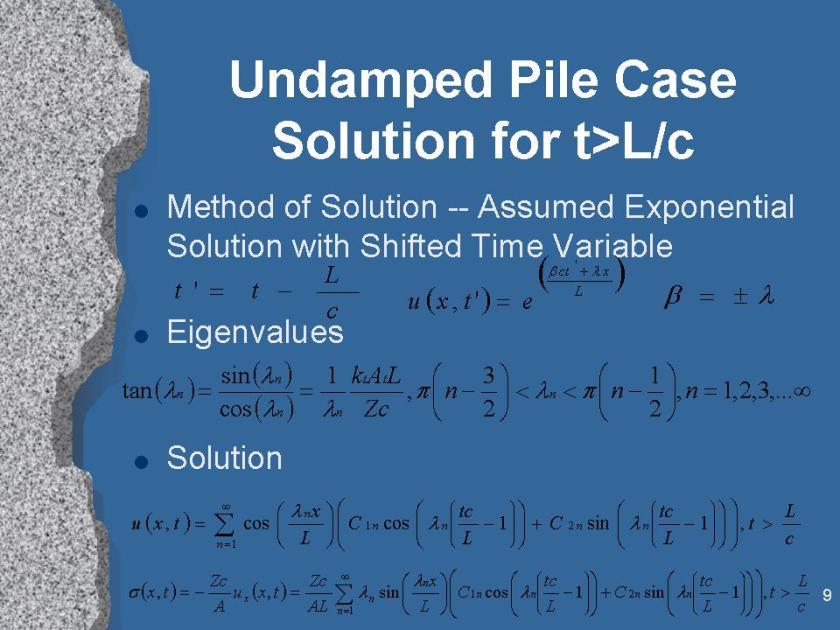
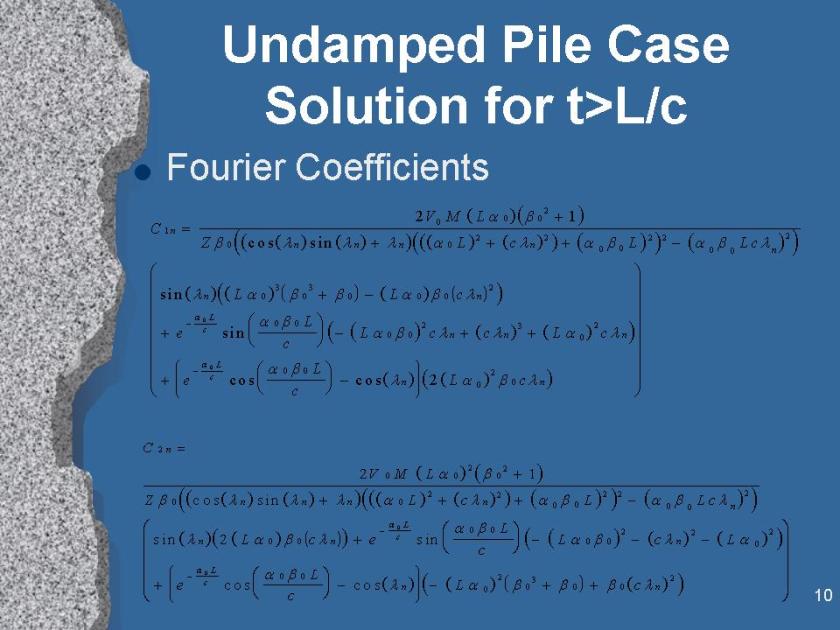
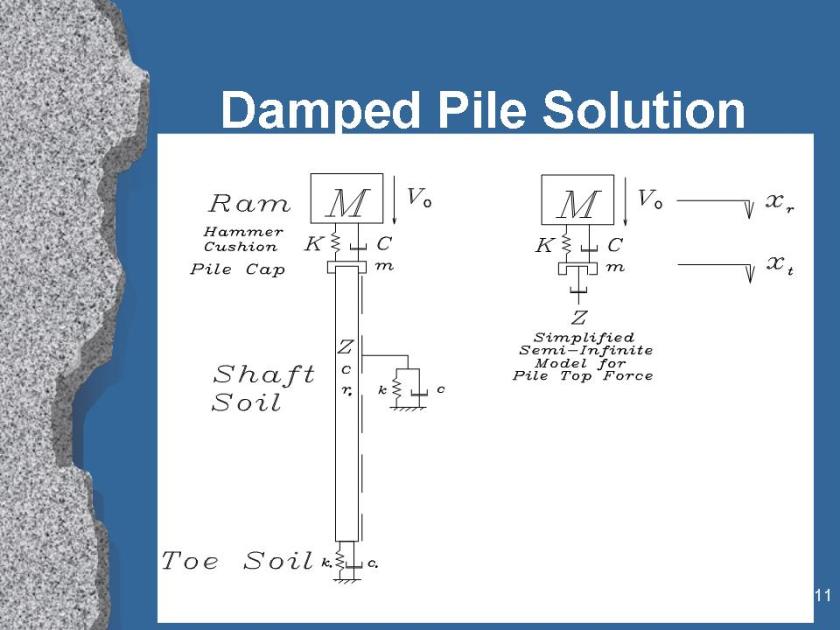
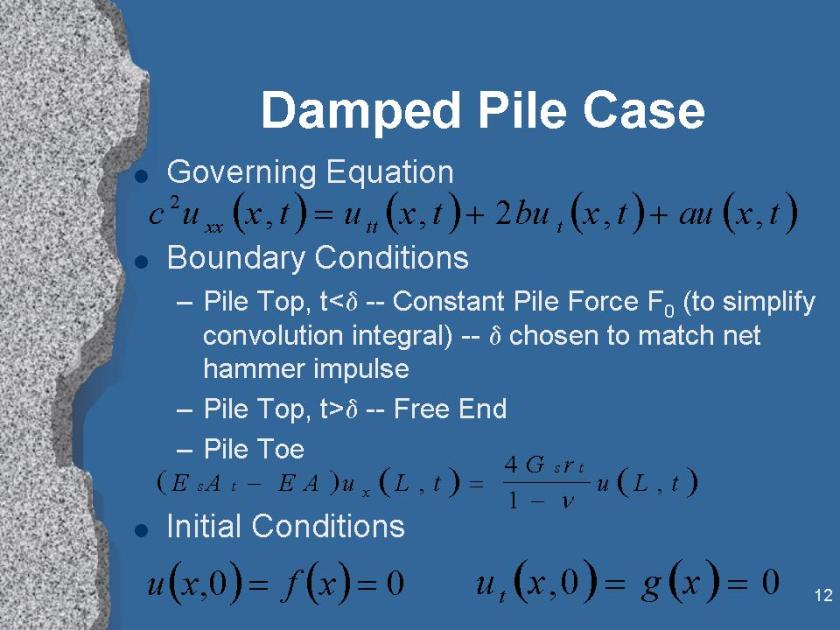
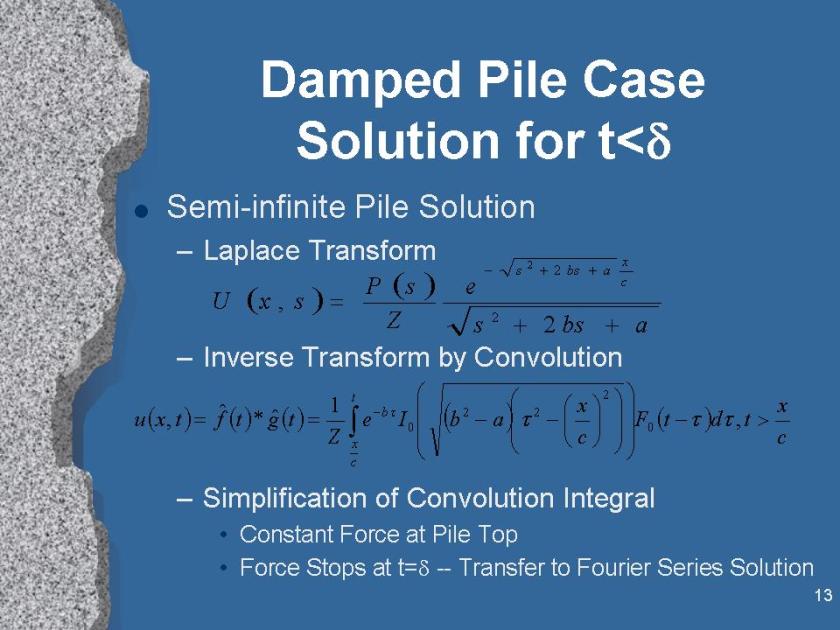
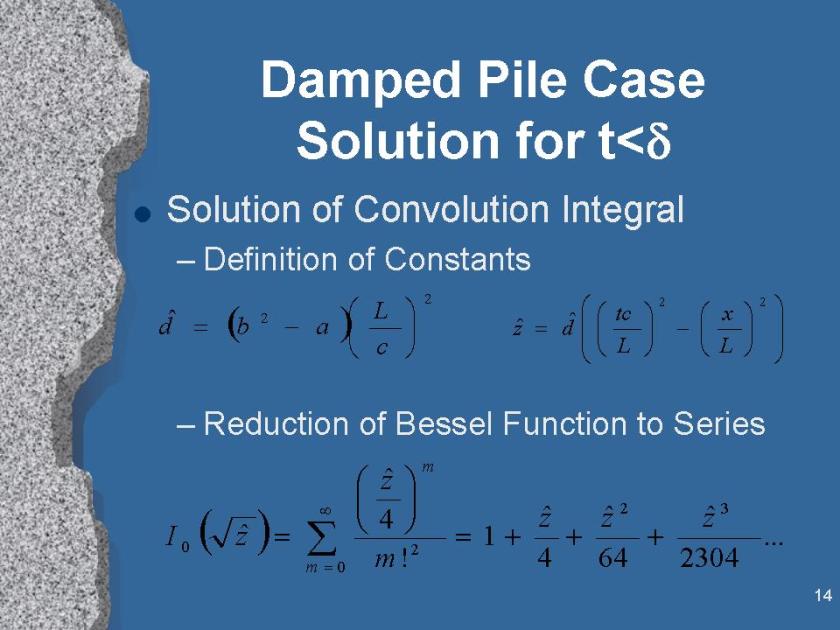
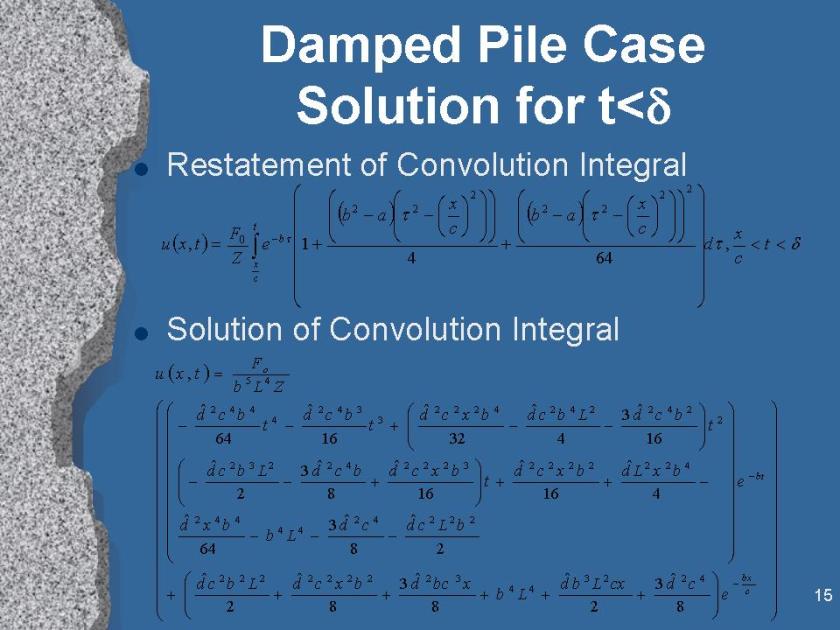
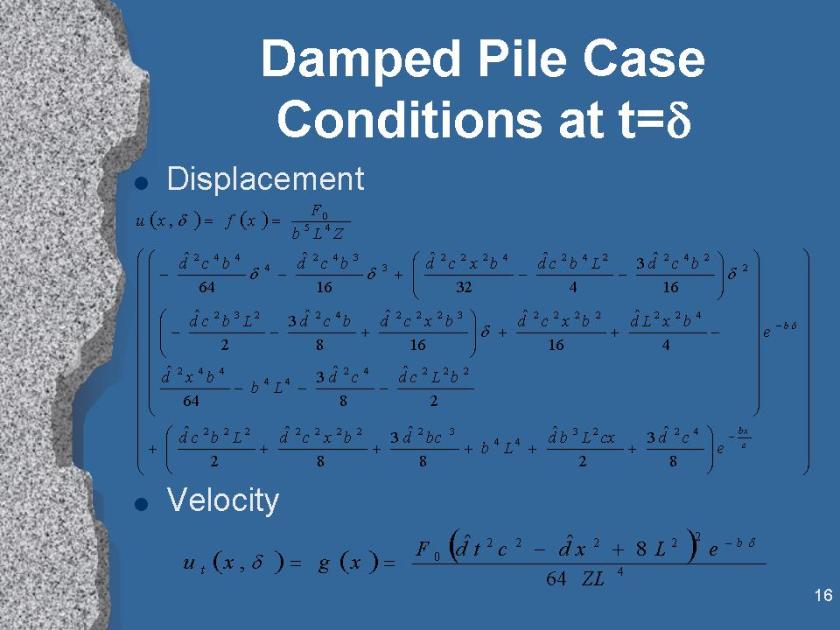
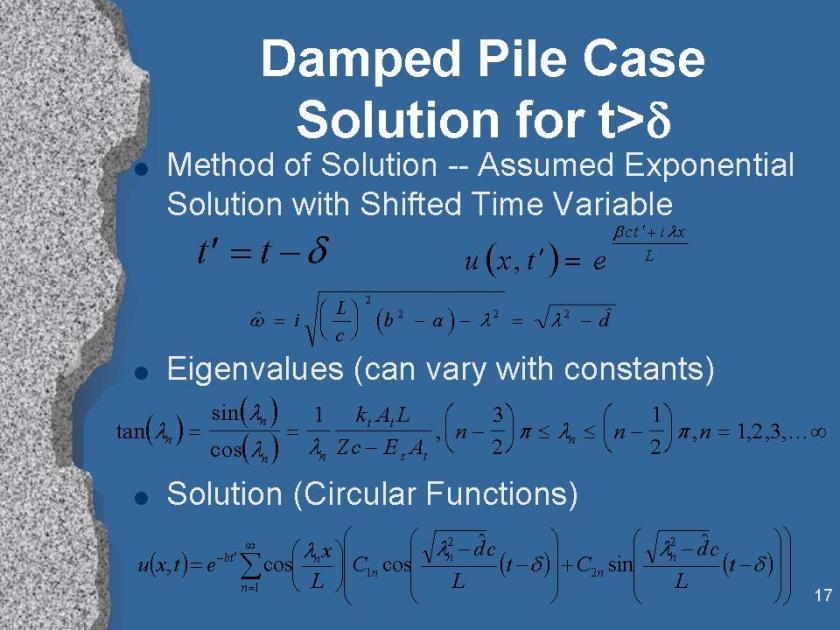
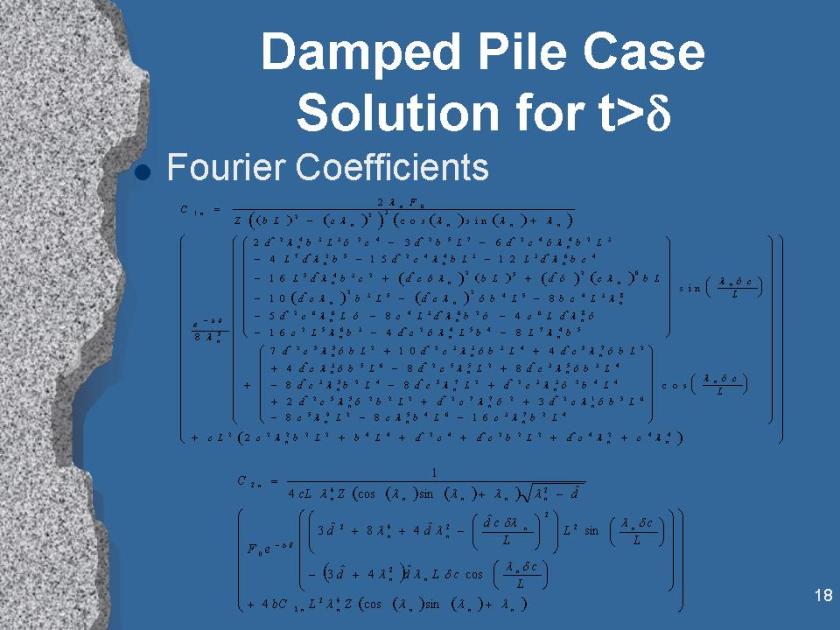
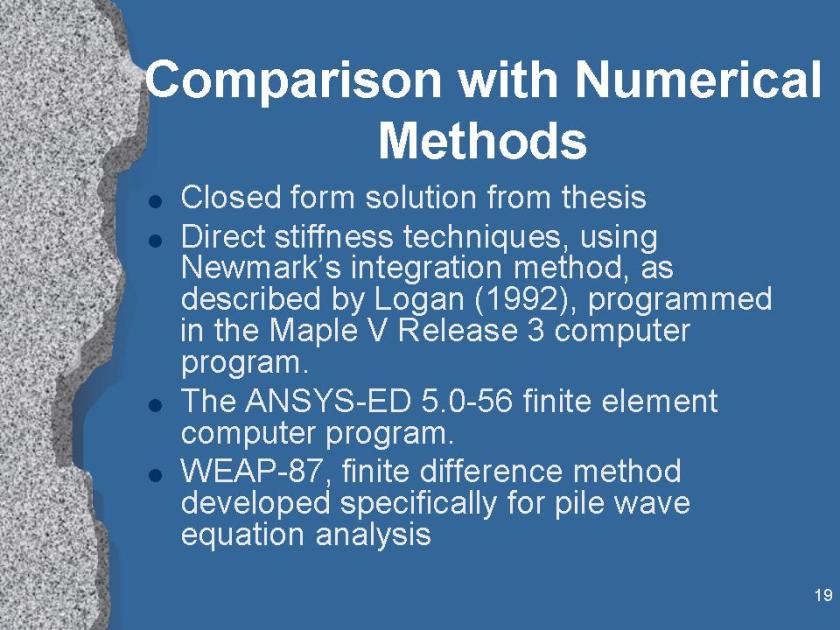
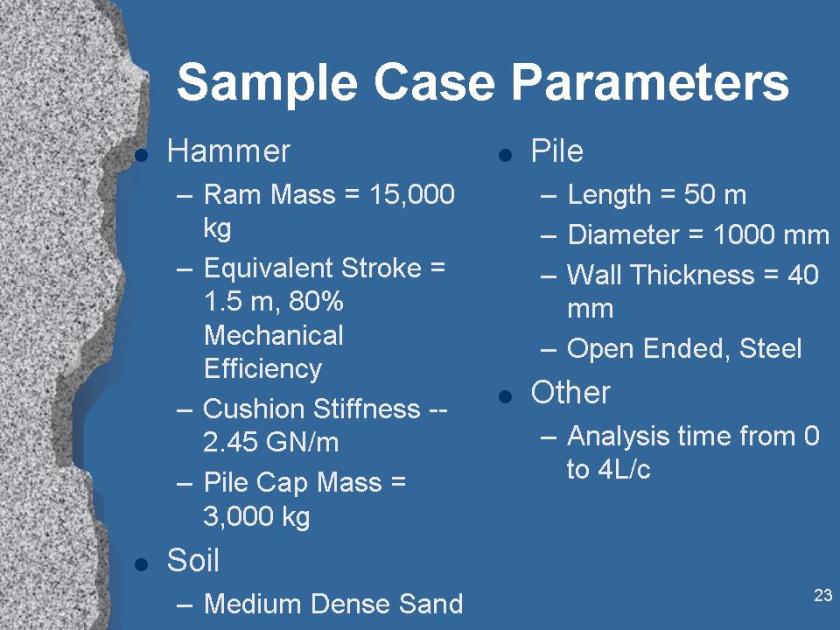
An attempt at such a solution was undertaken by Don C. Warrington at the University of Tennessee at Chattanooga; his result is documented in the master’s thesis Closed Form Solution of the Wave Equation for Piles. In addition to the thesis itself, we have the defence slideshow, abstract, preface and some papers related to the thesis.
Thesis Slideshow
Abstract
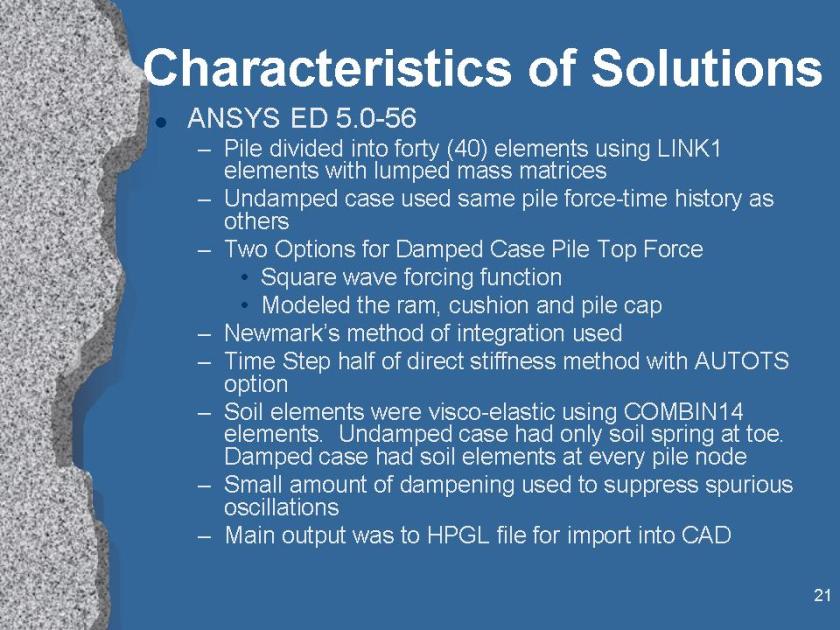
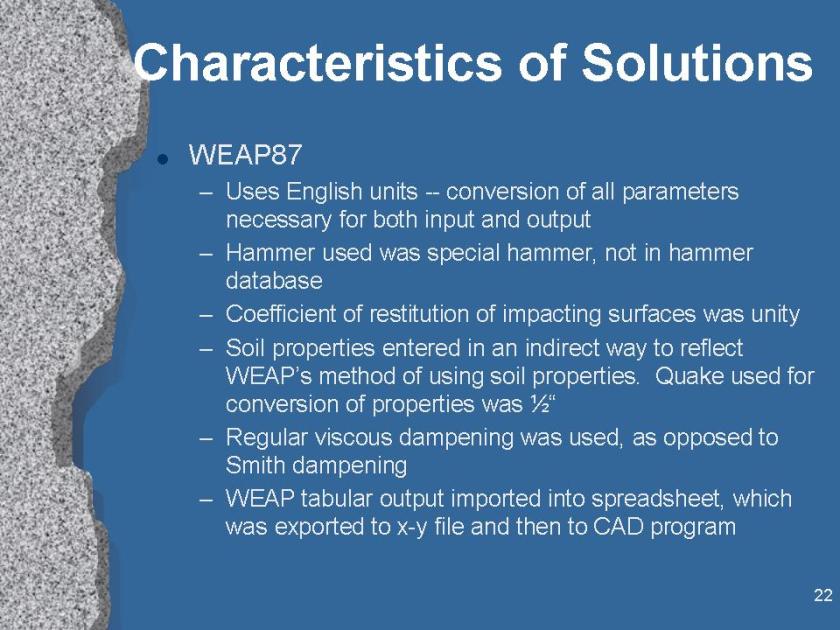
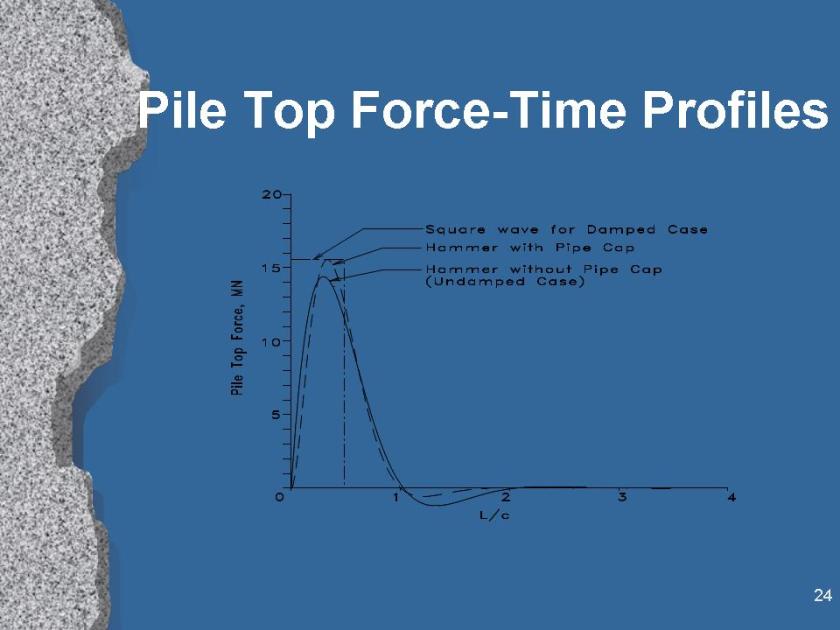
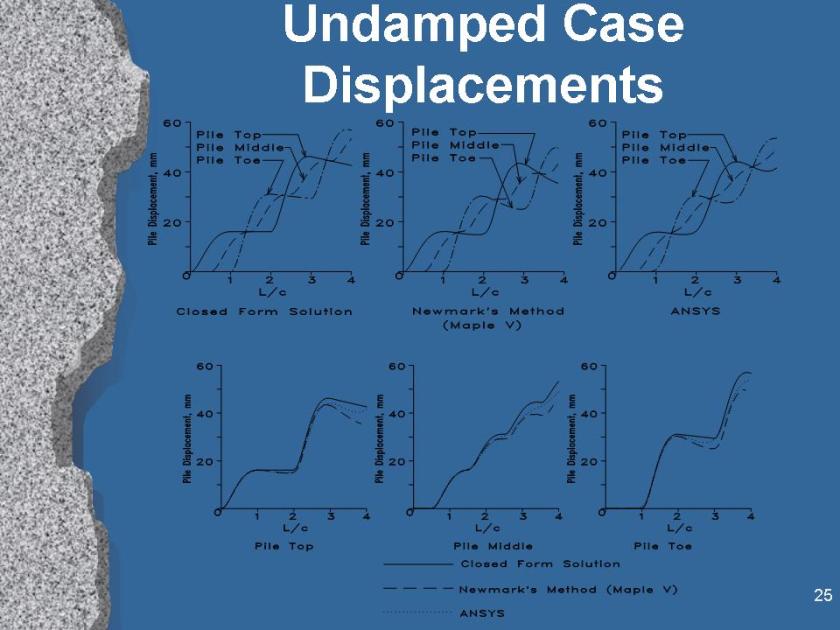
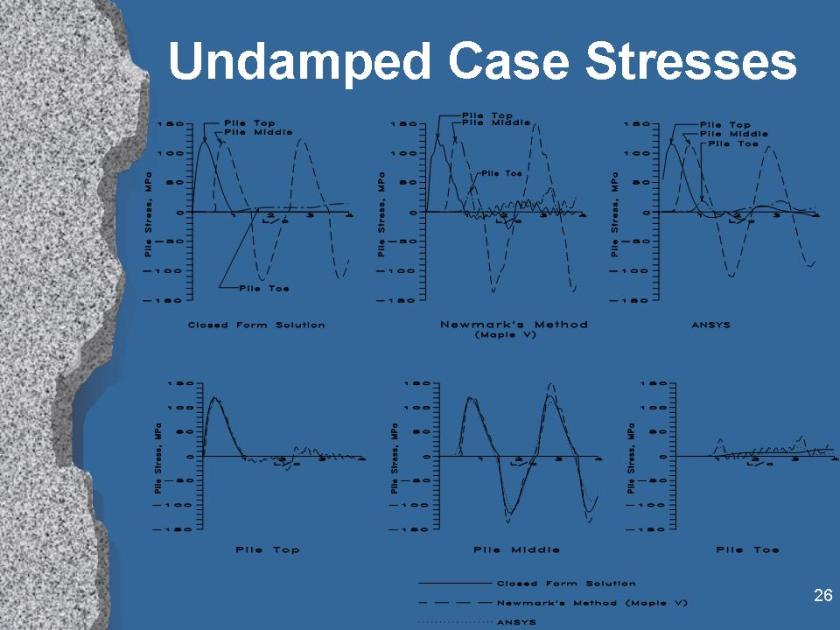
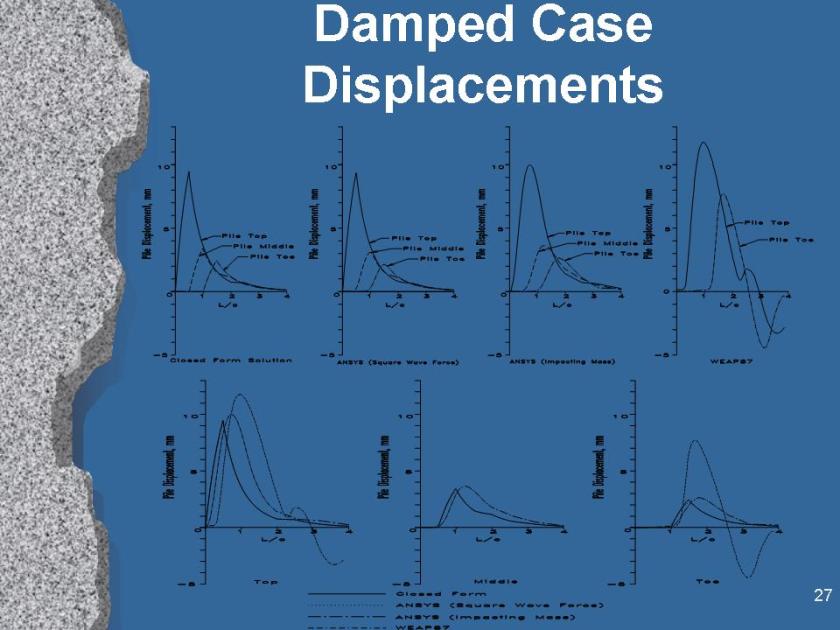
This thesis details the research into the one-dimensional wave equation as applied to piles used in the support of structures for civil works and driven using impact equipment. Since the 1950’s, numerical methods, both finite difference and finite element, have been used extensively for the analysis of piles during driving and are the most accepted method of analysis for the determination of driving stresses, dynamic and static resistance of piles. In this thesis the wave equation is solved in a relatively simple closed form without recourse to numerical methods. A review of past efforts to solve the wave equation in closed form is included. Problems that appear in previous related works are discussed and derived again, including the Prescott-Laura problem of the cable system stopped at one end and the solution of a hammer/cushion/cap/pile system for a semi-infinite pile. The latter is used to assist in the determination of a pile top force-time function that can be used to simulate the impact of the hammer on the pile. The basic equations, initial and boundary conditions are detailed, with the parameters adjusted to match actual soil dynamic behaviour while at the same time being a form convenient for closed form solution. To avoid difficulties due to spectral elements in the boundary conditions, a strain-based model of the radiation dampening in the pile toe was developed. The solution technique uses a Laplace transform of the semi-infinite pile problem for 0 < t < L/c (or for a time duration 0 < t < d, where d < L/c) and a Fourier series solution of the Sturm-Liouville problem thereafter. This solution is applied both to undamped and damped wave equations. The work includes comparison with existing numerical methods such as WEAP87, ANSYS, and Newmark’s method using Maple V.
Preface
Let us consider that if the ancients had kept to this deference of daring to add nothing to the knowledge transmitted to them and if their contemporaries had been as much opposed to accepting anything new, they would have deprived both themselves and their posterity of the fruit of their discoveries. Just as they used the discoveries handed down to them only as the means of making new ones, and that happy daring had opened the road for them to great achievements, so we should take the discoveries won for us by them in the same spirit, and following their example make these discoveries the means and not the end of our study, and thus by imitating the ancients try to surpass them.
This quotation, taken from the Preface to the Treatise on the Vacuum by the French scientist and Christian thinker Blaise Pascal, is as fitting way of beginning such a work as this as one can find. Although the wave equation itself has been investigated since the days of Bernoulli, the application of stress-wave theory to piles is relatively recent, going back to the early 1930’s. Although it is an exaggeration to refer to those who first investigated these matters as “ancients,” given the acceleration of the growth of knowledge and the application of technology the time between the first investigations of this problem and the present is in reality rather long.
In any investigation such as this the ideal goal is to come up with something truly novel, and many of such works emphasize their novelty to the denigration of those who have gone on before. While in some fields of endeavour this might be appropriate, in this case such sweeping novelty cannot be claimed. This work fits the mould as outlined by Pascal above: it takes the work that has been done before, advances it a step while realizing that there are many more steps before “perfection” is achieved.
The use of the analysis of stress waves in piles to determine everything from the performance of the hammer to the capacity of the pile is widespread today. Most of these methods use numerical methods for the analysis. The use of numerical methods came rather early in this history of stress wave application to piles, earlier in fact than the computer power really needed for practical application was readily available. Closed form solutions were either abandoned entirely or applied on a limited basis or in an ancillary way to other techniques.
The acceptance of these methods without a way to really compare them with some kind of “theoretical” result have left some involved in the analysis of pile driving uneasy as to the theoretical basis of the solutions employed. A great deal of work has been done to correlate the numerical models with field data. But are these adjustments being made to actual field phenomena or to underlying deficiencies in the methods we are using? The answer to this question is critical because without a solution to this problem we may be solving the wrong problem, and thus guaranteeing surprises in the future when a breakdown in our corrections is induced by unforeseen conditions. This is especially important in a geotechnical problem because the variables in a problem are generally complex and inadequately quantified.
It is for this reason that we are “backtracking” to a closed form solution in this thesis. In doing this we are forced to take a hard look at the underlying mathematical theory of the wave equation as it can be applied to piles. Putting together sound mathematical application with the basic physics of the problem is something that is frequently lacking (generally through no fault of the investigators) in works in this field. While in this thesis we have attempted to accomplish this, we have both applied mathematics in a different way and in the process acquired a new sense of humility because the complexity of the problem stretches the mathematics applied to the limit.
With these thoughts we proceed to our subject, realizing that we are indebted to those who have gone before us and hoping to be yet another link in the chain of knowledge and understanding to those who might come after. With regard to understanding, however, we close with a quotation from the great Jewish scholar Moses Maimonides, from his Guide to the Perplexed:
My son, so long as you are engaged in studying the Mathematical Sciences and Logic, you belong to those who go round about the palace in search of the gate…When you understand Physics, you have entered the hall; and when, after completing the study of Natural Philosophy, you master Metaphysics, you have entered the innermost court, and are with the king in the palace. You have attained the degree of the wise men, who include men of different grades of perfection. There are some who direct all their mind toward the attainment of perfection in Metaphysics, devote themselves entirely to God, exclude from their thought every other thing, and employ all their intellectual faculties in the study of the Universe, in order to derive therefrom a proof for the existence of God , and to learn in every possible way how God rules all things; they form the class of those who have entered the palace, namely the class of prophets.
Related Articles
This paper presents the application of the closed form solution for the damped wave equation to piles. The wave equation in numerical solution has been used for many years, generally without even a simple closed form counterpart. In this paper the closed form solution for the damped wave equation will first be stated and related to an actual pile driven into the soil. Following this is a discussion of the boundary conditions: the hammer at the pile top and the soil response at the pile toe. To avoid spectral components in the Fourier series eigenvalues and to preserve orthogonality, a new strain based soil model to simulate radiation dampening from the pile toe is proposed. A solution to this equation which involves the solution of the semi-infinite pile using Laplace transform for the first part of the impact followed by a Fourier series solution for the remainder. Comparison with numerical methods for a sample case is also presented.
David Espinoza
Purdue University
December 1991
Pile foundations are commonly used for off-shore structures, bridge supports, in areas were the applied loads cannot be supported by the underlying soil and they have to be transferred to a more competent stratum. It is clear that the amount of load that each pile can support will depend on the resistance characteristics of the surrounding soil (shaft friction) as well as the soill beneath the pile (tip resistance). In order to evaluate much load each pile can support a number of models based on the one-dimensional wave equation have been presented. These models are used to predict the stresses on driven piles induced by impact loads as well as the permanent displacements associated with these impact loads. The soil dynamic resistance is modelled as a system of spring and dashpots concentrated at the nodes. The numerical procedures usually employed in the solution of these problems are finite differences and finite element. In the solution scheme, the soil resistance is assumed to be elasto-plastic, i.e. proportional to the soil displacement up to a given maximum value. The non-linear behaviour of the soil resistance restricts the use of spectral analysis for this type of problems. Nonetheless, spectral analysis can be used for cases where the impact loadings are small enough that the soil response is within the elastic range.
John Prescott
College of Technology, Manchester
An excellent textbook on the subject, including mechanics of materials, bending, torsion, cylinders, places, strings and rods. The last featured the Prescott-Laura problem which was crucial in the development of the closed form solution.
This paper documents both the development of a closed form solution for the one-dimensional wave equation as it is applied to piles and its comparison to numerical solutions of the same problem. Wave mechanics have been used extensively in piles for many years but the solution of the wave equation has been almost exclusively a numerical one. The closed form solution used involves the solution of the semi-infinite pile solution immediately after impact and a Fourier series solution for times thereafter. This solution is compared with numerical solutions of different kinds for a given test case. The comparison shows variations between the closed form solution and the numerical methods that, although not egregious, are also not consistent from case to case. A wider variety of cases is needed to come to more general conclusions about the variations in these methods.
This paper is an analysis of pile toe plates that are assumed to interact with elastic foundations. A solution to the deflection and moment equations is derived and discovered to be in fact made up of Bessel functions with complex arguments. A solution based on the analysis of the series that make up the Bessel functions is performed. The solution is presented in the form of charts based on dimensionless parameters. A sample case is analysed and discussed.
This paper is a review and summary of the efforts made to develop a closed form solution of the wave equation as applied to driven piles. It discusses the early development of solutions and includes discussion of such topics as semi-infinite piles, solutions using both Fourier series and the method of images, and solutions specific to vibratory hammers. Results, advantages, and limitations of each of these methods are discussed. The rationale for the use of closed form solutions as opposed to the numerical ones is set forth. The paper concludes with a discussion of the possibilities of future research and sets forth the requirements for making this research successful.
Andrew J. Deeks
University of Western Australia
1992
The use of foundation piles to support structures over water or soil with inadequate bearing capacity dates from pre-historical times. Although the use of cast in-situ piles has become popular in recent years, piles are commonly driven into the ground with some type of hammer. Until the nineteenth century, the size and number of piles required to support a particular structure, and the hammer required to install those piles, were determined by rules of thumb and experience.
As scientific engineering expanded, formulae for pile capacity and drivability were developed. Pile drivability formulae initially represented a correlation of empirical data, and later formulae were based on a combination of basic mechanics and empirical data.
Although the dynamics of pile driving were appreciated early in the twentieth century, a practical method of solving the pile driving wave equation was not developed until the advent of digital computers. The method then developed employed an empirical model of the soil surrounding the driven pile. The one-dimensional wave equation is still the primary means of analysing pile drivability today. The last thirty years have seen various improvements made to the original method. Much additional data has been collected, allowing the empirical soil parameters to be refined, and the computational techniques have been improved.
Because of the wealth of experience and data, the current techniques provide satisfactory solutions for most practical pile drivability problems today. However, there are some cases, particularly in the offshore engineering field, in which piles of unusual size must be driven into soils which are uncommon on land. Since a large empirical database is not available, the parameters required for the standard wave equation analysis can be difficult to determine. This has motivated attempts to formulate a numerical model relying only on fundamental soil properties, which can be measured by standard geotechnical investigation methods. The finite element method has been used to analyse pile drivability occasionally, but the highly transient dynamics of the stress wave propagation and the non-linear behaviour of the soil cause such a solution to be computationally expensive.
Several models based on the one-dimensional wave equation and measurable soil parameters have been proposed. The finite element method has been used previously in attempts to verify these models, but the lack of a conclusive comparison in the literature suggests that these attempts have been less than successful. The coarseness of the finite element meshes used in these studies has led to some concern.
This thesis is a contribution to the process of finding a suitable one-dimensional model, based on measurable soil parameters, which adequately represents the pile driving process. The finite element method is used to accurately analyse the response of an ideal von Mises soil during a hammer blow on a full displacement pile. A one-dimensional model is developed which gives excellent agreement with the finite element results. In the process, doubt is cast on the accuracy of some of the finite element work previously reported in the literature, but the ability of one-dimensional wave equation models to represent pile driving behaviour is veritled.
This dissertation was co-directed by Spencer J. Buchanan, Distinguished Professor of Soil Mechanics and Foundation Engineering at Texas A&M and before that founder and Chief of the Soil Mechanics Division of the U.S. Army Waterways Experiment Station. The Spencer Buchanan Lecture at Texas A&M, an important lecture in geotechnical engineering, is named in his honour.John V. Perry (1924-2009) taught Mechanical Engineering at Texas A&M (with some breaks) from 1948 until 1995.
On a lighter note, his department head, C.M. Simmang (who signed off on the dissertation,) was commenting to his class on a visit by the late President Gerald Ford to San Antonio in 1976. Shaking his head in disbelief, he said, “At least I had enough sense to shuck the tamale before I ate it.”
John Vivian Perry, Jr.
Texas A&M University
August 1963
This research was undertaken to determine the amount and extent of soil motions under vibrating foundations. The test soil was standard 20-30 Ottawa sand, ASTM C-190, that was contained in a one-meter cubical box. A force generator was mounted above the soil and applied dynamic loads to a circular footing. These were harmonic forces and were applied at frequencies between five and fifty cycles per second.
Three hundred and sixty-seven test runs were recorded on an electromagnetic oscillograph from signals generated by an acceIerometer buried in the soil. This acceIerometer was located at various depths beneath the center of a footing and, at other times, it was located beneath and offcenter. Other variables were the footings which had different diameters and masses.
Three empirical equations were developed from the test results using dimensional analysis. These equations were for maximum values of acceleration, velocity and displacement, respectively.
A. Holeyman
A brief (and in some ways controversial) discussion of dynamic capacity estimations, especially with high blow-count piles.
This work is a classic for soil dynamics in general and the response of soil to the vibration of foundations in particular. Lysmer’s simplification of the response equation was a major step forward in the rational analysis of this phenomenon.
Lysmer’s Analogue–which reduced the soil response of a rigid circular foundation to a single degree of freedom spring-dashpot system–also has found application in pile toe response to pile driving.
John Lysmer was for many years a Professor of Civil Engineering at the University of California at Berkeley. He passed away in 1999.
John Lysmer
U.S. Army Corps of Engineers Contract Report 3-115
University of Michigan
June 1965
This investigation includes a theoretical solution for a rigid footing, resting on an elastic half-space, which is subjected to steady-state vertical oscillation. It is shown how this steady-state solution can be used to describe the response of the footing to a transient pulse-type vertical loading.
After establishing the theoretical solution, and evaluating the approximations required for its development, it is further demonstrated that the theory permits evaluation of quantities which may represent spring constants and damping factors for use in the usual theory for vertical motion of a damped-one-degree-of freedom system. The agreement between the simple theory and elastic half-space theory is well within the limit required for engineering solutions.
The results of the study provide information from which the elastic dynamic response of rigid footings subjected to transient vertical loads may be evaluated. By taking advantage of such standard procedures as the phase-plane method, the dynamic response of footings may still be estimated even if the stresses in the soil extend into the inelastic range. A detailed discussion of the application of this method to inelastic settlements of vertically loaded footings will be presented in a subsequent report.
Finally, the theoretical developments included in this report for vertical oscillations may serve as a guide to develop similar theoretical evaluations of the dynamic response of rigid footings in other uncoupled modes of oscillation.

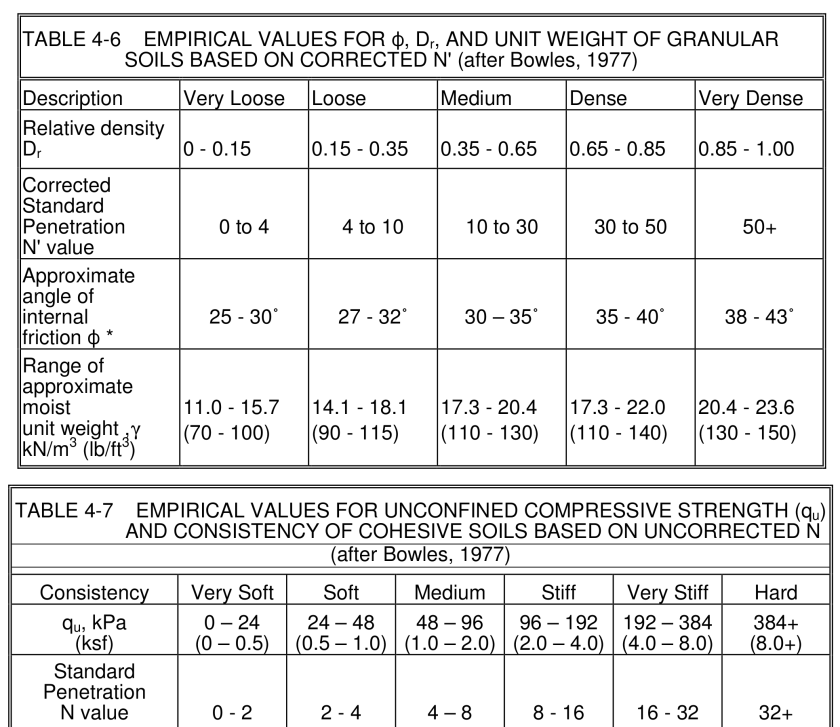





.


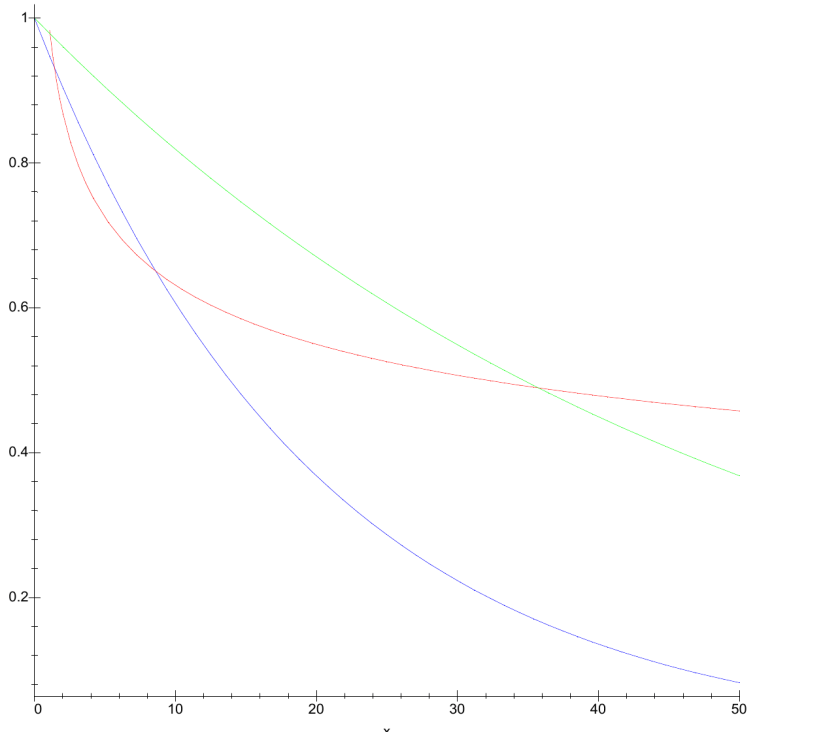
 can vary from one formulation to the next. With clays, also as always, things are more complicated.
 , thus

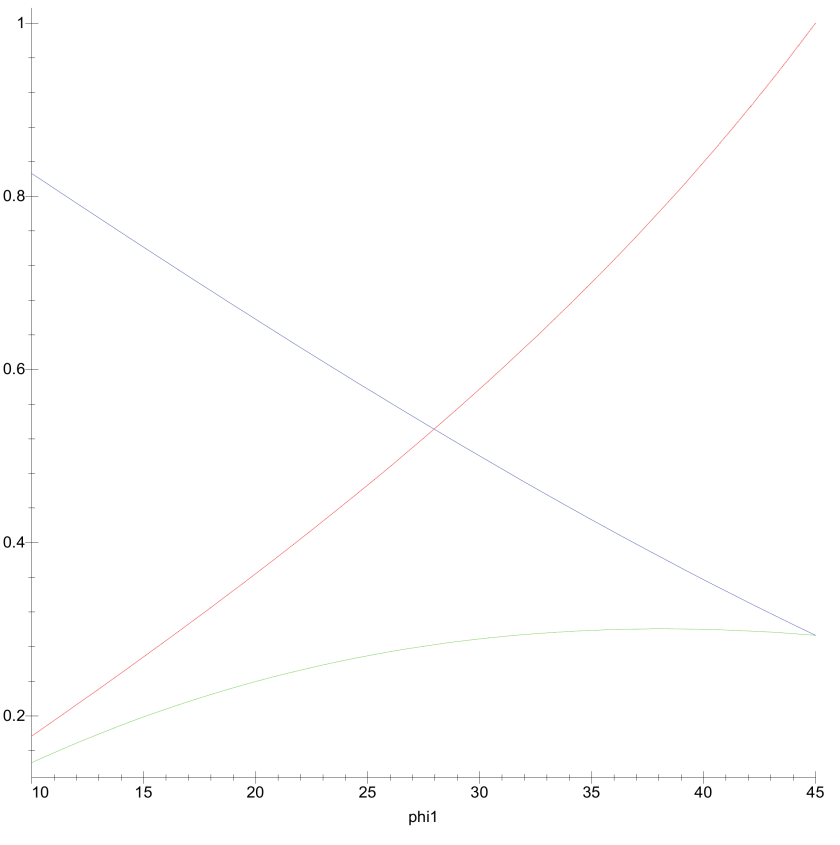
 is in
is in  is in
is in  is in
is in  . This is accompanied by a growing conviction that pile support in clay is frictional in character–that load transfer is dependent upon the effective lateral pressure acting against the side of the pile after it is driven.




 appears in both this formulation and that for sands
  in
in  in
in  .
. .
. might result if this had been in Kolk and van der Velde’s original statistical correlation equation.
 vulcanhammer.net