
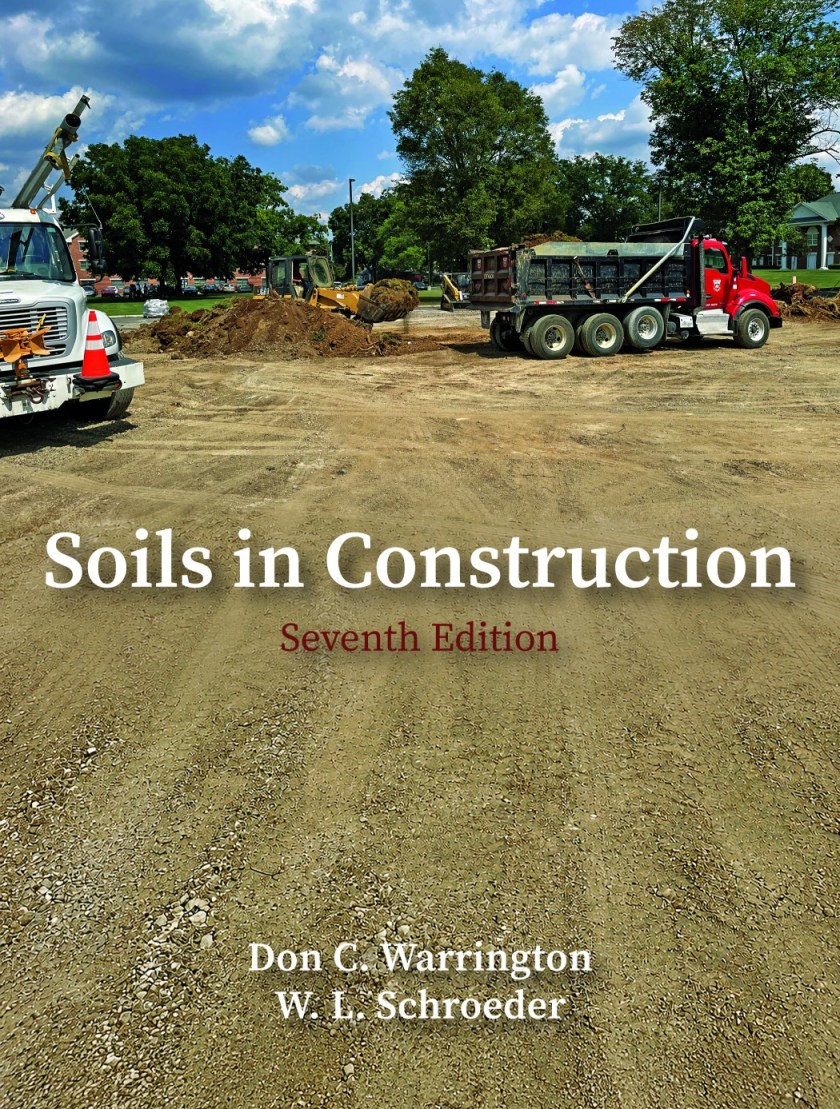
Soils in Construction speaks not only to engineers, but to the people who must build with soils in the real world: construction managers, engineering managers, students, and working professionals who need practical judgement as much as theory. Written from the contractor’s point of view, this long-standing classic explains the soil mechanics and foundation principles that shape successful construction projects.
The Seventh Edition has been thoroughly revised with updated graphics, tables, examples, and problems throughout. New and expanded coverage includes weathering and soil origins, soil index properties and classification, effective stress and settlement, contracts and compaction specifications, soils reports and subsurface exploration, embankment construction and control, dewatering, excavation support, shallow and deep foundations, and more. The book also adds appendices that support laboratory instruction and broaden its usefulness as a standalone course text or reference.
We are pleased to introduce this page, designed to help you, the instructor, student or geotechnical/construction professional, with this book and the courses it was designed to be used with. Here you can find supplementary materials that can be useful in teaching and learning the material this book presents. Some of this material has been borrowed from other geotechnical courses such as Soil Mechanics, Foundation Design and Analysis and Soil Mechanics Laboratory, but some is original to this course.
Note on the slides: the slides for this book are those when I taught the course in the Fall of 2026 at Lee University. Because of the specific needs of that course, some of the material has been rearranged, and this is noted in the slides. The book can be taught in a number of ways, which is explained in the Instructor’s Manual, obtainable from the publisher.
The outline is here, we’ll be filling in the blanks as we go:
- How to obtain the book, both for teachers and students
- The “Why” and “What” of Soils in Construction
- Chapters in the Book
- Overview of Rocks and Soils
- Soil and Behavior of Soil Particles
- Soil Index Properties
- Soil Classification
- Slide Presentation
- Unified Soil Classification, from NAVFAC DM 7
- Sorting Out the Coarse Fraction Using Pie Charts, and a Unified Classification Example
- Ohio DOT’s Rendition of the AASHTO Classification System. A different view from an agency that uses it for more than pavements.
- Stress Analysis and Engineering Properties
- Slide Presentation
- From Elasticity to Consolidation Settlement: Resolving the Issue of Jean-Louis Briaud’s “Pet Peeve”. An explanation as why consolidation settlement problems aren’t linear
- Deriving and Solving the Equations of Consolidation. This is beyond the book’s scope, but for those of you who are interested, here it is.
- Determining the Degree of Consolidation
- The Contract and Contract Documents
- Interpretation of Soils Reports
- Slide Presentation
- SPT Hydraulic Hammer in Action
- An Introduction to Drilling and Sampling in Geotechnical Practice — the “Boring Video”
- p-q Diagrams and Mohr-Coulomb Failure. This was incorporated into this edition, with some improvements.
- Embankment Construction and Control
- Dewatering
- Excavations and Excavation Supports
- Slide Presentation
- A Quick Preliminary Way to Determine Slope Stability
- Designing Cantilever Sheet Pile Walls Using a Chart
- Analyzing Sheet Pile Walls with SPW 2006. This topic is beyond the treatment in this book. However, it’s an introduction to sheet piling software. These days, software is almost essential to designing sheet pile walls. Video tutorial included.
- Why Only Rankine? Since Rankine theory is the only one we use in this book, some explanation about it is in order
- SLOPE Stability Software Program, mentioned in the text. This is a tutorial to explain how to use the program and has a link to download the free software
- Shallow Foundations and Pavements
- Deep Foundations
- Slide Presentation
- The Wave Equation after TAMWAVE: Alternatives and Substitutes
- Driven Pile Design
- Driven Pile Design: Introduction and Overview
- Driven Pile Design: Axial Loads, General Considerations
- Driven Pile Design: Three Methods of Analysis
- Driven Pile Design: Static Load Testing and Axial Settlement
- Driven Pile Design: Axial Group Bearing Capacity and Settlement
- Driven Pile Design: Lateral Loads on Piles
- Driven Pile Design: Wave Equation Analysis
- Driven Pile Design: Inverse and Verification Methods
- Driven Pile Design: ASD and LRFD Methods
- Appendices: these have been in the book for many years, with the Seventh Edition we have added several that brings the book up to preparing students for the FE exam.
- Appendix A: Laboratory Testing Exercises. In this edition we used the “DD” forms, some of these can be downloaded below:
- Sand Cone Test
- Water Content. This isn’t explicitly included in the text, but is part of many soils tests
- Gradation or Particle Size Analyses (Sieve and Hydrometer Analysis)
- Specific Gravity
- Soil Consistency Tests (Atterberg Liquid and Plastic Limits)
- Compaction Tests
- Appendix B: Selected Driven Pile Configurations
- Appendix C: Pile Hammer Specifications
- Appendix D: Unit Conversions and Principles
- Appendix E: Consolidation Settlement with Preconsolidated Soils
- Included in the slide presentation for Chapter 5
- Appendix F: Mohr’s Circle and Stresses at a Point
- Included in the slide presentation for Chapter 5
- An Overview of Mohr-Coulomb Failure Theory
- Soil Mechanics: Introduction to Soil Stress States
- p-q Diagrams and Mohr-Coulomb Failure
- Appendix G: Estimation of Swelling of Expansive Soils and Identification of Collapsible Soils
- Appendix H: Flow Nets, Finite Element Analysis of Groundwater Flow, and Structural Considerations
- Appendix I: Lateral Earth Pressure Loads on Walls and Unbalanced Hydrostatic Pressure
- Appendix A: Laboratory Testing Exercises. In this edition we used the “DD” forms, some of these can be downloaded below:
- Useful Reference Books
- Soils and Foundations Reference Manual. Material from this book was used extensively in the preparation of this edition and the last one. It has taught a generation or more of DOT officials in the finer points of geotechnical engineering as a science.
- NAVFAC DM 7.01 and 7.02. Another “geotechnical classic,” this was also used extensively. Now dated, it’s still a good reference, even though it’s not recommended as a textbook (that’s from experience.)
- The “New” NAVFAC DM 7.1, the replacement for the first part of the old NAVFAC documents.
- The “New” NAVFAC DM 7.2, the replacement for the second part of the old NAVFAC documents.
- Soil Mechanics. An interesting take on the subject, used some of this for this edition.
- Errata
- p. 37: Add to caption for Figure 3.2 the following: “Top: Well Graded, Center: Poorly Graded, Bottom: Gap Graded” (see slides for Chapter 3)
- p. 44: Equation (3.7) should read “W = Ws + Ww“
- p. 50: Problem 3.10, delete “(b)” and “(c)”
- p. 107: Caption for Table 5.4 should read “Data for Problem 6”
- p. 108: Caption for Table 5.5 should read “Data for Problem 7”
- p. 235: “Problem 2” is in fact a part of Problem 1, following problems should be reduced by one number.
- p. 298: Figure 10.20,
should read
; first sentence after Equation (10.9) should read “
applies to soils where
.”
Other Material
I have presented these type of links over the years to my students.
- Mathematical Resources (because everybody needs help in math)
- Blessed are the Merciful: I keep getting requests to “go light” on the grading. This is how I did it myself.
- My Thoughts on Sleeping in Class
- In Search of the Lost Movado. Bar hopping has consequences.
- Who’s This Idiot? That’s Me! It’s easy to get trapped in the system.
- When the Pathfinder Gets Lost: some students like to “follow the lead” of someone else to get the course work done. That can have negative results other than those described in the syllabus, just like this example
- The Last Supper, the Iranians and the Perfect Dissertation: A Maundy Thursday Reflection. Some say the “perfect” dissertation can’t be written, but that isn’t true.
- Taking the Last Voyage with Newton and Pascal: many of you will recognise the name of Saint-Venant from mechanics of materials. However, here’s another side of his life and work. With comment from former department head.
- What’s Really Important When You Hit the Field
- The Two Promises I Made to Myself
- Lessons from the Cotter Bridge
- Mirroring Our Creator


Hello,
I am an adjunct faculty member at Macomb Community College in Warren, Michigan. I am teaching a class called Soils & Foundations and using the textbook: Soils in Construction by W.L. Schroeder & Don C. Warrington, 6th Edition, Waveland Press, Inc. (ISBN 978-1-4786-3619-9)
I would like to request the teachers addition of this textbook, or at the very least the answers to all the end of chapter questions. If that is possible, please send to me.
Thank You
Antonio Cicchetti
LikeLike