This week we’ll look at the first chapter of the book. The whole business of “problem soils” is not straightforward because it’s a matter of degree. Given the nature of soils vs. other engineering materials, all soils are problem soils; it’s just that some soils pose a greater problem to those of us who choose to build on, under or next to them than others, greatly so in some cases.
Most of the problem soils identified in the chapter are clays: loess, expansive soils, residual silts and clays, etc. Organic soils are included in this list, although the best way to deal with most of these is to avoid them altogether. Most of the descriptions of these soils is qualitative rather than quantitative, and that’s the weakness of the whole discussion. While general awareness of these soils and the challenges they create is useful, some quantitative description would have been useful.
An example of this is the determination of the growth of expansive soils with changing water content. Many of the studies of the volume change in these soils produce results that are either too specific or too difficult to readily implement either in an academic setting (where qualitative discussions of these soils abound) or in practice. Some of this is addressed in DM 7.1, but a more thorough approach would have been appreciated. I tackled this issue by presenting van der Merwe’s method in a more detailed fashion than usual; some more of this here would have been helpful.
The last part of the chapter deals with specialty construction methods in a page diagram reminiscent of the old driven pile diagrams from the previous edition. These are helpful because many proprietary methods don’t get the coverage in undergraduate texts that would be useful in the field. Fortunately in these cases specific references to more detailed descriptions–including design information–are given. The documents referred to are available on this site.
And a word of thanks…
I want to thank all of you who ordered the new DM 7.2 after its introduction last month. And that was quite a few of you: this has been the most successful publication launch of any book I have offered since I started doing this in 2006. Thank you so much for your support of our publications; it means a great deal for the continuation of this site.
And then there was another surprise last week in the video launching of the book from the Geo-Institute:
Notice the book cover on the splash screen? I had no idea they would do that. The first volume noted that it had been on the bookshelves of engineers for many years, and at this point the only way to acquire these books in print (AFAIK) is here.
A couple of years ago our bookstore was reorganised to put our offerings in wider distribution. Some of the discontinued titles are being put back into print, directly from the printer. Click on the title or image to to order.
This manual presents guidelines for calculation of the bearing capacity of soil under shallow and deep foundations supporting various types of structures and embankments. Principles for evaluating bearing capacity presented in this manual are applicable to numerous types of structures such as buildings and houses, towers and storage tanks, fills, embankments and dams. These guidelines may be helpful in determining soils that will lead to bearing capacity failure or excessive settlements for given foundations and loads. Consideration should be given to obtaining the services and advice of specialists and consultants in foundation design where foundation conditions are unusual or critical or structures are economically significant.
Settlement Analysis
This manual presents guidelines for calculation of vertical displacements and settlement of soil under shallow foundations (mats and footings) supporting various types of structures and under embankments. Vertical displacements and settlement caused by change in stress and water content are described in this manual. Limitations of these movements required for different structures are also described. Various types of settlement are discussed in detail, including settlement due to elastic deformation, consolidation, secondary compression and creep, settlement due to dynamic loads, and expansive and collapsible soils. Solutions to soil movement problems are discussed and detailed. Deep foundations and landfills are also discussed.
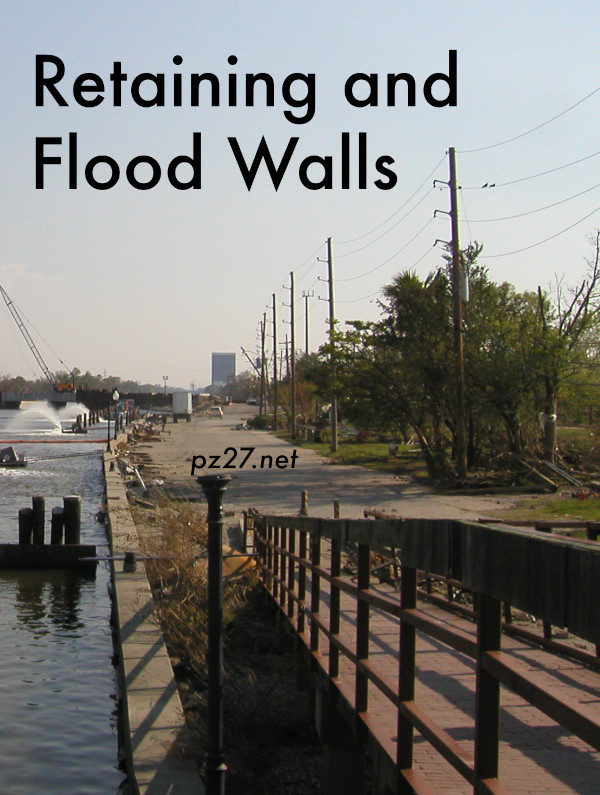
This book presents information on the design of retaining walls and inland and coastal flood walls. Retaining walls are defined as any wall that restrains material to maintain a difference in elevation.
A floodwall is defined as any wall having as its principal function the prevention of loading of adjacent land. Not specifically covered in this book are seawalls which are defined as structures separating land and water areas, primarily designed to prevent erosion and other damage due to wave action. They are frequently built at the edge of the water, but can be built inland to withstand periods of high water.
Seawalls are generally characterized by a massive cross section and a seaward face shaped to dissipate wave energy. Coastal flood walls, however, are generally located landward of the normal high water line so that they are inundated only by hurricane or other surge tide and have the smooth-faced cantilever stems shown in this book. This book also describes procedures for the design of retaining and flood walls on shallow foundations, i.e., those bearing directly on rock or soil.
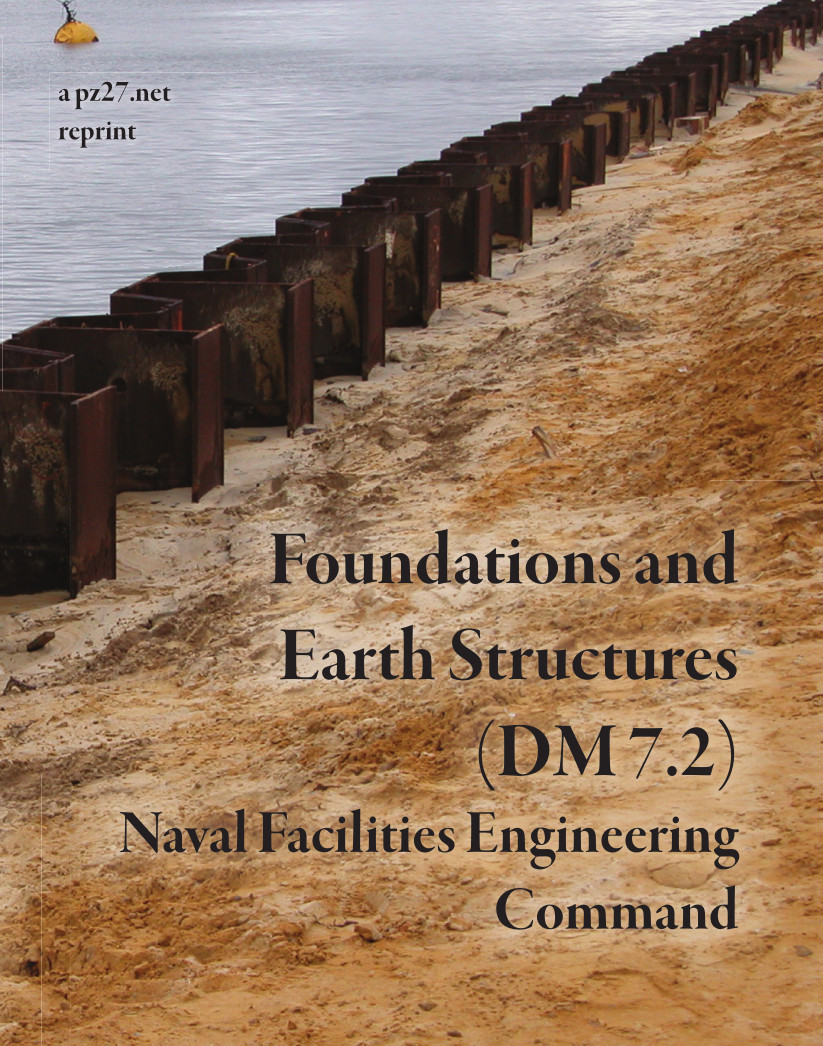
This book deals with the soil mechanics aspects of the design of waterfront retaining structures built to withstand the effects of earthquake loadings. It addresses the stability and movement of gravity retaining walls and anchored sheet pile walls, and the dynamic forces against the walls of drydocks and U-frame locks. It also contains one of the most complete descriptions of lateral earth pressure theory available anywhere.
The effects of wall displacements, submergence, liquefaction potential, and excess pore water pressures, as well as inertial and hydrodynamic forces, are incorporated in the design procedures. Several new computational procedures are described in this report.
The procedures used to calculate the dynamic earth pressures acting on retaining structures consider the magnitude of wall displacements. For example, dynamic active earth pressures are computed for walls that retain yielding backfills, i.e., backfills that undergo sufficient displacements during seismic events to mobilize fully the shear resistance of the soil. For smaller wall movements, the shear resistance of the soil is not fully mobilized and the dynamic earth pressures acting on those walls are greater because the soil comprising the backfill does not yield, i.e., a nonyielding backfill. Procedures for incorporating the effects of submergence within the earth pressure computations, including consideration of excess pore water pressures, are described.
Originally written to supply engineer officers and noncommissioned officers with doctrinal tenets and technical facts concerning the use and management of soils during military construction, Military Soils Engineering is one of the most practical guides to basic engineering geology and soil mechanics available. It provides guidance in evaluating soil conditions, predicting soil behavior under varying conditions, and solving soil problems principally related to military operations but applicable to the construction of a wide variety of foundations and earth structures.
Construction in a military theater of operations is normally limited to roads, airfields, and structures. This manual emphasizes the soils engineering aspects of road and airfield construction. The references included in the manual give detailed information on other soils engineering topics that are discussed in general terms.
In addition to this, the manual:
Provides a discussion of the formation and characteristics of soil and the Unified System of soil classification, used by the United States (US) Army and most geotechnical engineers;
Gives an overview of classification systems used by AASHTO and the Department of Agriculture;
Describes the compaction of soils and quality control, settlement and shearing resistance of soils;
Describes the movement of water through soils, frost action, and the bearing capacity of soils that serve as foundations, slopes, embankments, dikes, dams, and earth-retaining structures; and
Has a detailed description of the geologic factors that affect the properties and occurrences of natural mineral/soil construction materials used to build a wide variety of structures.
Military Soils Engineering is an indispensable reference for geotechnical engineers, engineering geologists and laboratory and field technicians.
This is a combination of two authoritative documents on this vital subject.
Federal Guidelines for Dam Safety (FEMA 93): These guidelines apply to management practices for dam safety of all Federal agencies responsible for the planning, design, construction, operation, or regulation of dams. They are not intended as guidelines or standards for the technology of dams. The basic principles of the guidelines apply to all dams. However, reasonable judgments need to be made in their application commensurate with each dam’s size, complexity, and hazard. Federal agencies have a good record and generally sound practices on dam safety. These guidelines are intended to promote management control of dam safety and a common approach to dam safety practices by all the agencies. Although the guidelines are intended for and applicable to all agencies, it is recognized that the methods of the degree of application will vary depending on the agency mission and functions.
Safety of Dams—Policy and Procedures (U.S. Army Corps of Engineers ER 1110-2-1156): This regulation prescribes the guiding principles, policy, organization, responsibilities, and procedures for implementation of risk- informed dam safety program activities and a dam safety portfolio risk management process within the United States Army, Corps of Engineers (USACE). Risk is defined as a measure of the probability and severity of undesirable consequences or outcome. The purpose and intent of this regulation is to ensure that responsible officials at all levels within the Corps of Engineers implement and maintain a strong dam safety program in compliance with “Federal Guidelines for Dam Safety.” The program ensures that all dams and appurtenant structures are designed, constructed, and operated safely and effectively under all conditions, based on the following dam safety and dam safety program purposes, as adopted by the Interagency Committee on Dam Safety (ICODS).
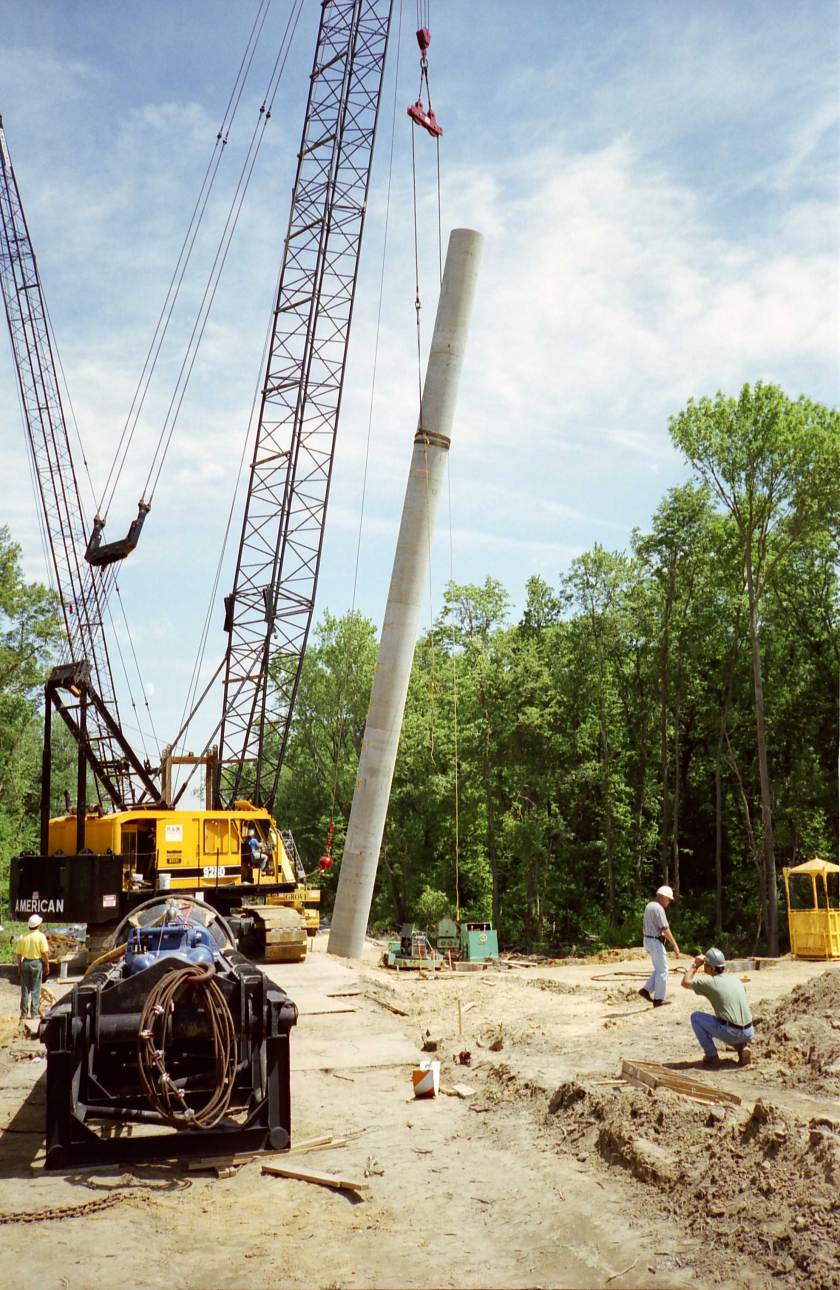
Of all the topics I taught in my course on foundation design and analysis, my favourite topic was driven piles. I have taken this part of the course and am presenting it on the companion site vulcanhammer.info. The topics are as follows:
In putting this together, I added some material, including a different example problem and actual runs of axial and lateral load software, along with the wave equation analysis.
I trust that you will find this enjoyable and profitable.
My effort in geotechnical education has never been strictly about the classes I teach at the University. This website has enabled me to disseminate information on the topic for many years, which is implicitly educational. In more recent times I have posted topics of interest, many of which have emerged from my teaching, and I will continue that practice.
With that introduction out of the way, I can proceed to respond to the various topics that Salgado brings up.
Empiricism, science and geotechnical design
As the scion of one of the oldest active families in the business–the Vulcan Iron Works–I feel I am in an interesting position to address this issue. The Warrington-Vulcan hammer was introduced in the late 1880’s into a world where wood piles–the same types of piles driven by the Lake Dwellers in Switzerland–were pretty much the norm. It was also the era when the Engineering News formula (itself an empirical project) came into being. In subsequent years many other types of piling were introduced, but as Salgado notes soil mechanics–with the exception of lateral earth pressures–were pretty much undiscovered territory. Pile dynamics suffered from a similar level of ignorance, one compounded by civil engineers’ historic aversion to things that move. Vulcan was aware of the problems with the dynamic formulae, but it wasn’t until after World War II that these problems were tackled with a more scientific approach, and even then one gets the impression that Smith’s choice of soil model was fortuitous as much as anything else. In the meanwhile Salgado’s statement that “There is a common misconception that all engineering done before the advent of science was conservatively done” was a misconception not shared by those who really understood the problems with the pile dynamics of the first half of the twentieth century.
The Original Sins of Mohr-Coulomb and the Associated Flow Rule
I have to confess that my thinking on these topics has been formed by two processes: 1) my years of teaching a discipline where the topics do not have as immediate an integration one to another as other branches of civil engineering, and 2) my dissertation, which wasn’t complete until 2016. The latter involved writing geotechnical finite element code from the ground up, which gives me something of a greater appreciation for the issues which Salgado brings up than many who teach this course on an undergraduate level.
Let’s start with Mohr-Coulomb itself: I used it in my FEA code with the following justification:
Based on this and the elasto-plastic discussion, the Mohr-Coulomb failure model was chosen. As Abbo et.al. (2011) point out: “The Mohr–Coulomb yield criterion provides a relatively simple model for simulating the plastic behavior of soil. Other more sophisticated constitutive models for predicting the behavior of soil have been developed over the past three decades, however the complexity of these models, as well as the additional testing required to determine the various soil parameters involved, minimizes their utility for practicing geotechnical engineers. The Mohr–Coulomb yield function is also of importance to finite element researchers and practitioners as it forms the basis of many analytical solutions. These analytical solutions serve as crucial benchmarks for validating numerical algorithms and software.” This observation is supported by McCarron (2013).
In spite of its limitations, Mohr-Coulomb still has its place in geotechnical engineering. Salgado focuses on two serious problems with Mohr-Coulomb: the sharp division between cohesionless and cohesive soils and the use of the associated flow rule, an issue which doesn’t emerge in many “closed form” solutions but is certainly an important one in finite element code.
To illustrate my own journey with the first problem, having come from a deep foundations background, I was taught the cohesionless/cohesive dichotomy which is built into the whole “alpha/beta” method business. That was challenged by John Burland a long time ago. The key to ditching alpha methods–and by doing this use beta methods–is to note that the cohesion of a soil is a function of its effective stress (and other variables.) It is for this reason why I have not taught alpha methods for driven piles for some time but prefer Fellenius’ Method, recognising that the student may find themselves forced to use another method once “in the wild.” (One of these days we’ll fix that dichotomy embedded in O”Neill and Reese’s method for drilled shafts.) Fellenius’ Method has its own problems (it requires the student to use some judgement, which they haven’t quite developed) but I think in the end beta methods will win out.
But there is a more compelling factor at work: the most important single factor in the behaviour of a soil is its grain size distribution. With this soils don’t neatly divide themselves into two categories; it’s a continuum from coarse-grained to fine-grained soils. Even the classification system doesn’t quite do this justice; it’s hard to argue that a soil with 51% fines is that much different (all other things being equal) to one with 49% fines, even though they will have different classifications and the former will be considered “cohesive” and the latter “cohesionless.”
Looking at things this way, “purely” cohesive or cohesionless soils–each at the extreme of grain size distribution–are rare exceptions rather than the rule. This means that, from a Mohr-Coulomb standpoint, virtually all soils have a non-zero and , something that Salgado notes engineers figured out a long time ago (erroneously, in his opinion.) But that’s just the beginning of the problem, we must now deal with the other quantity that Salgado brings up: dilatancy. And that in turn leads us to the business of the associated flow rule.
Once again my position on that topic is in my dissertation:
Except for purely cohesive soils, a purely associated flow rule is to be avoided for soil materials in the model. Such a rule is acceptable for many engineering materials but does not realistically model the dilation of soils, especially cohesionless ones. The downside to this is that the elasto-plastic constitutive matrix is non-symmetric, which, strictly speaking, will result in a non-symmetric stiffness matrix, increasing the cost of the problem solution.
With an associated flow rule and the dilatancy is “locked” into the value of the friction angle. With a non-associated rule and we must determine the value of . The literature on meaningful values of isn’t as copious as one would like but the situation is improving. Including the dilatancy solves many of the problems that Salgado raises with the Mohr-Coulomb failure criterion, especially the sole reliance on the Mohr-Coulomb failure function. (An implementation of such a rule is here.) His application of a non-associated flow rule to the bearing capacity problem is intriguing, and would be more intriguing except for the fact that generally settlement is a more important failure mode to consider than bearing capacity. (Application of this to Coulomb and log-spiral failure of retaining walls is another matter altogether.)
At this point we run into the serious problem: how to implement the solutions properly in the class setting. The problem we have in geotechnical engineering is that, in order to consider the effects of elasticity (assuming that exists, which is problematic,) plasticity and dilatancy in “one shot,” you really need finite element code, which can move from elastic to plastic deformation continuously. Most of the “hand” solutions we’ve used up to now have assumed either an elastic state or a plastic one, and the latter with an associated flow rule, as Salgado observes. I think that, moving forward, we need to consider numerical methods as the best way to solve problems in this profession. But it is dangerous to rely on these solely; they tend to become “black boxes” in the hands of many practitioners, whose results are taken as “final” even when they are erroneous. (Those of us involved in pile dynamics are all too aware of this problem.) The hand solutions in these cases need to be ancillary to make sure we are not doing something really stupid with the numerical ones, and I think our education needs to reflect that.
Shear Strain Localisation
The way I have dealt with this issue is to use the lower and upper bound concept, one which I have borrowed from Verruijt. By showing that there is a beginning of failure in the “surface” (a term Salgado objects to) and an end we can bracket the beginning and the end of plastic failure, which shows a truth students need to get used to in soil mechanics: our designs inherently have a degree of failure; the question that remains is how much is acceptable. Some of Verruijt’s examples of lower and upper bound are lame but that can be fixed. It’s also interesting that Salgado picked as a primary example a driven pile. In spite of being the driven pile person I am, I would not, but perhaps that’s because we get to slope stability, lateral earth pressures and bearing capacity before deep foundations. But a more comprehensive solution to the problem would be to pitch the “bearing capacity in piles” concept altogether and base design on load-settlement, which forces us to consider the progressive failure of the shaft surface from the head down and finally the failure of the toe itself.
Since he brought up the subject of driven piles and the “groundbreaking” studies of Randolph and Wroth: in that study they included varying the modulus of elasticity as one got away from the shaft surface. It is possible to use a hyperbolic stress-strain model of the soil to vary this with the strain continuously, as I demonstrate here.
Particulate Modelling and Artificial Intelligence
One thing I’m thankful that my dissertation committee (or one member) talked me out of was particulate modelling. I think that the non-homogeneity of soils and particle shapes will make this a challenging pursuit; continuum modelling should suffice for the foreseeable future.
Salgado is spot on about using any kind of artificial intelligence and machine learning without inclusion of physical modelling: it will not work. Reducing our analysis to a statistical pursuit with no regard for the basic physics of the problem–ours or anyone else’s–will lead to disaster. I have commented on this in other fora and hope our community will resist the temptation of yet another type of “magical thinking” that permeates our society.
Our World In Stress
I usually reserve things like this to another site but since he brought it up:
Our fertility rate globally is dropping. The biggest problem we have with this is that our democracies are not prepared on dealing with funding the consequences of that change. So we will not have so many people who are consuming.
I find it difficult to understand why, since the central problem is the emission of carbon dioxide, nuclear power is not included in the solutions. The anti-nuclear movement had its genesis in the 1960’s and 1970’s, a time when the mood among many was decidedly anti-technological. It’s time for a change.
It is ironic that the methods used by the oft-demonised oil industry are now key to offshore wind.
The second point, in a sense, leads me to why I am departing my 20+ years of teaching geotechnical engineering in a university setting. This fall, Lord willing, I will begin teaching at Lee University, my church’s institution of higher learning. They are beginning an engineering program which has not developed to the point of being discipline-specific. I think, however, that Lee needs an engineering program, its students need the option of one, and that the liberal arts centred educational system, one we inherited from the British and have had since before the Republic began, has failed us, not only in producing a leadership class totally incapable of informed decision on technological issues, but also bereft of what Antoine Arnauld and Pierre Nicole called Logic, or the Art of Thinking. Much of this is an outcome of the same era as the anti-nuclear movement; we have replaced a pursuit of understanding with a pursuit of raw power, and the end result will be that we will end up with neither.
In summary, I think that Salgado’s idea is basically a good one. In addition to what I have observed above, I think that his program will be easier to implement in a well-funded and deep-research institute such as Purdue than in places (and there are many) where geotechnical engineering is an afterthought.
Last year I posted The Sorry State of Compression Coefficients where I a) gave a brief summary of earlier posts on consolidation settlement and b)showed that there was more than one way to express them. An example of the “alternative” (for geotechs in some countries it’s the accepted way) compression coefficient is “Hough’s Method” which is featured in both the Soils and Foundations Reference Manual and the Shallow Foundations manual. Hough’s Method, however, is for cohesionless soils. Why, you ask, can methods usually associated with cohesive soils be applied to cohesionless ones? Because consolidation settlement methods using the logarithmic difference of pressure reflect the fact that the elastic (or shear) modulus of a soil increases as the void ratio/porosity of the material decreases, which I discuss in From Elasticity to Consolidation Settlement: Resolving the Issue of Jean-Louis Briaud’s “Pet Peeve”.
In this post I will attempt to do two things:
The method as presented in the above references has been described as too conservative, i.e., the settlements predicted are too large. I will attempt to explain this and perhaps offer a solution based on Hough’s own works.
Discuss the whole business of bearing capacity vs. settlement failure in shallow foundations, which was perhaps the greatest legacy of Hough’s work and remains an important issue in geotechnical engineering today.
Bearing Capacity vs. Settlement
Terzaghi’s solution (or more accurately his adaptation of Prandtl’s punching shear theory) of the bearing capacity problems was one in a number of solutions that became “reference standard” in geotechnical engineering.
We were regaled with photos of Canadian grain elevators on their side to show that bearing capacity failure was the first thing we should look for in shallow foundation design. Terzaghi’s formula was so highly regarded that for many years it was fashionable for introductory geotechnical courses to require students to learn both Terzaghi’s method and the subsequent improvements/extensions of that method by researchers such as Meyerhof, Vesic, Brinch Hansen, etc..
Up until that time shallow foundations were generally designed using what we call “presumptive bearing capacities” based on soil types and foundation configurations. These were enshrined in the building codes of the day. They were generally purely empirical in nature, as was most of geotech in the era before Terzaghi and his contemporaries. They had one advantage however: because they were derived from actual performance, be it ever so crude, they included the effects of soil settlement under load.
Like any other engineering material, only on a larger basis (because their elastic/shear moduli were several orders of magnitude lower than more conventional materials) soil is deformable under load. That deformation not only allows the foundation to deflect under load, it also affects the failure surfaces as they develop. The latter reality became apparent and so we have the modification of the bearing capacity for punching and local shear. It should be noted that Terzaghi and Peck were well aware of the problem of settlement, and included provision for it in their classic 1948 textbook Soil Mechanics in Engineering Practice.
One possible solution was to use elastic theory for the initial settlement. The implementation of that is discussed in Analytical Boussinesq Solutions for Strip, Square and Rectangular Loads. It is even possible to develop a lower bound solution for the bearing capacity problem, as was discussed in Lower and Upper Bound Solutions for Bearing Capacity. The problem with this is twofold. The first is that the lower bound solution assumes that the footing is a purely flexible foundation, which is not really true with this type of foundation. The second is that, if we went to the other extreme and assumed a purely rigid foundation, by elastic theory the stresses at the corners is infinite for any load. (This is conventionally attributed to foundations in cohesive soil, but it can be shown to be true by elastic theory.)
Hough’s Settlement Method
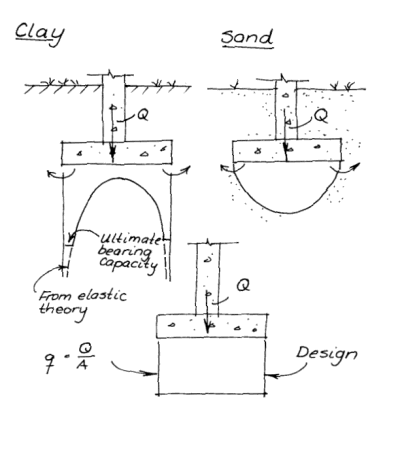
Hough presented his settlement method in his 1959 ASCE paper. He starts by presenting a graph similar to the following, which illustrates the transition from small, elastic displacement to large inelastic ones:
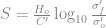
The solution is in the form (similar to that presented in Verruijt) of
The coefficient is determined using a chart which is below.
The chart itself is basically the same as the one in Hough (1959,) but now things get complicated.
Cheney and Chassie (2000) recommend that the SPT blowcounts be corrected for overburden pressure before correlating the N-values to the bearing capacity index, C′. An overburden correction by Bazaraa (1967) was recommended by Cheney and Chassie (2000). Since that time, many researchers have studied the effect of overburden stress on the SPT N-value, largely in support of liquefaction hazard assessment procedures. Recent consensus by the 1996 and 1998 National Center for Earthquake Engineering Research (NCEER) (Youd et al., 2001) concluded that the correction proposed by Liao & Whitman (1986) (shown in Figure 5-18) could be used for routine engineering applications. Therefore, the correction by Liao & Whitman is included here as part of the Hough procedure, in particular because it is easy to calculate and can be used without charts in simple computation spreadsheets.
The basic problem with this is that Hough himself never mentions any kind of correction for the variations of the SPT tests, overburden or otherwise, and that in modifying Hough’s Method we run the risk of making some assumptions that may not be applicable.
The idea of using the SPT tests, even with shallow foundations in cohesionless soils such as the ones Hough is concerned about, is admirable on the face because undisturbed samples of these soils are hard to obtain in normal soil testing. The problem with SPT tests–which were coming into acceptance when Hough presented his original method–is that their variations in both configuration and those induced by the overburden are significant. It wasn’t until the 1980’s that this was “formally” sorted out with the correction system that we have today.
With our current method we have two stages of correction. The first stage is for variations in the configuration of the split spoon, the effect of the rod and borehole, and most importantly the efficiency of the hammer itself. The second is for the overburden. In both his original paper and the presentation of the method in the Second Edition of his textbook Basic Soils Engineering (1969,) Hough does not delve into either of these.
The whole point of the N60 correction (the first series) was to harmonise the results to a single mechanical standard, and one that was generally attained “back in the day” so that empirical methods such as Hough’s could be used today. We could assume that Hough’s value are at least N60 values, although we’re not guaranteed of that due to the lack of supporting data.
The business of overburden correction brings up Bazaraa (1967.) At this point credit needs to be given where credit is due: Bazaraa had the thankless task of sorting out the settlement methods which were current in his day, and that task included dealing with the variations of the SPT method. Since his overburden correction method was originally used with Hough’s Method and then changed, let us compare the two. We start be defining
The two correction factors for overburden are shown below.
Except for the region where Liao and Whitman is “flat topped” the two are reasonably close, and so substituting Liao and Whitman’s correction is legitimate, assuming it should be used at all.
It should be noted, however, that Bazaraa’s objective is not to correct Hough’s method, which he did not do: it was to provide a new method of estimating settlements in cohesionless soils, and to advance Terzaghi and Peck’s 1948 method. So we are still “up in the air” about how to apply all of this to Hough’s Method.
If the overburden stress is less than the standard atmospheric pressure (approx. 2 ksf) then the N value used will be increased, the C’ values will likewise increase, and the estimated settlement will decrease, which may be more accurate but moves away from conservatism. If the opposite is true then the result will be more conservative. For shallow foundations such as Hough’s Method the lower overburden stresses will be more of a factor (depending upon the depth D.) At this point it is not clear to me (at least) that including an overburden correction is really significant given the other unsolved problems that exist with this method.
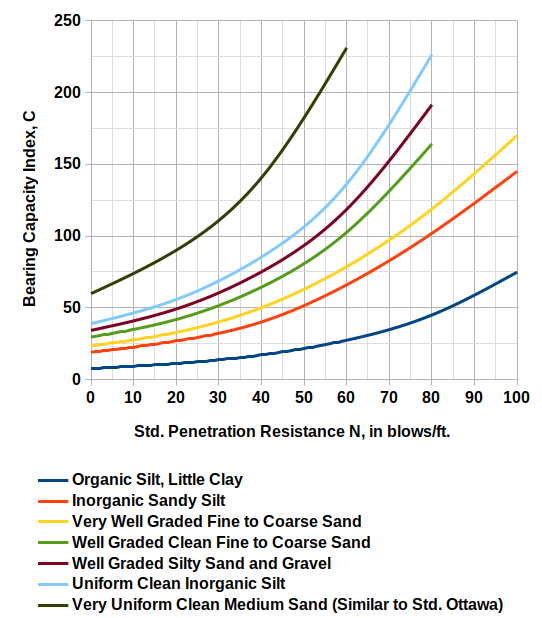
One further complicating factor is that, in the aforementioned Second Edition of Basic Soils Engineering, Hough presents a new chart (again with no explanation of correction of any kind) which is redrawn as follows:
Very Uniform Clean Medium Sand (Similar to Std. Ottawa)
58.66
0.0225
It should be noted that, where the curves are directly comparable with Hough (1959), they tend to be lower, i.e., the values of C are less. This would increase settlement and thus conservatism. At this point perhaps we should consider Hough’s Methods in the plural rather than the singular.
We have the conventional Cc based on either liquid limit, initial void ratio or water content. Hough is represented here as well; however, these correlations are for cohesive soils. Hough himself had a broader application for these.
In the Second Edition of Basic Soils Engineering, he presents a function to compute Cc as follows:
He also establishes a relationship between correlations based on liquid limit and those on void ratio, but getting to that is for another time.
In any case he presents values for this equation which are tabulated below, and include both cohesionless and cohesive soils.
a
b*
Uniform cohesionless Material (Cu < 2)
Clean Gravel
0.05
0.5
Coarse Sand
0.06
Medium Sand
0.07
Fine Sand
0.08
Inorganic Silt
0.1
Well-graded, cohesionless soil
Silty sand and gravel
0.09
0.2
Clean, coarse to fine sand
0.12
0.35
Coarse to fine silty sand
0.15
0.25
Sandy silt (inorganic)
0.18
0.25
Inorganic, cohesive soil
Silt, some clay; silty clay; clay
0.29
0.27
Organic, fine-grained soil
Organic silt, little clay
0.35
0.5
*The value of the constant b should be taken as emin whenever the latter is known or can conveniently be determined. Otherwise, use tabulated values as a rough estimate.
From here we can use the well-tried “Cc” formulae (which would include preconsolidated soils) to estimate settlement. This opens up a new vista for using conventional consolidation settlement theory to estimate the settlements of cohesionless soils.
To return to our original objectives, settlement and bearing capacity are, in the process of failure, two sides of the same thing. It is also worth noting that most foundations fail in settlement, although the failure isn’t as “spectacular” as bearing capacity.
The only way to treat them together is to use a method that can combines both phenomena, and finite element methods are capable of doing that. However our profession has been uncomfortable with “black box” methods such as these, although they really apply the same laws we use to formulate closed form solutions. In that respect they have value, and to apply methods such as Hough’s to cohesionless soils with better calibration of the constants would be a good step forward.
References
Bazaraa, A.R.S. (1967). “Use of the Standard Penetration Test for Estimating Settlements of Shallow Foundations on Sand,” Ph.D. Thesis presented to University of Illinois, Urbana.
Hough, B.K. (1959). “Compressibilty as the Basis for Soil Bearing Value,” Journal of the Soil Mechanics and Foundations Division, ASCE, Vol. 85, Part 2.
Hough, B.K. (1969). Basic Soils Engineering. Second Edition. New York: Ronald Press Company.





 and
and  , something that Salgado notes engineers figured out a long time ago (erroneously, in his opinion.) But that’s just the beginning of the problem, we must now deal with the other quantity that Salgado brings up: dilatancy. And that in turn leads us to the business of the associated flow rule.
 and the dilatancy is “locked” into the value of the friction angle. With a non-associated rule
  and we must determine the value of
  . The literature on meaningful values of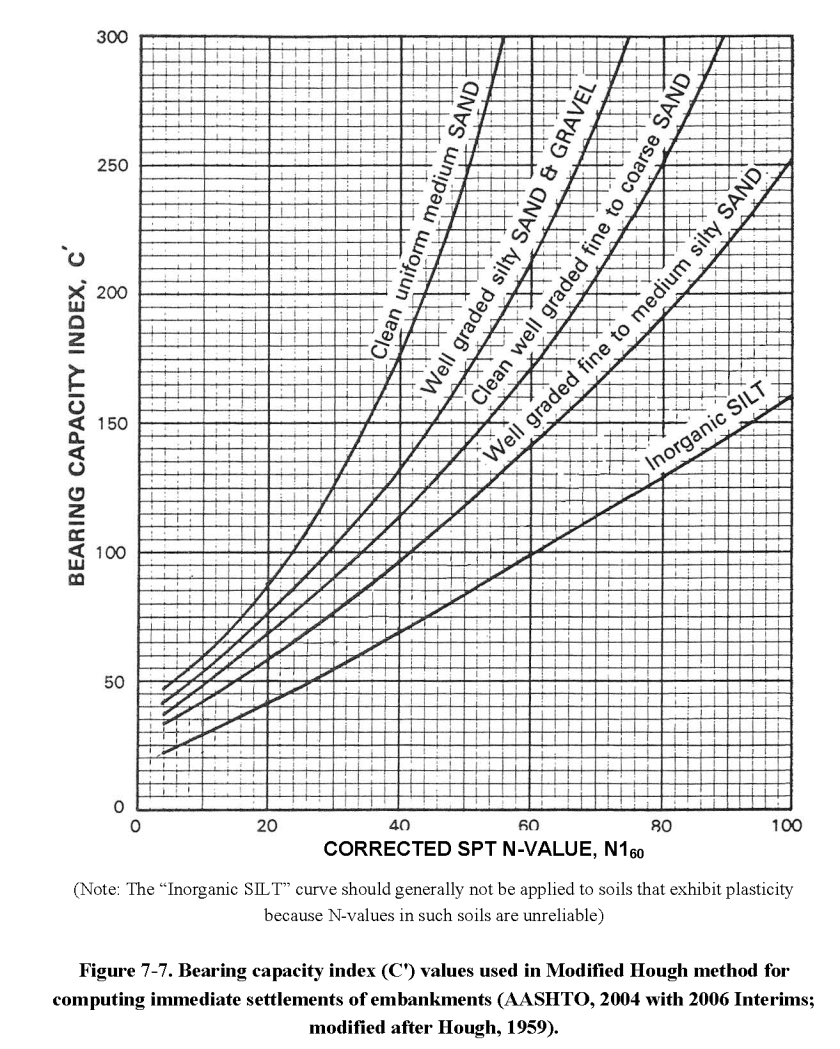



 is determined using a chart which is below.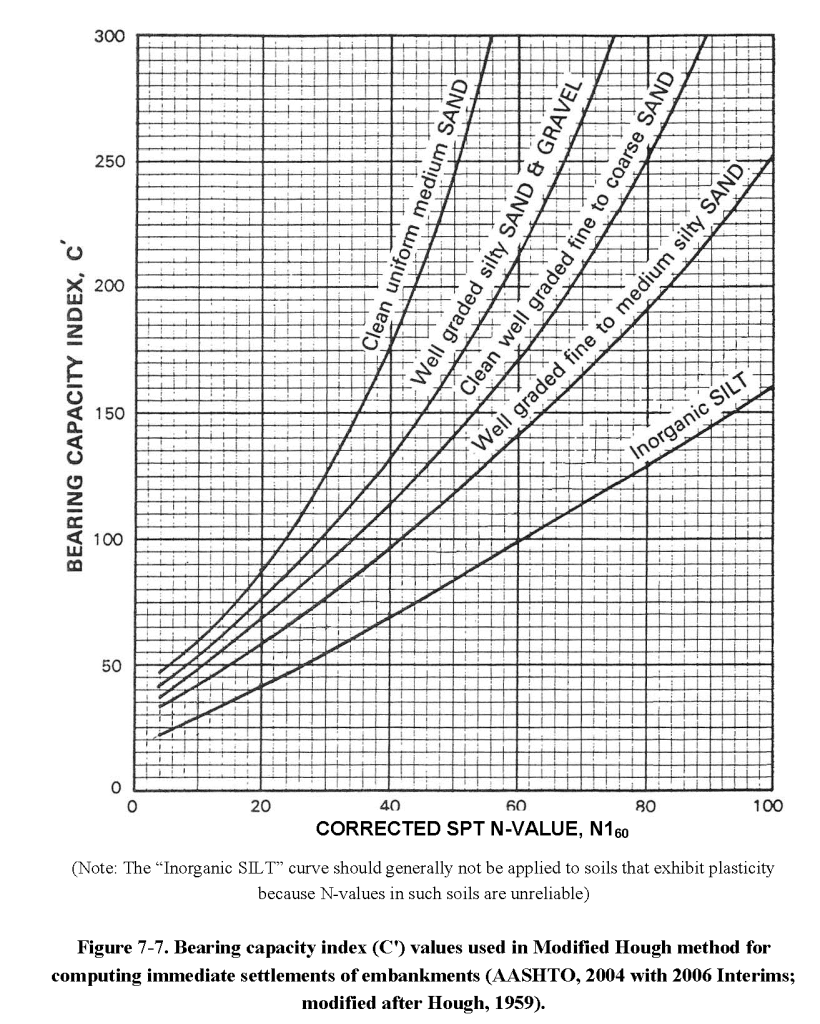

 for overburden are shown below.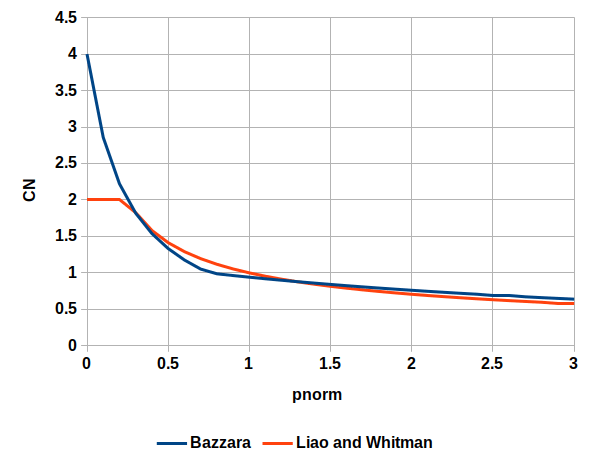



 vulcanhammer.net