Posted in Academic Issues, Deep Foundations

Comments on “Fictitious soil pile model for dynamic analysis of pipe piles under high-strain conditions”

Once again I find myself cited, this time in this paper by Yuan TU , M.H. El Naggar , Kuihua Wang , Wenbing WU , and Juntao WU. The citation comes from my paper “A New Type of Wave Equation Program,” documenting the development of the ZWAVE computer program. The abstract of this paper is as follows:

A fictitious soil pile (FSP) model is developed to simulate the behavior of pipe piles with soil plugs undergoing high-strain dynamic impact loading. The developed model simulates the base soil with a fictitious hollow pile fully filled with a soil plug extending at a cone angle from the pile toe to the bedrock. The friction on the outside and inside of the pile walls is distinguished using different shaft models, and the propagation of stress waves in the base soil and soil plug is considered. The motions of the pile−soil system are solved by discretizing them into spring-mass model based on the finite difference method. Comparisons of the predictions of the proposed model and conventional numerical models, as well as measurements for pipe piles in field tests subjected to impact loading, validate the accuracy of the proposed model. A parametric analysis is conducted to illustrate the influence of the model parameters on the pile dynamic response. Finally, the effective length of the FSP is proposed to approximate the affected soil zone below the pipe pile toe, and some guidance is provided for the selection of the model parameters.

The topic is an interesting one which I have touched on over the years. It seems to me that their characterisation of the model as “novel” may be a bit of a stretch but their implementation of it is very interesting.

What is a Fictitious Pile Model?

Most of us in the driven pile industry are familiar with the one-dimensional wave equation, which divides up the pile into discrete segments/elements and by doing so models the distributed mass and elasticity (or plasticity) or the system, such as is shown in Figure 1, from the Design and Construction of Driven Pile Foundations, 2016 Edition:
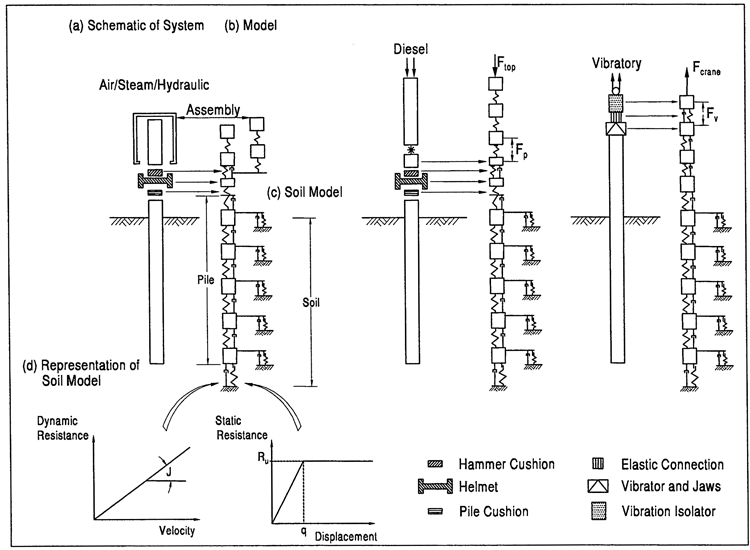
Figure 1 One-Dimensional Wave Equation Method Diagram (from Soils and Foundations Reference Manual)

An advance of this is the use of two- or three-dimensional elements in a finite element scheme, such as was featured in the earlier post Comments on “3D FE analysis of bored pile- pile cap interaction in sandy soils under axial compression- parametric study” and was analysed extensively in my dissertation Improved Methods for Forward and Inverse Solution of the Wave Equation for Piles. A cross section of that model is shown in Figure 2, from Inverse Analysis of Driven Pile Capacity in Sands:
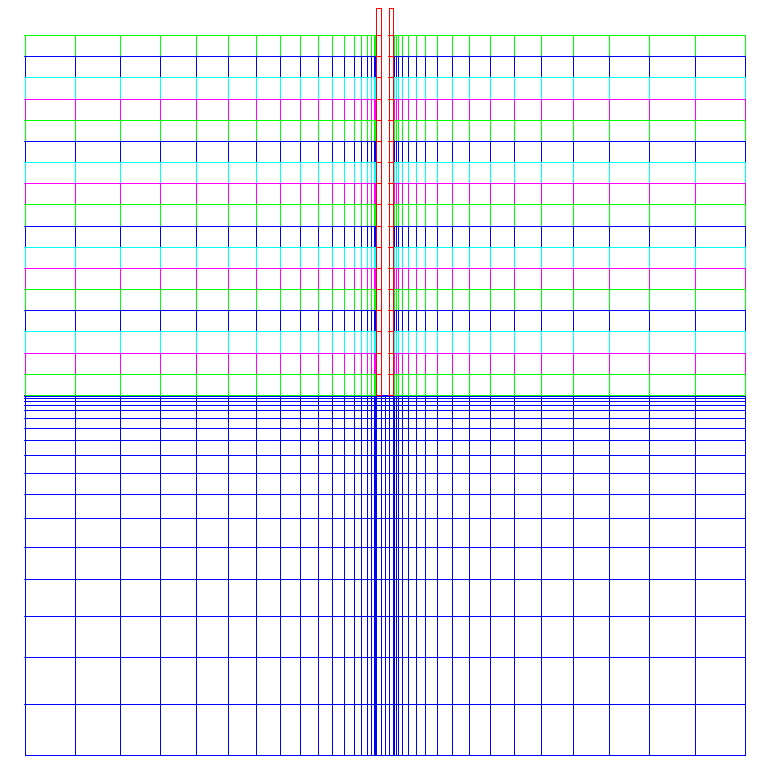
Figure 2. Cross-Section of Finite-Element Model for Pile and Soil (from Warrington (2020))

Note that the pile, which is in red, is basically a one-dimensional string of elements with distributed mass and elasticity. It’s worth noting, however, that using two- (or three- for that matter) dimensional elements enables the element to have a non-uniform stress distribution which would reflect the effect of the soil resistance, but let us set this last point aside.

Such a model as shown above models both the shaft friction along the side of the pile and the toe resistance under the end of the pile. It has been customary over the years, however, for researchers and practitioners alike to model this resistance in a rheological way. This has been easier with the shaft than with the toe, because of the complexities of the dynamic elasto-plastic response of the soil at the toe and the difficulties of establishing failure surfaces in the soil has led to many solutions of the problem.

One of those is to construct a fictitious pile under the toe which, instead of the straight sides we usually (but not always) see with piles, has a conical shape, so as the distance from the toe increases the size of the fictitious pile likewise increases.
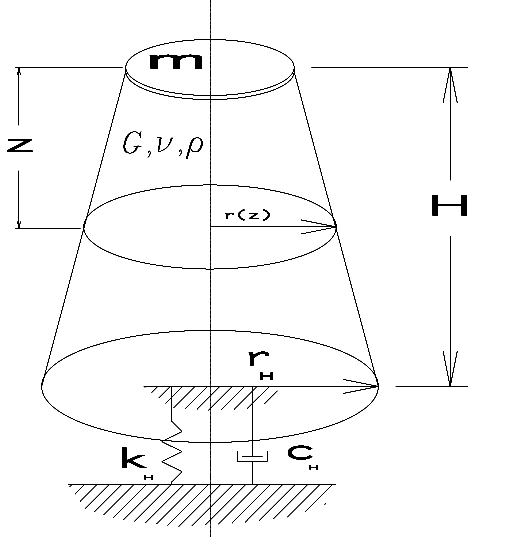
Figure 3. Fictitious Pile Model for the Pile Toe (from Holeyman (1988); Warring-
ton (1997))

The first proposal of this came from Holeyman (1988) and was discussed in Closed Form Solution of the Wave Equation for Piles and more recently in the paper STADYN Wave Equation Program 10: Effective Hyperbolic Strain-Softened Shear Modulus for Driven Piles in Clay. A diagram of this is shown in Figure 3. Although the model is generally done (as is the case in the models in Figure 1) with discrete elements, it can be modeled continuously. The paper under consideration did so using finite elements. A problem that occupied this researchers and those of the paper under consideration is the value of H, which does not have an “obvious” solution from the physics of the problem.

In the work under review, in addition to using finite elements the authors made two important improvements to the model shown in Figure 3:

  1. They added a “shaft” resistance along the side of the fictitious piles.
  2. They put a hole in the centre of the fictitious pile to assist in simulating the soil plug, which was one of the main goals of the study. Soil plugging is a difficult phenomenon in open-ended piles, and although we’ve made some progress in modelling it we still have a long way to go.

Some Comments on the Study Itself

The authors used ABAQUS to model both piles. This is a code which has been applied to geotechnical problems for at least thirty years, so it has a long track record. Having started from “scratch” with Improved Methods for Forward and Inverse Solution of the Wave Equation for Piles, I can attest that using a software package saves a great deal of time and effort, in addition to making graphical presentation of the results a good deal simpler. Having said that, if anyone has an ambition to use FEA to replace, say, GRLWEAP or CAPWAP, they’ll have to either a) pay licensing fees to a cut down “engine” from an established package like ABAQUS or b) use an open source alternative.

At the start of the study they make the following statement:

Open-ended pipe piles are increasingly used worldwide as foundations for both land and offshore structures [1,2]; therefore, the characterization of pipe pile capacity and behavior under static and dynamic loading conditions has gained much attention in recent years [3–5].

Open ended pipe piles have been used for much longer that this paragraph would imply, as this whole series will show. Getting them in the ground was much of the impetus for the TTI wave equation program, and the lateral loads they withstood were much of the push behind the development of p-y methods. And that was in the 1960’s and 1970’s.

The soil model they use is a cross between a elastic-purely plastic model and a hyperbolic soil model. Reconciling the two has been a preoccupation of this site since Relating Hyperbolic and Elastic-Plastic Soil Stress-Strain Models: A More Complete Treatment. Although the model they use certainly takes into consideration hyperbolic strain softening, I’m not convinced that their assumption that the rebound runs along the small-strain modulus of elasticity is valid. On the other hand I’m not sure what the best way out of this dilemma is; hyperbolic soil modelling hasn’t been as thorough in analysing the stress-strain characteristics of soil during rebound as it has been in doing so during loading.

One thing I noticed is the variance between the static load test results and that shown in the model. That’s not unexpected; I’ve encountered this difficulty, as you can see from this figure in STADYN Wave Equation Program 10: Effective Hyperbolic Strain-Softened Shear Modulus for Driven Piles in Clay:
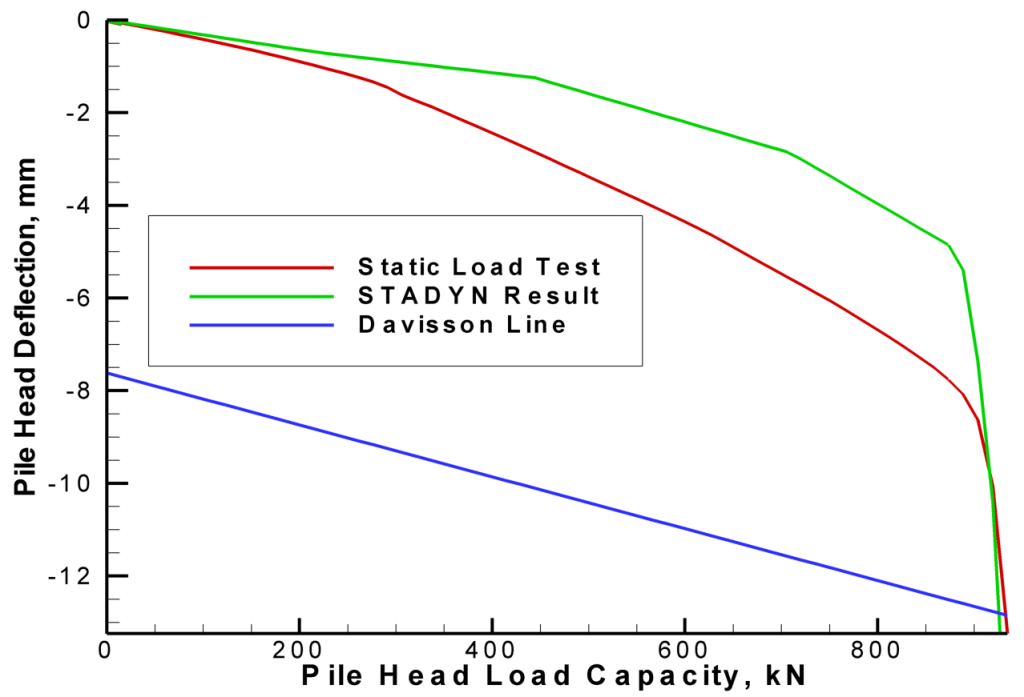
On the other hand, it’s possible to get a closer result, as is seen in Application of the STADYN Program to Analyze Piles Driven Into Sand:
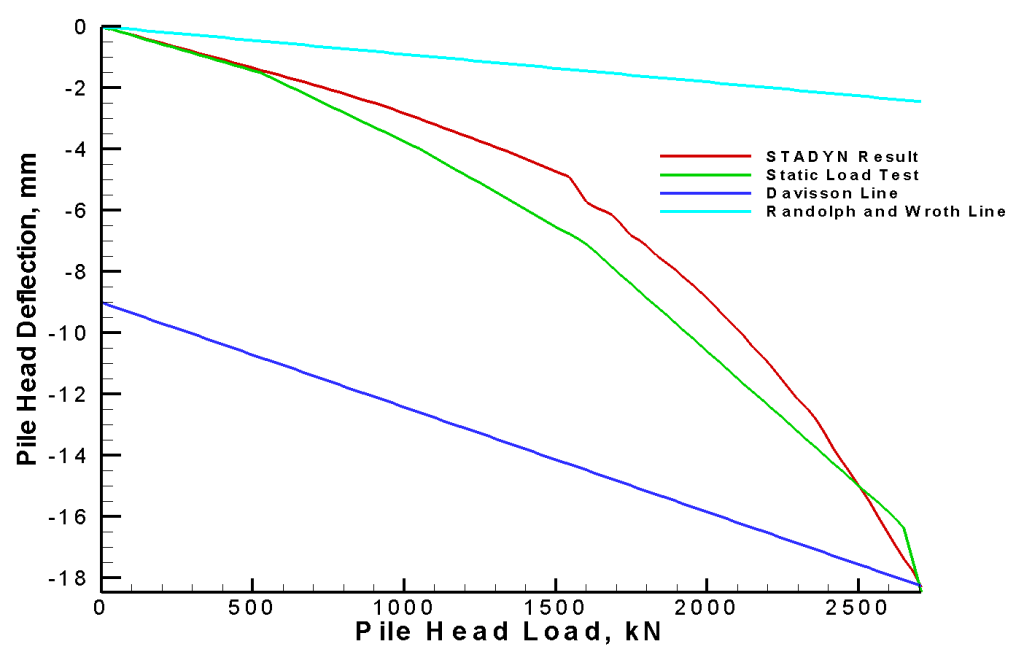
The basic problem is twofold:

  1. Although the relationship between the shear modulus of soils and the void ratio or porosity is well established, the coefficient used to determine the former from the latter is subject to uncertainty.
  2. The static and dynamic shear moduli of soils is different, which is an issue in pile dynamics that has not been adequately explored.

Conclusion

The paper is an excellent step forward, and the model presented has a great deal of potential in pile dynamics. It may be easier to use such a model than a full axisymmetric or 3D model to obtain the inverse solution to the problem, but many of the issues discussed here–such as the angle and depth of the fictitious pile cone and the shear moduli of the soils in question–need better resolution.

As far as the plugging issue is concerned, any advance in this is welcome, although I am inclined to think that a model which simulates the full, blow-by-blow installation of the pile with the formation of the plug, will ultimately be the best solution of the problem.
Posted in Academic Issues, Deep Foundations

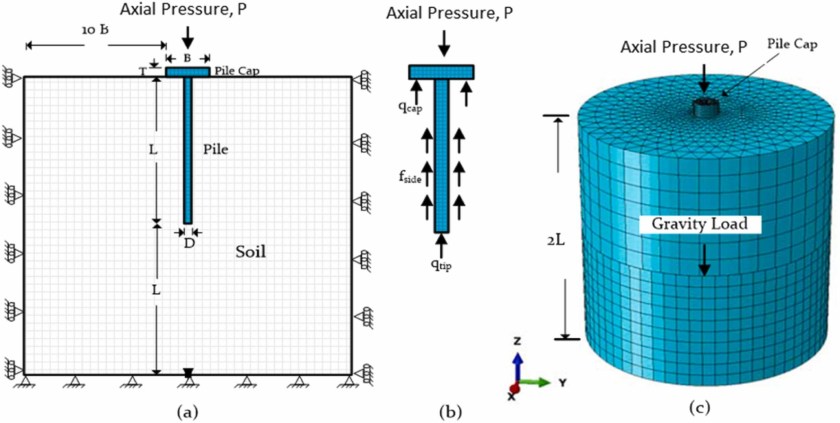
Comments on “3D FE analysis of bored pile- pile cap interaction in sandy soils under axial compression- parametric study”

As always I was gratified to be cited in the recent paper “3D FE analysis of bored pile- pile cap interaction in sandy soils under axial compression- parametric study,” by Faisal I. Shalabi, Mohammad U. Saleem, Hisham J. Qureshi, Md Arifuzzaman, Kaffayatullah Khan, and Muhammad M. Rahman. It is an interesting study of the topic at hand. Some comments are in order:

  • Although the citation is of Closed Form Solution of the Wave Equation for Piles, the work Improved Methods for Forward and Inverse Solution of the Wave Equation for Piles is really closer to the methodology shown in the paper, both in terms of the 3D FEA used (well, I took a shortcut and used axisymmetric 2D analysis) and to the use of Mohr-Coulomb theory for the analysis, which I discuss in An Overview of Mohr-Coulomb Failure Theory and Elasto-Perfect Plasticity with Mohr-Coulomb Failure. Mohr-Coulomb is still viable for many applications, especially with sands.
  • One especially interesting aspect of this study was the inclusion of a pile cap. The problem is similar to the the one I discuss in my post When Semi-Infinite Spaces Aren’t, and When Foundations are Neither Rigid Nor Flexible, where the foundation is neither perfectly flexible relative to the soil nor perfectly rigid. Although in this study the foundation rigidity is not varied, the soil’s is, and as is the case in elastic theory as the soil becomes less rigid the relative rigidity of the foundation increases, the soil stresses relative to the foundation towards the edge of the foundation likewise increase. This Fall I plan to include that elastic theory in my discussion of mat foundations here: Foundation Design and Analysis: Shallow Foundations, Other Topics.
  • I noted a drop in the shaft friction just before the toe, followed by an increase down to the toe itself. The interaction between pile, soil and shaft friction for deep foundations is a complicated one. The toe creates failure surfaces in the soil that are certainly there–and it is reasonable to assume that they affect the shaft friction near the toe as well–but they are not exactly like those generated in shallow foundations, something which has complicated toe resistance calculations for a long time. The relative uniformity of the unit toe resistance makes sense based on failure theories going back to at least Vesić’s work in the early 1970’s. One thing that bored piles do not have to consider is the effects of advancement due to impact which, as Mark Randolph’s work has shown, almost show a “leading edge” effect.

It is my opinion that 3D FEA will ultimately be our best tool for estimating the load/settlement characteristics of deep foundations–bored or driven, static or dynamic–and this paper is a step forward in that regard.

Posted in Academic Issues, Geotechnical Engineering

The Sorry State of Compression Coefficients

I’ve dealt with the issue of consolidation extensively since my first post on the subject, From Elasticity to Consolidation Settlement: Resolving the Issue of Jean-Louis Briaud’s “Pet Peeve”. His problem was the lack of relationship between the way we handle consolidation settlement vs. elastic settlement. In this post I plan to look at a different problem, i.e. the way we express the relationship between soil pressure and consolidation settlement, or settlement by rearrangement of the particles.

Up to now…

Graphic 1

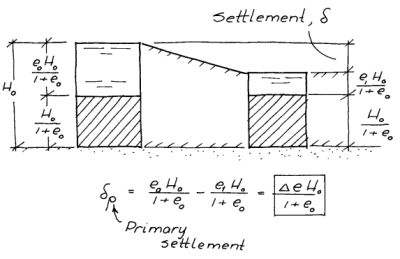
Let’s start with the diagram at the right, from Broms (as will be the case with the graphics we use.) Soil is made up of a combination of soil particles and voids between them. The voids can be filled with air, water or (God forbid) something else. For saturated soils water, for practical purposes, fills all of the voids.

In any case, for illustrative purposes we can “melt” the solids into a continuous solid and leave the rest as a void. We assume that the solids do not compress during the application of pressure and thus their volume is constant. From the first state (on the left) to the second state (on the right) additional pressure is applied. All the change of the volume must take place in the void; the equation at the bottom is based purely on the geometry, where H_o is the height of the layer being compressed, e_o is the initial void ratio of the soil, \Delta e is the change in void ratio during compression, and \delta_p is the primary settlement of the soil.

Graphic 2

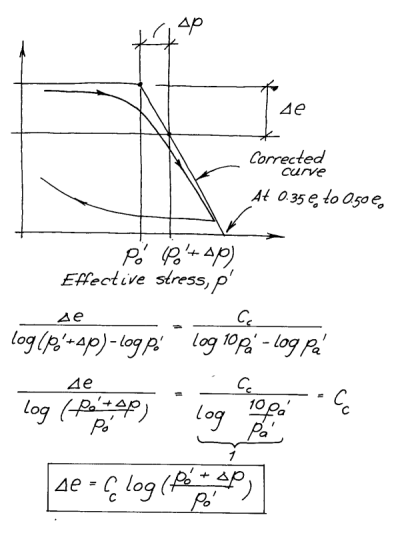
Unfortunately, as discussed elsewhere on this site, the relationship between the increase in pressure and the settlement/change in the volume of the voids isn’t linear but (empirically) logarithmic. That is shown in the graphic on the left; once the pressures get past the ambient effective stress, the settlement takes places according to the relationship shown at the bottom of the graphic. Here C_c is the compression coefficient, p'_o is the effective stress, and \Delta p is the change in pressure on the soil at a given point.

Combining the two equations in the two graphics yields the “accepted” form of the consolidation settlement equation for normally consolidated soils, thus

\delta_p = \frac{C_c H_o}{1+e_o}  \log_{10} (\frac{p'_o + \Delta p}{p'_o}) (1)

To this deceptively absolute state of affairs Verruijt has the following objections:

  • We should be using natural logarithms instead of common ones. Common logarithms date from the days when engineers used logarithmic and semi-logarithmic paper, determining C_c graphically. The compression coefficients would be changed by multiplying or dividing (depending on the form, more on that shortly) by a factor of 2.3. In an era of spreadsheets and MATLAB, natural logarithms would make more sense (and reduce student mistakes,) but I don’t see that changing.
  • We should use the strain rather than the void ratio. Actually, as Verruijt points out, this is done in Continental Europe. In the U.S. and Scandinavia, void ratio is used as the parameter of deflection. To change this would require a change in the compression coefficient, and that leads to…
  • …his preferred form of the compression equation, which would look like

\epsilon = \frac{1}{C_{10}}  \log_{10} (\frac{p'_o + \Delta p}{p'_o}) (2)

where C_{10} is another form of the compression coefficient. (Well, actually, he’d prefer natural logarithms, but as I said let’s put that aside.)

Multiplying both sides of Equation (2) by H_o gives us

\delta_p = \frac{H_o}{C_{10}}  \log_{10} (\frac{p'_o + \Delta p}{p'_o}) (3)

The two compression coefficients are related as follows:

\frac{1}{C_{10}} = \frac{C_c}{1+e_o} (4)

Actually a variant of Equation (4) finds its way into American practice in Hough’s Method for sands, which is described in the Soils and Foundations Reference Manual.

Enter NAVFAC DM 7.1

The “New” NAVFAC DM 7.1 (Soil Mechanics) is an excellent compendium of the current state of geotechnical practice relating to soil mechanics. In the process of discussing consolidation settlement, it highlights some recent changes that promise to add to the confusion described above.

For normally consolidated soils, Equations (1) and (3) are written as follows

\delta_p = C_{\epsilon c}  H_o \log_{10} (\frac{p'_o + \Delta p}{p'_o}) (5)

where C_{\epsilon c} is the modified compression index. This means that Equation (4) can be expanded as follows:

\frac{1}{C_{10}} = \frac{C_c}{1+e_o} = C_{\epsilon c} (6)

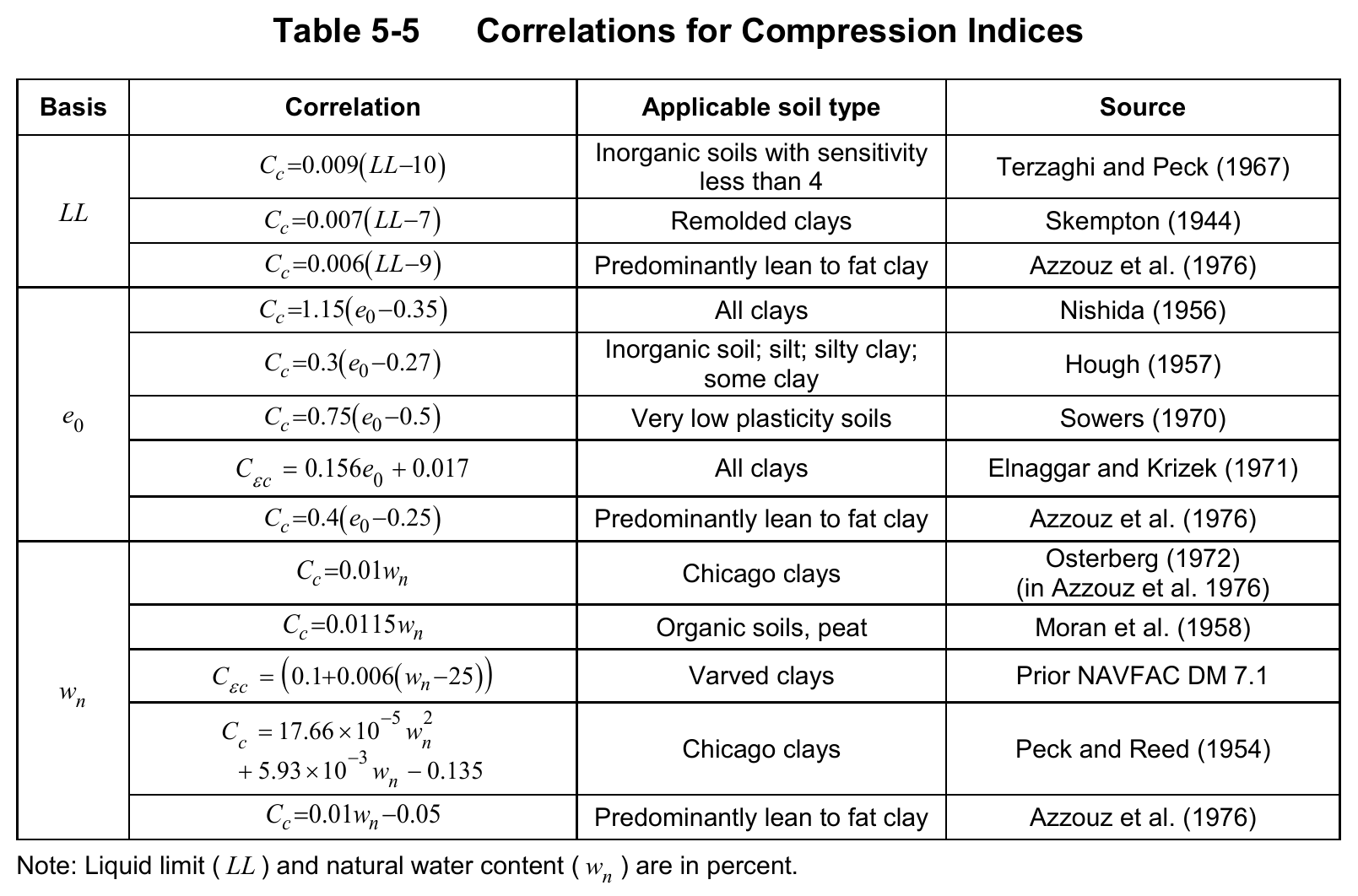
Whether we can dispense with the initial void ratio is a separate topic. Assuming that we can, what we have is a situation with three different compression coefficients, all designated with some form of C_x , and none of them the same. (If we threw in natural logarithms, we’d have six.) The potential for confusion is evident, no where than when two of the three coefficients end up in the same table:
And Secondary Compression…

Graphic 3

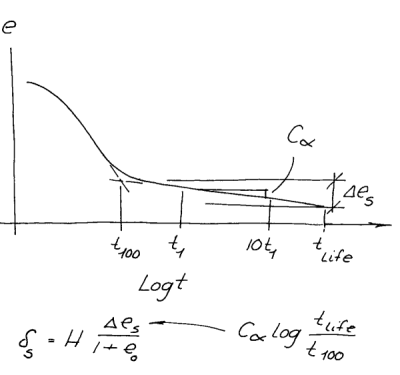
Secondary compression has had the problem for much longer. If we look at Graphic 3 on the right, we see that we have a secondary compression coefficient C_{\alpha}. The presentation is a little hard to follow but the secondary compression equation is

\delta_s = \frac{C_{\alpha}H_o}{1+e_o} \log_{10}\frac{t_{life}}{t_{100}} (7)

where \delta_s is the amount of secondary compression, C_{\alpha} is the coefficient of secondary compression, t_{life} is the life of the structure and t_{100} is the time at which 100% of primary compression has taken place. (Of course that’s a source of confusion in itself because, in theory, 100% primary compression is never achieved, something that buffaloed many of my students on a test last semester.)

However, as NAVFAC DM 7.1 points out, we can also write this as

\delta_s = C_{e \alpha}H_o \log_{10}\frac{t_{life}}{t_{100}} (8)

where the modified secondary compression coefficient is

C_{e \alpha} = \frac{C_{\alpha}H_o}{1+e_o} (9)

So what is to be done?

My advise to students and practitioners alike is to be vigilant and careful. Make sure you understand which coefficient is being called for. For software, make sure you completely understand which coefficient is being used by the software; otherwise, you will have the classic “garbage in/garbage out” result. Verruijt hoped that we would come to uniform practice but we can’t wait for this; we have to get our work done, and we need to do it carefully.

Posted in Deep Foundations, Geotechnical Engineering

Can Any Alpha Method be Converted to a Beta Method?

It’s been a favourite topic of this site to consider the issue of alpha vs. beta methods for deep foundations (both driven and bored piles.) In our post Shaft Friction for Driven Piles in Clay: Alpha or Beta Methods? we show that the Kolk and van der Velde method for driven piles in clay can be converted from an alpha method to a beta one by some simple math. The key to this success is that the ratio of undrained shear strength to effective stress is at the core of the method.

If we want to simplify things further, we can consider this, from the “new” NAVFAC DM 7.1, originally from Skemption:

\frac{c}{\sigma'_o} = 0.11+0.0037PI (1)

where

  • c = undrained shear strength of the soil
  • \sigma'_o = vertical effective stress of the soil
  • PI = plasticity index of the soil

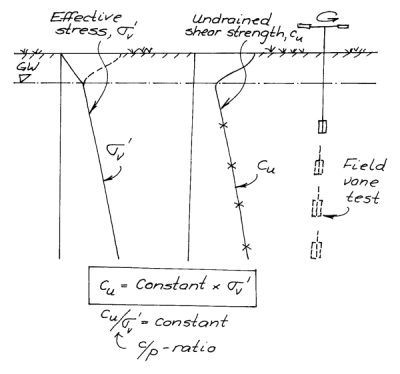
The relationship between undrained shear strength and vertical effective stress in a qualitative sense is illustrated by the diagram at the right, from Broms.

Substituting this into our derived value for \beta in the Kolk and van der Velde method yields

\beta = 0.9 (\frac{L-z}{d})^{-0.2}(0.11+0.0037PI)^{0.7} (2)

where

  • \beta = ratio of the vertical stress to the horizontal friction on the pile shaft
  • L = length of the pile
  • z = distance from the soil surface
  • d = diameter of the pile

This makes the \beta factor simply a function of the pile geometry and the plasticity index at a depth z .

But can this be done for methods where the relationship between undrained shear strength and the effective stress? The answer is “sort of,” and this post will explore that possibility.

Let us consider an example from the Dennis and Olson method for driven piles. It is a classic “alpha-beta” type of formulation; we will only consider the alpha method portion of the method. For a beta method to be equivalent to an alpha method, the following must hold:

f_s = \alpha c = \beta \sigma'_o (3)

We should note that, for the beta side of the method,

\beta = F_{SD} K \tan \delta (4)

where

  • F_{SD} = geometry factor based on the aspect ratio of the pile
  • K = lateral earth pressure coefficient
  • \delta = friction angle of the pile-soil interface

We will not consider this computation further, but only assume that

f_s = \beta \sigma'_o (5)

For the shaft resistance in clay

f_s = \alpha \overline{c} F_c F_L (6)

The two F constants are defined in the original monograph. The relationship between \alpha and c F_c is shown below.

Figure 1 Relationship of c Fc with alpha for Dennis and Olson Method

This is more complicated than, say the O’Neill and Reese method for drilled shafts. But the idea is the same. Our goal is basically to convert the values of alpha (where c is an independent variable) to use as a beta method.

We start by modifying Equation (3) for the Dennis and Olson method thus:

f_s = \alpha \overline{c} F_c F_L = \beta \sigma'_o (7)

Solving for \beta ,

\beta = \frac {\alpha \overline{c} F_c F_L}{\sigma'_o} (8)

Substituting Equation (1) into Equation (8) yields

\beta=\alpha\,\left ( .11+ .0037\,{\it PI}\right ){\it F_c}\,{\it F_L} (9)

The remaining difficulty is that \alpha is a function of c . This can be dealt with by manipulating Equation (1) to read

\overline c = (0.11+0.0037PI)\sigma'_o (10)

in which case

\overline c F_c = (0.11+0.0037PI)\sigma'_o F_c (11)

The left hand side is the independent variable of the graph above; the right hand side can be computed to substitute for that same independent variable.

Let us consider an example, namely the one used in the Dennis and Olson example:

Figure 2 Example Problem

The problem here is that we are given an undrained shear strength value for the clay layer but not a plasticity index. We are given a unit weight for the clay layer (not automatic for problems like this.) So we can compute the ratio of the undrained shear strength to the effective stress. For the top layer, the midpoint effective stress is 900 psf, and the undrained shear strength 2000 psf. The ratio is thus 2000/900 = 2.22. From Equation (1), the plasticity index is about 571. This, of course, is highly unlikely, and illustrates an important point about academically formulated problems: they’re not always realistic in their parameters. For the effective stress levels we have, it is likely that the undrained shear strength needs to be considerably lower than is given in the problem.

In any case substituting F_c and \sigma'_o from the original data and PI from the current data yields c F_c = 1400\,psf , which is the same as the original. From here we can compute \alpha = 0.49 and, substituting into Equation (9), we obtain \beta = 0.76 . Multiplying this by the effective stress of 900 psi yields the same result of f_s = 685\,psf .

Conclusion

  • Getting rid of \alpha altogether is hampered by the fact that there is not an analytic function for \alpha in the first place. The Dennis and Olson method is not unique in this regard.
  • For methods such as Kolk and van der Velde where the ratio of undrained shear stress and vertical effective stress are important parts of the method, applying correlations such as Equation (1) is fairly simple. When this is not the case then things are more complicated.
  • Using Equation (1) is doubtless a good check on values of c , which when applied in an alpha method implicitly contains the effects of effective stress.
  • Going forward, probably the best way to “close the loop” and make all methods beta methods is to formulate the method for clays in terms of \frac {c}{\sigma'_o} as is the case with Kolk and van der Velde. Doing this would be an important step in moving static methods forward.
Posted in Academic Issues, Civil Engineering

Floating or Compensated Foundations

One type of foundation that needs some explanation are floating or compensated foundations. Since they are sometimes referred to as “floating,” some fluid mechanics background is in order.

Fluid Mechanics

For ships to float, they obey Archimedes’ Law, where the weight of the ship is equal to the weight of water displaced by the hull of the ship. This is more thoroughly explained in my handout Buoyancy and Stability: An Introduction. I also go through all this in this video:

If the hull of the ship is rectangular, it’s also possible to compute the upward force of the water–which equals the downward force of the weight–by multiplying the hydrostatic pressure by the plan area of the ship, as is shown below. As the ship settles further and further into the water, the hydrostatic pressure increases until equilibrium is reached.

Illustrating Water Pressure Increasing in Proportion to the Draught

This last will be useful when we consider soils because, although box shaped ships are not so common, box shaped buildings and foundations are.

Turning to buildings, soils are an intermediate material between pure fluids and solids. Some are obviously more intermediate than others, but in softer soils they are more “fluid-like.” Let us consider the multi-storey building at the right.

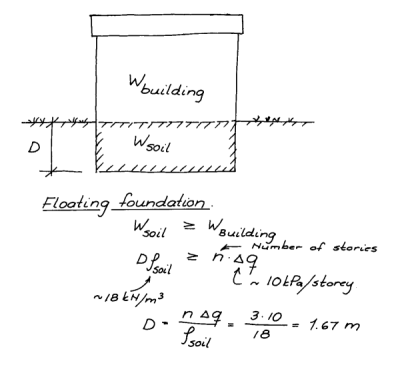
If we consider that the soil acts as a fluid, then for the building to “float” in the soil the weight of the soil displaced must be greater than or equal to the weight of the building. The difference between ships and buildings is twofold. One, it is possible for a building to weigh less than the weight of the soil displaced and not get shoved upward until equilibrium is reached. The second is that, frequently, we use a “per unit area” approach to balance the equation and come up with the “draught” D of the building.

In this case we have a three-storey building where each storey has a unit weight of 10 kPa, or 10 kN per square metre of area. Multiplying the number of storeys n by the unit weight Δq yields 30 kPa. The soil weight is 18 kN/m3, or otherwise put the displaced soil exerts an “upward force” of 18 kPa/m of depth. Dividing the downward pressure by the unit weight yields a foundation depth/draught D = 1.67 m.

At this point it is worth noting that, depending upon the properties of the soil, it is not always necessary for the soil displaced to equal in weight to the building, but can be less. This is because soils, unlike fluids, have shear strength when not moving, an issue I discuss in my monograph Variations in Viscosity. An illustration of this is at the left.

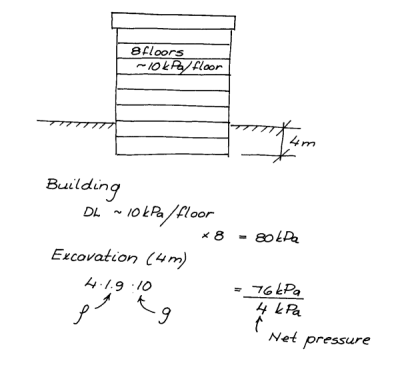
Here we have a building with eight storeys and 10 kPa/floor, for a total pressure of 80 kPa. On the soil side we have a unit weight of 19 kN/m3 (after eliminating those pesky kilogram force units) and a foundation depth of 4 m, which results in an upward pressure of 76 kPa. The difference between the two is 4 kPa, not much but still enough to reduce the depth of the basement if the soil were a true fluid.

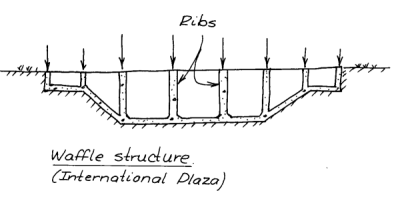
It’s first worth noting that an alternative way to look at the problem is that we are computing the total stress of the foundation at the base and then comparing it with the downward pressure of the building. That works for box like structures such as we are dealing with. If we have a more complex structure such as is shown at the right, we will have to adjust our strategy.

Beyond that, soils are routinely called upon to handle normal and shear stresses induced by the pressure exerted on the foundation. How well they do this is at the core of geotechnical foundation design. We must consider whether foundations will fail in bearing capacity, settlement or both. Bearing capacity is not as great of a problem with “large” structures such as mat foundations as it is with spread footings. Settlement, whether elastic or consolidation, is a major issue, and is something else that separates soils from fluids: rearrangement of the particles during volume change of the soil.

How much net pressure that is permissible is something that needs to be considered once it is established. Nevertheless, it is possible to use the soil’s own weight to help balance and support the structure during its useful life.

Note: graphics are from Bengt Broms, and more of these can be found in the post Bengt Broms Geotechnical Slides.