Posted in Academic Issues, Civil Engineering, Geotechnical Engineering

RIP J. David Rogers

Another giant in our profession has passed into the heavenlies:

Dr. J. David Rogers passed away on August 23, 2025, surrounded by his family and prepared to meet his Savior and Lord Jesus Christ.

A popular retired Missouri University of Science and Technology (MS&T) professor, David will be remembered for his love of teaching, his wide range of interests and knowledge, as well as his endearing sense of humor.

He was surely one of the greats of geotechinical engineering, and I have featured articles of his on this site, including Engineering Geology in the Civil Engineering Curriculum and Determination Of Earth Pressure Distributions For Large-Scale Retention Structures.

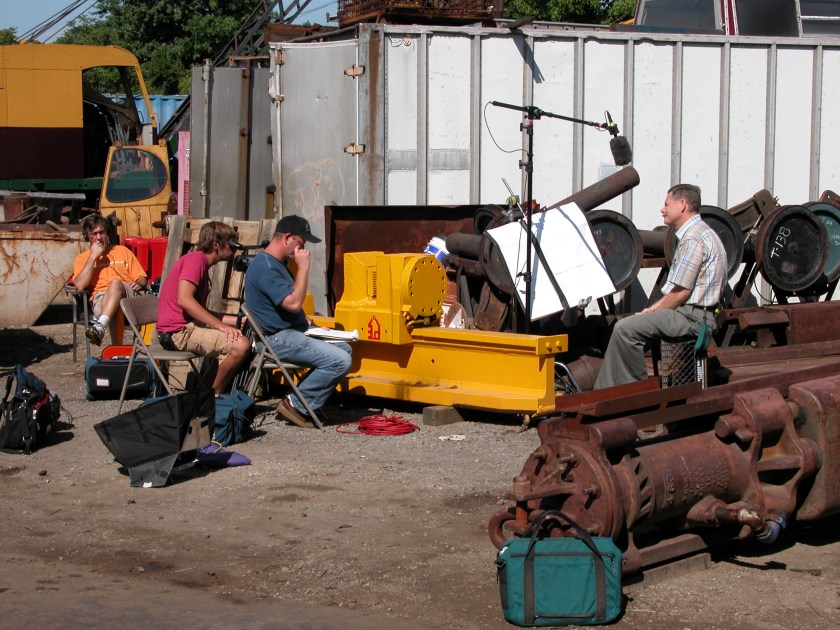
I got to meet him once in 2005 when the History Channel featured the Vulcan #2 hammer at a distributor’s yard in New Jersey. I am also indebted to him for much of the material in my own post Getting to the Bottom of Terzaghi and Peck’s Lateral Earth Pressures for Braced Cuts. In the photo at the top, that’s him at the right being interviewed by the channel. (He spent most of this time talking about Gow and the Chicago caissons, but Vulcan was expanding into marine and other applications.) He was doing what he was a master at: communicating, he was one of our industry’s best in that respect.

He had his own website and you can visit it here.

Memory eternal.

Posted in Civil Engineering

Longest Suspension Bridge in the World to be Built

ROME, ITALY: Italy’s government gave final approval on Wednesday to the construction of what will be the world’s longest single-span bridge, …

Longest Suspension Bridge in the World to be Built
Posted in Academic Issues, Civil Engineering, Geotechnical Engineering, Soil Mechanics

NAVFAC DM 7.2: Verification Examples, Some Parting Observations, and an Announcement About DM 7.1

At the end of NAVFAC DM 7.2 is a series of example problems which include the following:

  1. Cantilever Cut Wall
  2. Anchored Cut Wall
  3. Bearing Capacity of Shallow Foundations
  4. Mat Foundation Design
  5. Pile Group Capacity and Settlement
  6. Lateral Load Analysis
  7. Reliability Analysis of a Retaining Wall

Although the inclusion of these is “obvious,” some background is in order.

When the original DM 7.01 and 7.02 were introduced, examples were scattered throughout the books, and were of variable quality, generally not very detailed. Combined with the terse (and sometimes cryptic) guidance, the lack of detailed examples made them difficult to use in an academic setting for something other than a supplement, and including more examples would have made the concepts clearer.

DM 7.01 and 7.02 came at the end of a fruitful period of knowledge expansion in geotechnical engineering, but even towards the end of the 1980’s things were happening (many documented in NAVFAC DM 7.2) that really begged for an update. With the pedagogical deficiencies noted earlier, a comprehensive teaching document was needed to educate engineers and other practitioners in the science of geotechnical engineering, and that came forth in the Soils and Foundations Reference Manual. Although many of the facts (and figures, albeit redrawn) came from DM 7.01 and 7.02, the book was structured for an educational setting, complete with worked examples (which you can see now in NAVFAC DM 7.2.) Although it was intended primarily for short courses, it could be used for undergraduate students, and (with supplements) I used it in both my Soil Mechanics and Foundation Design and Analysis courses.

It is my hope that the FHWA will revise the nearly twenty year old Soils and Foundations Reference Manual, which is complementary to these new DM 7 documents.

An Announcement About DM 7.1

This site was quick to publish NAVFAC DM 7.1 when it came out in 2022, and it has been a success. There were a few typos and places where revision was needed, and about the time NAVFAC DM 7.2 came out Change 1 to NAVFAC DM 7.1 was also released. That Change was incorporated into the print document and can now be ordered. Whether you never bought NAVFAC DM 7.1 before or just want a corrected copy, it’s available both from the publisher and now in distribution, so you can order it in places such as amazon.com.

Some Parting Observations

The whole DM 7 project, including both NAVFAC DM 7.1 and NAVFAC DM 7.2, was a monumental task. While I voiced my objections about many things, most of these were about the state of geotechnical practice and how it can be improved. As books which document the state of the practice, NAVFAC DM 7.1 and NAVFAC DM 7.2 will become necessary references.

With many thanks to the authors and all of those who worked on these books, just one thing: don’t wait so long to update it…

Posted in Civil Engineering, Deep Foundations, Geotechnical Engineering, Pile Driving Equipment

NAVFAC DM 7.2: Deep Foundations

Now we get to another topic of intense interest: deep foundations. No topic in this book has advanced more than this one. When the original was published, driven piles were still the most common deep foundations. As much as we hate to admit it, that’s no longer the case.

But something else has happened along the way: most of the advances in the technology have been promoted and advanced (from a documentation standpoint at least) by the FHWA. Most of the chapter is a summary of those documents, and all of them (except for this one and helical piles, where a commercial book was referenced) are on this site. The summary is a reasonable one (and one which, hopefully, will inspire some textbook revisions) but there are a few points that need to be made.

Bearing Capacity vs. Settlement

Most engineering failure criteria in geotechnical engineering outside of lateral structures are based on what’s been traditionally called a “bearing capacity vs. settlement” paradigm. In current parlance (especially when considering LRFD, which is coming up) that referred to as “strength limit state vs. service limit state.” In NAVFAC DM 7.2: Shallow Foundations we saw both in evidence; which one predominated depended upon the configuration of the foundation and the nature of the soil.

NAVFAC DM 7.2 applies this paradigm to deep foundations as well. However, there is a “minority” school (Bengt Fellenius being its most vocal advocate) who believe that deep foundations basically don’t fail in bearing capacity but in excessive settlement. While structurally that may not be the case, geotechnically it’s hard to argue with this idea if one thinks about it long enough. Although, for example, classical bearing capacity equations have been applied to the pile toe, failure there really isn’t the same as shallow foundations due to the significant overburden. When we add the effects of shaft friction, and we look at the load-settlement curve we get out of a static load test (actual or simulated) we find that somewhere along the curve there is a “failure” point, determination of which depends upon the settlement limitations of the application and how we define “failure” along that curve (which is not univocal in geotechnical engineering.)

To get to the point where the ultimate load for a deep foundation is determined from predicted settlement, however, is going to take a major shift in how settlement is computed. NAVFAC DM 7.2 recognises the fact that the best way to estimate axial settlement is the t-z method and does not really offer a closed form, back of the envelope method to estimate them (for driven piles at least; drilled shafts get a different treatment.) The most straightforward method I’m aware of–Vesić’s Method of Estimating the Settlement of Driven Piles and Drilled Shafts–was in the previous book but has gone by the wayside. Further complicating things is the fact that many practitioners have used the bearing capacity/strength methods to estimate the ultimate resistances for the t-z method!

The situation we have on this topic is manifestly unsatisfactory but, until computer methods gain wider acceptance–and the wisdom in how to use them correctly–and we obtain more confidence, I suppose we’re stuck with the current paradigm.

Alpha and Beta Methods

This is another one of those “controversial topics” but NAVFAC DM 7.2 pretty much sticks with the current practice of alpha methods for clay soils and beta methods for sands. I’ve spent a great deal of time on this topic on this website in articles such as Shaft Friction for Driven Piles in Clay: Alpha or Beta Methods? To be fair, as is the case with the FHWA’s Soils and Foundations Reference Manual, Fellenius’ beta method for all types of soils is featured. I am more optimistic that this will be resolved in favour of the beta methods than I am with the settlement issue, but things move slowly in this business.

Lateral Loads and Settlements

For the last 30+ years it has been recognised that the p-y methods are the best for longer, laterally loaded piles. (An example of their application can be found in Driven Pile Design: Lateral Loads on Piles.) These, of course, require computer software, which these days is proprietary. An interesting development in the late 1990’s was the CLM 2.0 method, which featured a spreadsheet simplification for obtaining a solution. (I used it for many years in my teaching.) This study, however, shows shortcomings of the CLM method, and the authors of this part of NAVFAC DM 7.2 would have done well to consider this document in their deliberations.

Wave Mechanics

As someone who started out calling this site the “Wave Equation Page for Piling” this topic is of interest. Since this does require a computer solution (except perhaps for the Case Method,) the section on the subject is a good qualitative overview of the topic. In the wake of my Improved Methods for Forward and Inverse Solution of the Wave Equation for Piles I am seeing interest in advancing this technology, and am looking forward to overviews like this in the future.

Posted in Civil Engineering, Geotechnical Engineering, Soil Mechanics

NAVFAC DM 7.2: Shallow Foundations

This week we’ll turn in NAVFAC DM 7.2 to shallow foundations. It’s a well worn path and NAVFAC DM 7.2 does a good job covering it, but there are a points that are worth making. (Settlement for these foundations is covered in NAVFAC DM 7.1.)

Upper and Lower Bound Plasticity

It’s mentioned in both NAVFAC DM 7.1 and NAVFAC DM 7.2 but not really explained: the whole concept of upper and lower bound plasticity. Until recently most American textbooks avoided the subject; I used Verruijt’s coverage of the subject, which had problems of its own but gave a reasonable introduction to the subject. NAVFAC DM 7.2 refers to Terzaghi’s bearing capacity method (which really needs to be retired from use) as an “upper bound” method, but the truth is that all of the bearing capacity methods mentioned–Terzaghi, Brinch-Hansen, Vesić (more about that shortly) and Meyerhof–are all upper bound methods. For a credible lower bound method which is good to illustrate the concept with bearing capacity, take a look at my post Lower and Upper Bound Solutions for Bearing Capacity.

Geotechnical Eccentricity

For both square/rectangular and circular foundations, this gets nice coverage, with illustrations, in NAVFAC DM 7.2. It’s a subject my students wrestled with, especially when juxtaposed with “middle third” types of distributions (and that’s covered too,) and this will be a help.

Vesić’s Method

If there’s one serious lacuna in the presentation on bearing capacity, it’s the lack of coverage of Vesić’s Method. That’s because the FHWA, for better or worse, has adopted it (or a modification of same) as their principal recommended method for bearing capacity.

Groundwater and Layered Stratigraphies for Bearing Capacity

The coverage of both of these topics is extensive and welcome. The groundwater part is basically the same method as the FHWA uses; the layered part is an advance over this or any other method I’ve seen. One question hangs over the festivities: what’s the best way to put them together?

Shallow Foundations on Slopes

This represents a major advance over the old book. My students found Meyerhof’s method hard to use (I did too) and the tabular alternatives given are a welcome break.

Mat Foundations

This is always a difficult topic because, at the end of the day, a computer solution is necessary for a realistic analysis. In the interim NAVFAC DM 7.2 furnishes a method which hopefully will be helpful for preliminary or verification work. One topic that isn’t consistently treated is whether a foundation should be analysed as rigid or flexible in the first place. NAVFAC DM 7.1 was very helpful when I put together When Semi-Infinite Spaces Aren’t, and When Foundations are Neither Rigid Nor Flexible, and a similar approach here would have been helpful.

The rest of the chapter focuses on drainage of shallow foundations and rock and soil anchors. The latter edges into deep foundations, which will be our next topic.