Posted in Geotechnical Engineering, Soil Mechanics

Getting to the Bottom of Terzaghi and Peck’s Lateral Earth Pressures for Braced Cuts

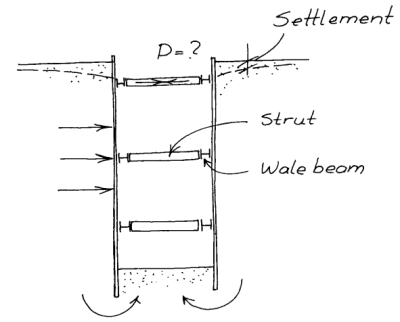
One of those “things” in geotechnical engineering that looks like “settled science” but may not be is the whole business of lateral earth pressures for braced cuts. (An example of one is shown at the right.) Textbooks of all kinds (including Soils in Construction) show pressure profiles and solution techniques that are “definitive.” Or are they? This article is more about asking questions than delivering another round of “definitive” answers, but hopefully it will at least spark some thought and perhaps make practitioners more careful in their application of these methods.

The Basic Problem
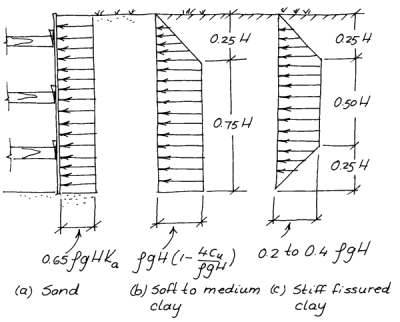
Based on experience, first in Berlin and later in Chicago, Terzaghi (and later also Ralph Peck) developed a set of pressure distributions as shown at the left. These are at variance with those usually associated with retaining walls in general and sheet pile walls in particular. The theory behind these (certainly for the clays) had its genesis in Rankine theory adapted for cohesive soils, but the distribution is rather different. These distributions have been reproduced in many textbooks and reference books, including Soils in Construction and Sheet Pile Design by Pile Buck.

It’s worth noting that there are other pressure distributions that have been formulated other than the ones shown above, as outlined by Boone and Westland (2005).

Along with the distributions came the method of using them: the “hinged method” of analysing the sheet pile wall. Strictly speaking the sheet pile wall is a continuous beam with multiple supports. Since there are usually more than two struts and supports, to use a continuous beam requires a statically indeterminate beam. Applying hinges (as shown at the right) can make the beam statically determinate. Although methods for solving statically indeterminate beams existed in Terzaghi’s day (remember it was geotechnical methods which then and now lag the rest of civil engineering in advancement,) converting the problem to a statically determinate one was convenient for computational purposes.

But then comes the kicker: as generally presented, if the distributions above are used, they must be used with the hinged method, even when analysing a braced cut wall using a braced cut method with a continuous beam is nearly trivial now. Why is this?

How It Came About

Like so many things in civil engineering, the investigation of pressures on braced cuts came about as a result of tragedy. As noted by Rogers (2013):

On the evening of December 1, 1938 Terzaghi delivered a terse lecture titled “The danger of excavating subways in soft clays beneath large cities.” The lecture focused on his recent experiences with construction of the Berlin Subway, which was hampered by a high water table in running sands. These conditions had contributed to the sudden failure of a shored excavation which killed 20 workers in August 1935. He made a convincing case for proper geotechnical oversight during construction if similar tragedies were to be avoided in Chicago.

The lecture with its graphic images of the dead bodies beneath the collapsed bulkhead along the Hermann Goring Strasse succeeded in scaring his audience to death, and promptly found the State Street Property Owners’ Association and City of Chicago bidding for Terzaghi’s services. The City wanted him to advise them on how best to monitor progress of excavations and ground settlement, differentiating what structural or architectural damage was caused by subway construction.

Both Terzaghi and Ralph Peck ended up doing the monitoring. The soils in Chicago were predominantly soft clays, so the earth pressures were different. Much of the theory and application behind this is documented in Peck (1943). (Interesting side note: one of the lines of the subway ran past the site of Vulcan’s old Milwaukee Avenue plant where the first Warrington-Vulcan steam hammers were designed and built.)

One might ask, “How did they come up with the earth pressure distributions?” They did so–and this is the key to the problem–by measuring the reactions on the braces. They did this in the face of the fact that, as is usual with braced cuts, the braces were put in successively with excavations, and that much of the movement of the wall–and thus the mobilisation of the earth pressures–was in place before the braces were installed. (It is easy to forget the importance of that mobilisation, but both Terzaghi and Peck were well aware of it and its effects.) To translate the loads on the braces into a pressure distribution, they adopted Terzaghi’s procedure from the Berlin subway as follows (Peck (1943)):

The vertical members of the sheeting are assumed to be hinged at each strut except the uppermost one, and a hinge is assumed to exist at the bottom of the cut. The abscissas of the pressure diagram “A” represent the intensity of horizontal pressure required to produce the measured strut loads. A study of such diagrams for all of the measured profiles disclosed that the maximum abscissa never exceeded the value KA Ya H. Every measured set of strut loads resulted in a different pressure diagram “A,” all of which were found to lie within the boundaries of the trapezoid indicated by the dotted lines. Thus, if strut loads are computed on the basis of this trapezoid, they will most probably be on the safe side.

This, therefore, is the origin of the requirement to use a hinged wall where there were no actual hinges. At the time it was a reasonable solution. As noted earlier, solutions for continuous beams existed but back-figuring the pressures using them would have been a formidable “inverse problem” given the computing power of the day. Doing this, however, raises as many questions as it answers, such as the following:

  • If a continuous beam had been used, would the pressure distribution have been different?
  • What is the relationship between the pressure distribution computed by Terzaghi’s method and what is actually experienced by the wall? Put another way, did Terzaghi’s simplification of the structural situation compromise his distribution? (No doubt some conservatism in the pressure distributions offset that problem.)
  • If the pressure distributions are right for engineering purposes, is it still necessary to use a hinged solution? Especially with beam software, a continuous beam is much simpler to analyse and structurally more representative of the actual sheeting and bracing.

Peck himself was well aware of the limitations of the method; he made the following admission:

It is apparent, therefore, that it is useless to attempt to compute the real distribution of lateral pressure over the sheeting. Of far greater practical importance is the statistical investigation of the variation in strut loads actually measured, in order to determine the maximum loads that may be expected under ordinary construction procedures.

This too raises another question: in developing distributions primarily to determine brace/strut loads, do we compromise the accuracy of determining the maximum moment in the sheeting itself?

Moving Forward

It’s difficult to really know how to answer many of the questions this problem raises. Some suggestions are as follows:

  • It is hoped that there is enough conservatism in these earth pressure distributions to accommodate either method. That’s likely, as inspection of some of Peck (1943) curves will attest. That likeliness is buttressed by the fact that these methods came out of a deadly accident.
  • More comparisons of hinged and continuous beam models are needed. There is one in Sheet Pile Design by Pile Buck and another in the post on this site A Simple Example of Braced Cut Analysis. These are simply not enough to establish a trend one way or another, although the results are interesting and hold promise.
  • A “hand” solution based on parametric studies using FEA or another numerical method would move things forward considerably. Obviously these are limited by the accuracy of the soil modelling but they can be applied to a wider variety of cases.
  • Field tests should include measurement of actual lateral earth pressures on the sheeting at various points. The use of strut loads, although easier to measure with the technology of the 1930’s and 1940’s, is still indirect. Another interesting approach is to use an inverse method and a continuous beam with existing data, although this is not as satisfactory as direct measurement of earth pressures.

References

  • Boone, S.J. & Westland, J. (2005) “Design of excavation support using apparent earth pressure diagrams: consistent design or consistent problem?” Fifth International Symposium on Geotechnical Aspects of Underground Construction in Soft Ground, International Conference on Soil Mechanics and Geotechnical Engineering, 809 – 816.
  • Peck, R.B. (1943) “Earth-Pressure Measurements In Open Cuts, Chicago (Ill.) Subway.” Transactions of the American Society of Civil Engineers, Vol 108, pp 1008-1036.
  • Rogers, D.A. (2013) “Ralph Peck’s Circuitous Path to Professor of Foundation Engineering (1930-48)” Presented at the Seventh International Conference on Case Histories in Geotechnical Engineering.
Posted in Academic Issues, Geotechnical Engineering

The “Why” and “What” of Soils in Construction

Anyone familiar with the history of geotechnical engineering is aware that its development can, to some extent, be tracked with the development of its textbooks.  Early textbooks tended to be vague and empirical in nature.  With new books more theory is found, especially after the works of Terzaghi, Peck, Tschebotarioff and Taylor.  By the early 1970’s there was a large selection of textbooks for the undergraduate instructor to choose from in the topics of soil mechanics, foundations or books that featured both.

This selection, which peaked with the end of the “Golden Age” of geotechnical engineering, has thinned considerably, as it has with most textbooks.  Soils in Construction made its debut in 1974, right in the middle of the last burst of activity in the field.  So why has this textbook endured when so many others have fallen by the wayside?

The answer is simple: it wasn’t aimed at undergraduate civil engineering students but at construction management ones, and in that respect it was far enough ahead of its time to endure but no so far as to die before its time would come.

When I started my career in the 1970’s, people with geotechnical knowledge working for contractors were a rare breed.  This is not to say that such people had not taken their place; the likes of Lazarus White comes to mind.  But most contractors–especially small and medium size firms, firms which frequently specialised in one or more aspects of geotechnical construction–did not have on staff people with a working knowledge of applied geotechnical theory.

Contractors were not alone in this lack.  State DOT’s were likewise short of people with this type of understanding, and they had large sums of public money entrusted to them.  The FHWA saw the need to address this issue, and the Soils and Foundations Reference Manual was the result of that effort.  Although it can be used in a college setting (I have done this in my Soil Mechanics and Foundation Design and Analysis courses) it takes a lot of work, more work than most academics are used to putting into an undergraduate course.

Soils in Construction is the answer to this dilemma.  It is geared towards construction management students whose mathematical level may not be up to that of their engineering counterparts.  (But…I always told my students that the only calculus they’d get in my courses is if they didn’t brush their teeth; even for them it is the nature of basic geotechnical engineering.)  It enables them to grasp the basics of the application of soil mechanics to practical problems, including temporary works, whose engineering is frequently overlooked but which is often vital for the successful completion of the permanent works to follow.

With this the authors commend this work to our readers, hoping that it will result in more successful geotechnical projects for contractor, owner and engineer alike.

Posted in Academic Issues, STADYN

My Response to Rodrigo Salgado’s “Forks in the road: decisions that have shaped and will shape the teaching and practice of geotechnical engineering” and an announcement

I was intrigued by Purdue University’s Rodrigo Salgado’s “Forks in the road: decisions that have shaped and will shape the teaching and practice of geotechnical engineering.” It comes at a timely point in my own journey in geotechnical education: as I write this response, I am in the process of finishing up and putting a wrap on my last semester of teaching geotechnical courses at the University of Tennessee at Chattanooga. I will explain more about this at the end of the piece but it will probably be the last time I teach these topics “face to face.”

My effort in geotechnical education has never been strictly about the classes I teach at the University. This website has enabled me to disseminate information on the topic for many years, which is implicitly educational. In more recent times I have posted topics of interest, many of which have emerged from my teaching, and I will continue that practice.

With that introduction out of the way, I can proceed to respond to the various topics that Salgado brings up.

Empiricism, science and geotechnical design

As the scion of one of the oldest active families in the business–the Vulcan Iron Works–I feel I am in an interesting position to address this issue. The Warrington-Vulcan hammer was introduced in the late 1880’s into a world where wood piles–the same types of piles driven by the Lake Dwellers in Switzerland–were pretty much the norm. It was also the era when the Engineering News formula (itself an empirical project) came into being. In subsequent years many other types of piling were introduced, but as Salgado notes soil mechanics–with the exception of lateral earth pressures–were pretty much undiscovered territory. Pile dynamics suffered from a similar level of ignorance, one compounded by civil engineers’ historic aversion to things that move. Vulcan was aware of the problems with the dynamic formulae, but it wasn’t until after World War II that these problems were tackled with a more scientific approach, and even then one gets the impression that Smith’s choice of soil model was fortuitous as much as anything else. In the meanwhile Salgado’s statement that “There is a common misconception that all engineering done before the advent of science was conservatively done” was a misconception not shared by those who really understood the problems with the pile dynamics of the first half of the twentieth century.

The Original Sins of Mohr-Coulomb and the Associated Flow Rule

I have to confess that my thinking on these topics has been formed by two processes: 1) my years of teaching a discipline where the topics do not have as immediate an integration one to another as other branches of civil engineering, and 2) my dissertation, which wasn’t complete until 2016. The latter involved writing geotechnical finite element code from the ground up, which gives me something of a greater appreciation for the issues which Salgado brings up than many who teach this course on an undergraduate level.

Let’s start with Mohr-Coulomb itself: I used it in my FEA code with the following justification:

Based on this and the elasto-plastic discussion, the Mohr-Coulomb failure model was chosen. As Abbo et.al. (2011) point out: “The Mohr–Coulomb yield criterion provides a relatively simple model for simulating the plastic behavior of soil. Other more sophisticated constitutive models for predicting the behavior of soil have been developed over the past three decades, however the complexity of these models, as well as the additional testing required to determine the various soil parameters involved, minimizes their utility for practicing geotechnical engineers. The Mohr–Coulomb yield function is also of importance to finite element researchers and practitioners as it forms the basis of many analytical solutions. These analytical solutions serve as crucial benchmarks for validating numerical algorithms and software.” This observation is supported by McCarron (2013).

In spite of its limitations, Mohr-Coulomb still has its place in geotechnical engineering. Salgado focuses on two serious problems with Mohr-Coulomb: the sharp division between cohesionless and cohesive soils and the use of the associated flow rule, an issue which doesn’t emerge in many “closed form” solutions but is certainly an important one in finite element code.

To illustrate my own journey with the first problem, having come from a deep foundations background, I was taught the cohesionless/cohesive dichotomy which is built into the whole “alpha/beta” method business. That was challenged by John Burland a long time ago. The key to ditching alpha methods–and by doing this use beta methods–is to note that the cohesion of a soil is a function of its effective stress (and other variables.) It is for this reason why I have not taught alpha methods for driven piles for some time but prefer Fellenius’ Method, recognising that the student may find themselves forced to use another method once “in the wild.” (One of these days we’ll fix that dichotomy embedded in O”Neill and Reese’s method for drilled shafts.) Fellenius’ Method has its own problems (it requires the student to use some judgement, which they haven’t quite developed) but I think in the end beta methods will win out.

But there is a more compelling factor at work: the most important single factor in the behaviour of a soil is its grain size distribution. With this soils don’t neatly divide themselves into two categories; it’s a continuum from coarse-grained to fine-grained soils. Even the classification system doesn’t quite do this justice; it’s hard to argue that a soil with 51% fines is that much different (all other things being equal) to one with 49% fines, even though they will have different classifications and the former will be considered “cohesive” and the latter “cohesionless.”

Looking at things this way, “purely” cohesive or cohesionless soils–each at the extreme of grain size distribution–are rare exceptions rather than the rule. This means that, from a Mohr-Coulomb standpoint, virtually all soils have a non-zero c and \phi , something that Salgado notes engineers figured out a long time ago (erroneously, in his opinion.) But that’s just the beginning of the problem, we must now deal with the other quantity that Salgado brings up: dilatancy. And that in turn leads us to the business of the associated flow rule.

Once again my position on that topic is in my dissertation:

Except for purely cohesive soils, a purely associated flow rule is to be avoided for soil materials in the model. Such a rule is acceptable for many engineering materials but does not realistically model the dilation of soils, especially cohesionless ones. The downside to this is that the elasto-plastic constitutive matrix is non-symmetric, which, strictly speaking, will result in a non-symmetric stiffness matrix, increasing the cost of the problem solution.

With an associated flow rule \phi = \psi and the dilatancy is “locked” into the value of the friction angle. With a non-associated rule \phi \neq \psi and we must determine the value of \psi . The literature on meaningful values of \psi isn’t as copious as one would like but the situation is improving. Including the dilatancy solves many of the problems that Salgado raises with the Mohr-Coulomb failure criterion, especially the sole reliance on the Mohr-Coulomb failure function. (An implementation of such a rule is here.) His application of a non-associated flow rule to the bearing capacity problem is intriguing, and would be more intriguing except for the fact that generally settlement is a more important failure mode to consider than bearing capacity. (Application of this to Coulomb and log-spiral failure of retaining walls is another matter altogether.)

At this point we run into the serious problem: how to implement the solutions properly in the class setting. The problem we have in geotechnical engineering is that, in order to consider the effects of elasticity (assuming that exists, which is problematic,) plasticity and dilatancy in “one shot,” you really need finite element code, which can move from elastic to plastic deformation continuously. Most of the “hand” solutions we’ve used up to now have assumed either an elastic state or a plastic one, and the latter with an associated flow rule, as Salgado observes. I think that, moving forward, we need to consider numerical methods as the best way to solve problems in this profession. But it is dangerous to rely on these solely; they tend to become “black boxes” in the hands of many practitioners, whose results are taken as “final” even when they are erroneous. (Those of us involved in pile dynamics are all too aware of this problem.) The hand solutions in these cases need to be ancillary to make sure we are not doing something really stupid with the numerical ones, and I think our education needs to reflect that.

Shear Strain Localisation

The way I have dealt with this issue is to use the lower and upper bound concept, one which I have borrowed from Verruijt. By showing that there is a beginning of failure in the “surface” (a term Salgado objects to) and an end we can bracket the beginning and the end of plastic failure, which shows a truth students need to get used to in soil mechanics: our designs inherently have a degree of failure; the question that remains is how much is acceptable. Some of Verruijt’s examples of lower and upper bound are lame but that can be fixed. It’s also interesting that Salgado picked as a primary example a driven pile. In spite of being the driven pile person I am, I would not, but perhaps that’s because we get to slope stability, lateral earth pressures and bearing capacity before deep foundations. But a more comprehensive solution to the problem would be to pitch the “bearing capacity in piles” concept altogether and base design on load-settlement, which forces us to consider the progressive failure of the shaft surface from the head down and finally the failure of the toe itself.

Since he brought up the subject of driven piles and the “groundbreaking” studies of Randolph and Wroth: in that study they included varying the modulus of elasticity as one got away from the shaft surface. It is possible to use a hyperbolic stress-strain model of the soil to vary this with the strain continuously, as I demonstrate here.

Particulate Modelling and Artificial Intelligence

One thing I’m thankful that my dissertation committee (or one member) talked me out of was particulate modelling. I think that the non-homogeneity of soils and particle shapes will make this a challenging pursuit; continuum modelling should suffice for the foreseeable future.

Salgado is spot on about using any kind of artificial intelligence and machine learning without inclusion of physical modelling: it will not work. Reducing our analysis to a statistical pursuit with no regard for the basic physics of the problem–ours or anyone else’s–will lead to disaster. I have commented on this in other fora and hope our community will resist the temptation of yet another type of “magical thinking” that permeates our society.

Our World In Stress

I usually reserve things like this to another site but since he brought it up:

  • Our fertility rate globally is dropping. The biggest problem we have with this is that our democracies are not prepared on dealing with funding the consequences of that change. So we will not have so many people who are consuming.
  • I find it difficult to understand why, since the central problem is the emission of carbon dioxide, nuclear power is not included in the solutions. The anti-nuclear movement had its genesis in the 1960’s and 1970’s, a time when the mood among many was decidedly anti-technological. It’s time for a change.
  • It is ironic that the methods used by the oft-demonised oil industry are now key to offshore wind.

The second point, in a sense, leads me to why I am departing my 20+ years of teaching geotechnical engineering in a university setting. This fall, Lord willing, I will begin teaching at Lee University, my church’s institution of higher learning. They are beginning an engineering program which has not developed to the point of being discipline-specific. I think, however, that Lee needs an engineering program, its students need the option of one, and that the liberal arts centred educational system, one we inherited from the British and have had since before the Republic began, has failed us, not only in producing a leadership class totally incapable of informed decision on technological issues, but also bereft of what Antoine Arnauld and Pierre Nicole called Logic, or the Art of Thinking. Much of this is an outcome of the same era as the anti-nuclear movement; we have replaced a pursuit of understanding with a pursuit of raw power, and the end result will be that we will end up with neither.

In summary, I think that Salgado’s idea is basically a good one. In addition to what I have observed above, I think that his program will be easier to implement in a well-funded and deep-research institute such as Purdue than in places (and there are many) where geotechnical engineering is an afterthought.