Posted in Academic Issues, Geotechnical Engineering

A Simplified Method to Design Cantilever Gravity Walls

On this site we feature the U.S. Army Corps of Engineers publication Retaining and Flood Walls, which details the design of several types of retaining walls. As it was published a good while back, it details the design of these walls using hand calculations. Sometimes these can get tedious, especially when the aptly named “trial wedge” solutions are employed.
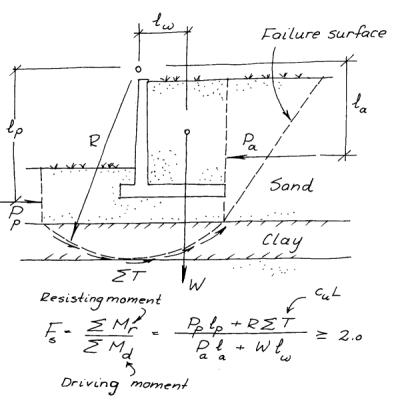
These days it’s more likely that a computer solution–be it a true finite element analysis or simply the automation of those tedious hand calculations–is used to finalise the design of a retaining wall. An example of such an analysis is shown above, and addresses in particular an issue that gets the short shrift in classical retaining wall analysis of any kind: global stability failure. An idea of a hand solution to this problem is shown at the right. Global stability failures still happen and are generally disastrous; beyond a conventional slope their analysis is fairly complex.

But in the meanwhile, what do we do to verify that we’ve got it right with a computer solution? Or what can we do to start with a reasonable design that we can refine with numerical analysis? Back in the “slide rule era” we used quick, “back of the envelope” methods to design things, and we can use them today both to get started and to gain a basic understanding of the elements of the design.

In this case we’re going to discuss the design of a cantilever retaining wall, an example of which is shown below.

The methodology is based on the aforementioned Retaining and Flood Walls and the example (which is a little clearer description of same) comes from Appendix A of Seismic Analysis of Cantilever Retaining Walls, Phase I. I’ve modified it in a couple of spots and will detail those modifications as we go.

The example we’ll look at is below. We need to design this wall to prevent failure against three events: sliding, overturning and bearing capacity failure.

Defining the Geometry, Weights and Centres of Gravity

Our datum/coordinate origin is at the toe, which is convenient since we assume that the overturning moment is computed around the toe. Since this is a cantilever/gravity wall, the weight of the wall is part of the resistance force and moment. Included with that is the backfill that is trapped behind the wall (shown above.)
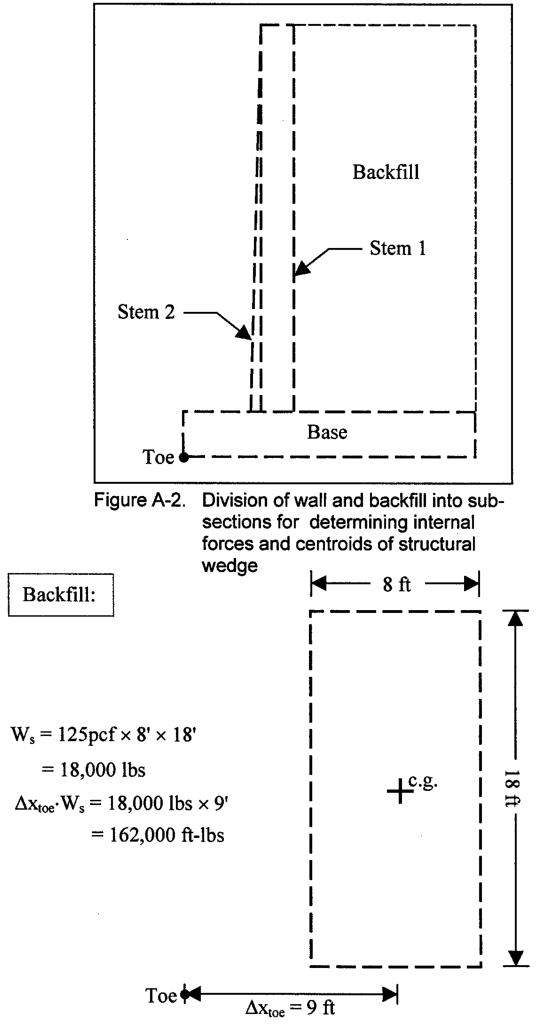
We start by dividing up the wall into sections, each of which has a weight and a centre of gravity. The first section we take up is the backfill, which is a simple rectangle shown above.

At this point we need to make one correction to the Corps’ work: the weights and moments are in pounds per unit length of wall and ft-pounds per unit length of wall, respectively. Leaving those per unit length designations is a common shortcut among practitioners but is confusing for students, who frequently find the unit length concept difficult to grasp at first. The weight of the backfill is properly 18,000 lbs/ft of wall and the moment around the toe ((clockwise) is 162,000 ft-lbs/ft of wall.

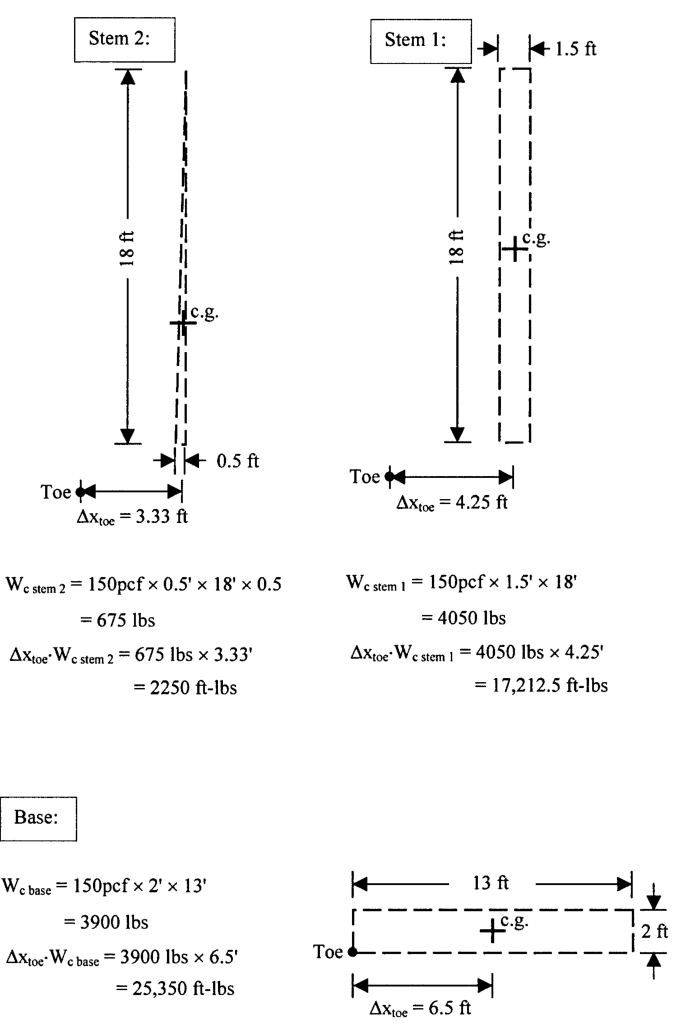
Computing the weights and moments of the various sections of the wall itself yields the following results.
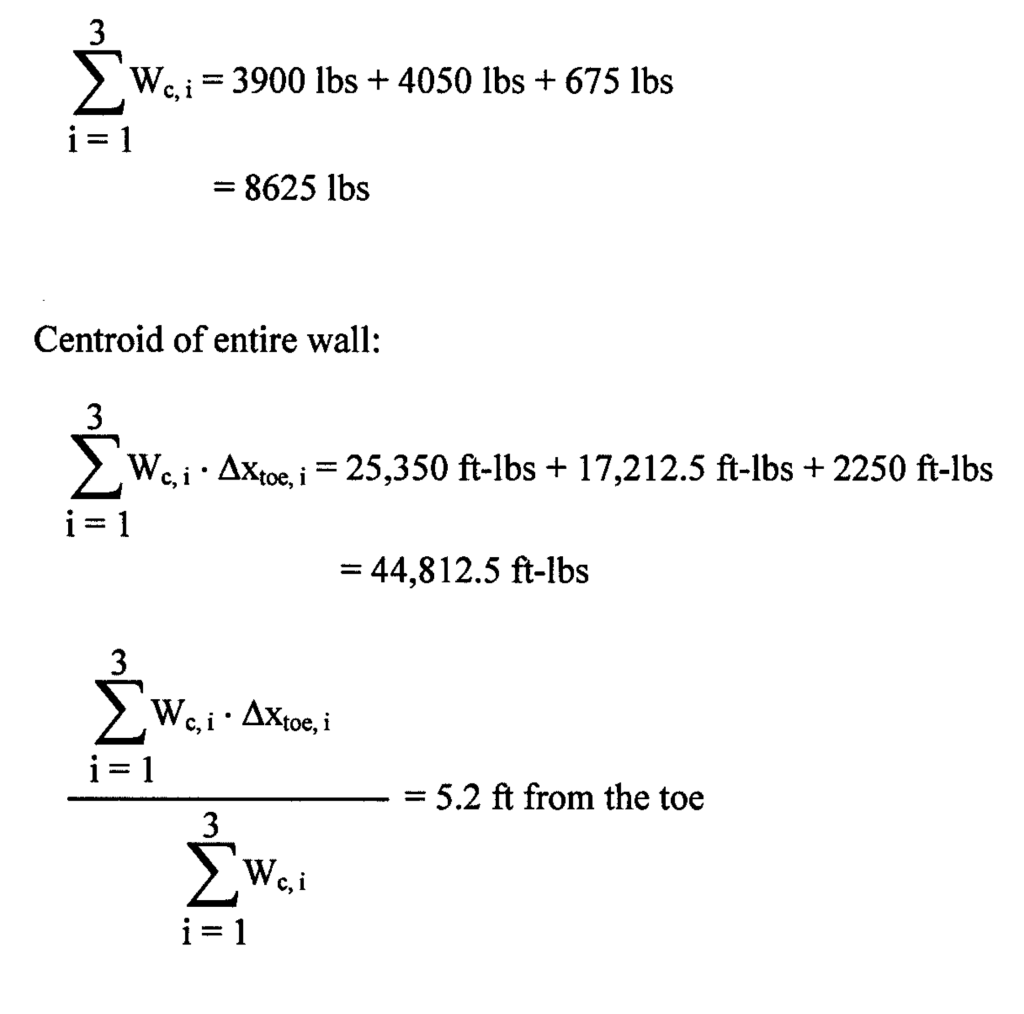
Taking all of this information and processing it yields the total weight, total moment around the toe, and moment arm around the toe:
Since most engineers have learned their statics via vectors, a review of Vector Statics and “Old Coot” Statics: An Example and What is a Resultant in Geotechnical Engineering? may be in order.

The Shear Mobilisation Factor

Now comes the tricky part: in retaining wall design, we traditionally define the factor of safety as

FS = \frac{F_{resisting}}{F_{driving}} (1)

Where the “F” values can be forces or moments and FS is the factor of safety. Sometimes this is not the optimal way of applying factors to account for uncertainties, especially when we get to LRFD. Another approach is either to increase the driving force or reduce the resisting force. We do the latter with sheet piling (where there there are earth forces to resist) but here we’ll to the former. To make this happen we first define a shear mobilisation factor (SMF) thus

SMF = \frac{\tan \phi'_{mob}}{\tan \phi'} (2)

The value of \phi'_{mob} can be computed thus:

\phi'_{mob} = \tan^{-1}(SMF tan \phi') (3)

For this problem, assuming SMF = 2/3 and φ’ = 35°, by substitution φ’mob = 25°. We will discuss the effect of cohesion later.

Now we turn to computing the force of the soil behind the wall on the wall.

We note the following:

  • Rankine theory is used. Methods shown in both Retaining and Flood Walls and the Soils and Foundations Reference Manual use Coulomb and/or log-spiral for these computations. The problem with this is that the value of wall friction δ is sometimes difficult to determine without data or experience, and in reality most of this pressure bears on soil, not the wall. So Rankine is easier to start with, and is more conservative.
  • The backfill is level, the formula for Ka only applies in that case. We will discuss sloping backfill below.
  • Note that φ’mob (not φ’ ) is being used to compute the soil force.

Analysing Sliding and the Location of the Resultant/Overturning

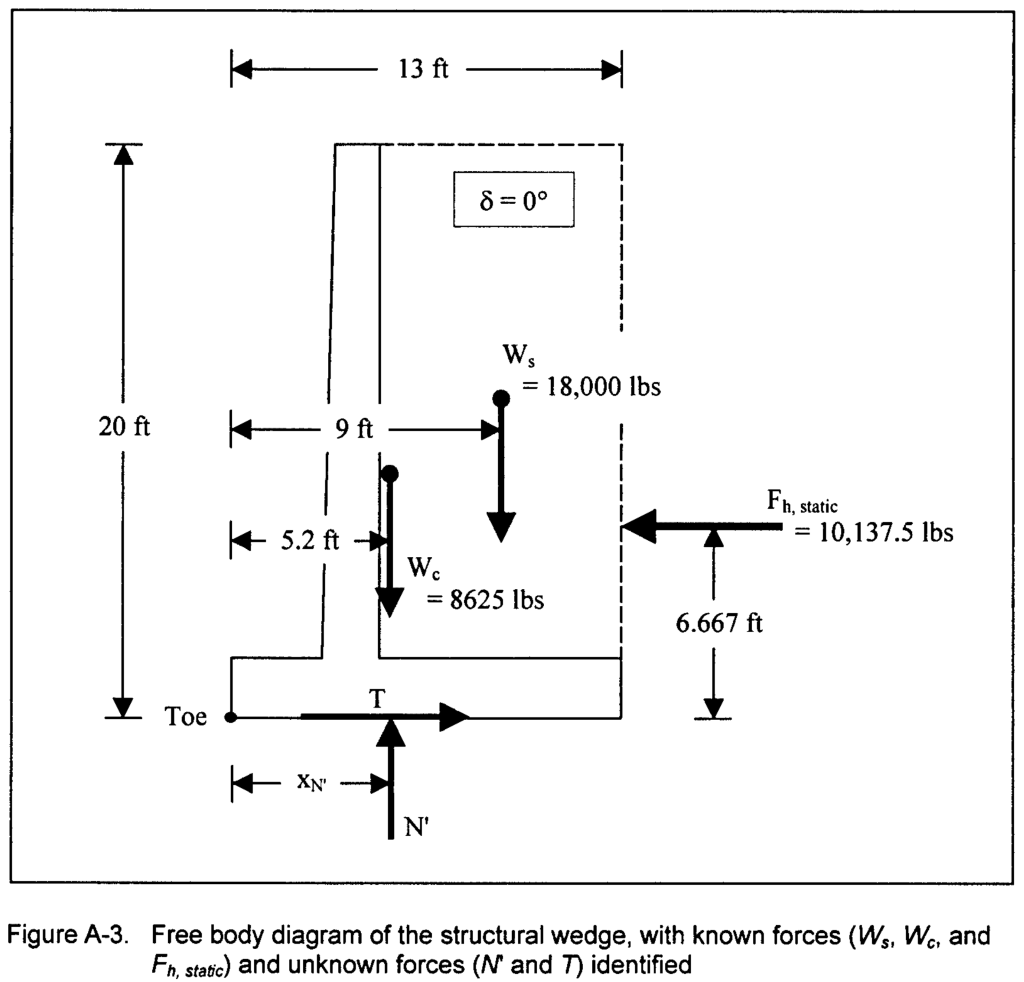
At this point we can compute the forces on the base (both the forces T’ and N’ and the location of the resultant xN’,) which are shown below.
The calculations are shown below.
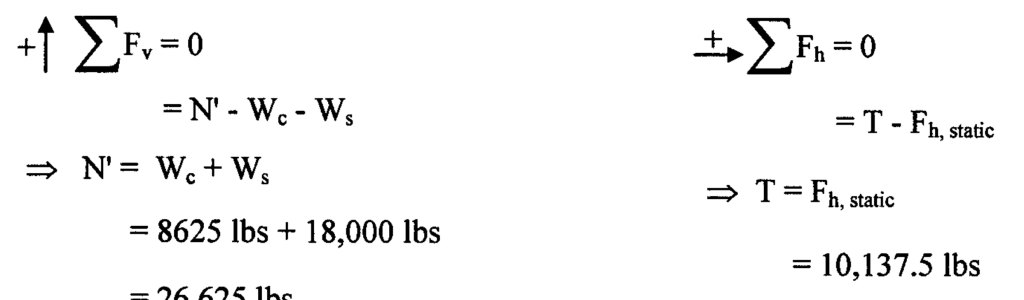
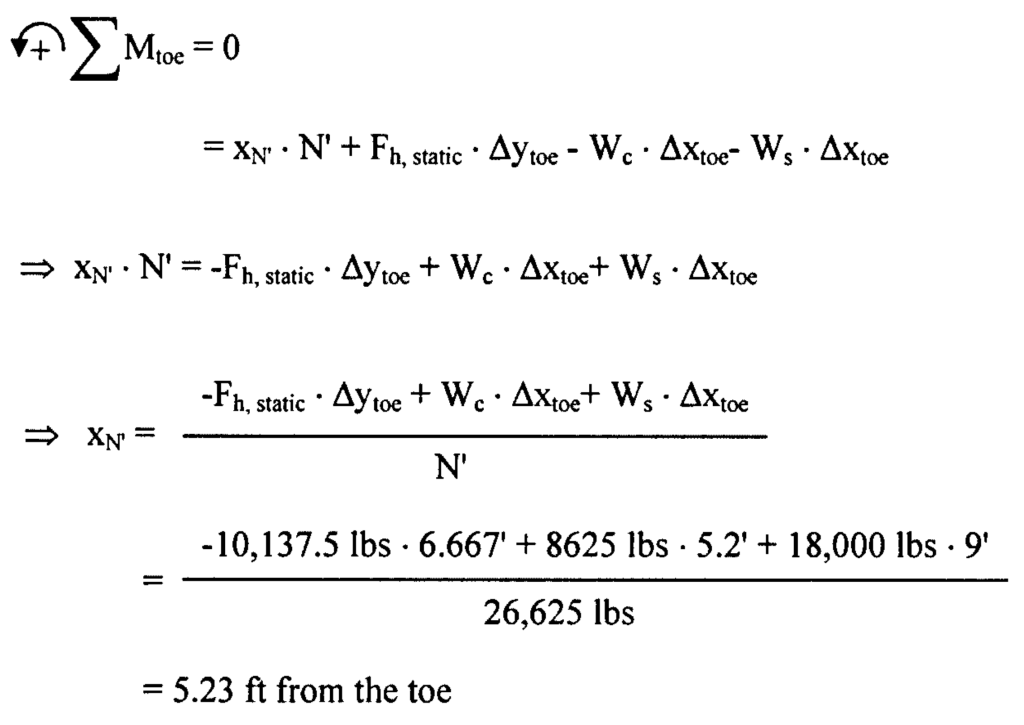
Turning to the sliding problem, the driving force is the earth pressure force and the resisting force is the maximum Coulomb friction of the base/soil interface. In this case the value of δ is equated to the unmodified value of φ’, although that isn’t always the case. (The basis for this is that there is a thin layer of backfill sand under the wall, under which is a different foundation soil.) We then apply Equation (1) and determine the factor of safety against sliding, which checks out against the Corps criteria.
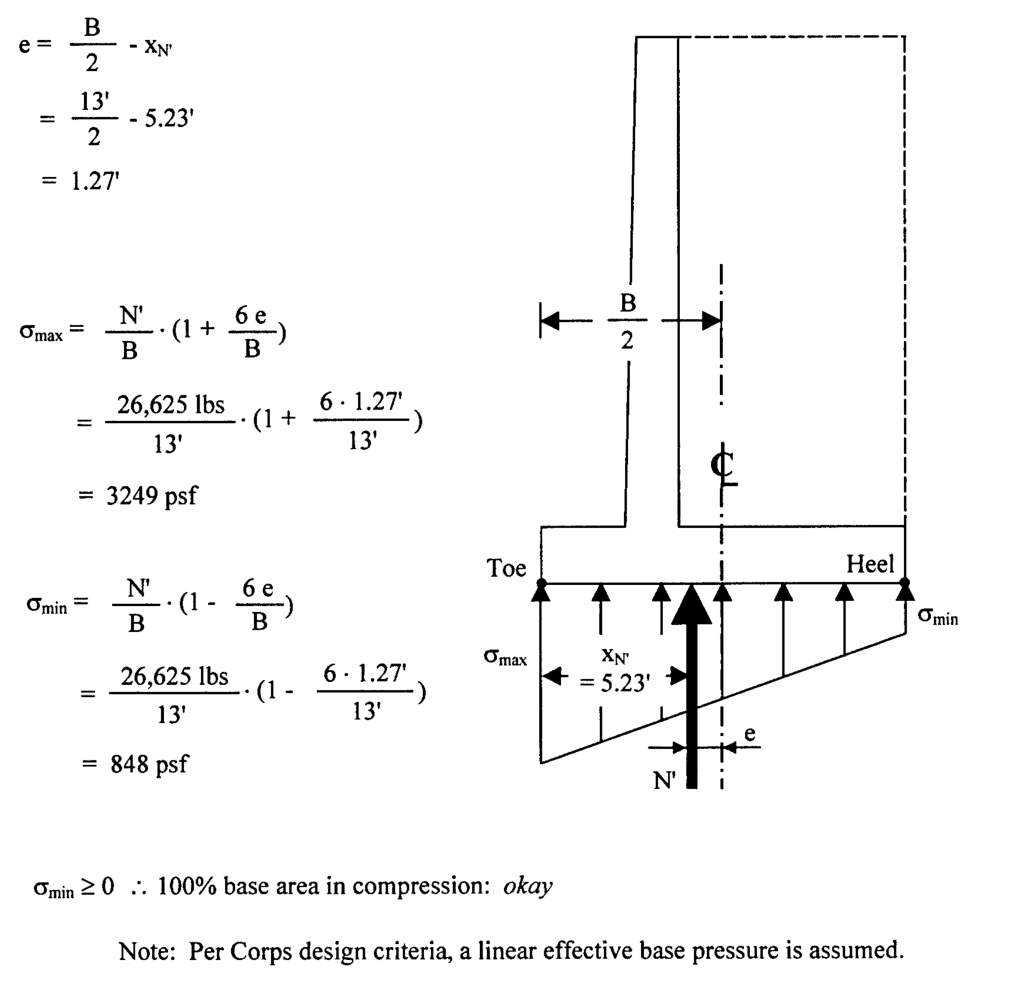
Knowing the location and magnitude of the resultant, we compute the maximum and minimum pressures on the base. Since both pressures are compressive, the resultant is in the middle third, and thus we can proceed with the base design.

One thing that is missing from this analysis is a specific analysis for overturning. In this case we make a common assumption that, as long as the resultant force of the wall is within the kern and there are no negative pressures on the base, overturning will not be experienced. It is certainly possible to do an explicit overturning analysis to check this result.

Bearing Capacity Analysis

With the wall’s sliding and overturning established, we turn to the bearing capacity analysis of the base. The complete bearing capacity equation, from the Soils and Foundations Reference Manual (with modification,) is

q_{ult}=s_{c}b_{c}l_{c}cN_{c}+s_{q}b_{q}l_{q}C_{wq}q_{o}N_{q}+\frac{1}{2}s_{\gamma}b_{\gamma}l_{\gamma}C_{w\gamma}\gamma B_{f}N_{\gamma} (4)

where

  • qult = ultimate unit upper bound bearing capacity
  • sc, sγ and sq = shape correction factors. These are unity in this case since it is a continuous foundation (generally the case with retaining walls)
  • bc , bγ and bq = base inclination correction factors (unity in this case since the foundation is level)
  • C and Cwq are groundwater correction factors (unity in this case since groundwater isn’t an issue, a rare event with retaining and especially flood walls)
  • Ic, Iγ and Iq = load inclination factors, discussed below
  • Nc , Nq and Nγ are bearing capacity factors that are a function of the friction angle of the soil. Nc , Nq and Nγ are shown in the table below. These are handled differently when a slope is present. They are given in the Soils and Foundations Reference Manual. There is a general consensus for Nc and Nq but not Nγ. In this case we will use Vesić’s values for it, following AASHTO/FHWA practice. For this case the base soil φ’ = 40° we have Nc = 75.3, Nq = 64.2 and Nγ = 109.4
  • Bf = Base width of the foundation. In this case, with an eccentrically loaded foundation, this must be reduced to the equivalent foundation width by the formula B’f = Bf – 2e = 13 – (2)(1.27) = 10.46’.
  • q0 = overburden pressure on the base from the dredge (low) side of the wall. For walls such as this we neglect all effects of this, both any potential passive lateral pressure and overburden pressure.
  • c = cohesion of the soil = 0
    • Because of this and the previous point, we can neglect the first two terms of Equation (4) and only concern ourselves with the last one.
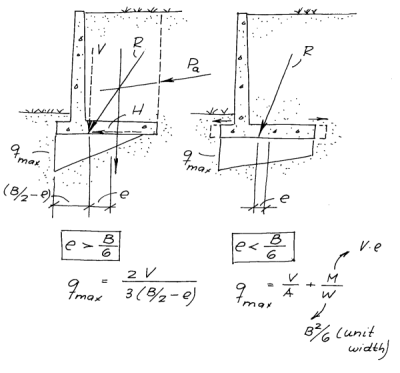
Load inclination is the result of two perpendicular loads acting on the base of the foundation. It is illustrated in the sketch at the left.

The load inclination factors are given as follows:

l_{c}=l_{q}=\left(1-\frac{\delta'}{90\textdegree}\right)^{2} (5a)

l_{\gamma}=\left(1-\frac{\delta'}{\phi'}\right)^{2} (5b)

where the load inclination angle is given as follows

\delta' = \tan^{-1}\frac{T}{N'} (6)

Substituting yields 𝞭’ = tan-1 (10,137.5 lbs/26,625 lbs) = 20.8°. The friction angle of the base soil proper is 𝟇 = 40°. Substituting into Equation (5b) yields l𝞬 = (1-20.8/40)2 = 0.23. We can neglect the factors for Equation (5a) as those terms do not apply to this situation, but for completeness lc = lq = (1-20.8/90)2 = 0.591.

Making all relevant substitutions:

  • qult = (0.5)(1)(1)(0.23)(1)(10.46)(125)(109.4) = 16,450 psf
  • Qult = qult Bf = (16,450)(10.46) = 172,067 lbs. = 172 kips
  • N =  26,625 lbs
  • FS = Qult/N = 172067/26625 = 6.46 (acceptable)

Settlement Analysis

Settlement of retaining wall is an important topic, as settlement of walls and levees has led to overtopping (as we found out the hard way during Hurricane Katrina.) Instead of picking a method and doing it “by hand,” we will use the USACOE software package CSANDSET, developed by Virginia Knowles. To accomplish this we need to do the following:

  • The foundation with we use is the reduced foundation width, or B’f = Bf – 2e = 13 – (2)(1.27) = 10.46’.
  • The normal load is N =  26,625 lbs.
  • The unit load on the foundation is thus 26625/(2000*10.46)=1.27 tsf (the units used by the program.)
  • We assume a length of 50′; this puts the L/B > 10, which is an assumption for continuous foundations.

The input data is shown in the screenshot below.
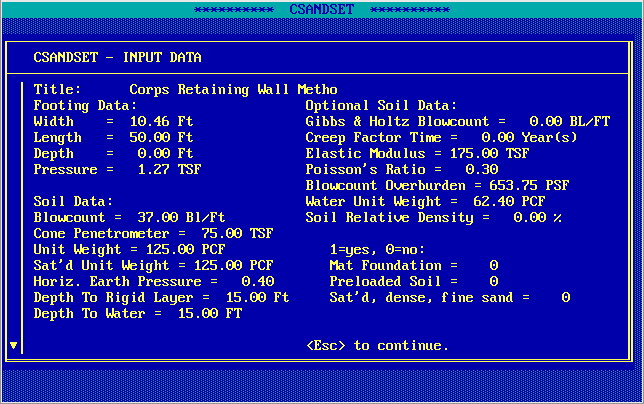
The SPT and CPT are taken from “typical” values as they were not given in the problem statement. The option data is generated by the program. The horizontal (at-rest) earth pressure is Jaky’s Equation for normally consolidated soils.

The solutions the program gives are as follows:
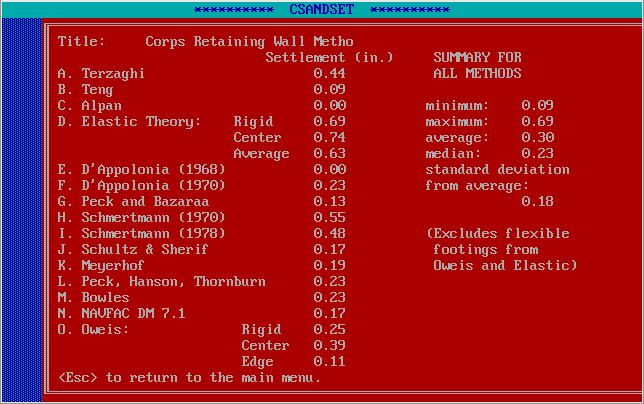
The various methods are described in the program documentation. Schmertmann’s Method is given a full description in Foundation Design and Analysis: Shallow Foundations, Settlement. Elastic methods are treated in Soil Mechanics: Elastic Solutions to Soil Deflections and Stresses and related posts. It is interesting to note the wide variance in results; this is typical of geotechnical methods in a state of flux, and can also be applied to bearing capacity of driven piles.

The supplemental data generated by the program is at the end of the post.

Dealing with Sloping Backfill
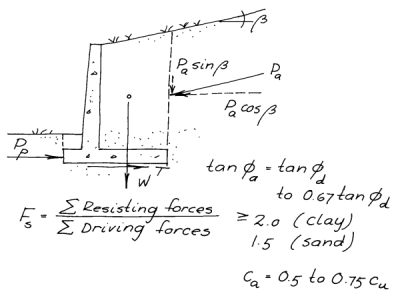
The example problem above has a level backfill. Sloping backfills–usually positive (up from the wall,) occasionally negative, are common with retaining walls. The problem of the sloping backfill is illustrated at the right.

Without going into the actual solution of the problem using a sloping backfill, the following changes must be made in order to accommodate the effects of this condition:

  • The Rankine equation for sloping backfill needs to be applied. This can be found in the post Rankine and Coulomb Earth Pressure Coefficients. The coefficient computed is actually Coulomb theory applied without wall friction; the differences between this and “extended Rankine” theory for sloping backfill are discussed in the post on the coefficients.
  • An additional region needs to be defined with the soil below the sloping backfill (assuming it’s positive) as shown in the diagram below.
  • The length a of this region is already defined. The length b is given by the equation b = a tan (β). That length is important in a) computing the weight of the region and b) computing the additional length of the height the soil bears on the wall, or H + b.
  • The backfill force must be separated into horizontal and vertical components, as shown in the diagram above. The vertical component actually increases both the weight on the foundation and the resisting moment of the weight.

Assuming a β = 10° and applying φ’mob = 25°, with the geometry shown we note the following:

  • With the two angles shown, Ka = 0.462, which is higher than the level backfill value.
  • The value of b = (8)(tan(10°))=1.41′. This means that the total height is 20 + 1.41 = 21.41′.
  • The lateral pressure at the base is (0.462)(21.41)(125) = 1236.5 psf.
  • The total lateral force on the wall Fh is (1236.4)(21.41)/2 = 13,236 lb/ft of wall. The resultant of that force is 21.41/3 = 7.14′ above the base of the foundation.
  • That lateral force has a horizontal component of (13236)(cos((10°)) = 13,035 lb/ft and a vertical component of (13236)(sin(10°)) = 2298 lb/ft. The latter has a moment arm of 13′ from the toe.
  • The area added by the sloping backfill has a weight Wba = (125)(8)(1.41)/2 = 705 lb/ft. Its centroid is located 5 + (2)(8)/3 = 10.3′ from the toe.

We will leave working out the effects of this backfill slope to the reader.

The Shear Mobilisation Factor (SMF) and Cohesive Soils

If we have soils with cohesion in the backfill, the cohesion should be modified in a similar way to the friction angle thus:

c' = c \times SMF (7)

A more complete treatment of the SMF is given in Retaining and Flood Walls.
Posted in Academic Issues, Geotechnical Engineering

The Sorry State of Compression Coefficients

I’ve dealt with the issue of consolidation extensively since my first post on the subject, From Elasticity to Consolidation Settlement: Resolving the Issue of Jean-Louis Briaud’s “Pet Peeve”. His problem was the lack of relationship between the way we handle consolidation settlement vs. elastic settlement. In this post I plan to look at a different problem, i.e. the way we express the relationship between soil pressure and consolidation settlement, or settlement by rearrangement of the particles.

Up to now…

Graphic 1

Let’s start with the diagram at the right, from Broms (as will be the case with the graphics we use.) Soil is made up of a combination of soil particles and voids between them. The voids can be filled with air, water or (God forbid) something else. For saturated soils water, for practical purposes, fills all of the voids.

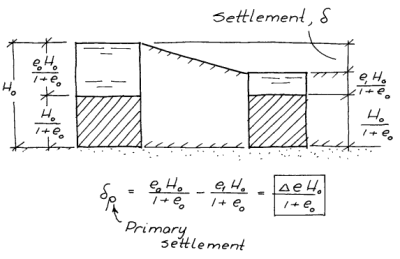
In any case, for illustrative purposes we can “melt” the solids into a continuous solid and leave the rest as a void. We assume that the solids do not compress during the application of pressure and thus their volume is constant. From the first state (on the left) to the second state (on the right) additional pressure is applied. All the change of the volume must take place in the void; the equation at the bottom is based purely on the geometry, where H_o is the height of the layer being compressed, e_o is the initial void ratio of the soil, \Delta e is the change in void ratio during compression, and \delta_p is the primary settlement of the soil.

Graphic 2

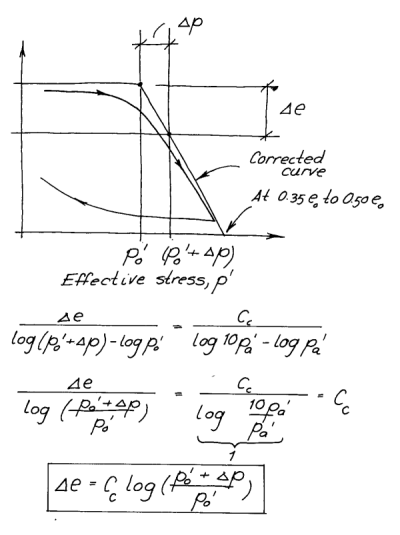
Unfortunately, as discussed elsewhere on this site, the relationship between the increase in pressure and the settlement/change in the volume of the voids isn’t linear but (empirically) logarithmic. That is shown in the graphic on the left; once the pressures get past the ambient effective stress, the settlement takes places according to the relationship shown at the bottom of the graphic. Here C_c is the compression coefficient, p'_o is the effective stress, and \Delta p is the change in pressure on the soil at a given point.

Combining the two equations in the two graphics yields the “accepted” form of the consolidation settlement equation for normally consolidated soils, thus

\delta_p = \frac{C_c H_o}{1+e_o}  \log_{10} (\frac{p'_o + \Delta p}{p'_o}) (1)

To this deceptively absolute state of affairs Verruijt has the following objections:

  • We should be using natural logarithms instead of common ones. Common logarithms date from the days when engineers used logarithmic and semi-logarithmic paper, determining C_c graphically. The compression coefficients would be changed by multiplying or dividing (depending on the form, more on that shortly) by a factor of 2.3. In an era of spreadsheets and MATLAB, natural logarithms would make more sense (and reduce student mistakes,) but I don’t see that changing.
  • We should use the strain rather than the void ratio. Actually, as Verruijt points out, this is done in Continental Europe. In the U.S. and Scandinavia, void ratio is used as the parameter of deflection. To change this would require a change in the compression coefficient, and that leads to…
  • …his preferred form of the compression equation, which would look like

\epsilon = \frac{1}{C_{10}}  \log_{10} (\frac{p'_o + \Delta p}{p'_o}) (2)

where C_{10} is another form of the compression coefficient. (Well, actually, he’d prefer natural logarithms, but as I said let’s put that aside.)

Multiplying both sides of Equation (2) by H_o gives us

\delta_p = \frac{H_o}{C_{10}}  \log_{10} (\frac{p'_o + \Delta p}{p'_o}) (3)

The two compression coefficients are related as follows:

\frac{1}{C_{10}} = \frac{C_c}{1+e_o} (4)

Actually a variant of Equation (4) finds its way into American practice in Hough’s Method for sands, which is described in the Soils and Foundations Reference Manual.

Enter NAVFAC DM 7.1

The “New” NAVFAC DM 7.1 (Soil Mechanics) is an excellent compendium of the current state of geotechnical practice relating to soil mechanics. In the process of discussing consolidation settlement, it highlights some recent changes that promise to add to the confusion described above.

For normally consolidated soils, Equations (1) and (3) are written as follows

\delta_p = C_{\epsilon c}  H_o \log_{10} (\frac{p'_o + \Delta p}{p'_o}) (5)

where C_{\epsilon c} is the modified compression index. This means that Equation (4) can be expanded as follows:

\frac{1}{C_{10}} = \frac{C_c}{1+e_o} = C_{\epsilon c} (6)

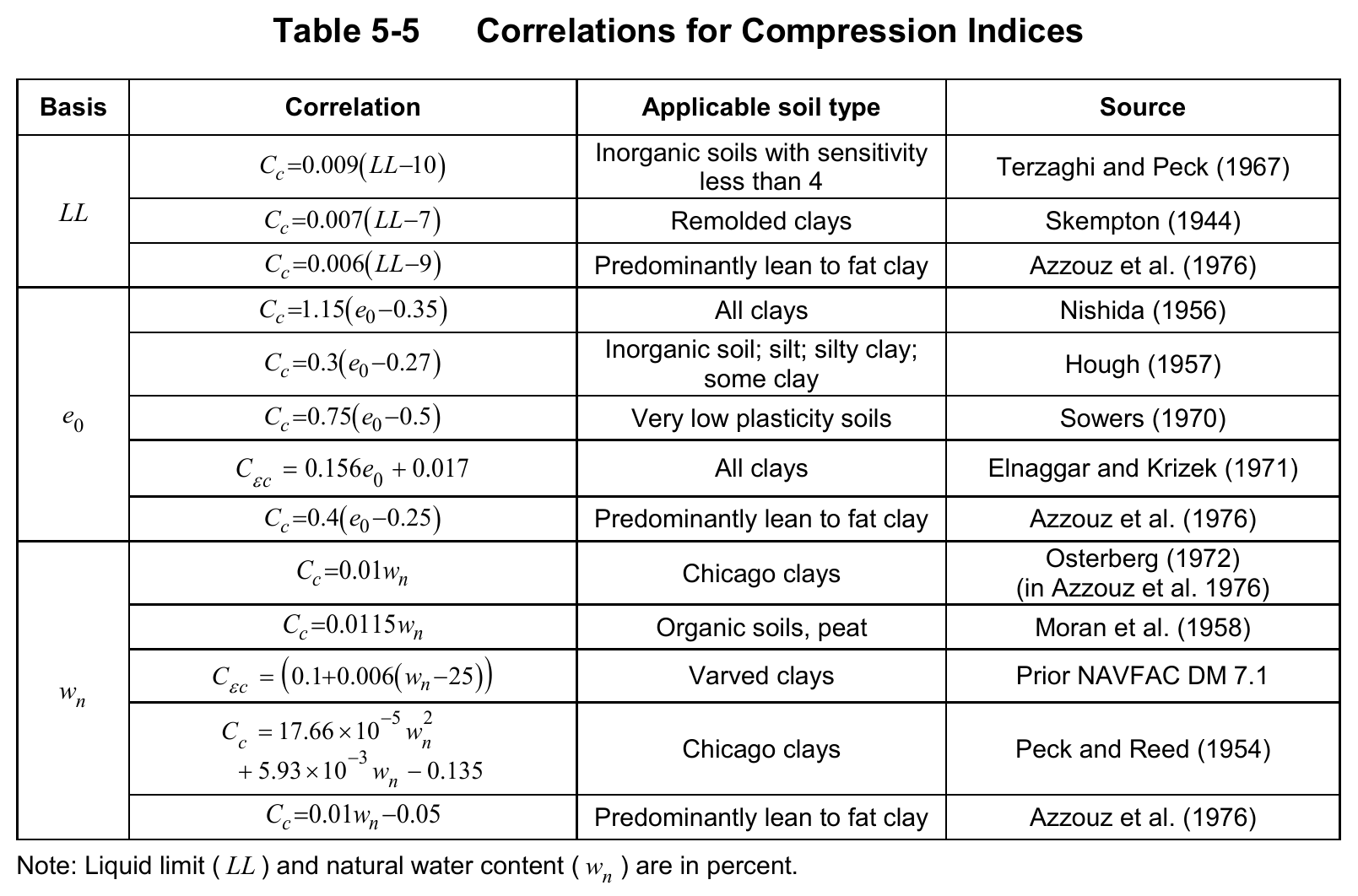
Whether we can dispense with the initial void ratio is a separate topic. Assuming that we can, what we have is a situation with three different compression coefficients, all designated with some form of C_x , and none of them the same. (If we threw in natural logarithms, we’d have six.) The potential for confusion is evident, no where than when two of the three coefficients end up in the same table:
And Secondary Compression…

Graphic 3

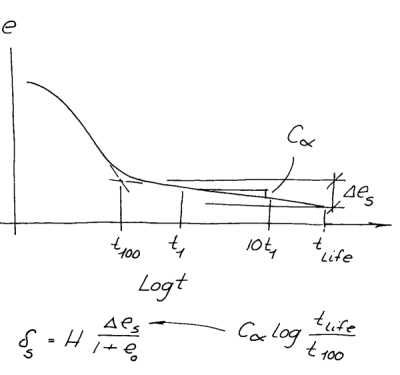
Secondary compression has had the problem for much longer. If we look at Graphic 3 on the right, we see that we have a secondary compression coefficient C_{\alpha}. The presentation is a little hard to follow but the secondary compression equation is

\delta_s = \frac{C_{\alpha}H_o}{1+e_o} \log_{10}\frac{t_{life}}{t_{100}} (7)

where \delta_s is the amount of secondary compression, C_{\alpha} is the coefficient of secondary compression, t_{life} is the life of the structure and t_{100} is the time at which 100% of primary compression has taken place. (Of course that’s a source of confusion in itself because, in theory, 100% primary compression is never achieved, something that buffaloed many of my students on a test last semester.)

However, as NAVFAC DM 7.1 points out, we can also write this as

\delta_s = C_{e \alpha}H_o \log_{10}\frac{t_{life}}{t_{100}} (8)

where the modified secondary compression coefficient is

C_{e \alpha} = \frac{C_{\alpha}H_o}{1+e_o} (9)

So what is to be done?

My advise to students and practitioners alike is to be vigilant and careful. Make sure you understand which coefficient is being called for. For software, make sure you completely understand which coefficient is being used by the software; otherwise, you will have the classic “garbage in/garbage out” result. Verruijt hoped that we would come to uniform practice but we can’t wait for this; we have to get our work done, and we need to do it carefully.

Posted in Deep Foundations, Geotechnical Engineering

Can Any Alpha Method be Converted to a Beta Method?

It’s been a favourite topic of this site to consider the issue of alpha vs. beta methods for deep foundations (both driven and bored piles.) In our post Shaft Friction for Driven Piles in Clay: Alpha or Beta Methods? we show that the Kolk and van der Velde method for driven piles in clay can be converted from an alpha method to a beta one by some simple math. The key to this success is that the ratio of undrained shear strength to effective stress is at the core of the method.

If we want to simplify things further, we can consider this, from the “new” NAVFAC DM 7.1, originally from Skemption:

\frac{c}{\sigma'_o} = 0.11+0.0037PI (1)

where

  • c = undrained shear strength of the soil
  • \sigma'_o = vertical effective stress of the soil
  • PI = plasticity index of the soil

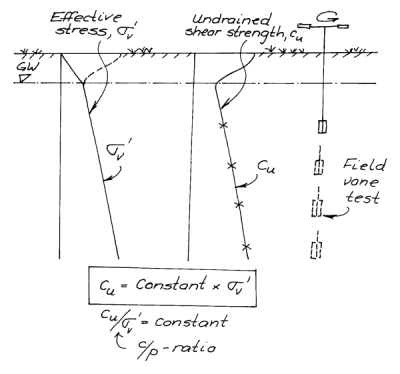
The relationship between undrained shear strength and vertical effective stress in a qualitative sense is illustrated by the diagram at the right, from Broms.

Substituting this into our derived value for \beta in the Kolk and van der Velde method yields

\beta = 0.9 (\frac{L-z}{d})^{-0.2}(0.11+0.0037PI)^{0.7} (2)

where

  • \beta = ratio of the vertical stress to the horizontal friction on the pile shaft
  • L = length of the pile
  • z = distance from the soil surface
  • d = diameter of the pile

This makes the \beta factor simply a function of the pile geometry and the plasticity index at a depth z .

But can this be done for methods where the relationship between undrained shear strength and the effective stress? The answer is “sort of,” and this post will explore that possibility.

Let us consider an example from the Dennis and Olson method for driven piles. It is a classic “alpha-beta” type of formulation; we will only consider the alpha method portion of the method. For a beta method to be equivalent to an alpha method, the following must hold:

f_s = \alpha c = \beta \sigma'_o (3)

We should note that, for the beta side of the method,

\beta = F_{SD} K \tan \delta (4)

where

  • F_{SD} = geometry factor based on the aspect ratio of the pile
  • K = lateral earth pressure coefficient
  • \delta = friction angle of the pile-soil interface

We will not consider this computation further, but only assume that

f_s = \beta \sigma'_o (5)

For the shaft resistance in clay

f_s = \alpha \overline{c} F_c F_L (6)

The two F constants are defined in the original monograph. The relationship between \alpha and c F_c is shown below.

Figure 1 Relationship of c Fc with alpha for Dennis and Olson Method

This is more complicated than, say the O’Neill and Reese method for drilled shafts. But the idea is the same. Our goal is basically to convert the values of alpha (where c is an independent variable) to use as a beta method.

We start by modifying Equation (3) for the Dennis and Olson method thus:

f_s = \alpha \overline{c} F_c F_L = \beta \sigma'_o (7)

Solving for \beta ,

\beta = \frac {\alpha \overline{c} F_c F_L}{\sigma'_o} (8)

Substituting Equation (1) into Equation (8) yields

\beta=\alpha\,\left ( .11+ .0037\,{\it PI}\right ){\it F_c}\,{\it F_L} (9)

The remaining difficulty is that \alpha is a function of c . This can be dealt with by manipulating Equation (1) to read

\overline c = (0.11+0.0037PI)\sigma'_o (10)

in which case

\overline c F_c = (0.11+0.0037PI)\sigma'_o F_c (11)

The left hand side is the independent variable of the graph above; the right hand side can be computed to substitute for that same independent variable.

Let us consider an example, namely the one used in the Dennis and Olson example:

Figure 2 Example Problem

The problem here is that we are given an undrained shear strength value for the clay layer but not a plasticity index. We are given a unit weight for the clay layer (not automatic for problems like this.) So we can compute the ratio of the undrained shear strength to the effective stress. For the top layer, the midpoint effective stress is 900 psf, and the undrained shear strength 2000 psf. The ratio is thus 2000/900 = 2.22. From Equation (1), the plasticity index is about 571. This, of course, is highly unlikely, and illustrates an important point about academically formulated problems: they’re not always realistic in their parameters. For the effective stress levels we have, it is likely that the undrained shear strength needs to be considerably lower than is given in the problem.

In any case substituting F_c and \sigma'_o from the original data and PI from the current data yields c F_c = 1400\,psf , which is the same as the original. From here we can compute \alpha = 0.49 and, substituting into Equation (9), we obtain \beta = 0.76 . Multiplying this by the effective stress of 900 psi yields the same result of f_s = 685\,psf .

Conclusion

  • Getting rid of \alpha altogether is hampered by the fact that there is not an analytic function for \alpha in the first place. The Dennis and Olson method is not unique in this regard.
  • For methods such as Kolk and van der Velde where the ratio of undrained shear stress and vertical effective stress are important parts of the method, applying correlations such as Equation (1) is fairly simple. When this is not the case then things are more complicated.
  • Using Equation (1) is doubtless a good check on values of c , which when applied in an alpha method implicitly contains the effects of effective stress.
  • Going forward, probably the best way to “close the loop” and make all methods beta methods is to formulate the method for clays in terms of \frac {c}{\sigma'_o} as is the case with Kolk and van der Velde. Doing this would be an important step in moving static methods forward.
Posted in Academic Issues, Geotechnical Engineering

Strange Results: The Case of Settlements on Non-Infinite Elastic Half Spaces and Flexible Foundations

In our earlier post Analytical Boussinesq Solutions for Strip, Square and Rectangular Loads we discussed the stress under and settlement of foundations (mostly flexible) on a semi-infinite half space.  Usually, though, a hard/competent layer intervenes to mess things up.  Some of the books offered on this site–in print and download–have solutions for this problem. Unfortunately unexpected things happen when we consider these things carefully.

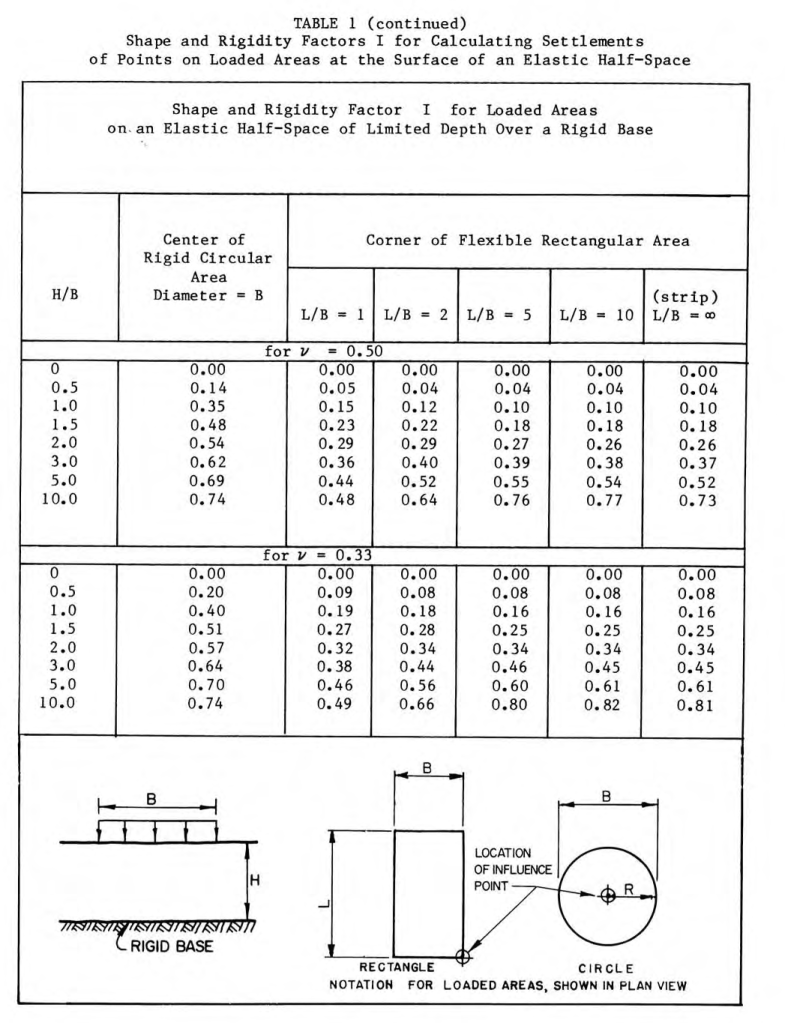
To illustrate this, let’s start with the table and diagram below, from NAVFAC DM 7.01.

Table 1. Shape and Rigidity Factors I for Calculating Settlements of Points on Loaded Area at the Surface of a Limited Elastic Half-Space (from NAVFAC DM 7.01)

The settlement at the centre of the full foundation (sum of the corners of the divided foundation, see below) is given by the equation

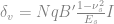
\delta_v = NqB' \frac {1-\nu_s^2}{E_s} I (1)

where

  • N = number of partial foundations used to compute total settlement (with centre settlements, usually N = 4
  • q = uniform load on foundation
  • B' = small dimension of partial foundation
  • \nu_s = Poisson’s Ratio of soil
  • E_s = Young’s Modulus of soil
  • I = influence coefficient

Note that we’re now dealing with settlements.  The soil being compressed is limited to a height H from the surface to the “rigid base.”  In this diagram we do this corner by corner, as we did for the stresses in Analytical Boussinesq Solutions for Strip, Square and Rectangular Loads.  In both this and Going Around in Circles for Rigid and Flexible Foundations we used another chart, which is shown below.

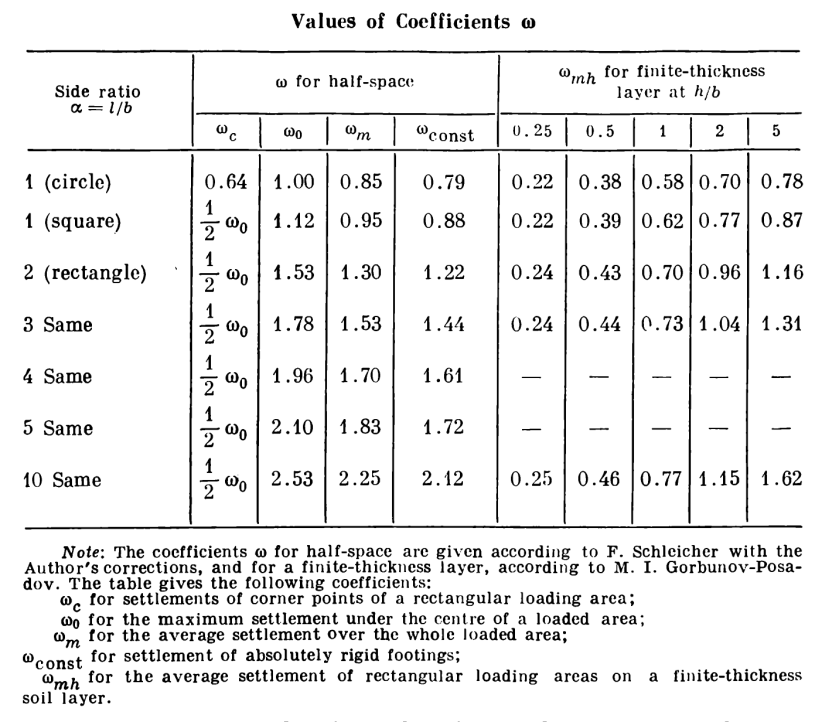
Table 2. Values for the influence coefficients omega (from Tsytovich (1976))

The two charts differ as follows:

  • Both use Equation (1), albeit differently, as described immediately below.
  • The basic formula is the same but the influence coefficient notation is different; the DM 7.01 chart uses I while the Tsytovich chart uses \omega .
  • The settlement is presented differently; the DM 7.01 chart shows it at the centre of the circular foundation and the corner of the rectangles while the Tsytovich charts shows an average settlement. For the Tsytovich chart, the dimension B’ should be replaced by b, the full small dimension of the foundation, and L’ by l, the full large dimension of the foundation. In this case \alpha = \frac{l}{b} .

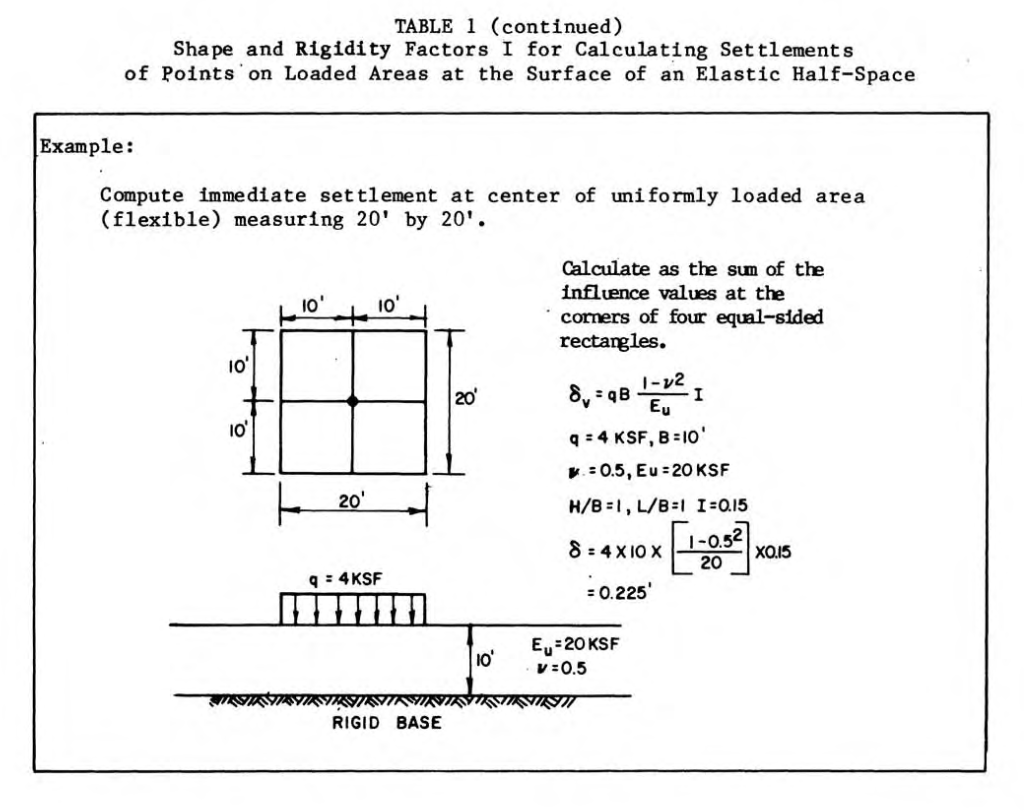
Let us look at an example, from NAVFAC DM 7.01.

Table 3. Example of Shape and Rigidity Factors I for Calculating Settlements of Points on Loaded Area at the Surface of an Elastic Half-Space (from NAVFAC DM 7.01)

As was the case with the stresses in Analytical Boussinesq Solutions for Strip, Square and Rectangular Loads, we use the corners and divide up the entire foundation into four (4) identical foundations.  The influence coefficients shown in the DM 7.01 chart above are used. The maximum deflection (at the centre) is thus four times the partial corner deflections.

Here’s where we run into the first problem: the example is wrong because it only considers the corner deflection of one partial foundation.  The problem statement implies that, if we add all four partial foundations touching the corners of the partial foundations (which are all at the centre of the full one) we would get the complete settlement at the centre.  Doing this yields \delta_{tot} = 4 \times 0.225 = 0.9' .

If we use the Tsytovich chart we can compute the average deflection of the foundation, and we can use the entire foundation at one time.  We first note that \alpha = \frac{l}{b} = \frac{20}{20} = 1 .  We then note that \frac{h}{b} = \frac{10}{20} = 0.5 .  From the Tsytovich chart \omega_{mh} = 0.39 and the settlement as follows:

\delta_{mh} = 4 \times 20 \times \frac{1-0.5^2}{20} \times 0.39 = 1.17' (2)

Although “average” results can be different based on the method of averaging (something students frequently overlook,) it makes sense that a average result should be somewhat below the deflection at the centre.  That’s not the case here.

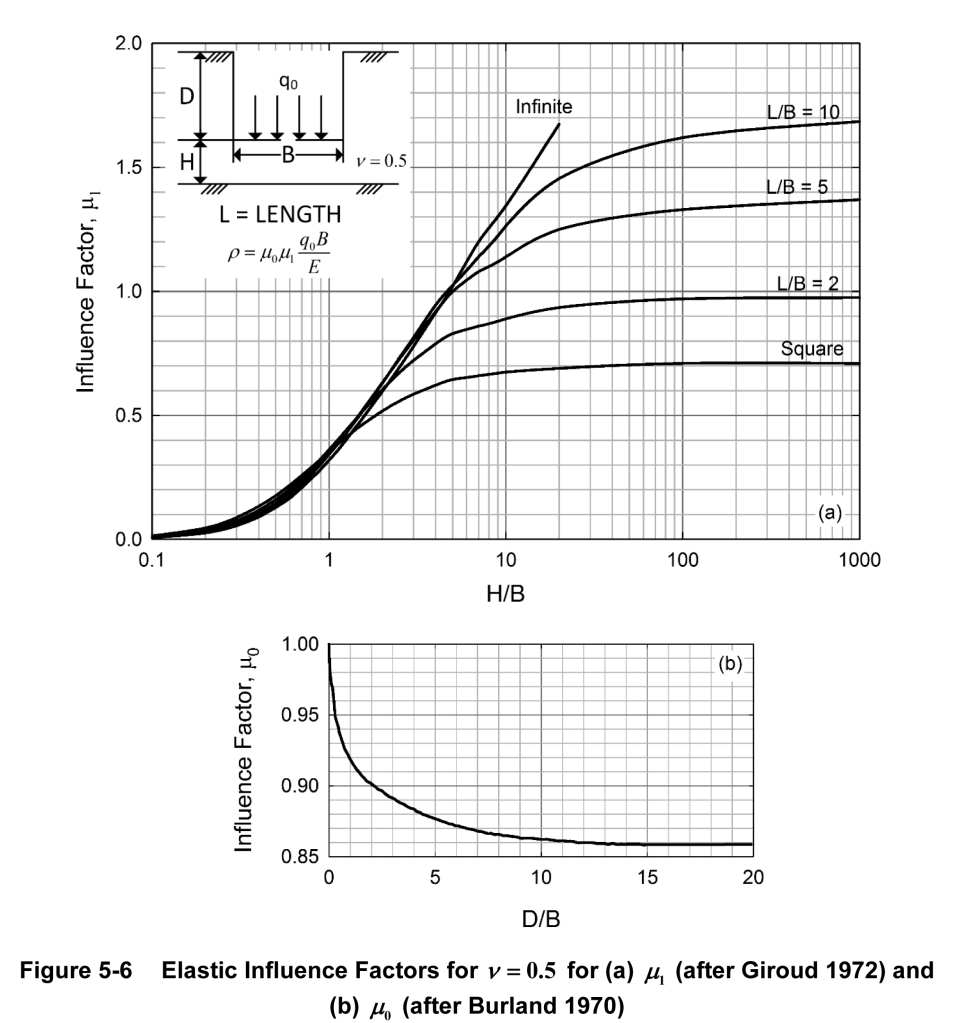
So let’s turn to the newer NAVFAC DM 7.1.  They replaced the above chart with the following for settlements:

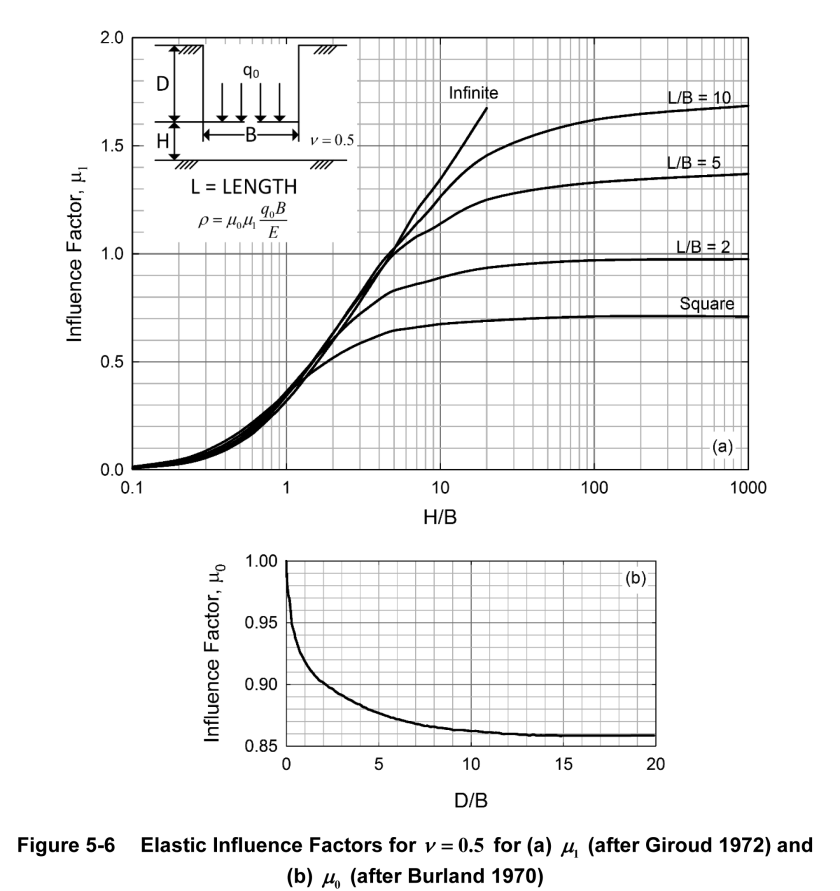
Figure 1. Elastic Influence Factors for Poisson’s Ratio = 1/2.  (a) for mu1, (b) for mu0.

To start with, Figure 5-6 (and the accompanying text) really don’t say whether it’s settlement at the corners, centre or an average settlement.  Giroud (1972), the source of Figure 5-6a, does say that it is a corner settlement similar in concept to the old DM 7.01, but the new document does not make this clear. From this, H/B = 10/10 = 1 and L/B = 1.  Looking at the chart \mu_1 = 0.35 and summing the corner displacements of the partial foundations,

\rho = 4 \times 1 \times 0.35 \times \frac {4 \times 10}{20} = 2.8' (3)

This is significantly different than the old DM 7.01. It is larger than the average settlement shown in the Tsytovich table. But can it be checked against another method?

The answer is “yes,” and to do so we turn to Das (2007). Let us begin by defining the reduced foundation dimensions as B’ and L’, which are obviously half each of B and L. The displacement at the centre of the foundation (the corners of the reduced foundations added together) is thus

\delta_v = NqB' \frac {1-nu_s^2}{E_s} I_s I_f (4)

In this case there are two influence factors, and they correspond with those given in NAVFAC DM 7.1 Figure 5-6: I_s with \mu_1 and I_f with \mu_0 . We can dispense with the latter by noting that, for the case with no embedment (D_f = 0 ,\,I_f = 1 in a similar way to \mu_0 above. (Das gives charts, which we do not reproduce here.) Let us then define

m = \frac{L'}{B'} (5)

and

n = \frac{H}{B'} (6)

Using these ratios, we can define two quantities

F_1 = \left(m\ln ({\frac {\left (1+\sqrt {{m}^{2}+1}\right )\sqrt {{m}^{2}+{n}^{2}}}{m\left (1+\sqrt {{m}^{2}+{n}^{2}+1}\right )}})+\ln ({\frac {\left (m+\sqrt {{m}^{2}+1}\right )\sqrt {1+{n}^{2}}}{m+\sqrt {{m}^{2}+{n}^{2}+1}}})\right){\pi }^{-1} (7)

F_2 = 1/2\,n\arctan({\frac {m}{n\sqrt {{m}^{2}+{n}^{2}+1}}}){\pi }^{-1} (8)

From these quantities,

I_s = F_1 + \frac{2-\nu}{1-\nu}F_2 (9)

For our example m = 10/10 = 1 and n = 10/10 = 1. For \nu = 0.5 (problem statement,) substituting and solving into Equations (4-8) yields the following:

  • F_1 = 0.142
  • F_2 = 0.083
  • I_s = 0.392

Substituting this yields 2.352′, which is reasonably close to the NAVFAC DM 7.1 solution, and still greater than the solution from Tsytovich.

Notes

  • The NAVFAC DM 7.1 solution is restricted to values of $\nu = 0.5 $. This is unreasonable; this assumes that the soil is a fluid. It also created a singularity in The Equivalent Thickness Method for Estimating Elastic Settlements.
  • This shows that even with as venerable a document as NAVFAC DM 7.01 errors can arise, and this should be considered with any book or paper. It also shows that, even with a “cut and dried” topic like theory of elasticity, variations can arise.
  • All of these solutions are shown in our Elastic Solutions Spreadsheet.
  • The charts in Das for I_f = \mu_0 are similar to the second chart in Figure 1, except that they vary for Poisson’s Ratio and the aspect ratio for the foundation.
References

  • Das, B.M. (2007) Principles of Foundation Engineering. Sixth Edition. Toronto, Ontario: Thompson.
  • Giroud, J.-P. 1972. “Settlement of Rectangular Foundation on Soil Layer.” Journal of the Soil Mechanics and Foundations Division, 98(SM1), 149-154.
Posted in Academic Issues, Geotechnical Engineering

The Equivalent Thickness Method for Estimating Elastic Settlements

In our very popular post Analytical Boussinesq Solutions for Strip, Square and Rectangular Loads we discuss the use of the theory of elasticity (as originally formulated by Boussinesq) to estimate the stresses and settlements under foundations. We start by giving methods of estimating the stresses under various configurations of rectangular foundations (the circular ones are discussed in the post Going Around in Circles for Rigid and Flexible Foundations.) We then show the use of superposition to expand the use of these results for complex foundations (with further discussion in our post Superposition, and Using Point Loads in Place of Distributed Ones.) We then show the estimation of deflections for simple rigid and flexible foundations. But when it comes to deflections for more complex situations…crickets.

This post is an attempt to solve the “crickets” problem through the use of a method shown in Tsytovich (1976). It’s doubtless useful for preliminary calculations and to enhance our understanding of how settlements of foundations in one place can affect adjacent structures. It also uses some of the linkage between elastic and consolidation settlement theory which is discussed in From Elasticity to Consolidation Settlement: Resolving the Issue of Jean-Louis Briaud’s “Pet Peeve”.

Let us start with Equation (4) of the last linked post, namely

\epsilon_{{x}}={\frac {p\beta}{E}} (1)

where we swap p for \sigma_x as the vertical pressure.

Now let us define an equivalent height heq. Keep in mind that we are assuming that the soil’s reaction to vertical pressure is that of a laterally confined specimen; the equivalent height is the height of that equivalent specimen. Multiplying both sides of Equation (1) by this equivalent height,

h_{{{\it eq}}}\epsilon_{{x}}={\frac {h_{{{\it eq}}}p\beta}{E}} (2)

Since by definition

\epsilon_x = {\frac {s}{h_{{{\it eq}}}}} (3)

where s is the settlement, Equation (1) becomes

s={\frac {h_{{{\it eq}}}p\beta}{E}} (4)

Equation (7) of the last linked post tells us that

E={\frac {\beta}{m_{{v}}}} (5)

where

\beta = 1-2\,{\frac {{\nu}^{2}}{1-\nu}} (7)

Combining Equations (4) and (5) yields

s=h_{{{\it eq}}}pm_{{v}} (8)

To compute the equivalent height, we turn to our post Analytical Boussinesq Solutions for Strip, Square and Rectangular Loads, where we modify the equation presented for the deflection of rectangles and squares with Equation (5) above to obtain

s={\frac {\omega\,pb\left (1-{\nu}^{2}\right )m_{{v}}}{\beta}} (9)

The value of \omega is discussed in that post for squares and rectangles and for circles in Going Around in Circles for Rigid and Flexible Foundations. These are very complex (and in the case of circles have no closed form solution.) For convenience the table for these is reproduced below.

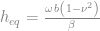
If we equate the right hand sides of Equations (8) and (9) and solve for heq, we have at last

h_{eq} = {\frac {\omega\,b\left (1-{\nu}^{2}\right )}{\beta}} (10a)

We can also substitute Equation (7) into Equation (10a) and obtain

h_{eq} = {\frac {\left (-1+\nu\right )^{2}b\omega}{1-2\,\nu}} (10b)

If we define

A = {\frac {\left (1-\nu\right )^{2}}{1-2\,\nu}} (10*)

we can also write the equation thus

h_{eq} = A\omega b (10c)

It should be evident that there are several computational routes to obtain the equivalent height, which is then substituted into Equation (8) to obtain the settlement. Let us consider these options:

  • We could tabulate values of A \omega for various foundation configurations and then use these to compute the equivalent height using Equation (10c). This is given in Tsytovich (1976).
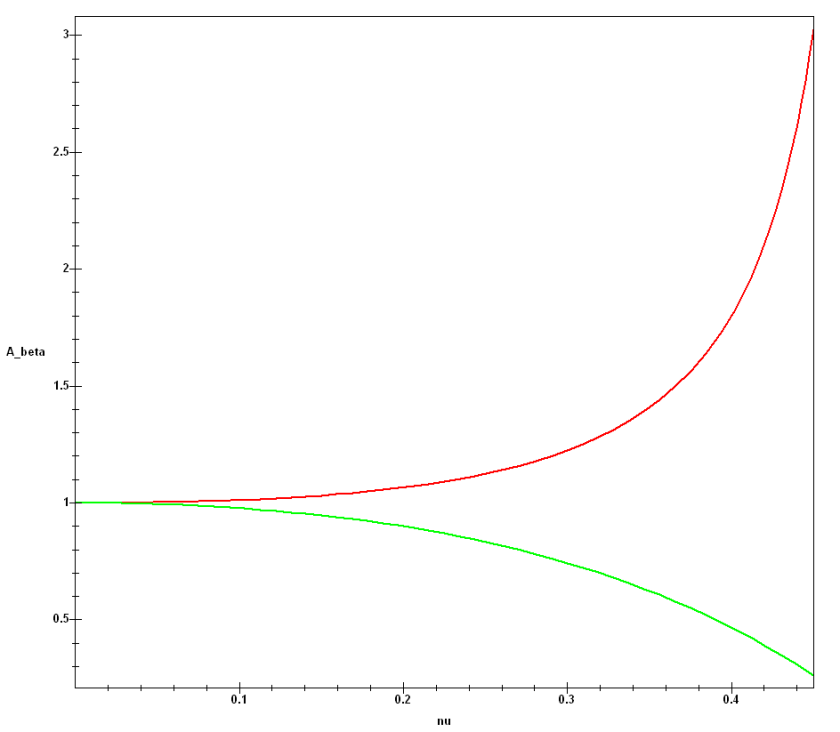
  • We could determine values for A (it is simply a function of Poisson’s Ratio \nu ), obtain \omega using the table above and then compute the equivalent height using the width of the foundation b . Values for both A and \beta are shown in graphical form as a check for computations.
  • We could perform direct substitution into Equations (10a) or (10b.) Equation (10a) is probably the best as it will be necessary to compute \beta using Equation (7).
Parameters for Tsytovich Equivalent Thickness Method as a function of Poisson’s Ratio. The red line is the parameter “A” and the green line is the parameter “β”.

Worked Example

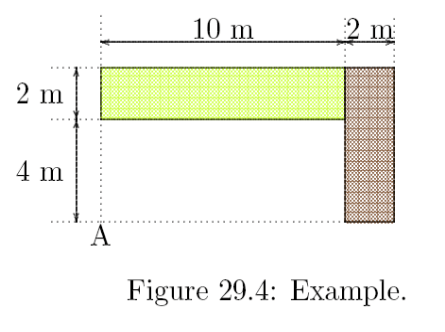
As an example, let us consider the same example from the post Analytical Boussinesq Solutions for Strip, Square and Rectangular Loads. The foundation diagram is shown below; we are interested in the settlement at Point A.

The complete solution is given in the same spreadsheet as the solution for the stress problem, which you can access here. The geometry is the same and the loading is the same: 5 kPa on the yellow (2 m x 10 m foundation) and 15 kPa on the brown foundation (2 m x 6 m.) Keep in mind that, for this method, the value b is always the smaller of the two, and that goes for the “void” foundations as well.

We do not need the depth from the surface; we are only interested in surface deflections. We do need the elastic modulus and Poisson’s Ratio of the soil, which are E = 10,000 kPa and ν = 0.25.

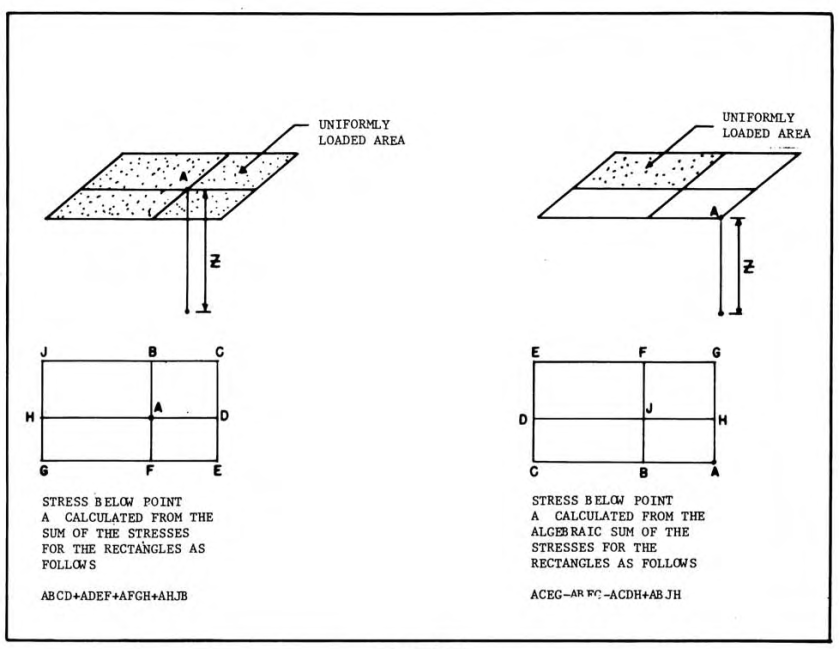
The superposition is exactly the same as before, using the following diagram as before:

The superposition scheme is as follows:

  • Yellow Foundation Positive, corners ABFG, pressure +5 kPa
  • Yellow Foundation Negative, corners ABJH, pressure – 5kPa
  • Brown Foundation Positive, corners ACEG, pressure +15 kPa
  • Brown Foundation Negative, corners ABFG, pressure – 15 kPa

We will only go through the calculations for the first one; you can view the spreadsheet for the rest. We proceed as follows:

  • We compute A and β as follows:
    • From Equation (10*), A = (1-0.25)2/(1-(2)(0.25)) = 1.125
    • From Equation (7), β = 1-(2)(0.25)2/(1-0.25) = 0.833
    • You can verify these using the plot of these parameters.
  • We compute the coefficient of volume compressibility by using Equation (5), mv = 0.833/10000 = 0.0000833 1/kPa
  • We compute the value of α = l/b = 10/6 = 1.6667
  • We compute the corner value for ω (since we are dealing with corners as was the case with stresses.) We can use the table for ω or we can compute it using the formulae from Analytical Boussinesq Solutions for Strip, Square and Rectangular Loads, but it is ω = 0.71.
  • We then use Equation (10c) to compute the equivalent height, thus heq = (1.125)(0.71)(6) = 4.8 m. This value will be different for each corner point considered.
  • Using Equation (8), the settlement for this portion of the analysis is s = (4.8)(5)(0.000083333) = 0.002 m = 1.998 mm.

You repeat this process for all four “foundations.” Keep in mind that the negative foundations will result in negative settlements. A summary of the results is as follows:

Yellow Foundation
RectangleB, mL, malphaomega (corner)heq, mPressure p, kPaDeflection, mm
ABFG (+)6101.66670.714.805.001.998
ABJH (-)4102.50000.833.76-5.00-1.565
Total0.433
Brown Foundation
RectangleB, mL, malphaomega (corner)heq, mPressure p, kPaDeflection, mm
ACEG (+)6122.00000.775.1715.006.462
ABFG (-)6101.66670.714.80-15.00-5.994
Total0.468
Complete Total0.901