Posted in Geotechnical Engineering, Soil Mechanics

p-q Diagrams and Mohr-Coulomb Failure

Students and practicioners of soil mechanics alike are used to seeing triaxial test results that look like this (from DM 7.01):

DM7 Triaxial Test Mohr-Coulomb Diagrams

Ideally, the Mohr-Coulomb failure line should be straight, but with real soils it doesn’t have to be that way.  With the advent of finite element analysis we also have the failure function to consider, thus (from Warrington (2016)):

Dissertation Presentation_Page_28

All of these involve constructing (or using) a line which is tangent to a circle at failure.  This can be confusing to understand completely.  The biggest problem from a “newbie” standpoint is that the maximum shear defined by the circle of stress (its radius) and the failure shear stress defined by the intersection of the circle with the Mohr-Coulomb failure envelope are not the same.
nhi16072-1

Is there a better graphical way to represent the interaction of stresses with the Mohr-Coulomb failure criterion?  The answer is “yes” and it involves the use of p-q diagrams.  These have been around for a long time and are used in such things as critical state soil mechanics and stress paths.  A broad explanation of these is found in our new publication, Geotechnical Site Characterization.  The purpose of this article is to present these as a purely mathematical transformation of the classic Mohr-Coulomb diagram.  This is especially important since their explanation is frequently lacking in textbooks.

The Basics

Consider the failure function, which is valid throughout the Mohr-Coulomb plot.  It can be stated as follows:

f=\sigma_{{1}}-\sigma_{{3}}-2\,c\cos(\phi)-\left (\sigma_{{1}}+\sigma_{{3}}\right )\sin(\phi)

(The main difference between the two formulations is multiplication by 2; the failure function can either be diametral or radial relative to Mohr’s Circle.  With a purely elasto-plastic model, the results are the same.)
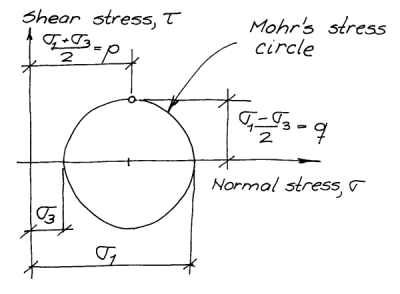
Now let us define the following terms:

p=1/2\,\sigma_{{1}}+1/2\,\sigma_{{3}}

q=1/2\,\sigma_{{1}}-1/2\,\sigma_{{3}}

We should also define the following:

\sin(\phi)=\tan(\delta)

The physical significance of the last one is discussed in this post.  In any case we can start with \phi and solve for \delta or vice versa.  Solving for \phi and substituting this and the equations for p and q into the failure functions yields

f=2\,q-2\,c\sqrt {1-\left (\tan(\delta)\right )^{2}}-2\,p\tan(\delta)

For the failure line, f = 0 .  Let us set the p axis as the abscissa (x-axis) and the q axis as the ordinate (y-axis.)  For the failure line, if we substitute for f and solve for q, we have

q = p\tan(\delta) + c\sqrt {1-\left (\tan(\delta)\right )^{2}}

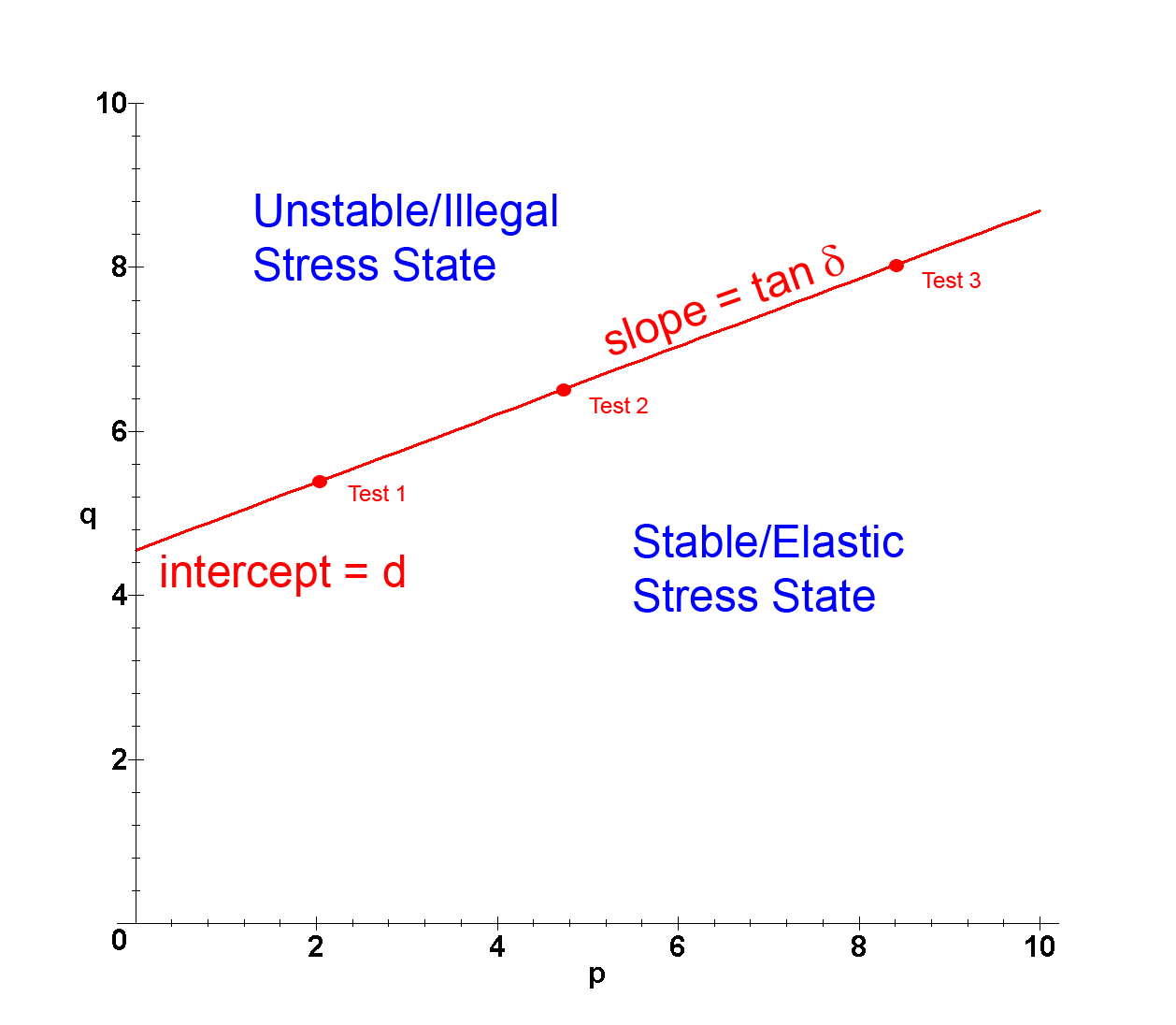
This is a classic “slope-intercept” form like y = mx + b , where in this case q = mp + b , m = \tan(\delta) and b = c\sqrt {1-\left (\tan(\delta)\right )^{2}} .  A sample plot of this kind is shown below.

p-q-diagram-illlustration

Some Observations

  1. For the case of a purely cohesive soil, where \phi = \delta = 0 , the failure envelope is horizontal, just like with a conventional Mohr-Coulomb diagram.
  2. For the case of a purely cohesionless soil, where c = 0 , the y-intercept is in both cases through the origin.
  3. The two diagrams are thus very similar visually, it’s just that the p-q diagram eliminates the circles and tangents, reducing each case to a single point.

Examples of Use

Drained Triaxial Test in Clay

Consider the example of a drained triaxial test in clay with the following two data points:

  1. Confining Pressure = 70 kPa; Failure Pressure = 200 kPa.
  2. Confining Pressure = 160 kPa; Failure Pressure = 383.5 kPa.

Determine the friction angle and cohesion using the p-q diagram.

We first start by computing p and q for each case as follows:

  • p_1 = 200/2+70/2 = 135\,kPa
  • p_2 = 383.5/2 + 160/2 = 271.75\,kPa
  • q_1 = 200/2-70/2 = 65\,kPa
  • q_2 = 383.5/2 - 160/2 = 111.75\,kPa

The slope is simply

m = \frac {q_2 - q_1}{p_2 - p_1} = \frac {111.75 - 65}{271.5 - 135} = 0.342 = \tan(\delta)

from which

\delta = 18.9^o

\phi = sin^{-1}(tan(\delta)) = sin^{-1}(0.342) = 20.03^o

b = q - mp = 65 - 0.342 \times 135 = 18.83 (using values from the first point, just as easy to use the second one.)

b = c\sqrt {1-\left (\tan(\delta)\right )^{2}} = c \sqrt {1-0.342^{2}} = 0.94 c

b = 18.83 = 0.94 c

c = 20.03\,kPa

Use of this method eliminates the need to solve two equations in two unknowns, and the repetition of the quantity tan(\delta) makes the calculations a little simpler.  When c = 0 , the calculations are even simpler, as p_1 = q_1 = 0 .

Example from Soils in Construction

Another example of this comes from the textbook Soils in Construction. Things are a little trickier because of the book’s notation but we’ll work through that.

Consider a two-triaxial test result as follows:

  • p1 = 295 kPa, p3 = 20 kPa
  • p1 = 329 kPa, p3 = 40 kPa

The problem here is immediately apparent: Soils in Construction uses p as its variable for soil pressures and stresses. We’ll get around the subscript issue by designating the two p and q values as a and b respectively.

That disposed of, we can compute these as follows:

  • p_a = \frac{295+20}{2} = 157.5\,kPa
  • p_b = \frac{329+40}{2} = 184.5\,kPa
  • q_a = \frac{295-20}{2} = 137.5\,kPa
  • q_b = \frac{329-40}{2} = 144.5\,kPa

The slope is simply

m = \frac {q_b - q_a}{p_b - p_a} = \frac {144.5-137.5}{184.5-157.5} = 0.259 = \tan(\delta)

from which

\delta = 14.5^o

\phi = sin^{-1}(tan(\delta)) = sin^{-1}(0.259) = 15^o

b = q - mp = 137.5 - 0.259 \times 157.5 = 96.7 (using values from the first point, just as easy to use the second one.)

b = c\sqrt {1-\left (\tan(\delta)\right )^{2}} = c \sqrt {1-0.259^{2}} = 0.966 c

b = 96.7 = 0.966 c

c = 100\,kPa

Although there are several steps, there is no need to solve two equations simultaneously, as is the case in the book.

Stress Paths

As mentioned earlier, p-q diagrams are commonly used with stress paths.  An example of this from DM 7.01 is shown below.

DM7 Triaxial Test Stress Path Diagram

We note that p and q are defined here exactly as we have them above.  (That isn’t always the case; examples of other formulations of the p-q diagram are here.  We should note, however, that for this diagram \phi" = \delta )  With this we can track the stress state of a sample from the start (where the deviator stress is zero, at the start of the triaxial test) around to its various points of stress.

As an example, consider the stress path example from Verruijt, A., and van Bars, S. (2007). Soil Mechanics. VSSD, Delft, the Netherlands.  The basic data from Test 1 are below:

\sigma_3 Deviator StressPore Water Pressure
4000
40104
40209
403013
404017
405021
406025

Using the p-q diagram and performing some calculations (which are shown in the spreadsheet Stress Paths Verruijt Example)  the stress paths can be plotted as follows:
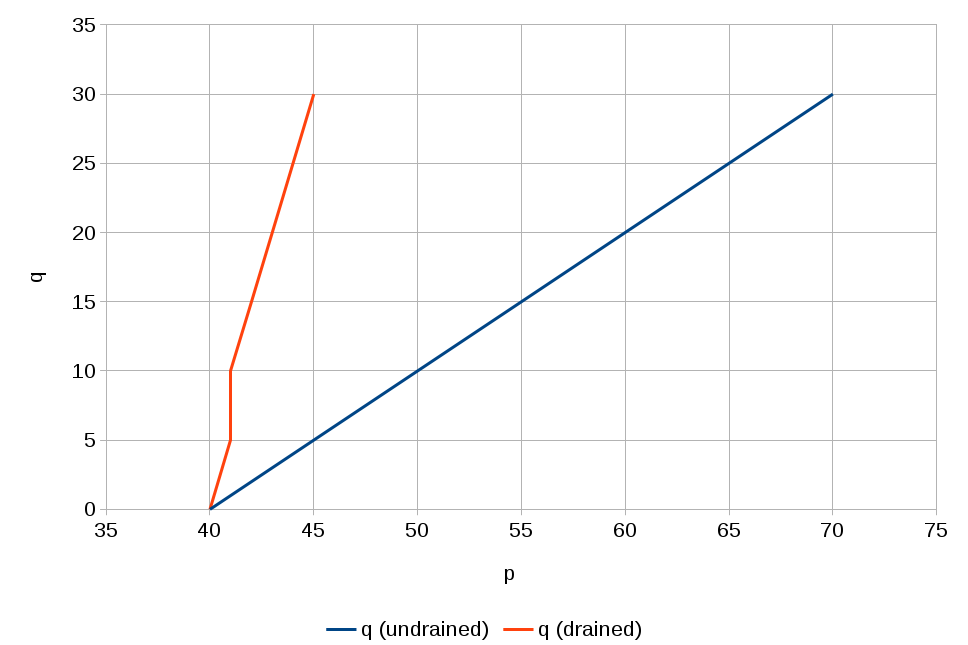
It’s worth noting that the q axis is unaffected by the drainage condition because the pore water pressures cancel each other out.  Only the p-axis changes.

Conclusion

The p-q diagram is a method of simplifying the analysis of triaxial and other stress data which are commonly used in soil mechanics.  It can be used in a variety of applications and solve a range of problems.
Posted in Deep Foundations, STADYN

Inverse Method for Pile Dynamics Using a Polytope Method: IFCEE 2018

This paper–which is part of the STADYN project–was presented at the IFCEE 2018 conference in Orlando, FL, 7 March 2018. The slide presentation for the paper is below.


This slideshow requires JavaScript.

The preprint for this paper can be found at ResearchGate.

Posted in Soil Mechanics

Computing Pore Water Pressure and Effective Stress in Upward (and Downward) Flow in Soil

Water flow through soil–and the whole subject of permeability–is one of those topics that tends to mystify students in undergraduate soil mechanics courses.  This article will deal with one type of flow–flow that is purely vertical, downward or upward–and show how it is possible to compute the pore water pressure and effective stress in soils with vertical water flow.

Hydrostatic Case

We’ll start with the hydrostatic case, classic in the determination of effective stresses in many soil strata.  The pore water pressure is computed by the equation usually written in this way:

u=\gamma_w z (1)

where u is the pore water pressure, \gamma_w is the unit weight of the water, and z is the distance from the phreatic surface/water table, where by definition z = 0 .

Let us write this equation more generally, thus

\Delta u=\gamma_w \Delta z (2)

where \Delta u is the change in the pore water pressure from some elevation 1 in the soil to some other elevation 2 in the soil, and \Delta z is the change in elevation from point 1 to point 2.  As a condition, since z is positive in the downward direction, \Delta z is likewise positive in the downward direction.

With soil layers and total stress, we routinely “pile on” the stresses from layer to layer, because the unit weight of the soil changes.  For hydrostatic water, we usually don’t because the unit weight of the water is considered a constant.

Vertically Flowing Water

With flowing water, although the unit weight of the water is a constant, the effect it has on effective stress changes.  For this case we can expand the previous equation to read as follows (from Verruijt, A., and van Bars, S. (2007). Soil Mechanics. VSSD, Delft, the Netherlands.):

\Delta u=\gamma_w \Delta z\left( i + 1 \right) (3)

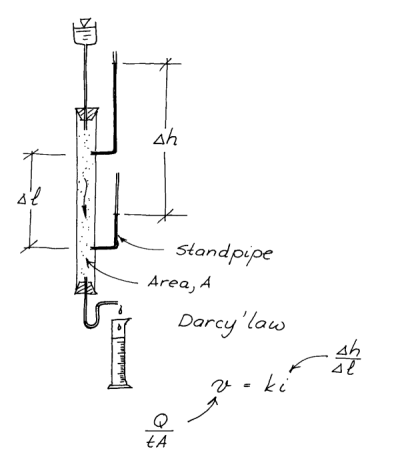
38

Note that we have added the hydraulic gradient into the mix, defined in the figure to the right.

This drawing shows a classic case of vertical, downward flow.  The coefficient of permeability k can be computed using methods described in Department of the Army (1986) — Laboratory Soils Testing for granular soils.  However, we can also use this test–or problems based on this test–to consider the effect of the flowing water on the effective stress, which in turn leads us to consider the topic of soil boiling when the flow is upward.  The best way to see how this works is to consider an example.

em-1110-2-1906-banner

Upward Flow Example

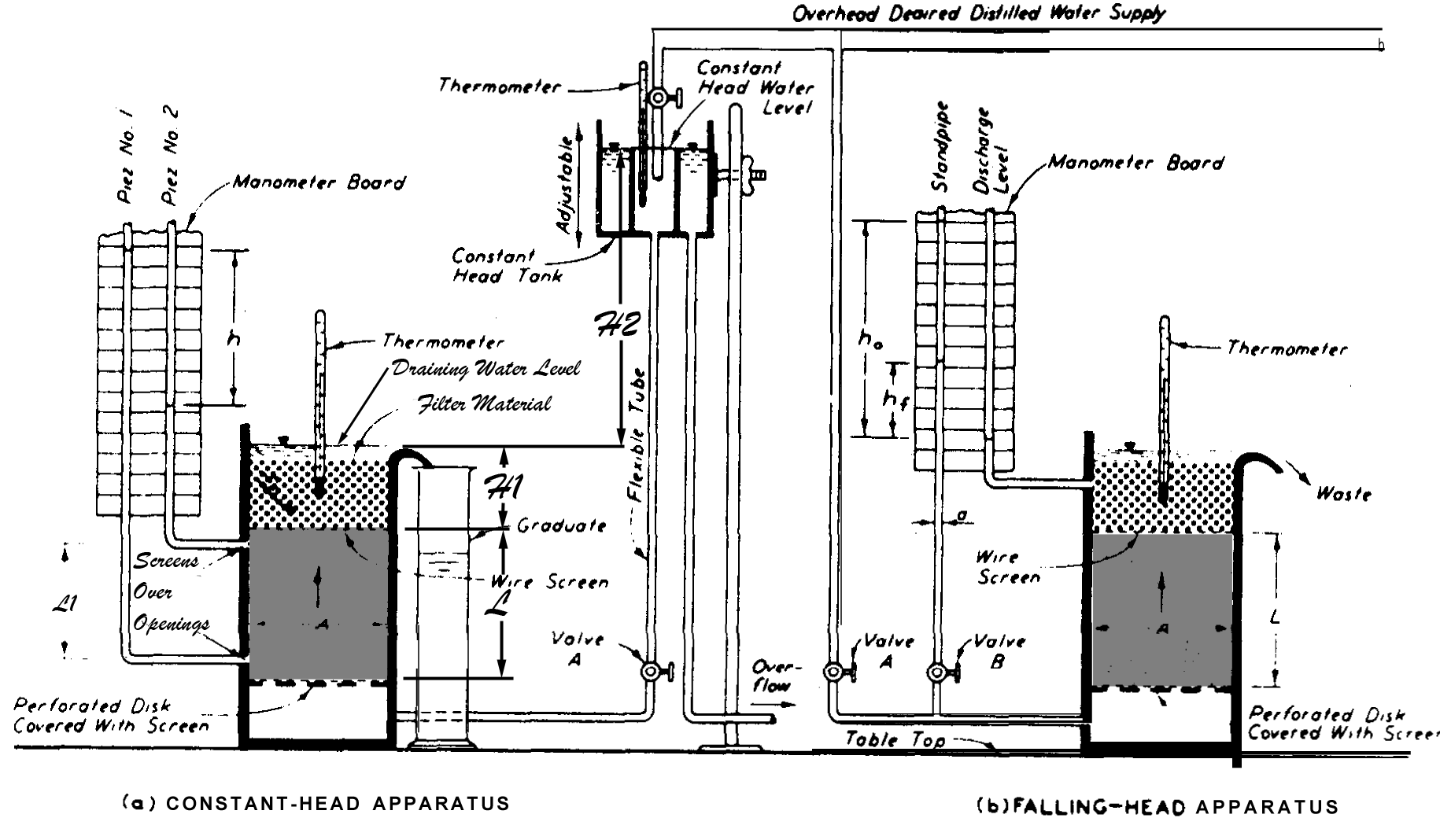
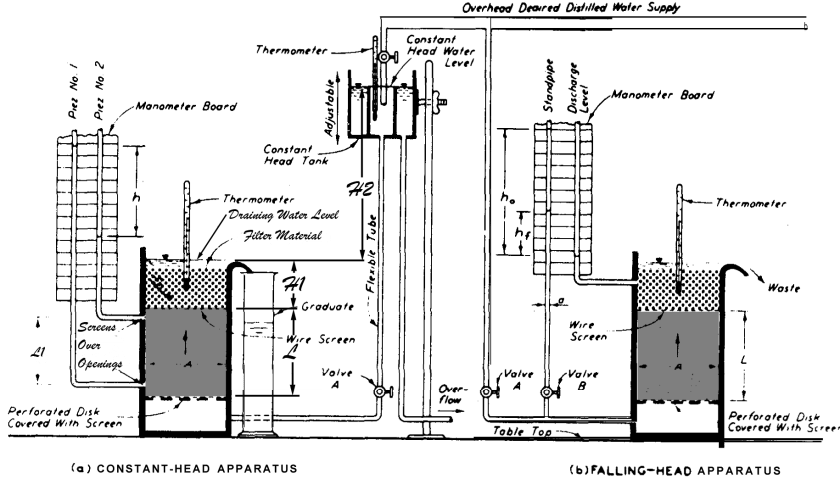
Consider the permeameter setup below.  We will concentrate on the constant head permeameter on the left.  The soil sample is in grey, with a length L and an area A.

EM-1110-2-1906-163

There is a distance H1 from the top of the soil sample to the surface of the water above it.  There is an additional distance H2 from that water surface to the water surface of the constant head tank. We’ll do this three ways:

  1. Effective stresses using the “proper” way
  2. Effective stresses using the quick way
  3. Calculations of head at given points

The “Proper” Way (from Verruijt)

Now consider an example with the following parameters:

  • H1 = 0.5 m
  • H2 = 2.5 m
  • L = 3 m
  • \gamma_{sat} = 19 \frac{kN}{m^3}

Compute the effective stress at a point halfway between the upper and lower surfaces of the soil sample.

First, we compute the total stress at the top of the soil, thus

\sigma_t\mid_{z=0.5} = 0.5 m \times 9.8 \frac{kN}{m^3} = 4.9 kPa (4)

Because the total stress at this point is due to free water, the pore water pressure u\mid_{z=0.5} = 4.9 kPa , and thus \sigma'_{vo} = 0 .

On the lower surface of the soil sample, the total stress is

\sigma_t\mid_{z=3.5} = 0.5 m \times 9.8 \frac{kN}{m^3} + 3\times 19\frac{kN}{m^3} = 61.9 kPa (5)

The pore water pressure, however, is due to the free water that begins in the constant head tank and ends at the bottom surface of the soil, thus

u\mid_{z=3.5} = \left( 2.5 + 0.5 + 3 \right)\times 9.8 \frac{kN}{m^3} = 58.8 kPa (6)

The effective stress at this point is 61.9 – 58.8 = 3.1 kPa.

So how do we compute the effective stress at the midpoint in the soil sample?  Let us revisit the equation

\Delta u=\gamma_w \Delta z\left( i + 1 \right) (1)

And determine the pore water pressure at the midpoint.  We first want to compute the hydraulic gradient of the entire specimen, substituting yields

\Delta u\mid_{z=3.5} = 58.8 - 4.9 = 53.9 kPa = 9.8 \times 3 \left( 1+i \right) (7)

Solving for the hydraulic gradient yields i = 0.833 .

Now we substitute this result back into the equation, changing the distance \Delta z = 1 m .  Keeping in mind that positive z is downwards, we start from the top of the soil sample.  The change in pore water pressure from the surface is

\Delta u\mid_{z=2} = 9.8 \times 1.5 \left( 1 + 0.833 \right) = 26.95 kPa (8)

Adding the pore water pressure at the soil’s upper surface yields u = 4.9 + 26.95 = 31.85 kPa.  The total stress at this point is

\sigma_t\mid_{z=2} = 0.5 m \times 9.8 \frac{kN}{m^3} + 1.5\times 19\frac{kN}{m^3} = 33.4 kPa (9)

The effective stress is simply 33.4 – 31.85  = 1.55 kPa.  Since this is the middle of the layer, we would expect this stress to be the average of the effective stress at the top of the soil and the bottom, which in fact is the case.

The Quick Way (which my students preferred)

We can show this by using a simpler method, by linearly interpolating between the properties of the top of the soil and the bottom.  Since the point of interest is in the middle, we can use a simple average of the properties of the top and bottom.  The averages are as follows:

  • Total Stress: \frac{4.9 + 61.9}{2} = 33.4 kPa
  • Pore Water Pressure: \frac{4.9+58.8}{2} = 31.85 kPa
  • Effective Stress: \frac{0 + 3.1}{2} = 1.55 kPa

which are the same answers without some of the computational effort.

Computing the Hydraulic Head

Yet another way is to compute the hydraulic head at a given point. This is done as follows:

  • At the top of the specimen, it’s simply the water depth from the surface = H1 = 0.5 m
  • At the bottom of the specimen, it’s simply the distance from the surface of the constant head tank to the bottom of the specimen, thus = H1 + H2 + L = 0.5 + 2.5 + 3 = 6m
  • The change in hydraulic head is the difference between the two, thus 6 – 0.5 = 5.5 m.
  • Again since we’re in the middle of the specimen, the head at that point is the average of the two, thus Hcentre = (0.5+6)/2 = 3.25 m. If it were somewhere else in the specimen, use linear interpolation between the top surface and the bottom, it is a linear function of the distance between the two.

The pore water pressure is simply (3.25 m)(9.8 kN/m3) = 31.85 kPa, which is the same as before. The hydraulic gradient can be computed by rearranging Equation (3) and eliminating the unit weight of water to yield

i = \frac{\Delta L}{\Delta z} = \frac{\Delta H}{\Delta L} - 1 (10)

Substituting yields 5.5/3 – 1 = 0.833, which is as before. Using hydraulic head eliminates the complications of the unit weight of water but hydraulic head may be an abstract concept for some students (but so in many cases is effective stress!) An example of hydraulic head “in action” can be seen in this experiment.

Comments

  • The hydraulic gradient is very high; in fact, the critical hydraulic gradient for this soil is (per Soils in Construction Equation 9.4) 19/9.8 – 1 = 0.939, leaving us with a factor of safety of 1.13 (per Soils in Construction Equation 9.5.)  This is reflected in the very low effective stresses that result.  Had the critical hydraulic gradient been exceeded, the effective stresses would have been negative.  Many “textbook” problems of this nature actually exceed any sensible range of hydraulic gradients because they don’t compute it as a part of the solution.  The soil in this case is about to “boil” (or at least put significant upward pressure on the filter material.)
  • Many students wonder why the formula for the hydraulic gradient i=\frac{\Delta h}{\Delta l} cannot be applied directly.  The reason is simple: even with moving water, the direct hydrostatic effect due to gravity does not go away, and has to be considered.  Thus we have the term \left( i + 1 \right) rather than just i .
  • Had the flow been downward, the hydraulic gradient would have been negative, and the effective stresses would have increased relative to hydrostatic stresses rather than decreased.
  • As long as the flow is vertical, this equation can be used with flow net type problems as well.
  • The critical hydraulic gradient equation can be derived using this equation.  As mentioned above, the critical hydraulic gradient is reached when the effective stresses in the soil are zero.  Assuming that we’re starting at the upper surface where the effective stress is zero, at the lower surface of the soil sample (or soil element in a flow net) the effective stress is zero when the total stress and pore water pressure is zero, or

\gamma_{sat} \Delta z = \gamma_w \Delta z\left( i + 1 \right) (11)

Solving for i_{crit} yields

i_{crit} = \frac{\gamma_{sat}}{\gamma_w} - 1 (12)

which is in fact the case.

Posted in Geotechnical Engineering

An Updated Version of Our Mohr’s Circle Routine Available, with Documentation

In 2016 we posted (and updated two years later) about two- and three-dimensional Mohr’s Circle problems and their solution using a strictly linear algebra solution.  We’ve done two things recently to update that: we’ve resolved some of the limitations of the original method (especially with the eigenvectors/direction cosines) and we’ve put the routine online for your use.  Both can be accessed here:

  1. Mohr’s Circle and Linear Algebra (the documentation)
  2. Online Routine

Image above from Verruijt, A., and van Bars, S. (2007). Soil Mechanics. VSSD, Delft, the Netherlands.

Update: the online routine is being phased out. You can see this routine in spreadsheet form here, where there is also a link to the updated monograph.

Posted in TAMWAVE

New Version of TAMWAVE Online Wave Equation Program Now Available

The completely revised TAMWAVE program is now available.  The goal of this project is to produce a free, online set of routines which analyse driven piles for axial and lateral load-deflection characteristics and drivability by the wave equation. The program is not intended for commercial use but for educational purposes, to introduce students to both the wave equation and methods for estimating load-deflection characteristics of piles in both axial and lateral loading.

We have a series of posts which detail the theory behind and workings of the program:

This program replaces the original routine which was originally written in 2005 and updated in 2010. The documentation for that effort is here.