A portion of the embankment on MS26 in George County Mississippi failed after heavy rains and flooding caused by Hurricane Ida. It created a hole about 20 feet deep and 50 feet across late on Monday night, and I can imagine it was difficult for motorists to see until it was too late. There were […]
Note: I have extensively revised this to boost the rigor of the equation derivation and to clarify the relationship between void ratio and shear/elastic modulus.
Nevertheless his Presidency would go unfinished if some explanation of the pet peeve wasn’t given. To remind my readers it is as follows:
The consolidation e versus log p’ curve is a stress-strain curve. Typically, stress-strain curves are plotted as stress on the vertical axis and strain on the horizontal axis. Both axes are on normal scales, not log scales. It’s my view that consolidation curves should be plotted in a similar fashion: effective vertical stresses on the vertical axis in arithmetic scale, and normal strain on the horizontal axis in arithmetic scale. When doing so, the steel ring confining the test specimen influences the the measurements and skews the stiffness data. Indeed the stress-strain curve, which usually has a downward curvature, has an upward curvature in such a plot.
Theory of Elasticity Considerations
Dr. Briaud notes that consolidation specimens are confined by a ring when they are tested in an odeometer. That’s to simulate the fact that one-dimensional consolidation theory (and the settlement theory that goes along with it) is based on the assumption that a) you have a uniform surcharge and b) the layer experiencing consolidation settlement is “confined” by the semi-infinite mass we assume the soil to be. That assumed, for theory of elasticity purposes we assume uniaxial strain conditions, which I discuss in my post Constitutive Elasticity Equations: Uniaxial Cases.
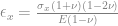
The uniaxial strain (assuming the x-direction is vertical) is
The variable is a measure of the effect of lateral confinement of either the odeometer specimen or the compressed layer in the field. At , and there is no confinement effect. At , , and the confinement effect is total: the “fluid” (which what it is in reality) is incompressible.
If we define, assuming that is the uniaxial stress applied to the specimen/soil,
(6)
then combining Equations (4) and (6) yields
(7)
Strain vs. Void Ratio
Using theory of elasticity involves stress vs. strain. Unfortunately, as Verruijt observes:
It is of course unfortunate that different coefficients are being used to describe the same phenomenon. This can only be explained by the historical developments in different parts of the world. It is especially inconvenient that in both formulas the constant is denoted by the character C, but in one form it appears in the numerator, and in the other one in the denominator.
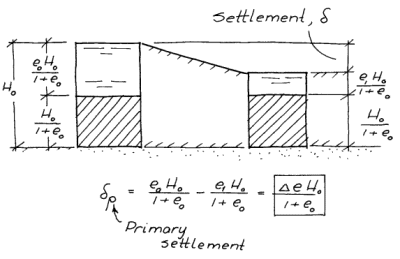
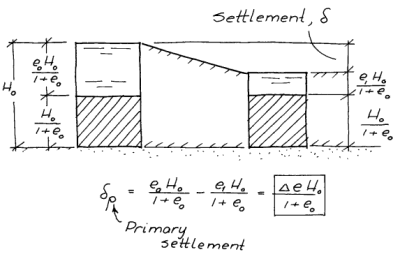
So we must relate strain to void ratio. To do this, we need to consider the compression of the soil from one void ratio to another, as is shown in the diagram below (from Broms):
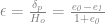
Manipulating the equation in the diagram, the relationship of strain to void ratio is as follows:
(8)
From Equation (6),
(9)
Combining and rearranging Equations (8) and (9),
(10)
At this point we can make the following observations:
The modulus of elasticity and the coefficient of volume expansion are linearly, inversely proportional to each other.
The physical difference between the two is that coefficient of volume expansion includes the effect of confinement while the elastic modulus does not. (Consider that most tension and compression tests on materials are conducted in an unconfined way.) This is the reason why we can write Equation (10) the way we can.
The coefficient of volume expansion is also important when we consider time consolidation.
If we assume to be constant and both of these parameters are constant for the range of void ratios under consideration, consolidation settlement can be considered in a linear elastic way.
It was noted at the time that the apparent elastic modulus increased more or less linearly with strain. Since void ratio and strain are linearly dependent, we would expect a similar looking result if we did a void ratio plot.
To solve this problem, we first observe that the elastic and shear modulus are linearly proportional via (as are and .) From this, it can be noted that the shear modulus can be estimated for a soil (excluding strain-softening effects) as follows:
(11)
where the notation is shown in the source. Let’s make some assumptions:
Poisson’s ratio remains constant, thus the relationship between strain and elastic modulus is constant.
is constant for a given soil type.
Effective stress for a given sample (that’s just about a given for triaxial tests in any event)
Other constants, such as and also remain constant.
That leaves the variable to change. The shear (and by extension the elastic) modulus of a material is a function of the void ratio. From the same source,
(12)
We plot this as follows, including a logarithmic trend line:
Plot of Equation (12) with Logarithmic Trend Line
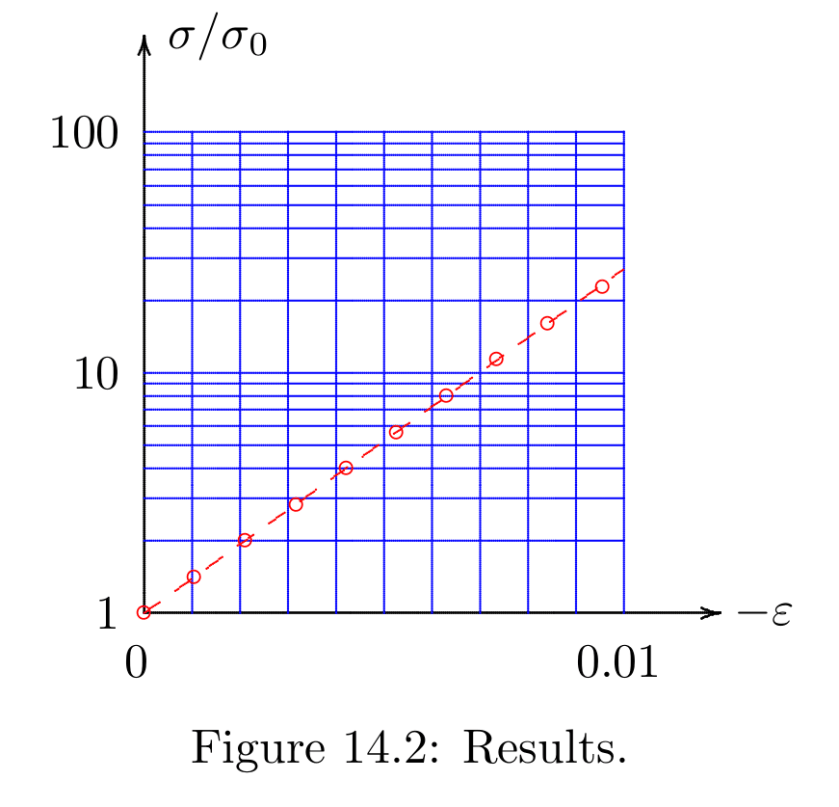
The logarithmic correlation isn’t perfect; however, as Verruijt notes in his commentary on his image below, in the caption:
When performing the test, it is observed, as expected, that the increase of vertical stress caused by a loading from say 10 kPa to 20 kPa leads to a larger deformation than a loading from 20 kPa to 30 kPa. The sample becomes gradually stiffer, when the load increases. Often it is observed that an increase from 20 kPa to 40 kPa leads to the same incremental deformation as an increase from 10 kPa to 20 kPa. And increasing the load from 40 kPa to 80 kPa gives the same additional deformation. Each doubling of the load has about the same effect. This suggests to plot the data on a semi-logarithmic scale. In this figure log(σ/σ0 ) has been plotted against ε, where σ0 denotes the initial stress. The test results appear to form a straight line, approximately, on this scale. The logarithmic relation between vertical stress and strain has been found first by Terzaghi, around 1930.
This, of course, leads us to the classic equation we use in one-dimensional consolidation theory for normally consolidated soils,
(13)
The need to treat compression due to settlement completely differently than that of elastic (or elasto-plastic) settlement is one of the anomalies of geotechnical engineering. The observation that the elastic modulus decreases with increasing void ratio (or strain) is a start in putting the two together and presenting a more or less unified theory of soil deformation. Coupled with agreement on using strain in consolidation tests, this would bring us a long way to solving the dilemma of Jean-Louis Briaud’s–and some of the rest of our–pet peeves.
Up until now the only comprehensive soil mechanics textbook we offered for download was Verruijt’s. We now add to that N. Tsytovich’s Soil Mechanics. Download is at the link or at the book cover below; information on the book is as follows:
This is a textbook in the course of Soil Mechanics for higher-school students of civil engineering and hydrotechnical engineering, and also for students of other specialties associated with construction of engineering structures, such as road constructors, ameliorators, geologists, soil scientists.
The Author has made an attempt to write a concise course on the basis of a wide synthesis of natural sciences and to present the theoretical data in the most simple and comprehensive form, without depreciating, however, the general scientific aspect of the problem; his other aim was to present a number of engineering solutions of problems in the theory of soil mechanics (calculations of strength, stability and deformability), which might be widely used in engineering.
Some problems in the book are discussed from new standpoints which take into account the principal properties of soils: contact shear resistance, structure-phase deformability (including creep of skeleton), compressibility of gas-containing porous water, and the effect of natural compaction of soils.
The book shows some new methods used for determination of characteristics of soils and gives some new solutions of the theory of consolidation and creep of soils, which can be used for predictions of settlement rates of foundations of structures and their time variations; a separate chapter discusses rheological processes in soils and their significance.
Topics include the following:
CHAPTER ONE. THE NATURE AND PHYSICAL PROPERTIES OF SOILS
Geological Conditions of Soil Formation
Components of Soils
Structural Bonds and Structure of Soils
Physical Properties and Classification Indices of Soils
CHAPTER TWO. BASIC LAWS OF SOIL MECHANICS
Compressibility of Soils. The Law of C o m p a c t i o n
Water Perviousness of Soils. The Law of Laminar Filtration
Ultimate Contact Shear Resistance of Soils. Strength Conditions
Structural-Phase Deformability of Soils
Features of the Physical Properties of Structurally Unstable Subsidence Soils
CHAPTER THREE. DETERMINATION OF STRESSES IN SOIL
Stress Distribution in the Case of a Three-Dimensional Problem
Stress Distribution in the Case of a Planar Problem
Pressure Distribution over the Base of the Foundation of Structures (Contact Problem)
CHAPTER FOUR. THE THEORY OF ULTIMATE STRESSED STATE OF SOILS AND ITS APPLICATION
Stressed State Phases of Soils with an Increase in Load
Equations of Ultimate Equilibrium for Loose and Cohesive Soils
Critical Loads on Soil
Stability of Soils in Landslides
Some Problems of the Theory of Soil Pressure on Retaining Walls
Soil Pressure on Underground Pipelines
CHAPTER FIVE. SOIL DEFORMATIONS AND SETTLEMENT OF FOUNDATIONS
Kinds and Causes of Deformations
Elastic Deformations of Soils and Methods for Their Determination
One-Dimensional Problem of the Theory of Soil Consolidation
Planar and Three-Dimensional Problems in the Theory of Filtration Consolidation of Soils
Prediction of Foundation Settlements by the Layerwise Summation Method
Prediction of Foundation Settlements by Equivalent Soil Layer Method
CHAPTER SIX. RHEOLOGICAL PROCESSES IN SOILS AND THEIR SIGNIFICANCE
Stress Relaxation and Long-Term Strength of Cohesive Soils
Creep Deformations in Soils and Methods for Their Description
Account of Soil Creep in Predictions of Foundation Settlements
CHAPTER SEVEN. DYNAMICS OF DISPERSE SOILS
Dynamic Effects on Soils
Wave Processes in Soils under Dynamic Loads
Changes in the Properties of Soils Subject to Dynamic Effects
The Principal Prerequisites for Taking the Dynamic Properties of Soils into Account in Vibrational Calculations of Foundations
The city with a metropolitan population of over 20 million is sinking at a rate of almost 50 centimeters (20 inches) per year — and this isn’t stopping anytime soon.
At first glance, you’d be inclined to attribute this to the strong earthquakes that sometimes strike Mexico City. But while earthquakes can cause their own damage, they’re not the main culprit here. Instead, it’s something much more inconspicuous: subsidence.
You can read it all here. Put into geotechnical terms, the bed of old Lake Texcoco has some very high void ratio soils, and as a large city puts pressure on them the void ratio decreases as the voids between the soil grains shrink. Thus the entire city has severe settlement, total and differential.
A diagram, from the Swedish geotechnical engineer and academic Bengt Broms, showing how we consider the volume and mass/weight relationships in soil. The particulate matter of the soil means that the soil mass has three components: solid (particles,) water (in the voids) and gas/air (also in the voids.) That simplification is shown above, along with the definition of void ratio.
A diagram, again from Bengt Broms, illustrating the problem in Mexico City and whenever what we call consolidation settlement takes place. The soil particles have been combined into one mass (hatched area.) As pressure is applied, the particles come closer to each other and the volume of the voids decreases, thus we have settlement.
A photo from Mexico City showing the effects of subsidence many years ago. The top of the pole was originally the ground surface before structures were built on it and subsidence started. The photo and an explanation can be found in the textbook Soils in Construction. Needless to say, it’s only gotten worse in the intervening years. Photo courtesy of J.R. Bell.



 (1)
(1) (2)
(2) ,
, (3)
(3) (4)
(4) (5)
(5) is a measure of the effect of lateral confinement of either the odeometer specimen or the compressed layer in the field. At
  ,
,  and there is no confinement effect. At
  ,
,  , and the confinement effect is total: the “fluid” (which what it is in reality) is incompressible.
 is the uniaxial stress applied to the specimen/soil,
 (6)
(6) (7)
(7) 
 (8)
(8) (9)
(9) (10)
(10) and the coefficient of volume expansion
  are linearly, inversely proportional to each other.
 to be constant and both of these parameters are constant for the range of void ratios under consideration, consolidation settlement can be considered in a linear elastic way.
 plot below:
 are linearly proportional via
  (11)
(11) is constant for a given soil type.
 for a given sample (that’s just about a given for triaxial tests in any event)
 and
and  also remain constant.
 to change. The shear (and by extension the elastic) modulus of a material is a function of the void ratio. From the same source,
 (12)
(12)
 (13)
(13)


 vulcanhammer.net