Posted in Geotechnical Engineering, Soil Mechanics

Mexico City’s surprising crisis: the city is sinking

The city with a metropolitan population of over 20 million is sinking at a rate of almost 50 centimeters (20 inches) per year — and this isn’t stopping anytime soon.

At first glance, you’d be inclined to attribute this to the strong earthquakes that sometimes strike Mexico City. But while earthquakes can cause their own damage, they’re not the main culprit here. Instead, it’s something much more inconspicuous: subsidence.

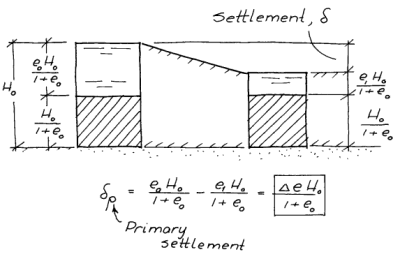
You can read it all here. Put into geotechnical terms, the bed of old Lake Texcoco has some very high void ratio soils, and as a large city puts pressure on them the void ratio decreases as the voids between the soil grains shrink. Thus the entire city has severe settlement, total and differential.

A diagram, from the Swedish geotechnical engineer and academic Bengt Broms, showing how we consider the volume and mass/weight relationships in soil. The particulate matter of the soil means that the soil mass has three components: solid (particles,) water (in the voids) and gas/air (also in the voids.) That simplification is shown above, along with the definition of void ratio.
A diagram, again from Bengt Broms, illustrating the problem in Mexico City and whenever what we call consolidation settlement takes place. The soil particles have been combined into one mass (hatched area.) As pressure is applied, the particles come closer to each other and the volume of the voids decreases, thus we have settlement.
A photo from Mexico City showing the effects of subsidence many years ago. The top of the pole was originally the ground surface before structures were built on it and subsidence started. The photo and an explanation can be found in the textbook Soils in Construction. Needless to say, it’s only gotten worse in the intervening years. Photo courtesy of J.R. Bell.

My own lecture on the subject of settlement and consolidation is here.

Posted in Geotechnical Engineering

Retaining Wall Collapse on I-295 Project in Bellmawr, New Jersey

An MSE Retaining Wall suffered a dramatic failure last week closing the right northbound lanes of I-295 indefinitely. The wall is part of the Direct Connection Project to reduce congestion on I-295/I-76/Route 42 in Bellmawr, […]

Retaining Wall Collapse on I-295 Project in Bellmawr, New Jersey
Posted in Deep Foundations, Geotechnical Engineering, Pile Driving Equipment

Reconstructing a Soviet-Era Plastic Model to Predict Vibratory Pile Driving Performance — vulcanhammer.info

The latest in our series of monographs on vibratory pile drivers, this one takes us back to the beginnings of vibratory pile driving in the Soviet Union. It was prepared for the ReSEARCH Dialogues at the University of Tennessee at Chattanooga in April 2021. The vibratory driver that started it all: the Soviet BT-5, used […]

Reconstructing a Soviet-Era Plastic Model to Predict Vibratory Pile Driving Performance — vulcanhammer.info
Posted in Academic Issues, Civil Engineering, Geotechnical Engineering

My Review for the FE Exam Civil/Geotechnical Section

Over the years, my department has asked me to give a review session for my students before they take the FE exam. In this time of COVID, I’ve committed all my other lectures to video, and this one is now no exception:

The slide presentation that goes with this is here.

I mention a few of things in the intro I’d like to elaborate on:

  • About ten years ago, it was brought to my attention that my students weren’t doing well on the FE Exam geotechnical section. My response to that was simple: “I’ll fix that problem.” I did that by aligning what I taught in class with what was in the FE “cheat sheet” (I’m sure NCEES loves that designation.) I don’t subscribe to the idea that we should only be “teaching to the test” but the FE exam’s geotechnical requirements are pretty basic, so that wasn’t much of a conflict. What has been tricky is that they’ve shifted around what they require over the years. But my students’ performance on the test has improved.
  • Since COVID I’ve put my lectures online. If you need to investigate some topics in detail, I’ve got them either at my Soil Mechanics or Foundations pages.
  • Once you’ve digested what’s presented in the video, you can and should solve sample problems. I just don’t recommend that you start your preparation doing that.
Posted in Geotechnical Engineering

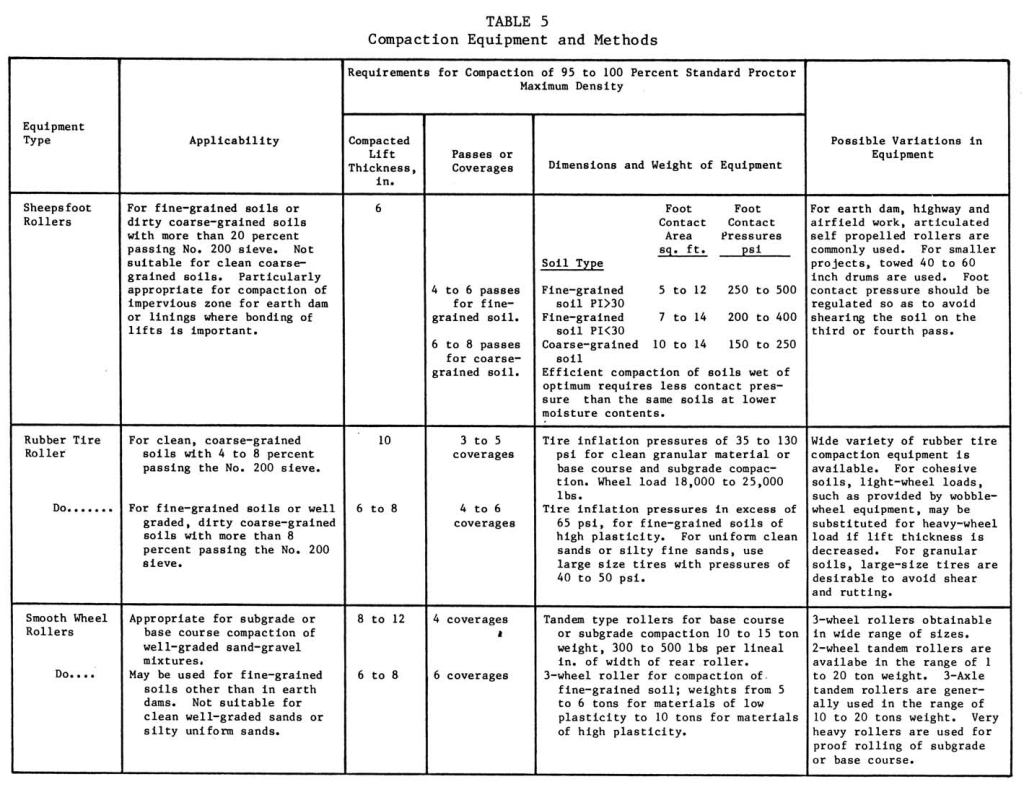
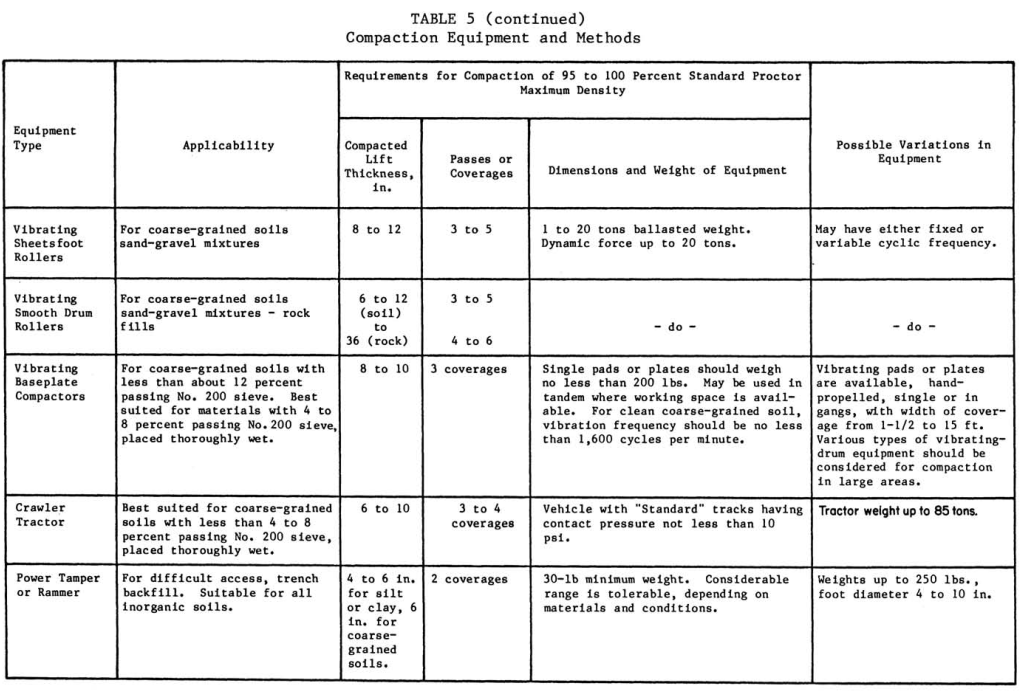
An Overview of Compaction Equipment, from DM 7

Below are some charts for selecting compaction equipment for a given project and soil condition, from NAVFAC DM 7.02

You can order NAVFAC DM 7.02–and 7.01–for this and more valuable information by clicking here.