Posted in Academic Issues, Deep Foundations

Comments on “3D FE analysis of bored pile- pile cap interaction in sandy soils under axial compression- parametric study”

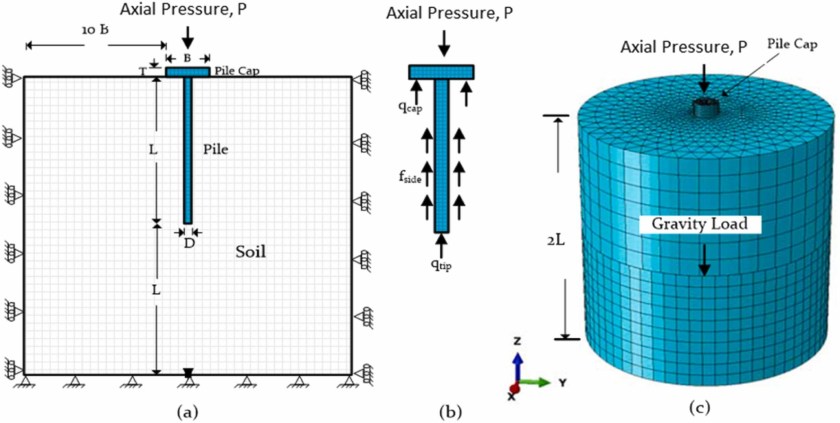
As always I was gratified to be cited in the recent paper “3D FE analysis of bored pile- pile cap interaction in sandy soils under axial compression- parametric study,” by Faisal I. Shalabi, Mohammad U. Saleem, Hisham J. Qureshi, Md Arifuzzaman, Kaffayatullah Khan, and Muhammad M. Rahman. It is an interesting study of the topic at hand. Some comments are in order:

  • Although the citation is of Closed Form Solution of the Wave Equation for Piles, the work Improved Methods for Forward and Inverse Solution of the Wave Equation for Piles is really closer to the methodology shown in the paper, both in terms of the 3D FEA used (well, I took a shortcut and used axisymmetric 2D analysis) and to the use of Mohr-Coulomb theory for the analysis, which I discuss in An Overview of Mohr-Coulomb Failure Theory and Elasto-Perfect Plasticity with Mohr-Coulomb Failure. Mohr-Coulomb is still viable for many applications, especially with sands.
  • One especially interesting aspect of this study was the inclusion of a pile cap. The problem is similar to the the one I discuss in my post When Semi-Infinite Spaces Aren’t, and When Foundations are Neither Rigid Nor Flexible, where the foundation is neither perfectly flexible relative to the soil nor perfectly rigid. Although in this study the foundation rigidity is not varied, the soil’s is, and as is the case in elastic theory as the soil becomes less rigid the relative rigidity of the foundation increases, the soil stresses relative to the foundation towards the edge of the foundation likewise increase. This Fall I plan to include that elastic theory in my discussion of mat foundations here: Foundation Design and Analysis: Shallow Foundations, Other Topics.
  • I noted a drop in the shaft friction just before the toe, followed by an increase down to the toe itself. The interaction between pile, soil and shaft friction for deep foundations is a complicated one. The toe creates failure surfaces in the soil that are certainly there–and it is reasonable to assume that they affect the shaft friction near the toe as well–but they are not exactly like those generated in shallow foundations, something which has complicated toe resistance calculations for a long time. The relative uniformity of the unit toe resistance makes sense based on failure theories going back to at least Vesić’s work in the early 1970’s. One thing that bored piles do not have to consider is the effects of advancement due to impact which, as Mark Randolph’s work has shown, almost show a “leading edge” effect.

It is my opinion that 3D FEA will ultimately be our best tool for estimating the load/settlement characteristics of deep foundations–bored or driven, static or dynamic–and this paper is a step forward in that regard.

Posted in Deep Foundations, Geotechnical Engineering

Can Any Alpha Method be Converted to a Beta Method?

It’s been a favourite topic of this site to consider the issue of alpha vs. beta methods for deep foundations (both driven and bored piles.) In our post Shaft Friction for Driven Piles in Clay: Alpha or Beta Methods? we show that the Kolk and van der Velde method for driven piles in clay can be converted from an alpha method to a beta one by some simple math. The key to this success is that the ratio of undrained shear strength to effective stress is at the core of the method.

If we want to simplify things further, we can consider this, from the “new” NAVFAC DM 7.1, originally from Skemption:

\frac{c}{\sigma'_o} = 0.11+0.0037PI (1)

where

  • c = undrained shear strength of the soil
  • \sigma'_o = vertical effective stress of the soil
  • PI = plasticity index of the soil

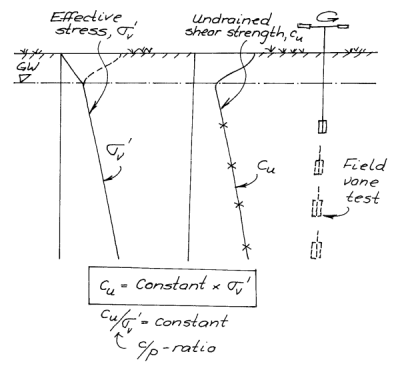
The relationship between undrained shear strength and vertical effective stress in a qualitative sense is illustrated by the diagram at the right, from Broms.

Substituting this into our derived value for \beta in the Kolk and van der Velde method yields

\beta = 0.9 (\frac{L-z}{d})^{-0.2}(0.11+0.0037PI)^{0.7} (2)

where

  • \beta = ratio of the vertical stress to the horizontal friction on the pile shaft
  • L = length of the pile
  • z = distance from the soil surface
  • d = diameter of the pile

This makes the \beta factor simply a function of the pile geometry and the plasticity index at a depth z .

But can this be done for methods where the relationship between undrained shear strength and the effective stress? The answer is “sort of,” and this post will explore that possibility.

Let us consider an example from the Dennis and Olson method for driven piles. It is a classic “alpha-beta” type of formulation; we will only consider the alpha method portion of the method. For a beta method to be equivalent to an alpha method, the following must hold:

f_s = \alpha c = \beta \sigma'_o (3)

We should note that, for the beta side of the method,

\beta = F_{SD} K \tan \delta (4)

where

  • F_{SD} = geometry factor based on the aspect ratio of the pile
  • K = lateral earth pressure coefficient
  • \delta = friction angle of the pile-soil interface

We will not consider this computation further, but only assume that

f_s = \beta \sigma'_o (5)

For the shaft resistance in clay

f_s = \alpha \overline{c} F_c F_L (6)

The two F constants are defined in the original monograph. The relationship between \alpha and c F_c is shown below.

Figure 1 Relationship of c Fc with alpha for Dennis and Olson Method

This is more complicated than, say the O’Neill and Reese method for drilled shafts. But the idea is the same. Our goal is basically to convert the values of alpha (where c is an independent variable) to use as a beta method.

We start by modifying Equation (3) for the Dennis and Olson method thus:

f_s = \alpha \overline{c} F_c F_L = \beta \sigma'_o (7)

Solving for \beta ,

\beta = \frac {\alpha \overline{c} F_c F_L}{\sigma'_o} (8)

Substituting Equation (1) into Equation (8) yields

\beta=\alpha\,\left ( .11+ .0037\,{\it PI}\right ){\it F_c}\,{\it F_L} (9)

The remaining difficulty is that \alpha is a function of c . This can be dealt with by manipulating Equation (1) to read

\overline c = (0.11+0.0037PI)\sigma'_o (10)

in which case

\overline c F_c = (0.11+0.0037PI)\sigma'_o F_c (11)

The left hand side is the independent variable of the graph above; the right hand side can be computed to substitute for that same independent variable.

Let us consider an example, namely the one used in the Dennis and Olson example:

Figure 2 Example Problem

The problem here is that we are given an undrained shear strength value for the clay layer but not a plasticity index. We are given a unit weight for the clay layer (not automatic for problems like this.) So we can compute the ratio of the undrained shear strength to the effective stress. For the top layer, the midpoint effective stress is 900 psf, and the undrained shear strength 2000 psf. The ratio is thus 2000/900 = 2.22. From Equation (1), the plasticity index is about 571. This, of course, is highly unlikely, and illustrates an important point about academically formulated problems: they’re not always realistic in their parameters. For the effective stress levels we have, it is likely that the undrained shear strength needs to be considerably lower than is given in the problem.

In any case substituting F_c and \sigma'_o from the original data and PI from the current data yields c F_c = 1400\,psf , which is the same as the original. From here we can compute \alpha = 0.49 and, substituting into Equation (9), we obtain \beta = 0.76 . Multiplying this by the effective stress of 900 psi yields the same result of f_s = 685\,psf .

Conclusion

  • Getting rid of \alpha altogether is hampered by the fact that there is not an analytic function for \alpha in the first place. The Dennis and Olson method is not unique in this regard.
  • For methods such as Kolk and van der Velde where the ratio of undrained shear stress and vertical effective stress are important parts of the method, applying correlations such as Equation (1) is fairly simple. When this is not the case then things are more complicated.
  • Using Equation (1) is doubtless a good check on values of c , which when applied in an alpha method implicitly contains the effects of effective stress.
  • Going forward, probably the best way to “close the loop” and make all methods beta methods is to formulate the method for clays in terms of \frac {c}{\sigma'_o} as is the case with Kolk and van der Velde. Doing this would be an important step in moving static methods forward.
Posted in Deep Foundations, Pile Driving Equipment

About that “Warrington Method” For Vibratory Pile Drivability — vulcanhammer.info

Every now and then something comes up that you really didn’t expect. That took place with a paper published this year cited “W.J. Lu, B. Li, J.F. Hou, X.W. Xu, H.F. Zou, L.M. Zhang, “Drivability of large diameter steel cylinders during hammer-group vibratory installation for the hong kong–zhuhai–macao bridge,” Engineering (2022), doi: https://doi.org/10.1016/j.eng.2021.07.028.” (You can […]

About that “Warrington Method” For Vibratory Pile Drivability — vulcanhammer.info
Posted in Civil Engineering, Deep Foundations

The Paper “Vibratory and Impact-Vibration Pile Driving Equipment” Cited — vulcanhammer.info

It’s happened again: the paper “Vibratory and Impact-Vibration Pile Driving Equipment” has been cited by Mohammed Al-Amrani and M Ikhsan Setiawan in their paper “Prefabricated and Prestressed Bio-Concrete Piles: Case Study in North Jakarta.” The abstract of their paper is here: In this research, we will talk about Prefabricated and Prestressed Concrete piles in general and […]

The Paper “Vibratory and Impact-Vibration Pile Driving Equipment” Cited — vulcanhammer.info
Posted in Deep Foundations, Geotechnical Engineering

Clyde N. Baker, Jr., A Geotechnical Giant (1930-2022)

From the Deep Foundations Institute:

DFI and the DFI Educational Trust are saddened at the passing of industry legend Clyde N. Baker, Jr., P.E., S.E., who retired after a successful career as senior principal engineer at STS Consultants and later as a senior consultant at GEI Consultants.

“Clyde was a giant in geotechnical engineering, who has been recognized with many awards over his years of designing foundations to support iconic tall structures,” says Theresa Engler, DFI executive director. “He graced the cover of the Engineering News-Record (ENR) after winning its Award of Excellence, as well as receiving the American Society of Civil Engineers OPAL Award, Ralph B. Peck Award, Martin S. Kapp Award, serving as the Terzaghi Lecturer and receiving DFI’s Distinguished Service Award. But what I remember most was his generous spirit in sharing his knowledge with other industry professionals and his genuine kindness and altruism.” 

In 2020, the Trust established the Clyde N. Baker, Jr. Foundation Engineering Scholarship Fund to honor Clyde’s extraordinary contributions to the deep foundations industry. To continue to provide scholarships in Clyde’s name, proceeds from this year’s DFI Educational Trust Gala Fundraising Dinner on November 3 in New York will benefit the Baker fund and the Trust’s General Fund. We hope you’ll join us or take this opportunity to be one of the supporters of the Baker fund by sponsoring the event or making a direct donation to the fund. The goal is to bring the fund to a self-sustaining level so we can provide perpetual scholarships in Clyde’s name for years to come.



