Of all the topics I taught in my course on foundation design and analysis, my favourite topic was driven piles. I have taken this part of the course and am presenting it on the companion site vulcanhammer.info. The topics are as follows:
In putting this together, I added some material, including a different example problem and actual runs of axial and lateral load software, along with the wave equation analysis.
I trust that you will find this enjoyable and profitable.
My post Getting to the Legacy of B.K. Hough and his Settlement Method got a good amount of interest. Unfortunately it left several “loose ends,” some of which is because we don’t have full information on some of Hough’s methodology, and others because we don’t have full information on the FHWA’s thinking in their resurrection of the method. The objective of this post is to clear up some of these loose ends, especially the latter.
What we needed was some additional information on the background for both Hough’s work and the FHWA’s interpretation of that work. That information came from an unexpected source: the FHWA’s Design and Construction of Driven Pile Foundations, 2016 Edition. This has been available on vulcanhammer.info just about since it was first published. Now some of you are asking, “Why is this guy waiting until now to come out with stuff he’s had for years? Doesn’t he read the material he offers for download?” In my defence, I didn’t expect the solution to come from the driven pile manual, since it’s primarily a shallow foundation issue. It’s there because it’s proposed for use with groups of driven piles in cohesionless soils.
With all that said let’s look at some of the issues this “new” source tackles.
The SPT Correction Issue
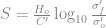
The basic equation for Hough’s method is similar to that used for one-dimensional consolidation settlement and is
(1)
where
settlement of cohesionless soil layer
layer thickness
compression coefficient
effective stress at the centre of the layer
effective stress at the centre of the layer plus the induced stress from the surface at the centre of the layer
Hough’s Method may or may not have used a 60% (N60) efficient hammer to develop the method. It’s entirely possible but Hough (1959) doesn’t say what type of hammer he used to develop the method.
The FHWA implementation of Hough’s method included an SPT correction for overburden, which was absent in Hough (1959.)
An absence of any mention of Hough (1969,) where he modified the values.
The lack of an attempt to convert the chart to equations. My original post demonstrates how this can be done, using the method of Hough (1969.)
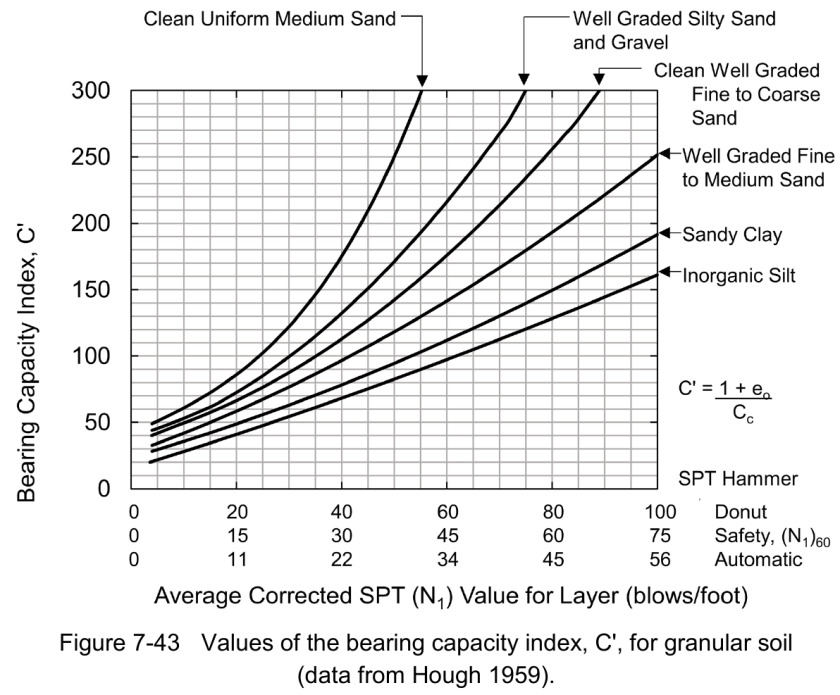
Cheney and Chassie (2002) report that FHWA experience with this method indicates the method is usually conservative and can overestimate settlements by a factor of 2. This conservatism is attributed to the use of the original bearing capacity index chart from Hough (1959) which was based upon SPT donut hammer data. Based upon average energy variations between SPT donut, safety, and automatic hammers reported in technical literature, Figure 7-43 now includes a correlation between SPT N values from safety and automatic hammers and bearing capacity index. The safety hammer values are considered N60 values. This modification should improve the accuracy of settlement estimates with this method.
The following should be noted about these changes:
The assumption that Hough used a “donut” hammer is a reasonable one based on the technology of the time, but it’s still an assumption. Hough doesn’t tell us the kind of SPT hammer he used, or even how he came up with the C’ values shown above.
The chart above (Figure 7-43) shows the correlation for three types of hammers: donut, safety, and automatic hammers (which now “rule the roost” in testing.) However, it still insist that the safety hammer values should be corrected for overburden, something else absent from Hough’s study.
There is still no awareness of Hough (1969.)
So we can say that we have, perhaps, made some progress toward a solution, but at this point we are not quite where we would like to be.
My Thinking on the Way Forward
We usually think in terms of progress in this field in terms of peer-reviewed articles. But we’ve had the peer-reviewed articles, the experts weigh in on what they mean, and another set of experts try to make things better. My own solution to this problem would run like this:
Let’s accept the FHWA’s idea that Hough used a donut hammer for his original work. Donut hammers have a “standard” efficiency of 45%. To get the SPT blow counts to an N60 value (60% efficiency) we need to divide the donut SPT values by 60/45 = 4/3. (That’s what’s going on in the graph above.)
Let’s use Hough’s method as he presented it in Hough (1969) and assume that those values too came from donut hammers.
Let’s lose the overburden correction; it wasn’t in the original and I don’t see how one can justify putting it into this method.
If we implement all of this, the chart now looks like this:
If formulae are preferred (and that’s normally the case these days) they will again be in the form
(2)
and the coefficients will be as follows:
Soil Type
A
B
Organic Silt, Little Clay
7.22
0.0305
Inorganic Sandy Silt
18.27
0.0279
Very Well Graded Fine to Coarse Sand
22.86
0.0270
Well Graded Clean Fine to Coarse Sand
28.22
0.0289
Well Graded Silty Sand and Gravel
32.85
0.0289
Uniform Clean Inorganic Silt
37.02
0.0294
Very Uniform Clean Medium Sand (Similar to Std. Ottawa)
58.66
0.0299
The “B” coefficients run in a fairly narrow range and have an average of 0.0289. It’s possible using this or a more sophisticated method to apply the same value of B to all of the soils.
Any comments from those of you who have used Hough’s Method, or have research on the topic, would be greatly appreciated.
References
Hough, B.K. (1959). “Compressibilty as the Basis for Soil Bearing Value,” Journal of the Soil Mechanics and Foundations Division, ASCE, Vol. 85, Part 2.
Hough, B.K. (1969). Basic Soils Engineering. Second Edition. New York: Ronald Press Company.
Part of Soils in Construction‘s presentation of dewatering is this topic. I cover it in my treatment of flow nets in Soil Mechanics: Groundwater and Permeability II; however, Soils in Construction uses a less computationally intensive approach. In this piece I’ll explain that, give some better graphics than the book had available at the time of publication, and compare them with the flow net/FEA results I discussed in my Soil Mechanics course.
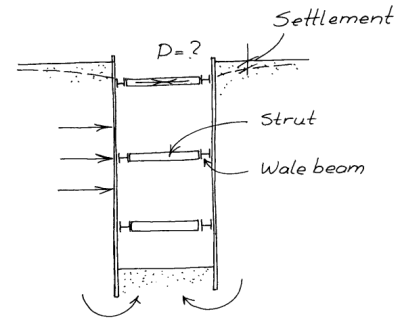
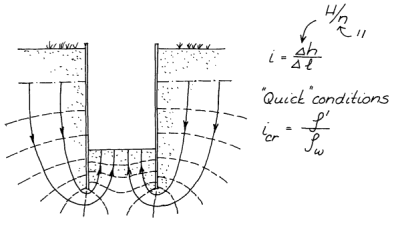
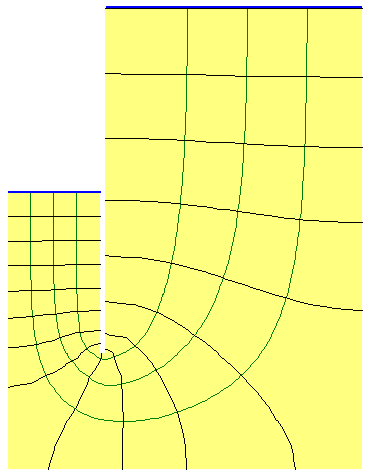
Let us consider the problem of a braced cut, which is commonly used for “cut and cover” construction. Such a construction is shown at the right. One of the challenges of temporary works such as this is to insure that a) there is sufficient pumping capacity to keep the “steel trench” dry, and b) the hydraulic gradient of the water coming up into the trench is sufficiently low to avoid soil boiling and bottom heave due to that soil boiling. (Bottom heave can take place due to other factors as well.) An example of that (showing a flow net) is below to the left.
Because the cut is internally braced, it is usually possible to make the sheeting walls simply penetrate to just below the bottom of the trench. However, in order to mitigate the effects of water flowing from around the cut into the bottom, the sheeting can be extended. The idea is that, the longer the extensions, the longer distance the water has to flow, the increased resistance of the soil to flow, and the lower the hydraulic gradients, which both reduce the flow overall and the possibility that the soil at the bottom of the trench will boil, i.e., enter into a quick condition.
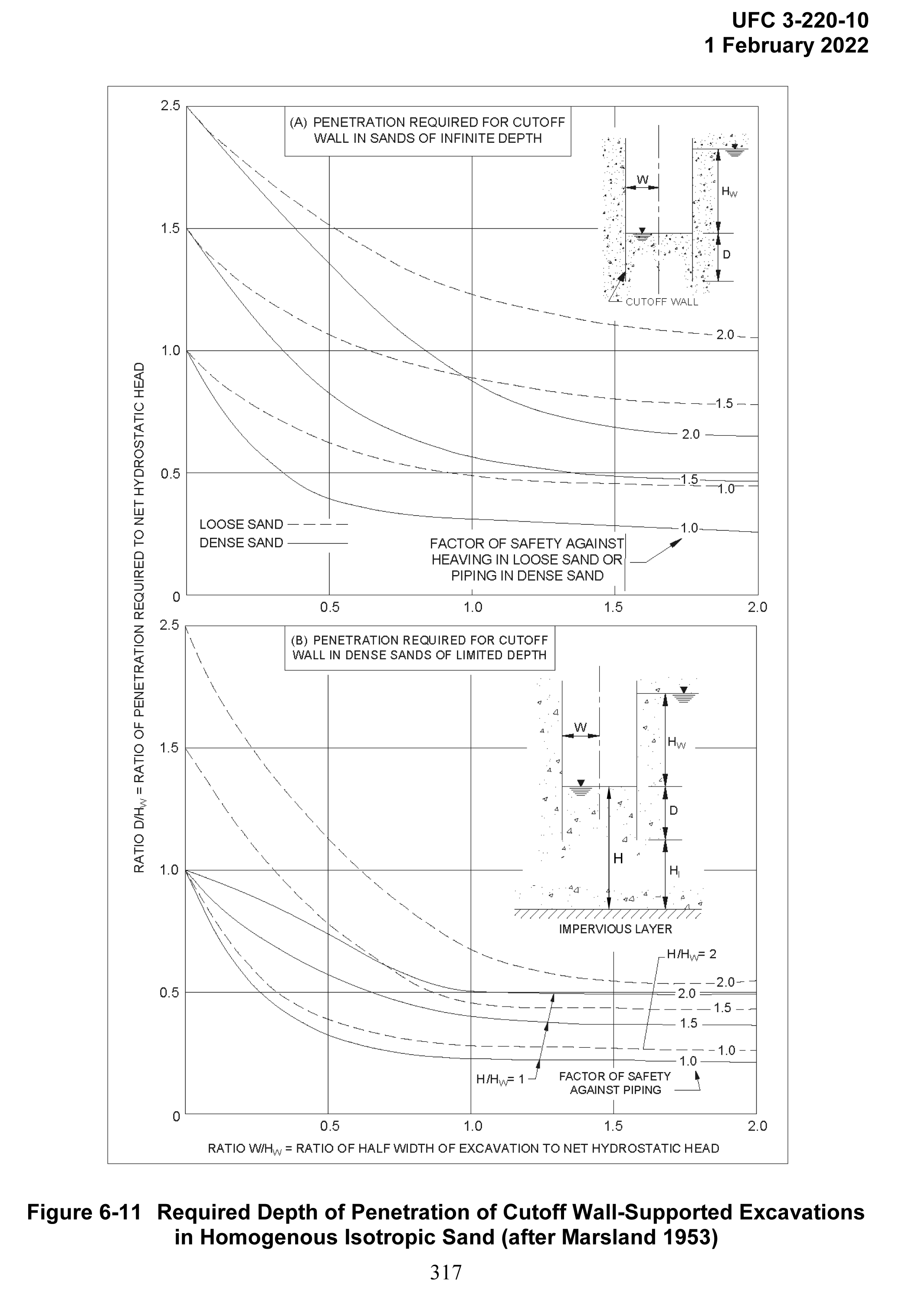
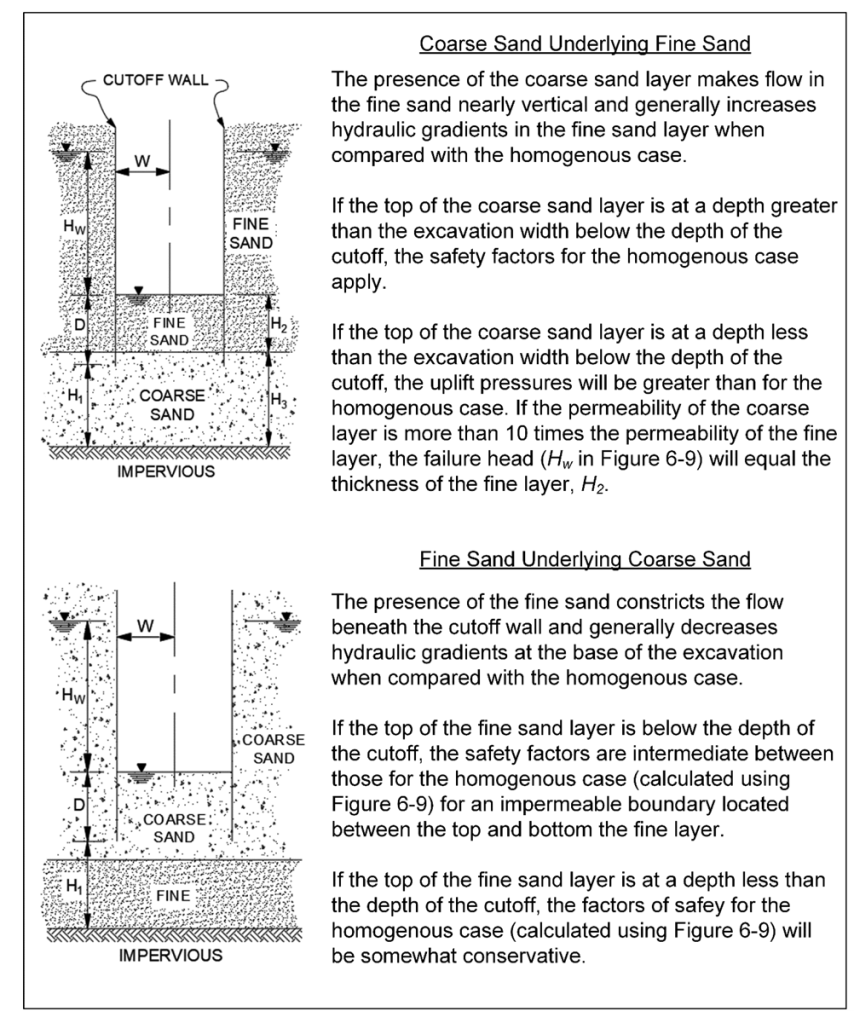
Charts to determine the minimum extension of the sheeting. These were developed by Marsland (1953). In the book they were taken from NAVFAC DM 7.01, but since the book’s publication NAVFAC DM 7.1 has redone the graphics, and you can see that below (and click on it to download). It is important to note that there is an error in the lower part of this figure; I checked it against Marsland (1953) and have modified it a bit to restore it to Marsland’s original formulation, the following example will show how it is supposed to be used.
Impervious layer 20’ below the toe of the sheeting
Length of Sheet Piling = 66’
Water table at the excavation level on the excavation side
Water table 6’ below the top of the sheeting on the soil side
Variables for chart above
Hw = 38 – 6 = 32′
D = 66 – 38 = 28′
Hl = 20′
H = D + Hl = 28 + 20 = 48′
W = 16′
Even though the graphic for the problem doesn’t show it, the problem statement indicates an impervious layer below the excavation; thus, we will use the lower chart for this problem.
Soil Conditions
Uniform medium sand, k = 0.0003 ft/sec
Saturated Unit Weight = 115 pcf
We need to, one way or another, insure that the design does not experience soil boiling.
The “rule of thumb” in Soils in Construction states that “the depth of penetration of the cut-off wall below the bottom of the excavation should be a third of the “length” computed. For this wall, the ratio is 28/66 = 42%, which means the rule of thumb is achieved.
Turning to the chart above, we must compute three quantities:
The x-axis ratio of half width of excavation to net hydrostatic head, or W/Hw = 16/32 = 0.5;
the y-axis ratio of penetration required to net hydrostatic head, or D/Hw = 28/32 = 0.875; and
the ratio of the depth between the bottom of the excavation and the impervious layer to the net hydrostatic head, or H/Hw = 48/32 = 1.5.
In this case we only have two values of H/Hw to work with: 1 and 2. For H/Hw = 1, FS ~ 2.5 (this is a very rough extrapolation.) For H/Hw = 2, FS = 1.75. Since H/Hw = 1.5 is in the middle between the two, the FS = (2.5+1.75)/2 = 2.125.
If we want to check our results by neglecting the impervious layer, we use the upper chart, and assuming the soil is closer to being a loose sand, FS ~ 1.4.
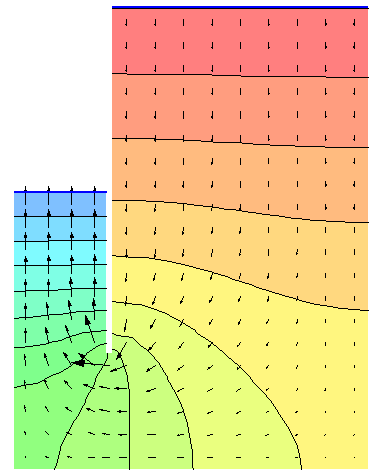
So how does this all compare to a flow net/FEA result? Same is given below.
At the right is a flow net generated by the finite element program SEEP-W. At the left is a chart showing the direction of the water flow (arrows) and the hydraulic head (coloured bands.) An in-depth explanation of these can be found at Soil Mechanics: Groundwater and Permeability II. The results are as follows:
The factor of safety from the chart ignoring the presence of the impervious layer is the closest to the FEA/flow net result. For the chart with the impervious layer, the extrapolation for the lower factor of safety should perhaps be ignored.
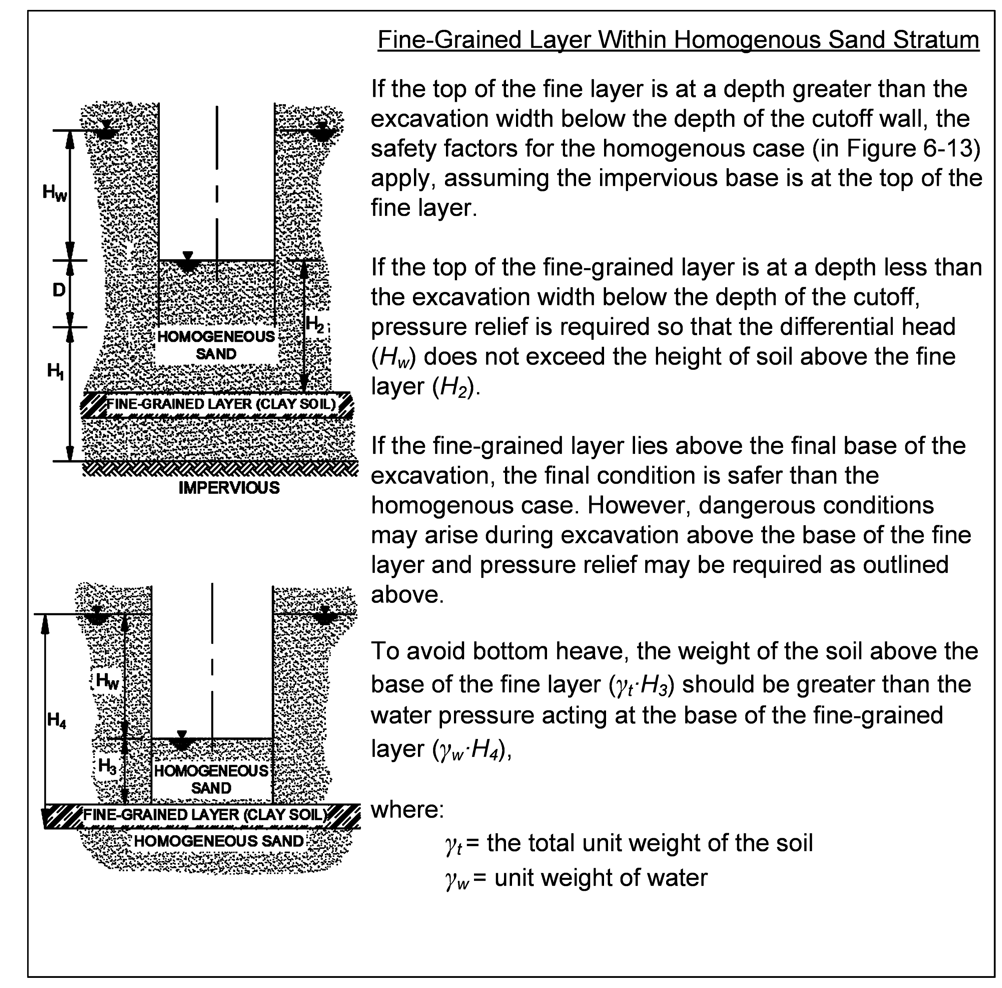
A couple of other charts (based on Marsland (1953)) are shown below.
References
Marsland, A.R. 1953. “Model Experiments to Study the Influence of Seepage on the Stability of a Sheeted Excavation in Sand.” Geotechnique, 3(6), 223-241.
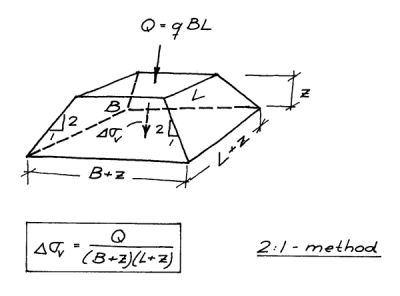
Readers of my post Analytical Boussinesq Solutions for Strip, Square and Rectangular Loads and those related to it know that the math related to these methods can get complicated, and in any case the idea of a “purely elastic” soil response to load is purely theoretical. So is there a simpler way? The most common simplification used is the 2:1 Method, shown at the right.
The method basically assumes the following:
Uniformly loaded foundation
Only stresses of interest are under the centroid of the foundation, as shown, and only vertical stresses are considered
Stresses decrease as if there is a truncated pyramid below the foundation with a slope of 1H:2V.
As shown, to determine the additional vertical stress at a distance below the centre of the foundation, the equation for a rectangular foundation of width B and length L (can be interchanged, but conventionally B is the smaller of the two) for a load Q on the surface is given by the equation
(1)
If the equation is written in terms of the unit load q, it becomes
(2)
Obviously for square foundations but the solution is the same.
Formulating the problem as shown in Equation (2) also allows us to apply the 2:1 method to continuous foundations, for as the equation reduces to
(2a, Continuous Foundations)
As an example, let us consider a foundation where . By substitution into Equation (1), . If we compute the unit load to be , substitution into Equation (2) yields the same result.
Although it is possible to apply this method to circular foundations, it is just as easy to use Boussinesq theory under the centre of the foundation. The equation for a circle of radius and all other variables the same is

 (1)
(1) settlement of cohesionless soil layer
 layer thickness
 compression coefficient
 effective stress at the centre of the layer
 effective stress at the centre of the layer plus the induced stress from the surface at the centre of the layer
 . My criticisms of the FHWA’s implementation of the method in the post
  values.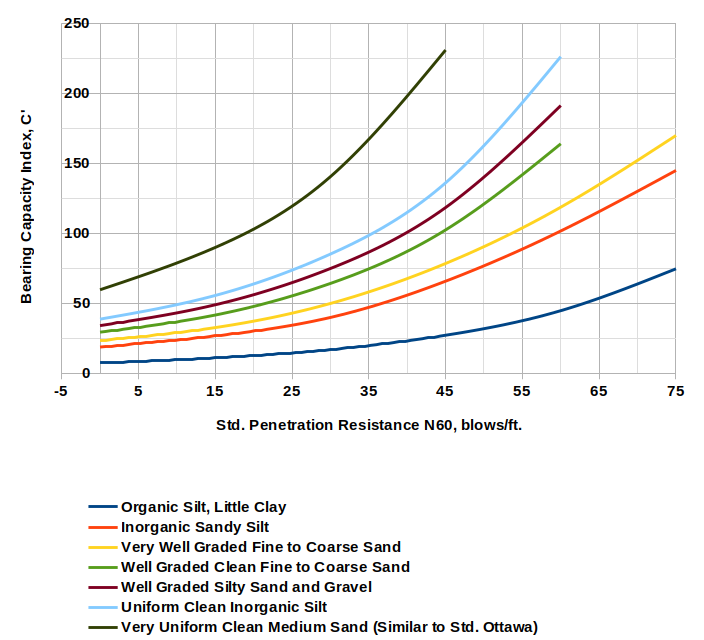
 (2)
(2)

 at a distance
  below the centre of the foundation, the equation for a rectangular foundation of width B and length L (can be interchanged, but conventionally B is the smaller of the two) for a load Q on the surface is given by the equation
 (1)
(1) (2)
(2) but the solution is the same.
 the equation reduces to
 (2a, Continuous Foundations)
 . By substitution into Equation (1),
  . If we compute the unit load to be
  , substitution into Equation (2) yields the same result.
 and all other variables the same is
 (3)
(3)
 vulcanhammer.net