Most geotechnical engineers will recognize the name Harry Poulos. The Geo-Institute’s Geo-Legends series recently posted an interview with Professor Poulos of Coffey Engineering and the University of Sydney. He has worked on the foundations of some of the most well-known skyscrapers in the world in Dubai and elsewhere.
Note: I have extensively revised this to boost the rigor of the equation derivation and to clarify the relationship between void ratio and shear/elastic modulus.
Nevertheless his Presidency would go unfinished if some explanation of the pet peeve wasn’t given. To remind my readers it is as follows:
The consolidation e versus log p’ curve is a stress-strain curve. Typically, stress-strain curves are plotted as stress on the vertical axis and strain on the horizontal axis. Both axes are on normal scales, not log scales. It’s my view that consolidation curves should be plotted in a similar fashion: effective vertical stresses on the vertical axis in arithmetic scale, and normal strain on the horizontal axis in arithmetic scale. When doing so, the steel ring confining the test specimen influences the the measurements and skews the stiffness data. Indeed the stress-strain curve, which usually has a downward curvature, has an upward curvature in such a plot.
Theory of Elasticity Considerations
Dr. Briaud notes that consolidation specimens are confined by a ring when they are tested in an odeometer. That’s to simulate the fact that one-dimensional consolidation theory (and the settlement theory that goes along with it) is based on the assumption that a) you have a uniform surcharge and b) the layer experiencing consolidation settlement is “confined” by the semi-infinite mass we assume the soil to be. That assumed, for theory of elasticity purposes we assume uniaxial strain conditions, which I discuss in my post Constitutive Elasticity Equations: Uniaxial Cases.
The uniaxial strain (assuming the x-direction is vertical) is
The variable is a measure of the effect of lateral confinement of either the odeometer specimen or the compressed layer in the field. At , and there is no confinement effect. At , , and the confinement effect is total: the “fluid” (which what it is in reality) is incompressible.
If we define, assuming that is the uniaxial stress applied to the specimen/soil,
(6)
then combining Equations (4) and (6) yields
(7)
Strain vs. Void Ratio
Using theory of elasticity involves stress vs. strain. Unfortunately, as Verruijt observes:
It is of course unfortunate that different coefficients are being used to describe the same phenomenon. This can only be explained by the historical developments in different parts of the world. It is especially inconvenient that in both formulas the constant is denoted by the character C, but in one form it appears in the numerator, and in the other one in the denominator.
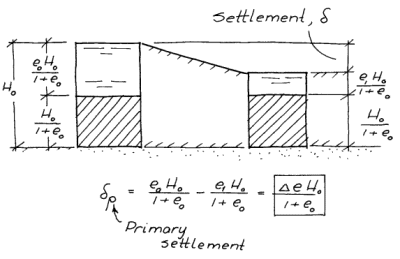
So we must relate strain to void ratio. To do this, we need to consider the compression of the soil from one void ratio to another, as is shown in the diagram below (from Broms):
Manipulating the equation in the diagram, the relationship of strain to void ratio is as follows:
(8)
From Equation (6),
(9)
Combining and rearranging Equations (8) and (9),
(10)
At this point we can make the following observations:
The modulus of elasticity and the coefficient of volume expansion are linearly, inversely proportional to each other.
The physical difference between the two is that coefficient of volume expansion includes the effect of confinement while the elastic modulus does not. (Consider that most tension and compression tests on materials are conducted in an unconfined way.) This is the reason why we can write Equation (10) the way we can.
The coefficient of volume expansion is also important when we consider time consolidation.
If we assume to be constant and both of these parameters are constant for the range of void ratios under consideration, consolidation settlement can be considered in a linear elastic way.
It was noted at the time that the apparent elastic modulus increased more or less linearly with strain. Since void ratio and strain are linearly dependent, we would expect a similar looking result if we did a void ratio plot.
To solve this problem, we first observe that the elastic and shear modulus are linearly proportional via (as are and .) From this, it can be noted that the shear modulus can be estimated for a soil (excluding strain-softening effects) as follows:
(11)
where the notation is shown in the source. Let’s make some assumptions:
Poisson’s ratio remains constant, thus the relationship between strain and elastic modulus is constant.
is constant for a given soil type.
Effective stress for a given sample (that’s just about a given for triaxial tests in any event)
Other constants, such as and also remain constant.
That leaves the variable to change. The shear (and by extension the elastic) modulus of a material is a function of the void ratio. From the same source,
(12)
We plot this as follows, including a logarithmic trend line:
Plot of Equation (12) with Logarithmic Trend Line
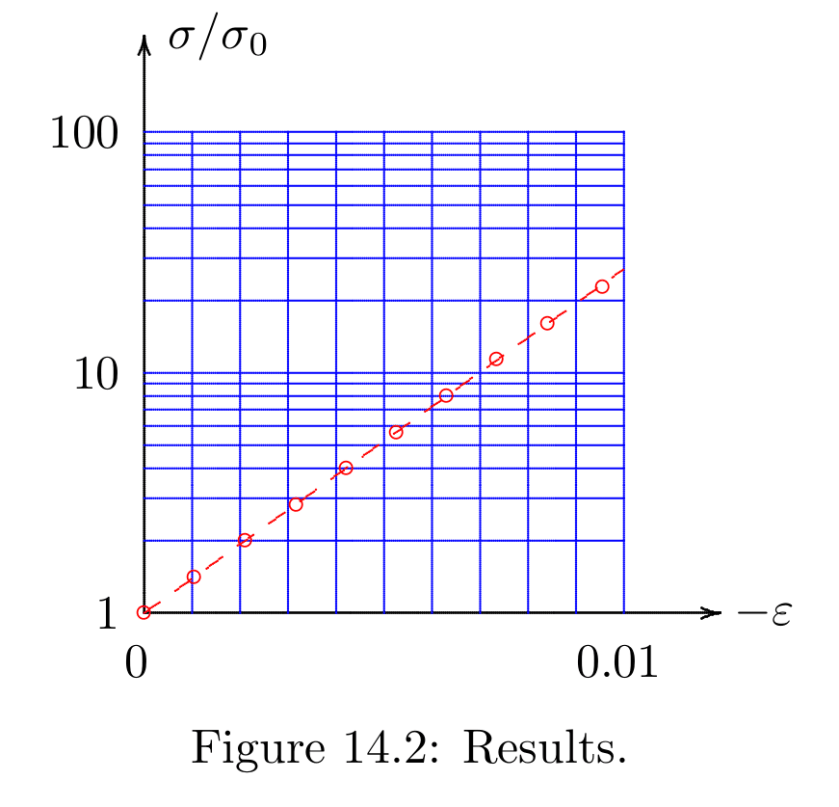
The logarithmic correlation isn’t perfect; however, as Verruijt notes in his commentary on his image below, in the caption:
When performing the test, it is observed, as expected, that the increase of vertical stress caused by a loading from say 10 kPa to 20 kPa leads to a larger deformation than a loading from 20 kPa to 30 kPa. The sample becomes gradually stiffer, when the load increases. Often it is observed that an increase from 20 kPa to 40 kPa leads to the same incremental deformation as an increase from 10 kPa to 20 kPa. And increasing the load from 40 kPa to 80 kPa gives the same additional deformation. Each doubling of the load has about the same effect. This suggests to plot the data on a semi-logarithmic scale. In this figure log(σ/σ0 ) has been plotted against ε, where σ0 denotes the initial stress. The test results appear to form a straight line, approximately, on this scale. The logarithmic relation between vertical stress and strain has been found first by Terzaghi, around 1930.
This, of course, leads us to the classic equation we use in one-dimensional consolidation theory for normally consolidated soils,
(13)
The need to treat compression due to settlement completely differently than that of elastic (or elasto-plastic) settlement is one of the anomalies of geotechnical engineering. The observation that the elastic modulus decreases with increasing void ratio (or strain) is a start in putting the two together and presenting a more or less unified theory of soil deformation. Coupled with agreement on using strain in consolidation tests, this would bring us a long way to solving the dilemma of Jean-Louis Briaud’s–and some of the rest of our–pet peeves.
Today is an anniversary I’ve commemorated before: it’s the anniversary this web site/blog (take your pick) got its start as the Wave Equation Page for Piling. It’s been twenty-four years since I put the first pages on GeoCities, and it’s been going (with spin-offs) ever since. It’s time for a little looking back, and some looking forward too.
The year 2020 was traumatic for just about everyone but it was a good year for this site. It was even a better year in that most of the traffic to the site came from outside the United States (that trend has continued into 2021.) This is in spite of the fact that my students at the University of Tennessee at Chattanooga mostly access it from within the country, having no small part in the visits/page views for the site. (I say mostly; a few actually did so from outside the country, as they were forced to continue their coursework from overseas due to COVID.)
One of the long-term goals of this site has been to disseminate knowledge about geotechnical engineering to where it’s needed most: to developing countries which need to build their infrastructure and bring a better life to their citizens. In the first decade of this millennium, it tended to dominate the field, but realistically this is no longer the case. Nevertheless it remains an important resource in a shifting internet, and in a field where social media cannot (or at least has not) replaced the open internet.
One thing that has helped this change–and the long-term value of this site–has been the growing educational component of the site in Soil Mechanics, Soil Mechanics Laboratory and Foundations classes. I have taught consistently at UTC since 2009 and have put up most of my educational material for these courses on this site. The COVID pandemic only accelerated that; I taught this past academic year completely online, which necessitated putting the lectures onto YouTube. This means that one can take entire courses (except for the homework and tests) on this site, or use this material as a facilitator for online courses.
That leads to the next announcement: I am retiring from full-time teaching at the end of the month. There’s a lot of academic “inside baseball” in that, but I will revert to adjunct teaching after that time, as I did before my full-time appointment in 2019. I will continue, Lord willing, to teach in the immediate future, and also plan to continue to build this site with new educational materials of all kinds, both for the courses and for the documents that have been a hallmark of this site from its earliest times.
As always, thanks for your support, or as I say at the end of all my videos, thanks for watching and God bless.
Most Soil Mechanics and Foundations text and reference books (such as NAVFAC DM 7.01 and Verruijt) state the equations for Boussinesq’s point load problem without proof. For those who are interested in how these equations are developed, below is the derivation, taken from Manual of the Theory of Elasticity, by V.G. Rekach, where more detail is given along with the notation, which is different from what we have in the U.S.. The derivation from Rekach is given below.
An introduction to problems in the theory of elasticity. You can download the book by clicking here. Contents are as follows: Notation Chapter I Theory of Stress I. Static and Dynamic Equilibrium Equations II. Surface Conditions III. State of Stress at a Point Problems Chapter 2 Theory of Strain I. Strain Equations in Orthogonal Co-ordinates […]


 (1)
(1) (2)
(2) ,
,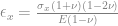 (3)
(3) (4)
(4) (5)
(5) is a measure of the effect of lateral confinement of either the odeometer specimen or the compressed layer in the field. At
  ,
,  and there is no confinement effect. At
  ,
,  , and the confinement effect is total: the “fluid” (which what it is in reality) is incompressible.
 is the uniaxial stress applied to the specimen/soil,
 (6)
(6) (7)
(7) 
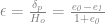 (8)
(8) (9)
(9) (10)
(10) and the coefficient of volume expansion
  are linearly, inversely proportional to each other.
 to be constant and both of these parameters are constant for the range of void ratios under consideration, consolidation settlement can be considered in a linear elastic way.
 plot below:
 are linearly proportional via
  (11)
(11) is constant for a given soil type.
 for a given sample (that’s just about a given for triaxial tests in any event)
 and
and  also remain constant.
 to change. The shear (and by extension the elastic) modulus of a material is a function of the void ratio. From the same source,
 (12)
(12)
 (13)
(13)


 vulcanhammer.net