This week we’ll turn in NAVFAC DM 7.2 to shallow foundations. It’s a well worn path and NAVFAC DM 7.2 does a good job covering it, but there are a points that are worth making. (Settlement for these foundations is covered in NAVFAC DM 7.1.)
Upper and Lower Bound Plasticity
It’s mentioned in both NAVFAC DM 7.1 and NAVFAC DM 7.2 but not really explained: the whole concept of upper and lower bound plasticity. Until recently most American textbooks avoided the subject; I used Verruijt’s coverage of the subject, which had problems of its own but gave a reasonable introduction to the subject. NAVFAC DM 7.2 refers to Terzaghi’s bearing capacity method (which really needs to be retired from use) as an “upper bound” method, but the truth is that all of the bearing capacity methods mentioned–Terzaghi, Brinch-Hansen, Vesić (more about that shortly) and Meyerhof–are all upper bound methods. For a credible lower bound method which is good to illustrate the concept with bearing capacity, take a look at my post Lower and Upper Bound Solutions for Bearing Capacity.
Geotechnical Eccentricity
For both square/rectangular and circular foundations, this gets nice coverage, with illustrations, in NAVFAC DM 7.2. It’s a subject my students wrestled with, especially when juxtaposed with “middle third” types of distributions (and that’s covered too,) and this will be a help.
Vesić’s Method
If there’s one serious lacuna in the presentation on bearing capacity, it’s the lack of coverage of Vesić’s Method. That’s because the FHWA, for better or worse, has adopted it (or a modification of same) as their principal recommended method for bearing capacity.
Groundwater and Layered Stratigraphies for Bearing Capacity
The coverage of both of these topics is extensive and welcome. The groundwater part is basically the same method as the FHWA uses; the layered part is an advance over this or any other method I’ve seen. One question hangs over the festivities: what’s the best way to put them together?
Shallow Foundations on Slopes
This represents a major advance over the old book. My students found Meyerhof’s method hard to use (I did too) and the tabular alternatives given are a welcome break.
Mat Foundations
This is always a difficult topic because, at the end of the day, a computer solution is necessary for a realistic analysis. In the interim NAVFAC DM 7.2 furnishes a method which hopefully will be helpful for preliminary or verification work. One topic that isn’t consistently treated is whether a foundation should be analysed as rigid or flexible in the first place. NAVFAC DM 7.1 was very helpful when I put together When Semi-Infinite Spaces Aren’t, and When Foundations are Neither Rigid Nor Flexible, and a similar approach here would have been helpful.
The rest of the chapter focuses on drainage of shallow foundations and rock and soil anchors. The latter edges into deep foundations, which will be our next topic.
Both of these topics get expanded–and welcome–coverage. Water pressure loads are important and needed the attention, especially for those of who teach–or have taught–these at the undergraduate level. With surface loading, a chart for rectangular loads has been included, similar in concept to the Fadum charts. The traditional Boussinesq (Flamant should be included, per Verruijt) with Terzaghi modifications, but these really need another look (the tests to confirm them date back to Spangler in the 1930’s.) Also extensively treated are compaction loads; although compaction adversely affects the permeability of the backfill, it is unavoidable in many cases.
Earthquake Loads
It’s a clear sign of the conservatism of the industry that, for all of the earthquake research that has taken place since the 1960’s, the method that NAVFAC DM 7.2 chose to feature is the Mononobe-Okabe method, which is a century old. I think the basic problem is that it converts a dynamic problem into a static one, which increases civil engineers’ comfort level with the method. A more thorough treatment of the method is here, but this is yet again another topic where, although NAVFAC DM 7.2 has chosen to reflect current practice, it’s time to more forward.
Although I suspect that it was a political decision to include it, I think it’s time to ditch the Terzaghi “low walls” method of analysis. At the time it was a nice, quick method for engineers armed with slide rules to design walls, but given the computational power–and the relative simplicity of the problem–I think it’s time to move on from this too.
MSE Walls
These have advanced a great deal since the older document; however, the complexity of designing these walls inspired the authors (who had covered many of these issues in NAVFAC DM 7.1) to “punt” to the FHWA’s offerings on the subject. These can be found on our page Mechanically Stabilised Earth (MSE) Walls.
Sheet Piles and Other Flexible Retaining Structures
As the co-author/editor of Sheet Pile Design by Pile Buck, I need to point out that many advances have been made in the reference materials on sheet pile design since US Steel’s Steel Sheet Piling Design Manual. The principal author of US Steel’s manual was Harry Lindahl, who went on to author the Pile Buck Steel Sheet Pile Design Manual (an immediate successor to US Steel’s manual) and began work on Sheet Pile Design by Pile Buck, a work which was interrupted by his untimely death and which I had the privilege to finish.
With that out of the way, we can proceed as follows:
The treatment of anchored walls includes the introduction of what the Corps refers to as a shear mobilisation factor (SMF,) but which NAVFAC DM 7.2 refers to as a safety factor. The two are, strictly speaking, not the same. The SMF is featured in A Simplified Method to Design Cantilever Gravity Walls. The factor of safety in sheet piling design is generally a straight reduction of the passive earth pressure coefficient, which would include both frictional and cohesive portions of the soil strength (the Corps’ method includes that but it isn’t included in NAVFAC DM 7.2.)
Rowe’s Moment Reduction method gets overhauled graphics, but it should be pointed out that it is necessitated by the reality of soil-structure interaction (SSI,) which is better handled by a software solution. A simple implementation of this can be found in Analyzing Sheet Pile Walls with SPW 2006 (although I don’t recommend it for commercial use, it’s good to see how such software works and for academic use.) The problem with software like this–and this is common with many numerical methods–is that the results of the software given the same data are not exactly the same with different software packages and numerical methods. Software like SPW911 (more about that in a moment) are replications of “closed form” methods which should give the same results following the same procedures, but do not take some of the complexities of actual application into account. That leads to the procedure itself, with issues such as…
I am not sure why NAVFAC DM 7.2 is averse to the use of the “simplified method” for cantilever walls, the conventional method is retained as normative. This has been in SPW911 for many years and used elsewhere with success, but there are American practitioners which have stuck with the conventional method.
The chart solutions given in NAVFAC DM 7.2 are a carryover from the old book; except for academic use, I don’t think they’re very useful. OTOH I don’t see regular design of sheet pile walls without software with some hand checks; as the anchored bulkhead design scenarios show, the calculations can become very complex very quickly. That’s true whether you use “hand solution automations” such as SPW911 or more sophisticated software.
Cellular cofferdams get a broad overview, but the complexity of the topics prohibits much more than that. We deal with this in Sheet Pile Design by Pile Buck.
Overall the treatment of these walls is an improvement over what we had before. Some of the issues are the function of the editorial decisions of the authors, but many are issues in the sheet pile community that themselves have not been resolved, as was the case with the lateral earth pressures.
Now we get into a topic which has certainly been of interest to me, the co-author/editor of Sheet Pile Design by Pile Buck. I’m going to begin by tackling the subject of lateral earth pressure theories. NAVFAC DM 7.2‘s treatment of this subject is illuminating but raises many questions about how these relate to each other and to the design of retaining walls.
Acknowledging the Source of Jaky’s Equation
I’ll start with another topic, namely that of Jaky’s Equation, which is the “standard” for at-rest earth pressure theories. The first thing that comes up is the definition of the coefficient of earth pressure, given as
(4-1)
The hard truth here is that this is the definition of any lateral earth pressure coefficient; the difference is which theory is applied. It’s not just for at-rest earth pressures.
Turning to Jaky’s Equation, the equation for at-rest lateral earth pressure coefficients is given as
(4-2)
Obviously for normally consolidated soils (OCR = 1) this reduces to
but this is Jaky’s Equation, which is the basis for Equation (4-2). I think that credit needs to be given to its originator as has been the case with textbooks and reference books for many years.
Will the Real Rankine Theory Please Stand Up?
Now we get to the interesting part: the nature of Rankine Theory. The fact that, for vertical walls with level backfill and no wall-soil friction, the lateral earth pressure equations for both Rankine and Coulomb theory are the same. This has led to a good deal of confusion on the subject, such as “Rankine theory is just Coulomb theory with no wall friction,” but this is not the case. Rankine Theory is based on the application of Mohr’s Circle, while Coulomb Theory has its origins in static equilibrium of soil wedges. NAVFAC DM 7.2 does a good job making this distinction but in the process a few observations are in order.
First, while NAVFAC DM 7.2 goes into detail on the level backfill/vertical wall case, it does not include the “extensions” developed for sloping backfill. It states that “…there are published techniques that can accommodate inclined backfills.” I discuss one of these in my post Rankine and Coulomb Earth Pressure Coefficients. Excluding these restricts the use of Rankine theory in the same way we see in, say, Tsytovich, except that provision for cohesion is included.
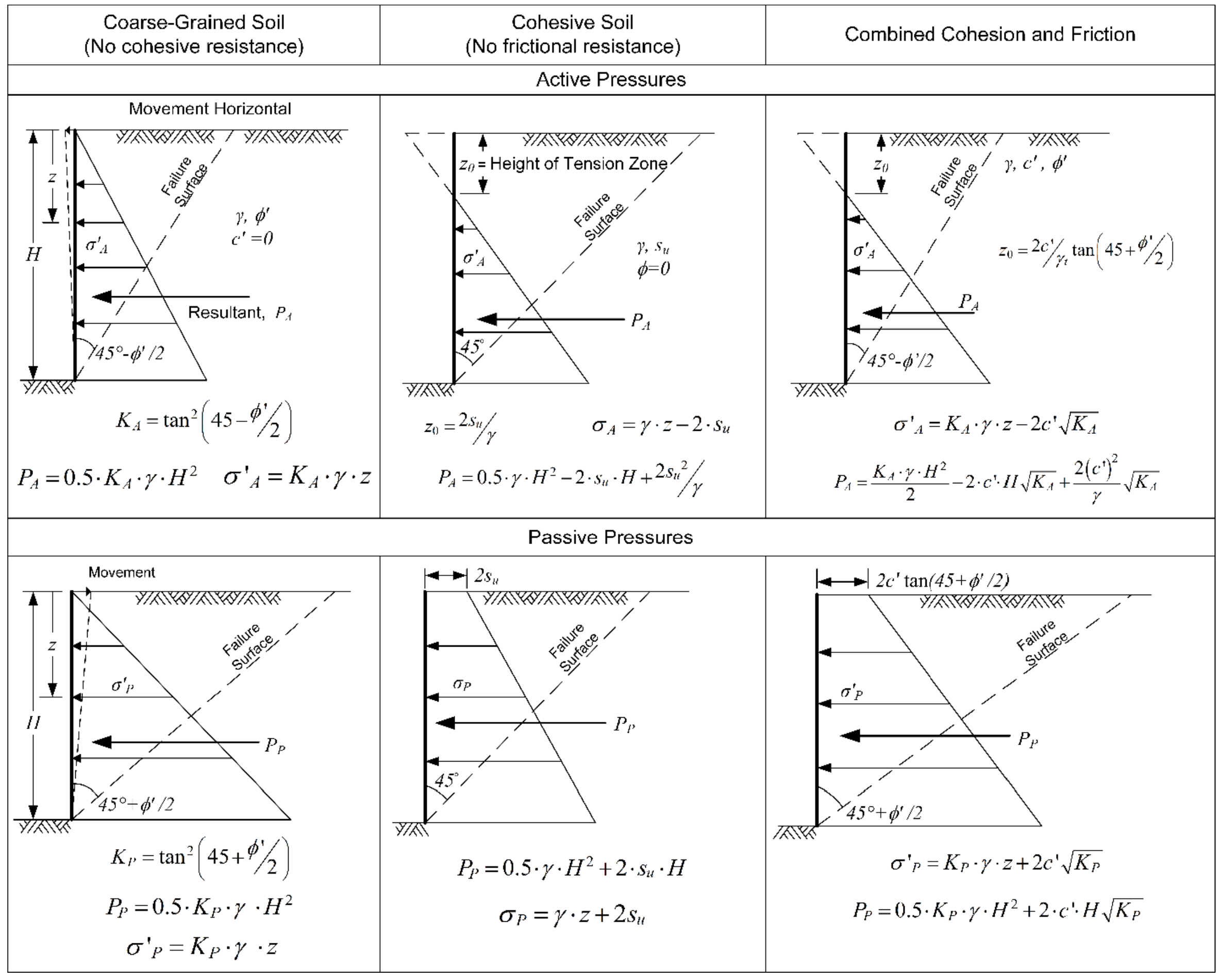
Pursuant to that inclusion, NAVFAC DM 7.2 redraws this diagram from DM 7.02 in this way:
If they’re serious about making a clear distinction between Rankine and Coulomb theories, they need to eliminate the failure surfaces in the diagrams. I’m as aware as anyone of the role failure surfaces play in things such as anchor design, but it doesn’t change the basic nature of the theories. (I’m aware that there are rupture surfaces in Rankine theory, but they are different than wedge failure. Inclusion of a diagram such as is shown below (from this source) would have clarified the distinction.)
Finally, I don’t understand why they included the material on wall/soil interface friction angles in the section on Rankine theory, since Rankine theory doesn’t take into account wall/soil friction (it doesn’t consider soil/soil friction along a failure surface either.)
And as for Coulomb…
The presentation on Coulomb theory is similar to that in the old book with redrawn graphics and some tighter limits on acceptable limits of parameters such as wall friction and backfill angle. As was the case with the old book, NAVFAC DM 7.2 includes charts for vertical walls with sloping backfill and no wall friction for both the earth pressure coefficients and failure plane angle. And, like the old book, it doesn’t really explain why these charts are important. Should we ignore wall friction in many cases (the old book implied that we could for active pressures)? And how do the results of Coulomb theory under these conditions compare with the “Rankine extensions” with which the new book dispenses but are found in practice? (The answer to the last question can be found in the post Rankine and Coulomb Earth Pressure Coefficients.) I think that, with topics like this where there is significant variance in the way the theory is applied, DM 7 in general tends to “punt” on issues like these.
Coulomb earth pressure inevitably lead to the issue of trial wedge methods for complex geometries and stratigraphies. Personally I think that, with the advent of FEA, trial wedge methods are obsolete. NAVFAC DM 7.2 notes that “…finite element and finite difference soil structure interaction software can be used to solve these types of problems, but considerable skill is required to obtain meaningful results.” The same observation could be made about trial wedge methods. As someone who spent two decades in geotechinical education (and more if you include my work on this site) I don’t see the generation of engineers coming up developing the skill set for trial wedge methods.
Log-Spiral Methods
Log-spiral theory (especially in the passive case) has two significant advantages over Coulomb theory: it more accurately models the failure surface (FEA eliminates the need to do that, it figures it out for itself) and that in turn results in a smaller soil wedge and lower (less unconservative) earth pressure coefficients. Using these require a chart solution, and NAVFAC DM 7.2 makes a significant advance in that it abolishes the correction table for different values of and simply presents the chart for as a typical value. The new book expresses doubts about the accuracy of these correction factors, but there’s one thing for sure: it’s much less confusing and subject to error in use, and will make classroom teaching of this method much easier. My only concern about these is applying them to walls where soil/wall friction is minimal, as is the case with fibreglass and vinyl sheet piling.
The FHWA’s Solution
In its discussion of the log-spiral method, NAVFAC DM 7.2 states that (…passive pressure should be computed using the log spiral method and not the Coulomb method.” This is obviously due to the advantages of log-spiral methods discussed above. It’s worth noting (and the book should have done so) that the FHWA’s usual solution to this problem is to use Coulomb active/log-spiral passive combinations in practice, as they explain in the Soils and Foundations Reference Manual. This would have buttressed support for their case and given the engineer more definitive guidance in what can be a confusing topic.
Lateral earth pressure is the oldest analytic topic in geotechnical engineering; Coulomb published his paper in the same year the American colonies declared their independence from Great Britain. It is an indication of the nature of the field that we still do not have a firm consensus on how these are to be precisely computed and applied.
This week we’ll look at Chapter 2 of the new NAVFAC DM 7.2, which covers excavations.
Vertical Excavations in Clay Soils
The chapter starts with Open-Cut Excavations, which gets into the issue of slope stability. That was covered in NAVFAC DM 7.1, but they make one mistake which needs some explanation. Their formula for the critical height of clay soils is the upper bound solution, namely
(2-1)
where su is the undrained shear strength of the clay and is the unit weight of the clay. I think the coefficient of 4 should be decreased (the lower bound is 2, which is what is used in lateral earth pressures) without some factor of safety in the formula. I discuss the whole business of upper and lower bound values for this in Soil Mechanics: Slope Stability, and will return to this topic later. (They do mention the fact that this is a metastable condition and that remoulding will change the soil properties, in this case adversely.
OSHA Trenching Standards
When I first became involved in Soils in Construction over twenty years ago, one of the recommendations from our reviewers for the Fifth Edition was that we include the OSHA trenching and shoring requirements. We did that and it made for a better book. NAVFAC DM 7.2 has updated that, also making for a better book and bringing the document in line with current practice. Trench collapses are preventable; this will help disseminate information on how to keep them from happening.
Deep Excavation Systems
The state of the practice in this field has brought many advances, and many of these are covered in this section of the book. This includes such things as king pile systems (which are featured on the cover of the book) and various types of support systems other than the venerable braced cuts, such as tiebacks and soil nails. The focus of the chapter on braced cuts is on settlement issues; the issues of lateral pressures are covered in Chapter 4.
Underpinning, Dewatering and Rock Excavation
These topics take up the rest of the chapter. Although much of this is qualitative, the underpinning section deals with more quantitative methods of estimating movements that would require underpinning of an adjacent foundation. The other sections are excellent and a good update both graphically and informationally. Dewatering is very job-specific and, given the uncertainties surrounding permeability, is still something of an art (although application of numerical methods will certainly shift it to a more analytical pursuit.)
This week we’ll look at the first chapter of the book. The whole business of “problem soils” is not straightforward because it’s a matter of degree. Given the nature of soils vs. other engineering materials, all soils are problem soils; it’s just that some soils pose a greater problem to those of us who choose to build on, under or next to them than others, greatly so in some cases.
Most of the problem soils identified in the chapter are clays: loess, expansive soils, residual silts and clays, etc. Organic soils are included in this list, although the best way to deal with most of these is to avoid them altogether. Most of the descriptions of these soils is qualitative rather than quantitative, and that’s the weakness of the whole discussion. While general awareness of these soils and the challenges they create is useful, some quantitative description would have been useful.
An example of this is the determination of the growth of expansive soils with changing water content. Many of the studies of the volume change in these soils produce results that are either too specific or too difficult to readily implement either in an academic setting (where qualitative discussions of these soils abound) or in practice. Some of this is addressed in DM 7.1, but a more thorough approach would have been appreciated. I tackled this issue by presenting van der Merwe’s method in a more detailed fashion than usual; some more of this here would have been helpful.
The last part of the chapter deals with specialty construction methods in a page diagram reminiscent of the old driven pile diagrams from the previous edition. These are helpful because many proprietary methods don’t get the coverage in undergraduate texts that would be useful in the field. Fortunately in these cases specific references to more detailed descriptions–including design information–are given. The documents referred to are available on this site.
And a word of thanks…
I want to thank all of you who ordered the new DM 7.2 after its introduction last month. And that was quite a few of you: this has been the most successful publication launch of any book I have offered since I started doing this in 2006. Thank you so much for your support of our publications; it means a great deal for the continuation of this site.
And then there was another surprise last week in the video launching of the book from the Geo-Institute:
Notice the book cover on the splash screen? I had no idea they would do that. The first volume noted that it had been on the bookshelves of engineers for many years, and at this point the only way to acquire these books in print (AFAIK) is here.

 (4-1)
(4-1) (4-2)
(4-2)

 and simply presents the chart for
  as a typical value. The new book expresses doubts about the accuracy of these correction factors, but there’s one thing for sure: it’s much less confusing and subject to error in use, and will make classroom teaching of this method much easier. My only concern about these is applying them to walls where soil/wall friction is minimal, as is the case with fibreglass and vinyl sheet piling.
 (2-1)
(2-1) is the unit weight of the clay. I think the coefficient of 4 should be decreased (the lower bound is 2, which is what is used in lateral earth pressures) without some factor of safety in the formula. I discuss the whole business of upper and lower bound values for this in
  vulcanhammer.net