Posted in Academic Issues, Geotechnical Engineering

An Anniversary, An Announcement and Looking Ahead

Today is an anniversary I’ve commemorated before: it’s the anniversary this web site/blog (take your pick) got its start as the Wave Equation Page for Piling. It’s been twenty-four years since I put the first pages on GeoCities, and it’s been going (with spin-offs) ever since. It’s time for a little looking back, and some looking forward too.

The year 2020 was traumatic for just about everyone but it was a good year for this site. It was even a better year in that most of the traffic to the site came from outside the United States (that trend has continued into 2021.) This is in spite of the fact that my students at the University of Tennessee at Chattanooga mostly access it from within the country, having no small part in the visits/page views for the site. (I say mostly; a few actually did so from outside the country, as they were forced to continue their coursework from overseas due to COVID.)

One of the long-term goals of this site has been to disseminate knowledge about geotechnical engineering to where it’s needed most: to developing countries which need to build their infrastructure and bring a better life to their citizens. In the first decade of this millennium, it tended to dominate the field, but realistically this is no longer the case. Nevertheless it remains an important resource in a shifting internet, and in a field where social media cannot (or at least has not) replaced the open internet.

One thing that has helped this change–and the long-term value of this site–has been the growing educational component of the site in Soil Mechanics, Soil Mechanics Laboratory and Foundations classes. I have taught consistently at UTC since 2009 and have put up most of my educational material for these courses on this site. The COVID pandemic only accelerated that; I taught this past academic year completely online, which necessitated putting the lectures onto YouTube. This means that one can take entire courses (except for the homework and tests) on this site, or use this material as a facilitator for online courses.

That leads to the next announcement: I am retiring from full-time teaching at the end of the month. There’s a lot of academic “inside baseball” in that, but I will revert to adjunct teaching after that time, as I did before my full-time appointment in 2019. I will continue, Lord willing, to teach in the immediate future, and also plan to continue to build this site with new educational materials of all kinds, both for the courses and for the documents that have been a hallmark of this site from its earliest times.

As always, thanks for your support, or as I say at the end of all my videos, thanks for watching and God bless.

Posted in Soil Mechanics

Soil Mechanics Textbook by Tsytovich Available

Up until now the only comprehensive soil mechanics textbook we offered for download was Verruijt’s. We now add to that N. Tsytovich’s Soil Mechanics. Download is at the link or at the book cover below; information on the book is as follows:

This is a textbook in the course of Soil Mechanics for higher-school students of civil engineering and hydrotechnical engineering, and also for students of other specialties associated with construc­tion of engineering structures, such as road constructors, ameliorators, geologists, soil scientists.

The Author has made an attempt to write a concise course on the basis of a wide synthesis of natural sciences and to present the theore­tical data in the most simple and comprehensive form, without depreciating, however, the general scientific aspect of the problem; his other aim was to present a number of engineering solutions of problems in the theory of soil mechanics (calculations of strength, stability and deformability), which might be widely used in engi­neering.

Some problems in the book are discussed from new standpoints which take into account the principal properties of soils: contact shear resistance, structure-phase deformability (including creep of skeleton), compressibility of gas-containing porous water, and the effect of natural compaction of soils.

The book shows some new methods used for determination of characteristics of soils and gives some new solutions of the theory of consolidation and creep of soils, which can be used for predictions of settlement rates of foundations of structures and their time varia­tions; a separate chapter discusses rheological processes in soils and their significance.

Topics include the following:

  1. CHAPTER ONE. THE NATURE AND PHYSICAL PROPERTIES OF SOILS
    • Geological Conditions of Soil Formation
    • Components of Soils
    • Structural Bonds and Structure of Soils
    • Physical Properties and Classification Indices of Soils
  2. CHAPTER TWO. BASIC LAWS OF SOIL MECHANICS
    • Compressibility of Soils. The Law of C o m p a c t i o n
    • Water Perviousness of Soils. The Law of Laminar Filtration
    • Ultimate Contact Shear Resistance of Soils. Strength Conditions
    • Structural-Phase Deformability of Soils
    • Features of the Physical Properties of Structurally Unstable
      Subsidence Soils
  3. CHAPTER THREE. DETERMINATION OF STRESSES IN SOIL
    • Stress Distribution in the Case of a Three-Dimensional Problem
    • Stress Distribution in the Case of a Planar Problem
    • Pressure Distribution over the Base of the Foundation of
      Structures (Contact Problem)
  4. CHAPTER FOUR. THE THEORY OF ULTIMATE STRESSED STA­TE OF SOILS AND ITS APPLICATION
    • Stressed State Phases of Soils with an Increase in Load
    • Equations of Ultimate Equilibrium for Loose and Cohesive
      Soils
    • Critical Loads on Soil
    • Stability of Soils in Landslides
    • Some Problems of the Theory of Soil Pressure on Retaining Walls
    • Soil Pressure on Underground Pipelines
  5. CHAPTER FIVE. SOIL DEFORMATIONS AND SETTLEMENT OF
    FOUNDATIONS
    • Kinds and Causes of Deformations
    • Elastic Deformations of Soils and Methods for Their Determi­nation
    • One-Dimensional Problem of the Theory of Soil Consolidation
    • Planar and Three-Dimensional Problems in the Theory of Fil­tration Consolidation of Soils
    • Prediction of Foundation Settlements by the Layerwise Summa­tion Method
    • Prediction of Foundation Settlements by Equivalent Soil Layer Method
  6. CHAPTER SIX. RHEOLOGICAL PROCESSES IN SOILS AND THEIR SIGNIFICANCE
    • Stress Relaxation and Long-Term Strength of Cohesive Soils
    • Creep Deformations in Soils and Methods for Their Description
    • Account of Soil Creep in Predictions of Foundation Settlements
  7. CHAPTER SEVEN. DYNAMICS OF DISPERSE SOILS
    • Dynamic Effects on Soils
    • Wave Processes in Soils under Dynamic Loads
    • Changes in the Properties of Soils Subject to Dynamic Effects
    • The Principal Prerequisites for Taking the Dynamic Proper­ties of Soils into Account in Vibrational Calculations of Founda­tions
Posted in Uncategorized

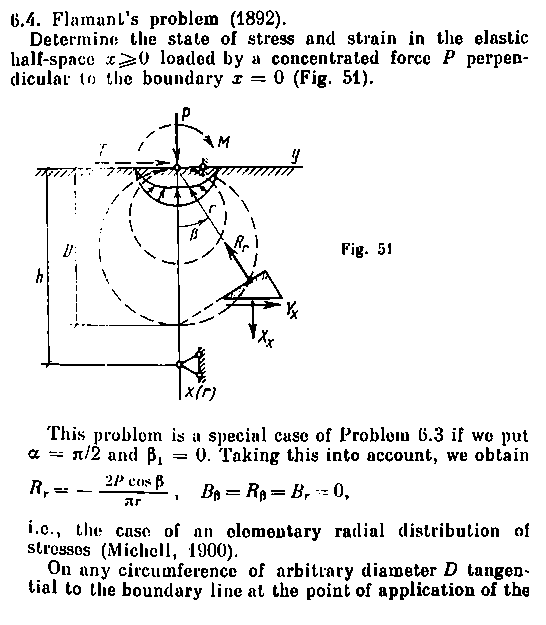
Derivation of Flamant’s Equations for the Elastic Response Under a Line Load

In the last post I showed the derivation of the elastic response of a soil to a point load using Boussinesq theory. This is a common part of elementary Soil Mechanics courses but it is uncommon to see the derivation.

The same situation exists with a line load, the elastic solution usually attributed to Flamant. The solution itself also presented in NAVFAC DM 7.01 and Arnold Verruijt’s Soil Mechanics. The derivation is presented below, and comes from the Manual of the Theory of Elasticity, by V.G. Rekach. Some discussion of similar solutions is in my post Analytical Boussinesq Solutions for Strip, Square and Rectangular Loads and my class presentation is at Soil Mechanics: Elastic Solutions to Soil Deflections and Stresses.

Posted in Academic Issues, Geotechnical Engineering

Derivation of Boussinesq’s Stress and Strain Equations for a Point Load on a Semi-Infinte Space (like soil)

Most Soil Mechanics and Foundations text and reference books (such as NAVFAC DM 7.01 and Verruijt) state the equations for Boussinesq’s point load problem without proof. For those who are interested in how these equations are developed, below is the derivation, taken from Manual of the Theory of Elasticity, by V.G. Rekach, where more detail is given along with the notation, which is different from what we have in the U.S.. The derivation from Rekach is given below.

Posted in Geotechnical Engineering

Manual of the Theory of Elasticity, by V.G. Rekach

An introduction to problems in the theory of elasticity. You can download the book by clicking here. Contents are as follows: Notation Chapter I Theory of Stress I. Static and Dynamic Equilibrium Equations II. Surface Conditions III. State of Stress at a Point Problems Chapter 2 Theory of Strain I. Strain Equations in Orthogonal Co-ordinates […]

Manual of the Theory of Elasticity, by V.G. Rekach