Posted in Academic Issues, Geotechnical Engineering

A Quick Preliminary Way to Determine Slope Stability

Slope stability for circular failure surfaces is one of those topics where, for a complete solution, solving the problem has involved a computer solution before there were computers. The problem is that it is necessary to a) discretise the problem before solving it, in this case using slices, and b) try a large number of circle centre locations before finding the right one. The problem is illustrated below.
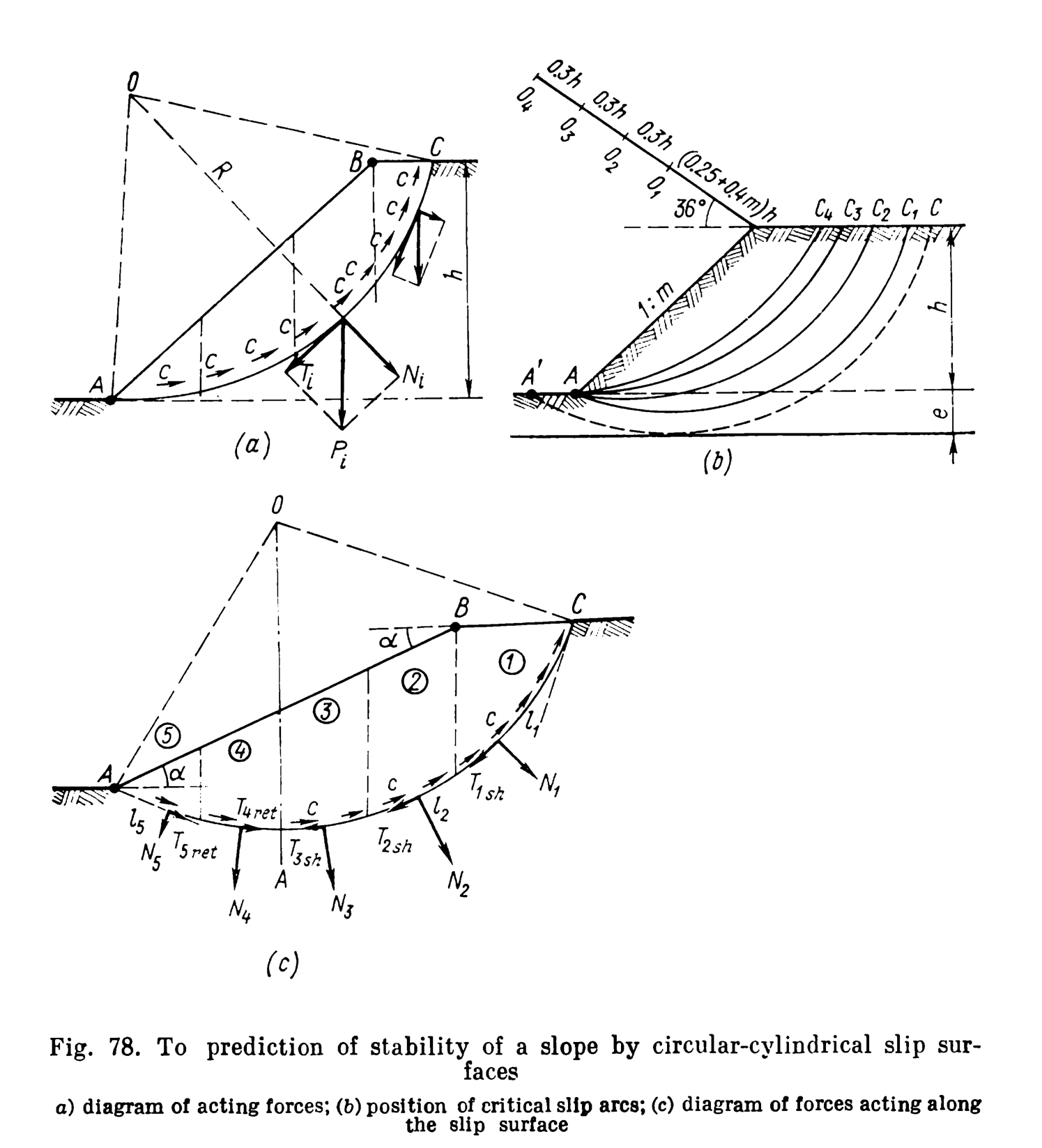
Prediction of slope stability by circular-cylindrical slip surfaces (from Tsytovich (1976))

One common method has been to use charts. A commonly used group is the Janbu series of charts, one of which is shown below.
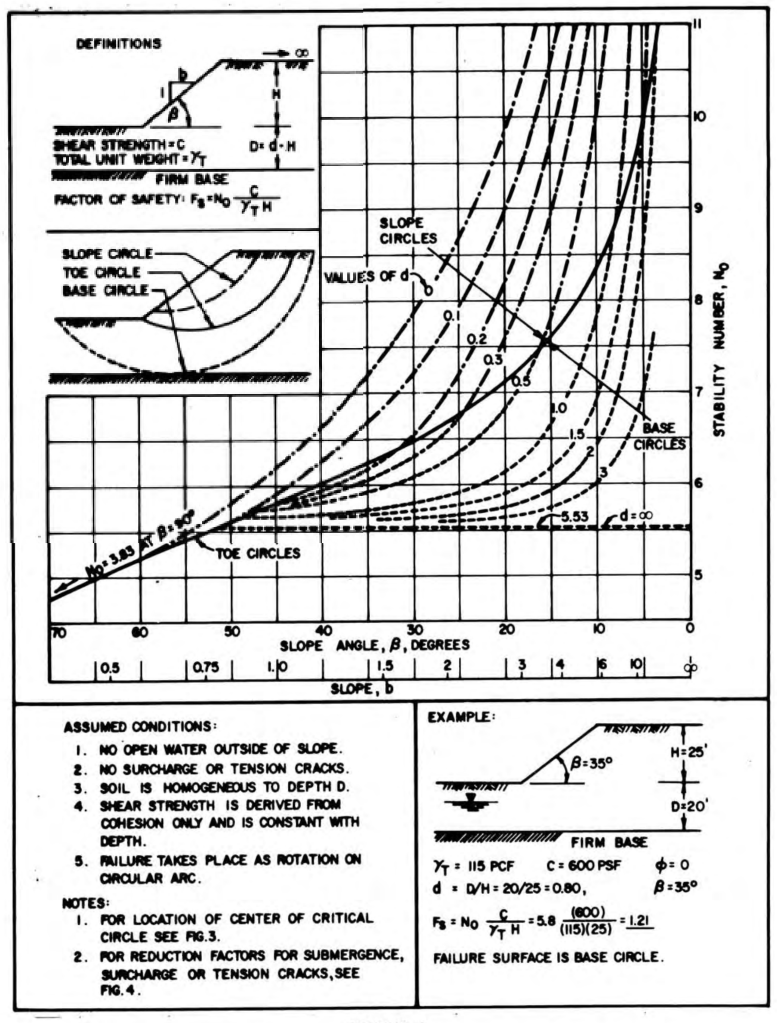
Janbu Chart for cohesive soil (from NAVFAC DM 7.01)

A simpler solution is presented by Tsytovich (1976). The equation proposed there is this:

{\it FS}=\tan(\phi)A+{\frac {cB}{{\it \gamma}\,h}} (1)

where

  • FS = factor of safety
  • \phi = internal frictional angle of the soil
  • c = cohesion of the soil
  • \gamma = unit weight of the soil
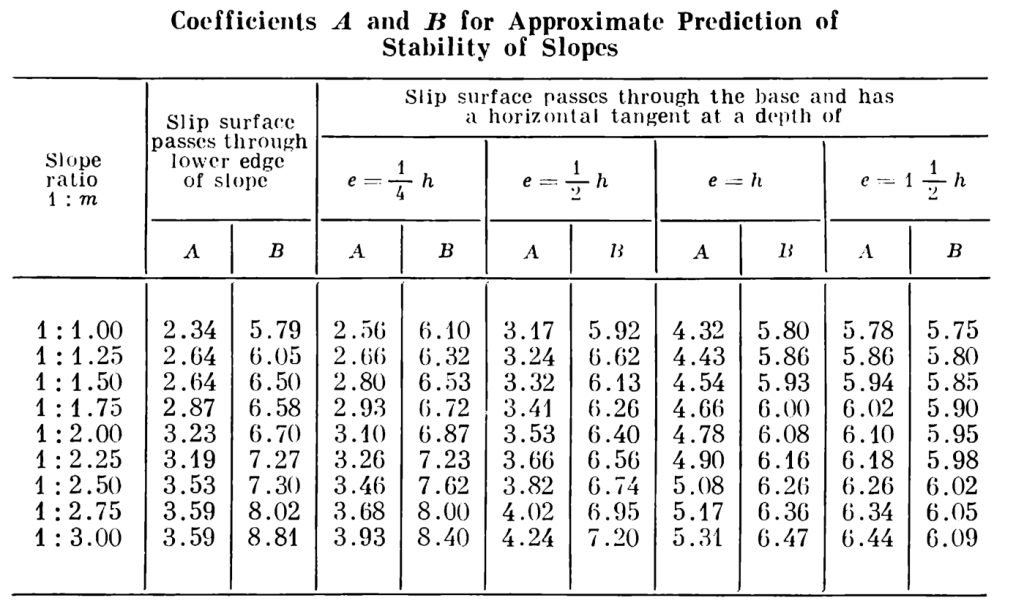
  • A,B = coefficients given below, functions of e and h
  • e = distance from slope toe to hard underground layer (see Figure 78(b))
  • h = height of slope from toe to top (see Figure 78(b))
  • m = second number of slope ratio rise:run (see Figure 78(b))

It is also possible to solve for a maximum height, thus:

h={\frac {cB}{{\it \gamma}\,\left ({\it FS}-\tan(\phi)A\right )}} (2)

Coefficients of A and B for Approximate Prediction of Stability of Slopes (from Tsytovich (1976))

As an example, consider a slope with an angle of 35 degrees and a height of 20′. The soil has an internal friction angle of 15 degrees, a cohesion of 600 psf and a unit weight of 120 pcf. Estimate the factor of safety against slope failure using the method described. For this slope e = 0, so assume the slip surface passes through the lower edge (toe) of the slope.

The slope ratio 1:m is the reciprocal of the tangent of the slope given. Taking the tangent and inverting it gives a slope ratio of 1:1.43. It can be seen by inspection that A = 2.64 and through interpolation B = 6.38. Direct substitution yields a factor of safety of 2.3.

As a comparison we use the Slope program from our Soil Mechanics Course, the results are shown below using Fellenius’ Method.
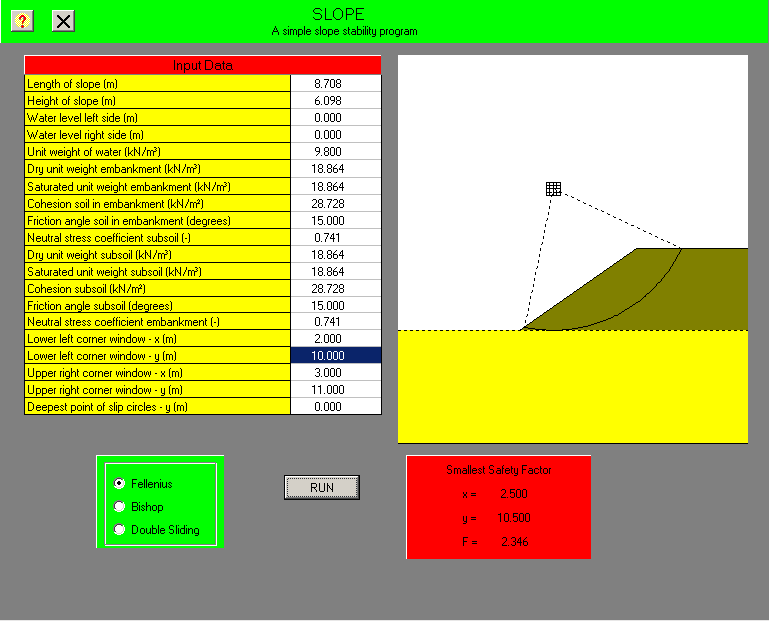
The factor of safety is very close. If we used Bishop’s Method in the program, we could expect the factor of safety to increase. One thing absent from this problem is the presence of water, which always complicates slope stability analysis.

If we consider the example problem from the Janbu chart above, Equation (1) reduces to the equation for FS on the chart provided that B = N_o . Doing the linear interpolation yields B = 6.05 , which is higher than the N_o = 5.8 on the chart, or FS = 1.26 .

Obviously the method is not suitable for final design but it is interesting for producing preliminary results for a problem which has traditionally been computationally difficult.

Posted in Academic Issues, Geotechnical Engineering

Foundation Design and Analysis: Shallow Foundations, Bearing Capacity

Other resources:

Note: this is an update from an earlier lecture, which actually combines two lectures as well. Some new equipment was used; however, the “live screen” method didn’t quite work out, which meant that I ended up putting the slides in the video during video editing. Since I point to the slides from time to time, this may end up with some awkward moments. I apologise for any inconvenience.

Posted in Geotechnical Engineering

General Geology – Lange, Ivanova, Lebedeva — Mir Books

In this post, we will see the book General Geology by O. Lange; M. Ivanova; N. Lebedeva. About the book The book is a basic introduction to geology. The first two chapters talk about the origin of the Earth and its properties, and the outer geospheres of earth: the atmosphere, hydrosphere, biosphere and lithosphere. The […]

General Geology – Lange, Ivanova, Lebedeva — Mir Books
Posted in Geotechnical Engineering, Soil Mechanics

Superposition, and Using Point Loads in Place of Distributed Ones

Elastic solutions to stresses induced by loads at the surface have their limitations, but they allow the use of the principle of superposition. The principle of superposition states that you can add the effects of different loads on a single point. Superposition requires that the stress state of the point be path independent, which is the case with elastic conditions. No matter how you load and unload a point in a system, if elasticity is maintained the result will be the same for a given set of loads.

This is illustrated for point loads in the graphic below, but it applies to distributed loads (such as this and this) as well.

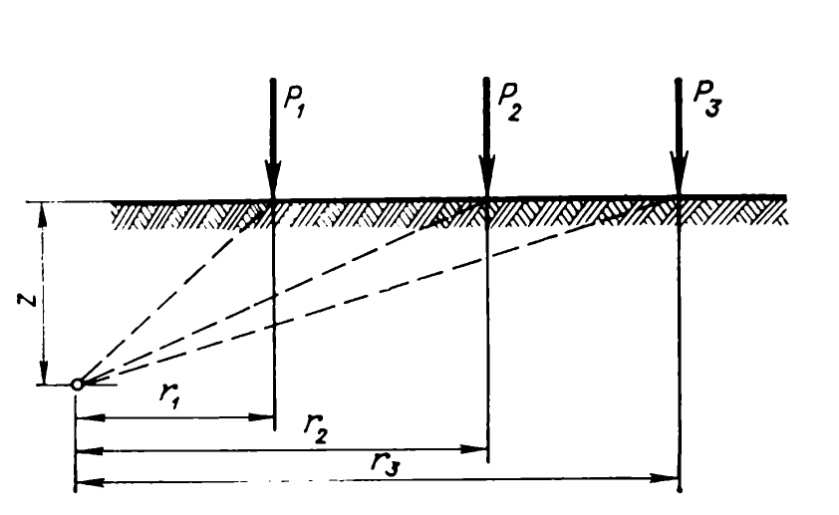
Action of a Number of Concentrated Forces (from Tsytovich (1976))

The stresses that result from each load affect the total stress at the point of interest. They can be computed and added together. So, since “point” loads are physically impossible, is their computation be useful? The answer to this question is “yes” but it takes some judgement, like so many things in geotechnical engineering.

Let us consider the following case, from NAVFAC DM 7.01.

Separate Column Footings Problem, from NAVFAC DM 7.01

To solve this problem, DM 7 converted the square footings to circular ones and then used the chart shown in the post Going Around in Circles for Rigid and Flexible Foundations. This chart, like others, is hard to read. Is it possible to use point loads as a substitute?

There are three things we need to note here. The first is that the load on each column is 27 tons, and is the same for each column.

The second is that the “r” shown in the table above is not the same as it is for the point loads. The variable “r” for the point loads is the horizontal distance from the load to the point of interest.

The third is that there are three column positions shown in the diagram, with three corresponding values of r:

  • The column on top of the load, Column B2
  • The columns in the mid-point of the edges, Columns A2, B1, B3, and C2. These have an value of r of 15′ from the point of interest.
  • The columns in the corners of the square, Columns A1, A3, C1, and C3. These have a value of r of 21.2′ from the point of interest.

Now, instead of the chart, we apply the formula derived earlier for the influence coefficient, which is

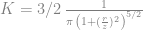
K=3/2\,{\frac {1}{\pi \,\left (1+(\frac{r}{z})^{2}\right )^{5/2}}}

from which the stress is computed by the equation

\sigma_z = K \frac{P}{z^2}

Using this formula, we can construct the table below for this problem.

(1) Z, ft(2) r/Z for B2(3) r/Z for A2, B1, B3, C2(4) r/z for A1, A3, C1, C3(5) K for B2(6) K for A2, B1, B3, C2(7) K for A1, A3, C1, C3(8) Stress for B2, tsf(9) Stress for each of A2, B1, B3, C2, tsf(10) Stress for each of A1, A3, C1, C3, tst(11) Total Stress at Z, tsf
207.50010.6070.4770.0000.0003.2230.0000.0003.224
403.7505.3030.4770.0010.0000.8060.0010.0000.810
602.5003.5360.4770.0030.0010.3580.0030.0010.370
1001.5002.1210.4770.0250.0070.1290.0070.0020.163
1501.0001.4140.4770.0840.0310.0570.0100.0040.113
2000.7501.0610.4770.1560.0730.0320.0110.0050.094
2500.6000.8490.4770.2210.1230.0210.0100.0050.080
Results from the Separate Column Footings problem in NAVFC DM 7.01, using point loads. Note that the stresses in Columns 9 and 10 are due to a single column, and not all four of them. The total stress in column (11) is the sum of the stress in Column 8 plus 4 times the result in Column 9 plus four times the result in Column 10.

We could have opted to add the influence coefficients and then compute the stresses since, for each elevation Z, both the elevation and the column load were the same. We did not for clarity; it is certainly possible to have columns of different loads.

The results are conservative, they tend to be higher, especially at the lower value elevations. It’s worth noting that the total stress at Z = 2′ is higher than the distributed loads on the footings. One way to make this better is to use the center formulae for stress under circles for Column B2 and point loads for the rest. Given, however, the limitations of the method in general, and the considerably lower effort in obtaining the influence coefficients, the method is a reasonable one to use.

Superposition doesn’t only apply to point loads; the example given in the post Analytical Boussinesq Solutions for Strip, Square and Rectangular Loads uses it for rectangular and square loads. Nevertheless, with appropriate engineering judgement, using point loads in place of distributed loads can be a viable option.

Posted in Academic Issues, Geotechnical Engineering

The “Quick and Dirty” Way to Derive Boussinesq’s Point Load Stress Equations

In another post we show the formal, nice way to derive the equations for stresses under point loads. Here we’re going to show a “quick and dirty” way to derive them (or at least some of them.) It’s based on Tsytovich (1976) but I have made some changes to tighten up the theory behind them and make them a little more comprehensible. They don’t derive all of the equations, but the method gives a better physical understanding of what’s going on when we apply such a load to the ground surface.

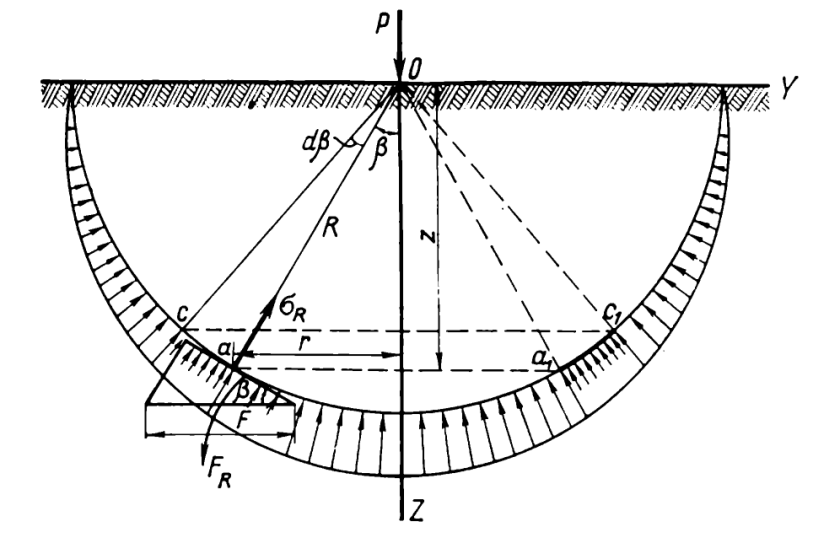
Let’s start with Tsytovich’s diagram, shown below.

Radial stresses under the action of a concentrated force (from Tsytovich (1976))

It can be shown that this state exists due to static equilibrium. The point load P forms a sphere around itself; the principal stresses \sigma_R radiate from the load, forming a sphere around the point of radius R. The magnitude of the stress is given by the equation


\sigma_R = A \frac{\cos(\beta)}{R^2}

By same static equilibrium, the vertical force of the stresses and P are thus

P-\int_{0}^{2\,\pi}\!\sigma_{{R}}\cos(\beta){dF}=0

The infinitesimal surface area of the stress can be defined as

dF = 2\pi(R \sin\beta)(R d\beta)

Substituting this into the integral yields

P-\int_{0}^{1/2\,\pi}\!2\,\sigma_{{R}}\cos(\beta)\pi\,{R}^{2}\sin(\beta){d\beta}=0

Making appropriate substitutions, the integral evaluates to

P-2/3\,A\pi =0

and thus

A=3/2\,{\frac {P}{\pi }}

Substituting,

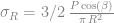
\sigma_R = 3/2\,{\frac {P\cos(\beta)}{\pi \,{R}^{2}}}

We want the vertical and shear stresses at this point. What we need is a conversion from the polar to cylindrical coordinates, which are given by the equations (Timoshenko and Goodier (1951))

\sigma_{{z}}=\sigma_{{R}}\left(\cos(\beta)\right)^{2}+\sigma_{{T}}\left(\sin(\beta)\right)^{2}
\tau_{{\it rz}}=\left(\sigma_{{R}}+\sigma_{{T}}\right)\sin(\beta)\cos(\beta)

These are coordinate transformations for plane stress equations and are discussed in detail in Boresi et.al. (1993) in terms of the direction cosines of the stress vectors. It may seem odd to see sine terms for these but \cos\beta = \sin(\beta-\frac{3\pi}{2}) . If we also assume that \sigma_T = 0 , again substituting we have

\sigma_{{z}}=3/2\,{\frac {P\left (\cos(\beta)\right )^{3}}{\pi \,{R}^{2}}}
\tau_{{{\it rz}}}=3/2\,{\frac {P\left (\cos(\beta)\right )^{2}\sin(\beta)}{\pi \,{R}^{2}}}

Since

\beta = \arccos({\frac {z}{\sqrt {{z}^{2}+{r}^{2}}}})

and

R = \sqrt {{z}^{2}+{r}^{2}}

substituting both of these yields our desired result

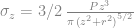
\sigma_{{z}}=3/2\,{\frac {P{z}^{3}}{\pi \,\left ({z}^{2}+{r}^{2}\right )^{5/2}}}
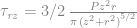
\tau_{{{\it rz}}}=3/2\,{\frac {P{z}^{2}r}{\pi \,\left ({z}^{2}+{r}^{2}\right )^{5/2}}}

Many textbooks (such as Verruijt) state these equations in terms of R, but in general problems such as this are defined most simply in terms of the depth of the point of interest z and the horizontal distance from that point r.

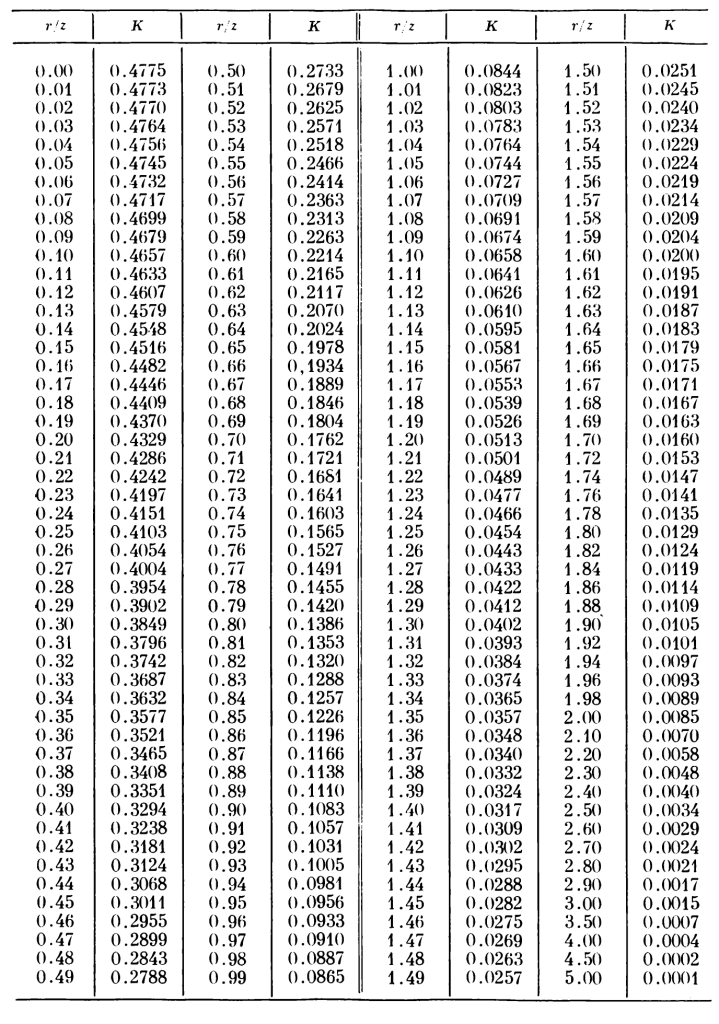
For the vertical stresses, if we define an influence coefficient

K=3/2\,{\frac {1}{\pi \,\left (1+(\frac{r}{z})^{2}\right )^{5/2}}}

then

\sigma_z = K \frac{P}{z^2}

and we can use the following table to determine the influence coefficients K.

Influence Coefficient K to calculate vertical stresses from a concentrated force for a given r/z ratio (from Tsytovich (1976))

The reason we’ve skipped the lateral stresses is because they’re dependent upon the elastic properties of the soil, and also because the vertical stresses are of greater interest.

The point load problem is an important one because many of the area load problems are based on its solution. It can also be used in other ways in spite of the fact that the solution is singular at the point where the load is applied.

Other References

  • Boresi, A.P., Schmidt, R.J., and Sidebottom, O.M. (1993) Advanced Mechanics of Materials. Fifth Edition. New York: John Wiley and Sons.
  • Timoshenko, S., and Goodier, J.N. (1951) Theory of Elasticity. New York: McGraww-Hill Book Company, Inc.