Posted in Academic Issues

Advice to Graduates: Past Performance is Not a Guarantee of Future Returns

It’s the time of the year when most people graduate from whatever school they’re graduating from.  This is a hypothetical graduation address, aimed a college students.

These days college–especially undergraduate studies–is a long, expensive undertaking, usually accomplished by a large amount of debt.  (Come to think of it, what in our society is accomplished without a large amount of debt?)  And yet, in spite of the long-term obligations that come with it, people continue to put a great deal of stock and effort in a college education.  Why is this?  Most of you know the answer: because jobs and careers opened up by a college education have a higher level of compensation than those that don’t, at least overall.  College seen in this way is an investment, and I’ll come back to the financial analogy.

One thing I’ve noticed while walking the halls of Old Kudzu (“Old Ivy” is more appropriate for places Up North which are not appropriate to speak about here) is the “first in family” thing about college.  There’s a great deal of emphasis on those people who have broken the multigenerational custom of living and dying for a college athletic program without having stepped foot on campus except to head to the football stadium.  As you would expect, an elitist snob like me doesn’t have that experience.  I come from a long line of “college men” whose main problem wasn’t going to college: it was getting to the place you’re at today, i.e., graduating.  Today that’s another obsession of our educational system.  We’re told that our graduation rates are too low, with the implication that those who don’t walk the stage don’t walk the golden path of success in life.  But somehow my ancestors were successful in spite of that fact.

chw-lehigh-2
One that actually did make it to the end was my grandfather, Chester H. “Chet” Warrington, who graduated–after giving his parents much heartburn–from Lehigh in 1912. He’s there on the right, before he actually made it through.

Even though he graduated from the birthplace of Tau Beta Pi, engineering’s highest honour fraternity, he wasn’t much of a scholar.  There have been many changes in the whole meaning of a university education from his day to ours, and one of them is how much more competitive our system–in and out of academia–has become.  In those days college was largely the province of the well-heeled, and the “Gentlemen’s C” was not a dishonourable result.  (I would say that the “Gentlemen’s C” is still very much alive and well on campus today, in spite of the changes!)

But we, as we do with just about everything, have pushed the whole business of academic achievement to the limit.  It’s surely frustrating to most academics that people who aren’t very good students actually have a successful life in this world, as my grandfather had.  It’s even more frustrating that, after all of the glow people put around academia, the money goes elsewhere.  So we’ve had a drumbeat, of late, of how important it is for people to have very high grades, and to correlate (at least in our minds) those high grades with success in life, and ultimately to try to rig the system so that those who do well in an academic setting will be afforded similar success afterwards.

But life neither starts or ends on campus.  And sometimes the reality of life wedges its way onto campus.  A good example of that happened in one of my classes last year, and the life lesson it taught bears repeating.

One of the courses I teach is Foundations.  First question some ask is “Foundations of What?” There are many “foundations” courses on campus to introduce students to a wide variety of subjects, but mine is the Foundations course par excellence: it concerns the design of foundations for real structures such buildings, bridges and the like.  This past year my students convinced me, for their design project, to enter the American Society of Civil Engineers MSE wall contest.  An “MSE” wall, for the uninitiate, is a Mechanically Stabilised Earth wall.  If you’ve driven down the interstate and seen newer walls flanking the roadway, usually with fancy decorations, you’ve probably seen an MSE wall.  The fancy decorations, however, have nothing to do with that: behind the front of an MSE wall is a network of grids and meshes by which the earth behind the wall actually helps to hold it up rather than just trying to push it down.

In this competition, the students build a large wooden box with a removable face.  They then put an MSE wall entirely built of kraft paper and tape behind it and fill the box with sand.  Removing the face, the moment of truth comes when the wall either holds the sand in place, leaks a great deal of sand, or collapses with sand on the floor following.

The class divides itself into two teams, using an electronic sign-up system.  When the team compositions were finalised, the “buzz” around the class was that one team was made up of the “smart” people and the other wasn’t.  I was unconvinced that it was that rigged; years in the private sector and engineering practice gave me the gut feeling that the outcome would not follow the conventional wisdom.

It didn’t.  When the removable panel was in fact removed, both walls held, but the “smart” team had the scarier moment as their wall bulged and leaked considerably.  Conventional wisdom took another hit.  But the whole point of an educational system is to learn something, and there’s a good lesson here.

There’s a great deal of emphasis on the value of intelligence these days.  It’s almost an obsession, really, and permeates our whole system, from child rearing to the educational system itself and ultimately to the credentialling system that marks the road to the top.  Raw intelligence, however, is only one piece of the puzzle.  That intelligence has to be properly applied to achieve the best results, and that application includes two things: an understanding of the environment in which you’re operating and the willingness to put the effort in to attain the goal.  Those two elements are frequently lacking, and I speak from experience: the lack of those two elements have led to many of the mistakes I have made in life.  Although there’s a great deal of talk about including “real life experiences” in an academic course, to be honest time constraints and the same lack of understanding in academics lead many such efforts to fall flat.

Even with the political clout that our financial system has these days, it’s still necessary for those selling financial products to make this disclaimer (or one like it): “Past Performance is Not a Guarantee of Future Returns”.  I think that should be placed somewhere, or at least watermarked, on every diploma issued by institutions of higher education.  Those of you who have finished the course of study can be justifiably proud of what you have done.  But you and the society you live and move and have your being in need to understand that what you’ve done isn’t a guarantee that what you do subsequently will have the golden touch.  The society that believes that and promotes accordingly is itself heading for a fall.  It was the hard lesson that Ch’ing Dynasty China found out the hard way the century before last; we will follow suit if we do likewise, our fall being at the hand of the same Chinese (with others) who did learn the lesson.

Graduation is a time of celebration, but, as the Latin root notes, it’s just another step in life.  The education doesn’t stop here, and by that I don’t mean the continuing education requirements that permeate our professional credentials.  Making the education work is the new task, and in many ways it’s as important–if not more important–than the first.
Posted in Academic Issues

Tech Symposium offers 130 student projects to local community

Engineering and computer science students from UTC displayed 130 projects at the second Tech Symposium in the downtown library.

Source: Tech Symposium offers 130 student projects to local community

Posted in STADYN

STADYN Wave Equation Program 10: Effective Hyperbolic Strain-Softened Shear Modulus for Driven Piles in Clay

It’s been a while, but we hope it’s worth the wait: the monograph Effective Hyperbolic Strain-Softened Shear Modulus for Driven PIles in Clay is now available.  It was presented at the Research Dialogues for the University of Tennessee at Chattanooga 9-10 April 2019.  The abstract is as follows:

Abstract: Although it is widely understood that soils are non-linear materials, it is also common practice to treat them as elastic, elastic-plastic, or another combination of states that includes linear elasticity as part of their deformation. Assuming hyperbolic behavior, a common way of relating the two theories is the use of strain-softened hyperbolic shear moduli. Applying this concept, however, must be done with care, especially with geotechnical structures where large stress and strain gradients take place, as is the case with driven piles. In this paper a homogenized value for strain-softened shear moduli is investigated for both shaft and toe resistance in clays, and its performance in the STADYN static and dynamic analysis program documented. A preliminary value is proposed for this “average” value based upon the results of the program and other considerations.

The slide presentation for this follows:

This slideshow requires JavaScript.

Posted in Academic Issues

The Raising of the Maine, Cellular Cofferdams, Why Puerto Rico is Part of the U.S., and Why Puerto Ricans are Americans

On this day in 1898 the USS Maine was sunk in Havana harbour, which precipitated (after a great deal of “yellow journalism” on the part of the American press) the Spanish-American War.  This topic is of interest, not only because of its place in American history, but also in the history of geotechnical engineering, as it was an early large-scale application of sheet piling and an early use of cellular cofferdams.

The cause of the Maine’s explosion is still a matter of debate, although the weight of the evidence leans toward some kind of coal explosion.  The Maine used the same type of Scotch marine boilers that Vulcan preferred for its offshore hammers in the 1960’s and onward; coal was the usual fuel at the time.  It was necessary, sooner or later, to get the wreckage off of the bottom of Havana harbour, and that involved a celluar cofferdam.  The following description of the job comes from H.S. Jacoby and R.P. Davis, Foundations of Bridges and Buildings, New York, NY: McGraw-Hill Book Company, 1914:

The cofferdam for raising the “Maine” represents a special type of steel cofferdam, very large and strong.  *”The problem was to surround the wreck of the vessel, lying in about 29 to 37 feet of water, with a cofferdam, which when unwatered would be tight enough to prevent leakage, strong enough to resist outside water and mud pressures, and a protection that would assure safety during the work.  The cofferdam should be self-sustaining, if possible.  Bracing by struts across its interior to resist the water and mud pressures might be difficult to install and would interfere with the operation of removal.  The borings indicated bad conditions for foundations.  The building of a cofferdam without internal bracing, which would withstand pressures from a head of 37 feet of water and practically 21 to 23 feet of mud, was an unprecedented task.

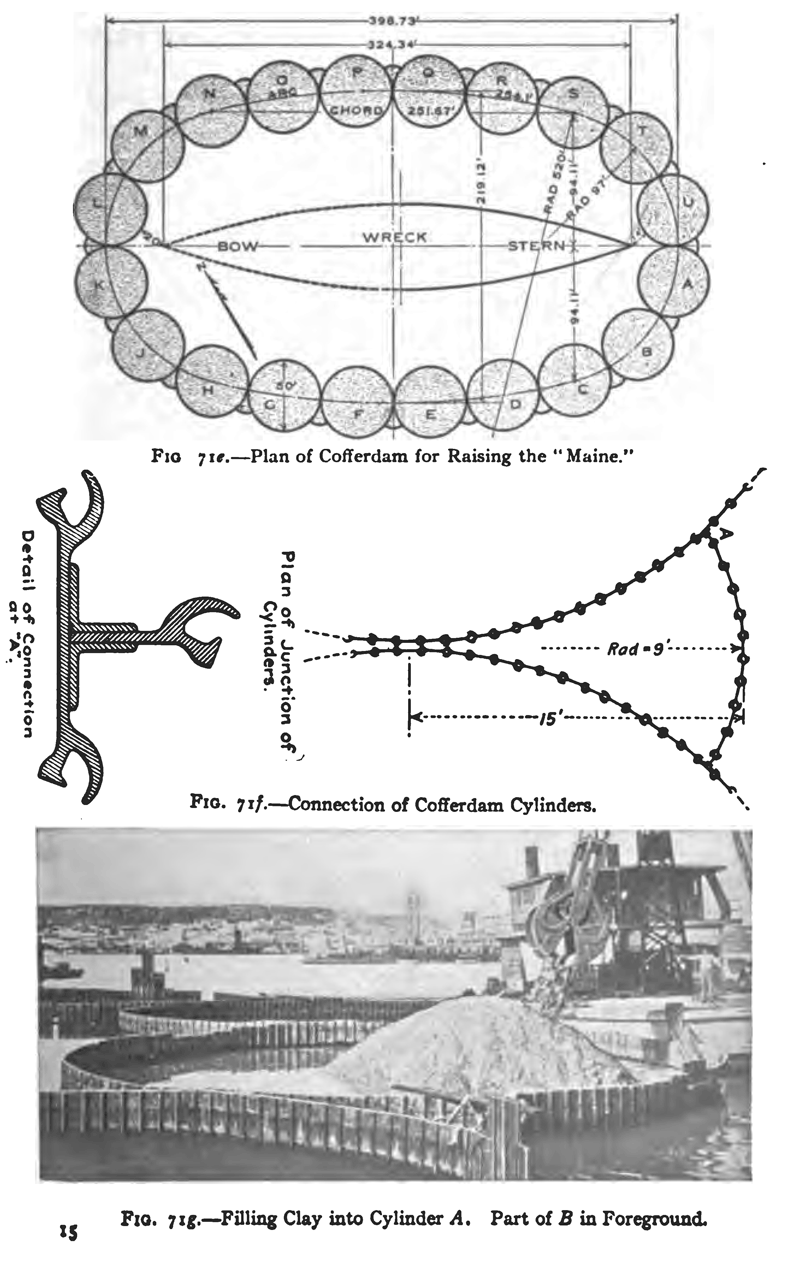
“The cofferdam should be not only self-sustaining and safe against the pressures to which it  was to be exposed, but it should also be capable of complete removal after it had served its purpose.  It should be able to support more or less superimposed loads, for working platforms had to be built upon it.  The work of unwatering the area enclosed had to be carried on from the top of the cofferdam; and afterward, men and materials had to be transferred from there to the interior, for work upon the wreck…The cofferdam decided upon consisted of 20 equal cylinders, 50 feet in diameter, and composed of steel piling 75 feet long…”  A plan is shown in Fig. 71e.

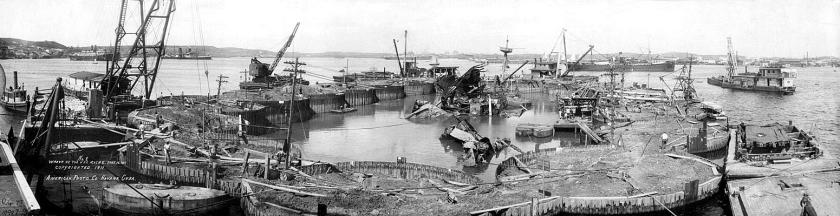
Raising-the-Maine
Raising the Maine, views of the cofferdam, from Jacoby and Davis, Foundations of Buildings and Bridges.

“The length of the major axis of the cofferdam was practically 399 feet, and of the minor axis 219 feet, leaving a 20-foot clearance at the submerged bow of the ship and a 14-foot clearance at the stern, with 45 feet at the side cylinders.  Such clearance was necessary to avoid portions of the wreck which had been blown beyond the position occupied by the hull.

“The units of the cofferdam were made cylindrical for the reason that the extremely high pressures, which would be exerted by the mud filling, would act radially and uniformly on each pile, straining each joint to the same amount at equal depths, and in the entire cofferdam cylinders would deform least from play in the piling interlocks.”*

The cylinders were driven tangent to one another and to insure their stability and prevent leakage of water through them when the cofferdam was pumped out they were filled to the top with clayey material that was dredged from the bottom of the harbor.  A curved diaphragm of steel-piling, as shown in Fig. 71f, was driven to connect the adjacent cylinders, and the space between this arc and the outer surfaces of the large cylinders was likewise filled with dredged material.

The piling used was the Lackawanna section, weighing 35 pounds per linear foot, and had a web 1/2 inch thick.  The piles were driven so that their tops were 2 to 3 feet above normal water level (Fig. 71g) and the 75-foot length of piling, which penetrated the harbor bottom to a distance of approximately 35 feet, was made of two lengths spliced together with channels.

*Bulletin No. 102, Lackawanna Steel Co., Buffalo, N.Y.

Cellular cofferdams have gone on to become an important type of retaining wall structure.  Probably the most significant change from this project is that cellular cofferdams are always built with permeable materials such as gravel and not clays such as were dredged from Havana harbour.  More information on this project and related topics are here:

The wreckage of the Maine wasn’t the only result of the Spanish-American war.  The United States virtually ended the Spanish empire, which had once covered much of the Western Hemisphere.  Cuba became independent.  The Philippines became an American possession (except for Japanese rule during World War II) until their independence in 1946.

Puerto Rico also became part of the United States by military invasion and annexation, and (through a long process) Puerto Ricans became full American citizens.  That’s something I remind my students about every time I teach this subject; an American history lesson never hurt anyone.  And the Puerto Ricans I go to church with (and I have in class) are grateful.

Posted in Geotechnical Engineering

Engineering Geology in the Civil Engineering Curriculum

For this post I’m featuring an article by J. David Rogers, Professor and Karl F. Hasselmann Chair in Geological Engineering, Department of Geosciences and Geological and Petroleum Engineering, Missouri University of Science and Technology, which he entitled  Disappearing Practice Opportunities: Why Are Owners And Engineers Taking Increased Risks? What Can Be Done To Counter This Threat?  It’s been around a while but bears repeating, especially for one thing: why we need to restore engineering geology to the civil engineering curriculum.