Posted in Geotechnical Engineering

A Geotechnical View of the Effect of Explosions in the Earth

Certainly relevant with events in the Ukraine, from Tsytovich’s Soil Mechanics text:


Explosions may cause a whole series of rapid mechanical processes in soils: appearance of an explosion gas chamber within a rather short interval of time (sometimes a few thousandths of a second), which exerts an enormous pressure (of the order of a few hundred thousand atmospheres), causes the formation and propagation of explosion waves which change the stressed state of a soil mass and cause its particles to move with velocities varying from a few thousand metres per second to zero.

Explosion impulses are characterized by the maximum pressure p_{max} the rise time t_1 during which this pressure is formed, the fall time t_2 during which the pressure drops from the maximum to zero, and the total time of explosion action t_{\sigma} .

As seen from experiments of Prof. G. M. Lyakhov*, the gas chambers formed in soil through explosion of deep concentrated charges of explosives are almost spherical in shape. With time, a gas chamber (the cavity in soil) is destroyed, but the time period of its destruction may be very different , from a few minutes (in sands) to several months (in dense clays).

As has been shown by the experiments, the radius of an explosion gas chamber R_{ch} , after it has been formed completely, is determined by the following relationship:

R_{ch} = \aleph \sqrt{C}

where

  • C = weight of explosive charge, kg
  • \aleph  = proportionality factor depending on the properties of the soil

According to G. M. Lyakhov, numerical values of this factor are:

for saturated sands\aleph = 0.4-0.7
for loams (according to G. I. Pokrovsky)\aleph = 0.45
for loess soils\aleph = 0.35
for clayey soils\aleph = 0.6-0.7

Explosion of a concentrated charge in a soil results in the formation of normal (radial) pressures p , lateral (tangential) pressures p_{\tau} , and the motion of particles with a velocity u .

For non-saturated soils and rocks, all these three parameters are determined in calculations as functions of time, i.e.,

p = p(t);\,p_{\tau} = p_{\tau}(t);\,\dot u=\dot u(t)

For saturated soils and liquid media, it is sufficient to investigate only two of these parameters, for instance,

p = p(t);\,\dot u=\dot u(t)

The parameters of stress waves in soils caused by explosions and the parameters of velocities of their propagation are determined by special field tests. Using the results of such tests, empirical formulae are established for determination of the design parameters of explosion, waves in soils depending on the weight of charge, the distance from explosion centre, etc.

* Lyakhov G. M. Osnovy dinamiki vzryva v gruntakh i zhidkikh sredakh (Fundamentals of Dynamics of Explosion in Soils and Liquid Media), Moscow, Nedra Publishers, 1964.


Although geotechnical engineering has always had a military application (witness the prominence of documents such as NAVFAC DM 7 and the many others offered on this site,) this is the only elementary level soil mechanics text where I can recall seeing such a presentation.

Posted in Geotechnical Engineering

Free Gravity and MSE Wall Design Software – RRWall+ — GeoPrac.net

Designing gravity or MSE retaining walls with the attractive Redi-Rock precast modular block (PMB) facing just got a lot easier! The latest version of RRWall+ design software was created by Fine Software, GeoPrac.net sponsors, and […]

Free Gravity and MSE Wall Design Software – RRWall+ — GeoPrac.net
Posted in Geotechnical Engineering, Soil Mechanics

Soil Mechanics Now in Print

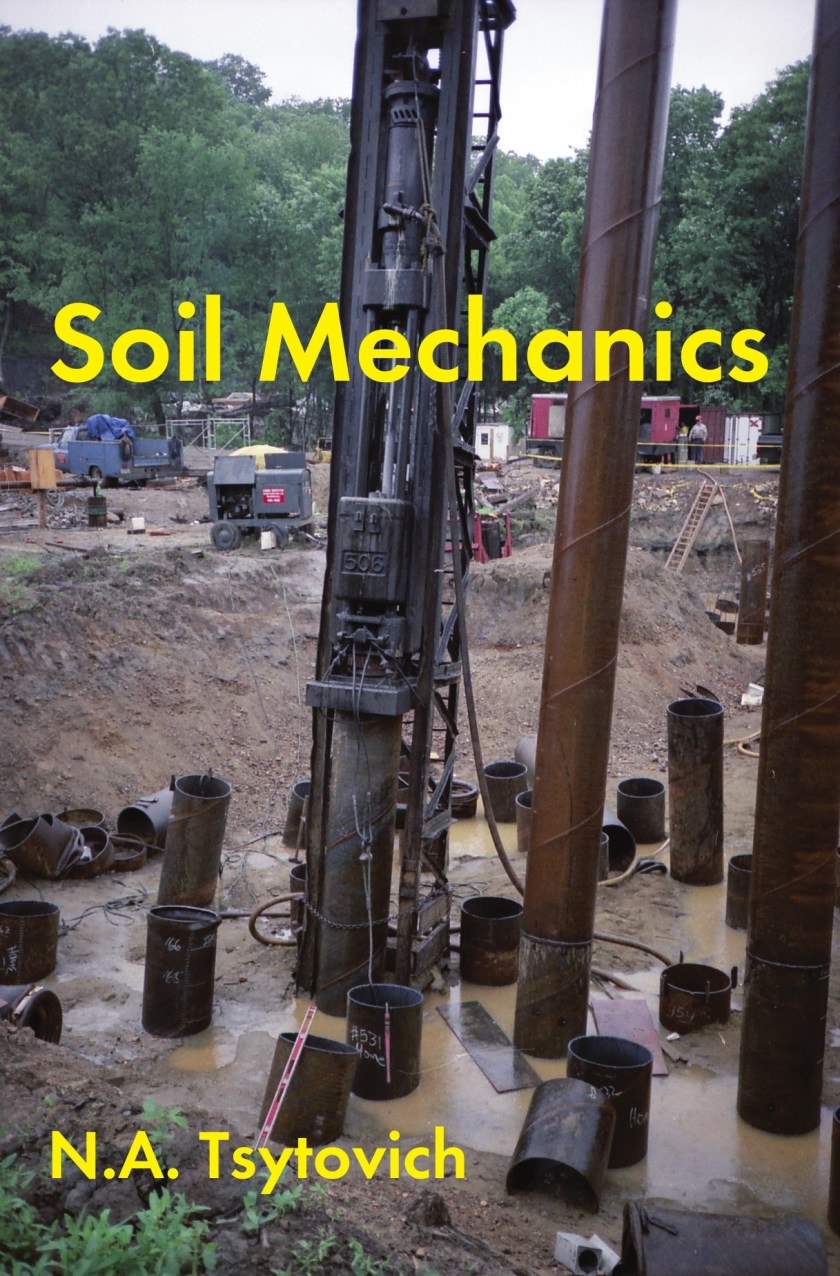
In the Soil Mechanics and Foundations courses on this site, we’ve relied on Verruijt’s text as the principal “theoretical” text. Last year we linked to download the Soil Mechanics Textbook by Tsytovich. Now we offer this text in print for sale.

Purchase Tsytovich’s Soil Mechanics

  • CHAPTER ONE. THE NATURE AND PHYSICAL PROPERTIES OF SOILS
    • Geological Conditions of Soil Formation
    • Components of Soils
    • Structural Bonds and Structure of Soils
    • Physical Properties and Classification Indices of Soils
  • CHAPTER TWO. BASIC LAWS OF SOIL MECHANICS
    • Compressibility of Soils. The Law of C o m p a c t i o n
    • Water Perviousness of Soils. The Law of Laminar Filtration
    • Ultimate Contact Shear Resistance of Soils. Strength Conditions
    • Structural-Phase Deformability of Soils
    • Features of the Physical Properties of Structurally Unstable
    • Subsidence Soils
  • CHAPTER THREE. DETERMINATION OF STRESSES IN SOIL
    • Stress Distribution in the Case of a Three-Dimensional Problem
    • Stress Distribution in the Case of a Planar Problem
    • Pressure Distribution over the Base of the Foundation of
    • Structures (Contact Problem)
  • CHAPTER FOUR. THE THEORY OF ULTIMATE STRESSED STA­TE OF SOILS AND ITS APPLICATION
    • Stressed State Phases of Soils with an Increase in Load
    • Equations of Ultimate Equilibrium for Loose and Cohesive
    • Soils
    • Critical Loads on Soil
    • Stability of Soils in Landslides
    • Some Problems of the Theory of Soil Pressure on Retaining Walls
    • Soil Pressure on Underground Pipelines
  • CHAPTER FIVE. SOIL DEFORMATIONS AND SETTLEMENT OF
  • FOUNDATIONS
    • Kinds and Causes of Deformations
    • Elastic Deformations of Soils and Methods for Their Determi­nation
    • One-Dimensional Problem of the Theory of Soil Consolidation
    • Planar and Three-Dimensional Problems in the Theory of Fil­tration Consolidation of Soils
    • Prediction of Foundation Settlements by the Layerwise Summa­tion Method
    • Prediction of Foundation Settlements by Equivalent Soil Layer Method
  • CHAPTER SIX. RHEOLOGICAL PROCESSES IN SOILS AND THEIR SIGNIFICANCE
    • Stress Relaxation and Long-Term Strength of Cohesive Soils
    • Creep Deformations in Soils and Methods for Their Description
    • Account of Soil Creep in Predictions of Foundation Settlements
  • CHAPTER SEVEN. DYNAMICS OF DISPERSE SOILS
    • Dynamic Effects on Soils
    • Wave Processes in Soils under Dynamic Loads
    • Changes in the Properties of Soils Subject to Dynamic Effects
    • The Principal Prerequisites for Taking the Dynamic Proper­ties of Soils into Account in Vibrational Calculations of Founda­tions

As with Verruijt, hopefully in the coming time we will feature interesting techniques in this book which may be of interest to our visitors.

Posted in Geotechnical Engineering

Carbonate sand fill

The properties of carbonate sand are different than more commonly used quartz sand and its behaviour must be considered when using it for fill.

Source: Carbonate sand fill

Posted in Academic Issues

“Getting to Know You”: My Profile for UTC’s College of Engineering and Computer Science

It’s not often that someone else does a write-up about me, but where I teach (at the University of Chattanooga’s College of Engineering and Computer Science) they did a profile of me in their series “Getting to Know You.” You can read it all here.