Posted in Uncategorized

Featured in Print: NAVFAC DM 7.01 and 7.02

4191

navfac-dm-7It’s emblazoned at the top of every page: the printed home of NAVFAC DM 7.  Many of you who are relatively new to geotechnical engineering will ask, “Why is that a big deal?”

The better question is this: where would geotechnical engineering be without DM 7.01: Soil Mechanics and its follow-up, DM 7.02: Foudations and Earth Structures? First, an explanation: “DM” stands for “Design Manual,” and a series of these were issued by the U.S. Navy in the 1960’s and 1970’s as guidance in designing and building the many bases, ports, harbours and other structures that it uses.  Most of the Design Manuals have been forgotten; not DM 7.  True to the geotechnical tradition, the information compiled in this series has become something of a “core knowledge” item for those in the profession.

It’s difficult to name a basic soil mechanics or foundations text produced during or since the 1970’s without at least one chart, drawing or reference to this, to say nothing of other publications from practical guides to peer-reviewed papers. As J. Ledlie Klosky explained in his introduction:

…it represents perhaps THE principal compendium of geotechnical knowledge used by designers between 1982 and around the turn of the century. It is a testament to the strength of the document that some of the design methods presented are still in use today.

navfac-dm-7-2-coverTopics include the following:

  • DM 7.01: Soil Mechanics
    • Identification and Classification of Solid Rock
    • Field Exploration, Testing and Instrumentation
    • Laboratory Testing
    • Analysis of Settlement and Volume Expansion
    • Seepage and Drainage
    • Slope Stability and Protection
  • DM 7.02: Foundations and Earth Structures
    • Excavations
    • Compaction, Earthwork and Hydraulic Fills
    • Analysis of Walls and Retaining Structures
    • Shallow Foundations
    • Deep Foundations

Strengths: even after all of these years, still a very strong reference for the topics it covers, containing information that is hard to find elsewhere.

Weaknesses: some of the data and methodology is “long in the tooth” (especially in 7.02) and must be used with care. Also its explanations of procedures are concise to the point of being cryptic; cannot be used as a textbook by itself.  In our geotechnical courses, we coordinate it with actual textbooks.

These two volumes have been best-sellers for the site: they’re a big reason why it’s still here.  So how do you get them?  We actually put out three different books based on them:

It’s been around for a long time but remains the most comprehensive reference of its kind available.

Posted in Uncategorized

Featured in Print: Arnold Verruijt’s Soil Mechanics

Way back in 2001 when I started to teach Soil Mechanics, my goal was to put a textbook in front of my students that was a) free and b) comprehensive.  Textbooks at the time were dreadfully expensive, something that hasn’t changed even with the advent of rental and electronic textbooks.  The best alternative out there was a relatively new free download, Soil Mechanics by Arnold Verruijt from the University of Delft, with a great deal of accompanying software.  It became evident, however, that American students (undergraduates, at least) weren’t quite ready for an e-textbook coming from Europe.

Soil Mechanics Arnold Verruijt
Click on the image to order.

Things have changed over the years:

  1. Verruijt has revised and improved the basic text over the years.
  2. It is now in print, revised by S. van Bars, link on the right.  (The two aren’t that different, really…)  The pricing is very reasonable, a result of the publisher’s philosophy.  And the online version does not have digital rights management, which means unrestricted access as a student moves into graduate studies or the workplace.
  3. The growth in the use of finite element analysis has made Verruijt’s theory of elasticity and plasticity approach important for geotechnical engineers to understand, irrespective of its limitations in soil mechanics.

Verruijt’s book gives a simple, straightforward presentation to the subject of soil mechanics, with some foray into foundations. It covers all of the major subjects in soil mechanics, including Darcy’s Law and permeability, stresses in soil both induced by effective stress and external loading, compression and consolidation, lateral earth pressures and bearing capacity. Includes problems and solutions. The software offered here is a companion to Verruijt’s book.

  • Strengths: Presentation of the theory and the basic concepts of soil mechanics is consistent and clear. Graphics are simple but informative.
  • Weaknesses: For Americans, Verruijt presents more of a European approach to the subject, which does not always cover methodologies preferred in the U.S.  I have addressed this issue by including NAVFAC DM 7 or the Soils and Foundations Manual in my required books, but there are other ways to accomplish this.  (OTOH, if you’re in Europe, that’s an advantage…)
Posted in Uncategorized

Design and Construction of Driven Pile Foundations, 2016 Edition, Now in Print

This slideshow requires JavaScript.

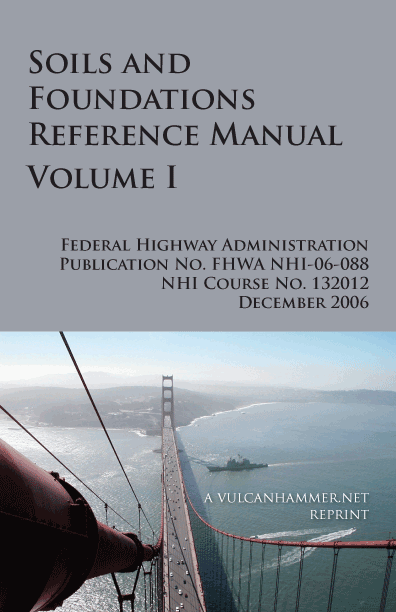
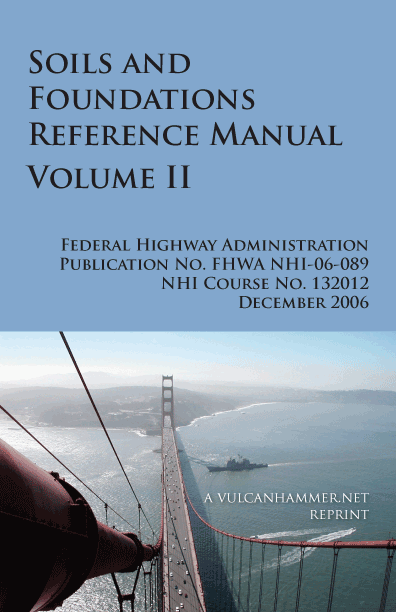
It’s updated: the new “Driven Pile Manual,” an important reference since the 1980’s, now with LRFD, available for purchase.  These economical books, packaged in an attractive, compact format, are the latest from the Federal Highway Administration.  You can order any or all of the three volumes:

Or check out all of our publications.

Posted in Uncategorized

A New Look for vulcanhammer.net

It’s done: vulcanhammer.net, which this year celebrates its twentieth anniversary, has migrated to WordPress.

WordPress is nothing new here: Positive Infinity, our companion site, has been a WordPress blog for the past ten years.  It powers about a quarter of the internet.  It wasn’t a decision taken lightly, but given the trends of search engines and considerations of the long-term viability of the site, it was the best decision.

Some features of the site, and some changes, are as follows:

  • All of the documents on the site have been moved to the new platform; the organisation is pretty much the same.  The way WordPress tracks views will make it easier to see which documents are in demand, and thus know what to emphasise and upload.
  • The geotechnical course section has been “merged back” into the UTC courses.  We have also eliminated the past years of UTC lecture slides.  We have maintained links to software here and elsewhere, although WordPress didn’t make that easy.
  • The articles by Dr. Mark Svinkin, a long-time feature of the site, no longer have their own section.  The ones in pdf format are at the Soil Dynamics page and the rest are in the blog section, which will aid in their dissemination.
  • The menu and search system should make it easier to find items.

We should also remind our visitors that the marine documents were moved to our Chet Aero Marine site a few months ago.

We thank you for your support of this effort, it has been a rewarding journey.