Don Warrington's avatarvulcanhammer.info

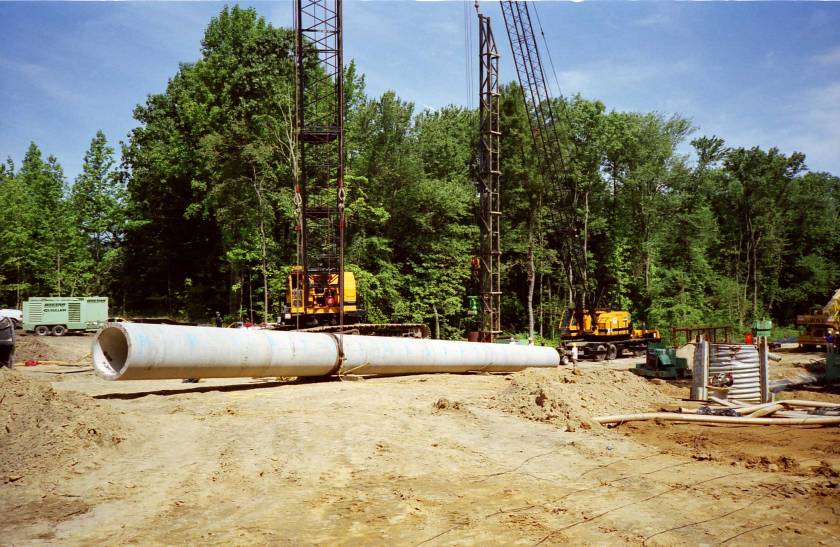
One of the concepts students in geotechnical engineering courses seem to have the most trouble with is estimating stresses in concrete piles during pick-up and setting them in place to drive.  The basic problem is that it’s sometimes hard to get our heads around the analytical simplification of the actual situation.  Let’s start by looking at the operation itself.  These first photos come from a job in Delaware in 1998, using a Vulcan 530 to drive cylinder piles.

Concrete-Pile-Pickup-Delaware-1998-1 The pile starts on the ground. What we have here is “one-point pickup” where only one line is used to pick up the pile. It’s put in a certain place (more about that later) in this case using a “choker.” (Some piles have pickup lifting eyes, they are best cast into the pile at the time of manufacture.) In this position the pile is horizontal. Once the crane operator lifts the choker…

View original post 666 more words

Picking Up Concrete Piles for Driving

Posted in Civil Engineering

Jean-Louis Briaud Elected President of ASCE

Congratulations are in order to Jean-Louis Briaud, Ph.D., P.E., D.GE, Dist.M.ASCE, and Spencer Buchanan Distinguished Professor of Civil Engineering at Texas A&M University, for his election as President of the American Society of Civil Engineers for 2019-20.

Jean-Louis is an old friend and a great person.  Our association goes back to the 1980’s when I was principal at Vulcan Iron Works and active in the Deep Foundations Institute.  He has been an encouragement to me through the years, especially with this effort.

On this site he was featured for his “pet peeve” regarding consolidation a few months ago.  He posed an interesting problem that needs some discussion.  I believe he will challenge us to tackle other interesting and important problems during his term as President.
Posted in Soil Mechanics

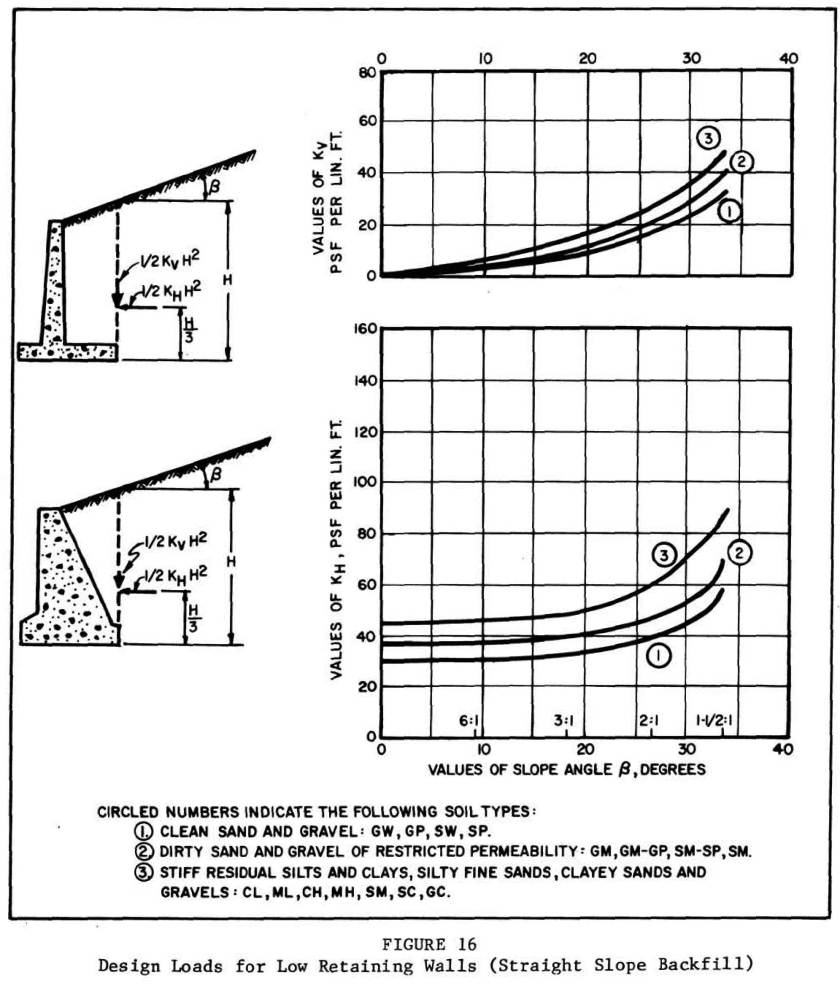
Terzaghi “Low Walls” Curve Correlations

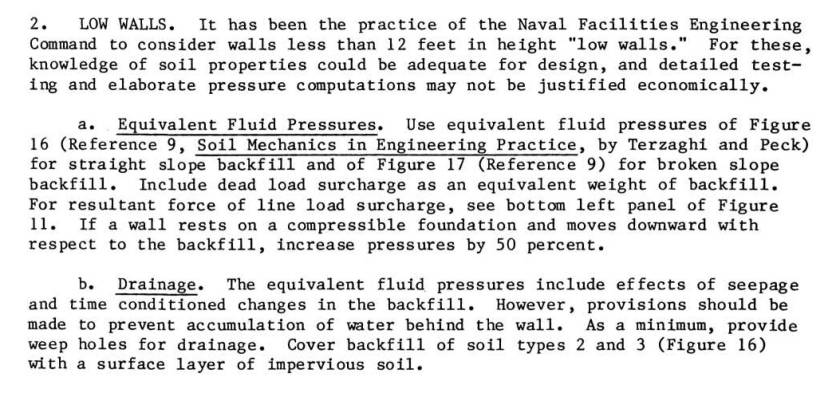
Practitioners who design gravity retaining walls are familiar with the existence of Terzaghi’s “low walls” curves to estimate the equivalent fluid pressure on the wall, horizontal and vertical.  The basic chart comes in several versions but the one (for straight backfill) from NAVFAC DM 7.02 is above.  The explanation for it (important when one is using it) is below.

dm7_02-101

In the “slide rule” days, reading charts like this was routine.  A better way now, with spreadsheets abounding, is to have a formula available.  Some least squares curve fitting correlations are shown below.  The variable \beta is the slope angle as shown in the figure.  As is the case with the chart, the formulas return K_v and K_h in units of \frac {psf}{ft} of wall length.

  • K_v (top chart)
    • Soil 1 K_v = 0.0127 \beta^{2.21}
    • Soil 2 K_v = 0.043 \beta^{1.92}
    • Soil 3 K_v = 0.109 \beta^{1.71}
  • K_h (bottom chart)
    • Soil 1 K_h = 30 + \frac{exp^{0.139 \beta}}{4}
    • Soil 2 K_h = 37 + \frac{exp^{0.138 \beta}}{4}
    • Soil 3 K_h = 48 + \frac{exp^{0.148 \beta}}{5}

The Esplanade Bridge is a 261-metre-long (850 ft.) road bridge that spans across the mouth of the Singapore River in Singapore with the Esplanade – Theatres on the Bay on its northern abutment and the Merlion on the southern. The 70 metre-wide (230 ft.) low-level concrete arched bridge has seven spans and supports two four-lane carriageways and walkways along both sides. The bridge was built to provide faster vehicular access between Marina Centre and the […]

via Esplanade Bridge over Marina Bay, Singapore — Construction and architecture

Esplanade Bridge over Marina Bay, Singapore — Construction and architecture

Posted in Civil Engineering

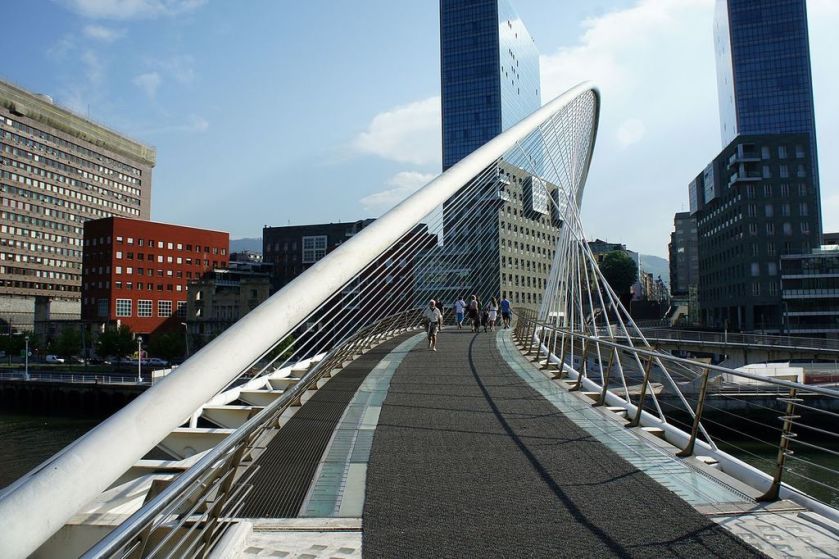
The Zubizuri Bridge, Bilbao, Spain

deconincks's avatarConstruction and architecture

TheZubizuri(Basquefor “white bridge“), also called theCampo Volantin BridgeorPuente del Campo Volantin, is atied archfootbridgeacross theNervion RiverinBilbao, Spain. Designed by architectSantiago Calatrava, the bridge links theCampo Volantinright bank andUribitarteleft bank of the river.

Opened in 1997, the bridge’s unusual design consists of a curved walkway which is supported by steel suspension cables from an overhead arch. The structure of the bridge is painted white and the bridge deck consists of translucent glass bricks. Access ramps and stairways are located on both banks.

The Zubizuri offers pedestrians a convenient route from hotels to the nearbyBilbao Guggenheim Museum.

Since its opening, it has been subjected to praise as a symbol of the new Bilbao and as a draw for tourism. Architectural professor Alexander Tzonis wrote:[

“The intelligence, vitality, and originality of the bridge’s…

View original post 334 more words