
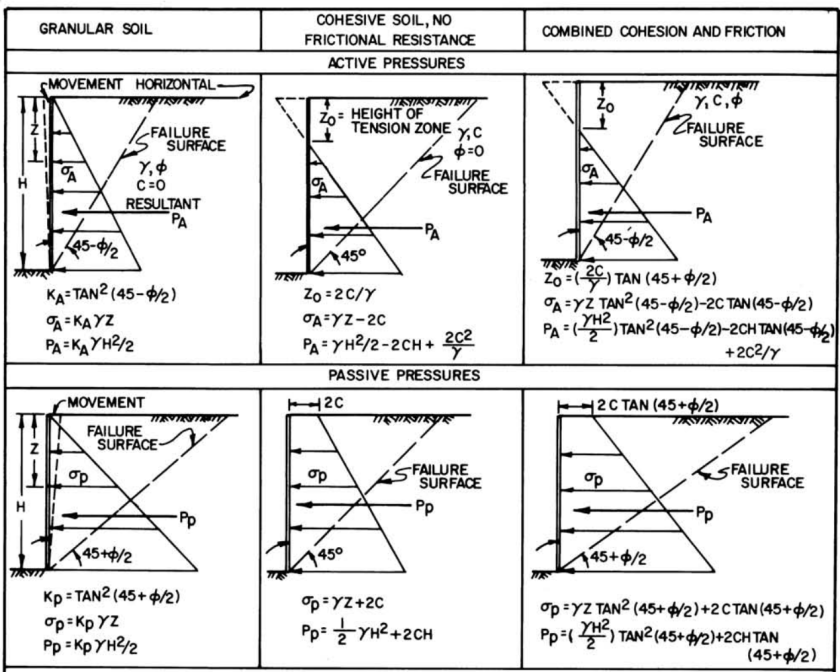
With release of Soils in Construction, Seventh Edition, we now turn to discuss some of the special topics surrounding this book. One of them is the earth pressure theory we adopted: Rankine earth pressures, level backfill, with provision (when necessary) for cohesive soils. For a textbook this seems awfully restrictive, but there are justifications for this policy.
Rankine earth pressure theory is the most elementary of the earth pressure theories. It is customary, however, in introductory geotechnical courses such as Soil Mechanics and Foundation Design and Analysis, to present all three failure criteria (Rankine, Coulomb and Log-Spiral.) For many years I did so in the first course and went back to expand on that in the second; it was the only topic I formally reviewed from one semester to the next. In spite of that, my students found the topic confusing, never sure which theory applied even when I made it clear (or so I thought.) What I ended up doing was teaching strictly Rankine theory in Soil Mechanics and the others in Foundation Design and Analysis.
Rankine is also characterised as the most conservative of the earth pressure theories. In his response to a paper by Terzaghi (reviewed for other reasons in my post An Industry Gets Restless: Terzaghi’s 1929 Paper on Dynamic Formulae and the Response) Lazarus White made the following observation:
In the Nineties, when the writer was an undergraduate student, he was thoroughly imbued with the classical methods of computing earth pressures, bearing values of soil, distribution of pressures, and pile-driving formula commonly taught–Rankine, Baker, Cain and Wellington–and, after his graduation, he set about to apply them…Later, during subway construction, he observed that contractors completely and successfully ignored Rankine and Cain in timbering work, and “got away with it” in so many instances that by no scientific philosophy could their theories be justified.
Of the four methods he mentions, only Rankine is still taught as a “currently” used method, although it too is being displaced by methods such as FEA. So how can the decision to teach only Rankine in Soils in Construction be justified? It is done as follows:
- It’s good that White’s result was “got away with it” and not a collapsed wall; retaining wall failures tend to be catastrophic. It kept his work out of trouble until better methods could be employed.
- It was the policy of previous editions of the book, although some attempt has been made to use Rankine in conjunction with Mohr-Coulomb for a theoretically consistent presentation.
- Soils in Construction is primarily aimed at giving contractors a better understanding of geotechnical issues, not as a design guide. It can be taught in a more geotechnical engineering way but its first task is contractor education.
- Some introductory geotechnical courses only teach Rankine theory with level backfill, such as Tsytovich, which came as something of a shock to me. Either proficiency in more advanced theories were left to experience or later courses for specialists.
- As noted and in common with NAVFAC DM 7.2, only level backfill is considered, as discussed in my post NAVFAC DM 7.2: Analysis of Walls and Retaining Structures, Part I: Will the Real Rankine Theory Please Stand Up?. Rankine theory can be extended to sloping backfills but again we did not feel this was necessary for a book such as Soils in Construction.
- Rankine theory with level backfill is the only theory necessary to take the FE exam; preparation for this was one of the objectives of the “extended” material in the book.

