Posted in Uncategorized

Two Deep Foundations Programs–BENT1 and PX4C3–Now Available

This week we feature two programs for the analysis of deep foundations: BENT1 and PX4C3.  Although these names may not be familiar, if you’re in the deep foundation engineering field you’ll probably recognise some of their successors.

Let’s start with BENT1, the program description is as follows:

BENT1 is a program designed to analyse two dimensional problems involving pile supported foundations subjected to inclined & eccentric loadings. It consists of an interactive solution for the three equilibrium equations. The purpose of the iterative procedure is to find deflected position of the structure so that equilibrium and compatibility are satisfied. The pile cap is assumed to be rigid in the analysis. Subroutines MAKE and COM62 are used in this program. A complete description of the program can be found in the document “Background Theory and Documentation of Five University of Texas Soil-Structure Interaction Computer Programs,” Miscellaneous Paper K-75-2, by N. Radhakrishnan and F. Parker.

COM62 is the ancestor of all of the programs with that in the name, and ultimately programs such as LPILE.

Then we consider PX4C3:

PX4C3 is a finite difference program used to compute load settlement characteristics on an axially loaded pile of constant outside diameter. A set of load transfer curves along the pile (i.e., skin friction developed on the side of the pile relative to the absolute axial displacement of the pile section) & four point resistance curve at the pile tip (i.e., relationship between the total axial soil resistance on the base of the pile tip & the pile tip movement) are used in program to obtain non-linear soil-pile relationships. Finite difference equations are used to achieve compatibility between pile displacement & load transfer along the pile & between soil resistance & load transfer along the tip of the pile. A complete description of the program can be found in the document “Background Theory and Documentation of Five University of Texas Soil-Structure Interaction Computer Programs,” Miscellaneous Paper K-75-2, by N. Radhakrishnan and F. Parker.

This is the ancestor of programs such as APILE.

Complete documentation for both programs is included, and can also be found here.

Download BENT1 and PX4C3

Posted in Uncategorized

Soils in Construction, Now at Waveland

It’s official: the construction management textbook Soils in Construction, Fifth Edition by W.L. Schroeder, S.E. Dickenson and D.C. Warrington is now at Waveland Press.  As someone who has dealt with contractors for his entire working career, I know that an understanding of the essentials of soil mechanics and foundations is crucial for successful–and profitable–completion of just about any civil engineering project.  Most soil mechanics and foundations textbooks are aimed at design professionals or engineering students; Soils in Construction, Fifth Edition is aimed at the contractor and the construction management student. It presents soil mechanics concepts in an easy to understand fashion. It includes many worked examples and illustrations to make understanding of the basic concepts simple.
And the really good news is that, with Waveland as publisher, the price has been reduced considerably.

Chapters in the book are as follows:

  1. Physical Character of Soil Constituents
  2. Natural Soil Deposits
  3. Soil Index Properties
  4. Soil Classification
  5. Stress Analysis and Engineering Properties
  6. The Contract and Contract Documents
  7. Interpretation of Soils Reports
  8. Embankment and Construction Control
  9. Dewatering
  10. Excavations and Excavation Supports
  11. Foundation Construction
  12. Construction Access and Haul Roads

The book also has two appendices:

  • Laboratory Testing Exercises
  • Pile Hammer Specifications

You can order a copy of the book by clicking on the graphic above or here.  Academics who would like more information or order a desk copy can do that here.

Posted in Uncategorized

Program AXILTR Now Available

Last week we posted an update to the program VDISPL, which estimates vertical displacements/settlement for shallow foundations.  Now we feature another program from our Bearing Capacity of Soils volume, namely AXILTR.

Program AXILTR, AXIal Load-TRansfeR, consists of a main routine and two subroutines. The main routine feeds in the input data, calculates the effective overburden stress, and determines whether the load is axial down-directed, pullout, or if uplift/downdrag forces develop from swelling or consolidating soil. The main routine also prints out the computations. Subroutine BASEL calculates the displacement at the base for given applied down-directed loads at the base. Subroutine SHAFL evaluates the load transferred to and from the shaft for relative displacements between the shaft and soil. An iteration scheme is used to cause the calculated applied loads at the top (butt) to converge within 10 percent of the input load applied at the top of the shaft.

The program is designed to run exactly as shown in Bearing Capacity of Soils, and you can find complete documentation there, as well as the source code for the program.

As was the case with VDISPL, the program was written by Lawrence D. Johnson at the Waterways Experiment Station.

Download AXILTR

Posted in Uncategorized

Update for Program VDISPL, Vertical Displacements of Shallow Foundations

A few years back we “resurrected” a program from the document EM 1110-1-1904, Settlement Analysis, called VDISPL, Vertical Displacements of shallow foundations.  The description of the program is given as follows:

This program, Vertical DISPLacements, was developed to assist in the calculation of vertical displacements beneath shallow foundations for various types of multilayered soils in support of this manual. The two types of foundations considered are rectangular footings or mats and long strip footings. These foundations are assumed flexible. Models available are immediate settlement of granular soil from cone penetration data, immediate settlement of granular soil from both cone penetration and dilatometer data, immediate settlement of an elastic soil using the Boussinesq pressure distribution and Young’s elastic soil modulus, consolidation or swell of a cohesive soil (ASTM D 4546), and settlement of a collapsible soil. Soil expansion is indicated by positive values and settlement by negative values.

It’s an old program with strictly text file input, which is described in the documentation.  When we first posted it, it was a 32-bit program with a 16-bit interface.  Windows versions from 7 onward generally don’t run any 16-bit code, so we have recompiled this to run in pure 32-bit mode (and more efficiently, although that’s not an issue with computer power being what it is these days…)

This program was originally written by Larry D. Johnson, a fine Christian man who worked for many years at the U.S. Army Corps of Engineers Waterways Experiment Station in Vicksburg, MS.  He tragically passed away from brain cancer, and this is posted in his memory.

Download VDISPL here

Posted in Uncategorized

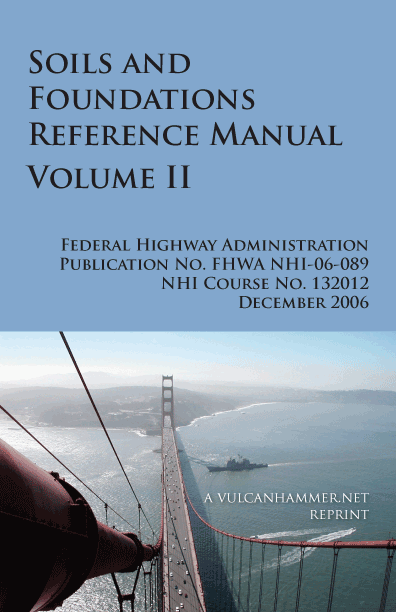
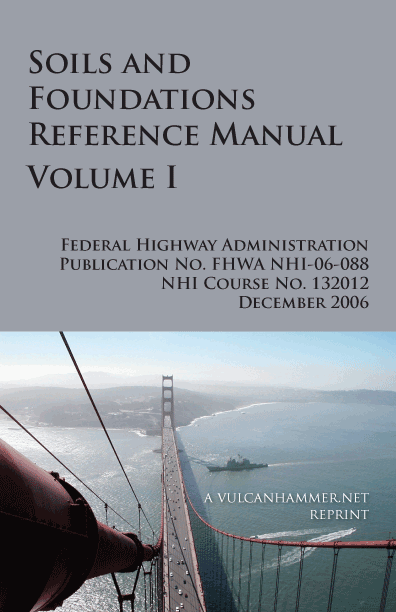
Featured in Print: Soils and Foundations Reference Manual

soils-and-foundations-cover-volume-i-digestWay back in the 1980’s, the Federal Highway Administration was faced with a problem: how is it possible to disseminate new technologies and methods to the state departments of transportation when many of their personnel lack a basic understanding of soil mechanics as an engineering discipline to evaluate changes?  Or, from another perspective, how is it possible for these people to intelligently evaluate proposals from industry without this knowledge?

The answer to this was the Soils and Foundations Workshop, introduced in 1982 and authored by Richard Cheney and Ronald Chassie.  In addition to the many live workshops these men gave, the first FHWA publication on the subject was widely disseminated by Pile Buck in its “White Book” series.  It has since become the best short course on soil mechanics and foundations in the United States.  Its contents are as follows:

  1. soils-and-foundations-cover-volume-ii-digestIntroduction
  2. Stress and Strain in Soils
  3. Subsurface Explorations
  4. Engineering Description, Classification and Characteristics of Soils and Rocks
  5. Laboratory Testing for Geotechnical Design and Construction
  6. Slope Stability
  7. Approach Roadway Deformations
  8. Shallow Foundations
  9. Deep Foundations
  10. Earth Retaining Structures
  11. Geotechnical Reports
  12. References

It includes several worked examples and an extensive test case with field data.

The current edition of the Soils and Foundations Reference Manual is the 2006 edition, which is featured in two handy digest volumes.  Although it does not cover some topics that generally appear in introductory soil mechanics courses (most notably permeability) and others not in the depth one would expect, its coverage of field testing and data is much more in depth than is found in most soil mechanics textbooks.  It is one of the best general references on the subject in print.  You can order it from the following links, or click on the book covers: