
In 2015 the PhD program I was going through nearly collapsed. We lost fifteen faculty members and key staff people in as many months. Needless to say, that produced consternation among the students, most of whom came from outside the United States. They did not understand our system (and honestly until I consulted with some officials of another university I didn’t either) required the University to support the program until the current students had graduated.
The exodus of faculty members created a great deal of empty office space. Like nature, bureaucracies abhor a vacuum, and my program director knew that, if he didn’t fill the office space, he would lose it. Since I was a faculty member (being faculty and student at the same time is as weird as it sounds) I got an office, the best one I ever had at UTC.

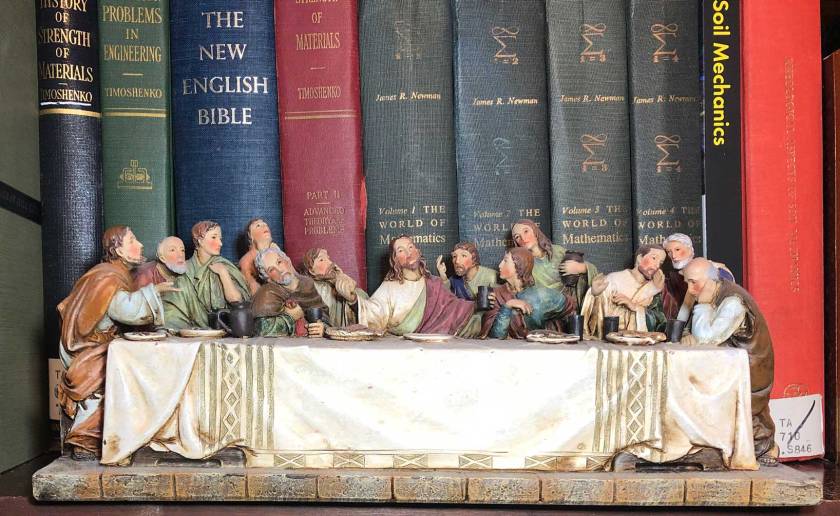
One day one of my Iranian colleagues came to see me. She was going through the program with her husband. The two of them exuded the charm and sophistication that the Iranians are famous for. But she was drawn to the ceramic sculpture based on Leonardo da Vinci’s The Last Supper. It had been given to me when I was working for my church a decade earlier. You can see it in detail at the top of the post.
Not too long after that her husband came to see me. He too was drawn to the sculpture. I was amazed; the Iranians tended to be secular and this couple was from Isfahan, known for its own architecture.
We all eventually graduated and I retained the office for while. Eventually I was evicted; another Iranian colleague allowed me to split an office with him in another building, for which I was grateful because I was given no alternative. By then this person had become a Christian and had been baptized. In spite of the fact that yet another Iranian faculty colleague had assured me that this new building had “bad spirits” in it, we went forward.
But going back, to prepare for our dissertation defense, I attended a seminar where the Assistant Dean of the Graduate School, Dr. Randy Walker, assured us that he reviewed every dissertation and had never found one without a mistake. But our program director sent an email to all of us about my first office visitor:
I want to congratulate ________ for a first !!!! I received word from Dr. Randy Walker that __________’s dissertation was the first and only dissertation/thesis that he has reviewed that did not require any revisions.
Dr. Walker retired after this.
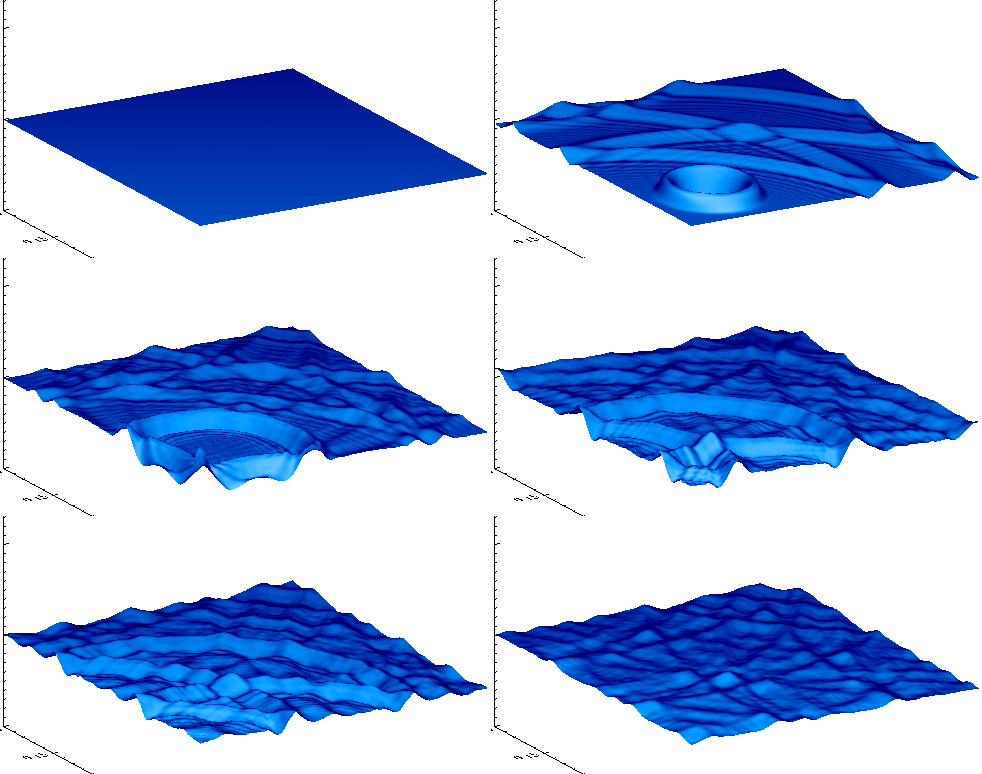
A perfect dissertation at the end of the long effort a PhD is not common. But a perfect work is not unique. Maundy Thursday is the day in the Christian calendar when the Last Supper of Jesus Christ and his disciples is commemorated. Shortly after that, he was arrested by the authorities and crucified the following day. But on the following Sunday he rose from the dead.
Perfection was part of his being: “We have, then , in Jesus, the Son of God, a great High Priest who has passed into the highest Heaven; let us, therefore, hold fast to the Faith which we have professed. Our High Priest is not one unable to sympathize with our weaknesses, but one who has in every way been tempted, exactly as we have been, but without sinning.” (Hebrews 4:14-15 TCNT) His action on the cross was likewise complete: “…for then Christ would have had to undergo death many times since the creation of the world. But now, once and for all, at the close of the age, he has appeared, in order to abolish sin by the sacrifice of himself.” (Hebrews 9:26 TCNT)
Perfection and completeness are hard to obtain in this life. But if we make Jesus Christ’s work on the cross our own, we too can have them in this life and the next.


 system to the p-q system by using the equations

![\left[\begin{array}{cc} 1/2 & 1/2\\ {\medskip}1/2 & -1/2 \end{array}\right]\left[\begin{array}{c} \sigma_{{1}}\\ {\medskip}\sigma_{{3}} \end{array}\right]=\left[\begin{array}{c} p\\ {\medskip}q \end{array}\right]](https://s0.wp.com/latex.php?latex=%5Cleft%5B%5Cbegin%7Barray%7D%7Bcc%7D+1%2F2+%26+1%2F2%5C%5C+%7B%5Cmedskip%7D1%2F2+%26+-1%2F2+%5Cend%7Barray%7D%5Cright%5D%5Cleft%5B%5Cbegin%7Barray%7D%7Bc%7D+%5Csigma_%7B%7B1%7D%7D%5C%5C+%7B%5Cmedskip%7D%5Csigma_%7B%7B3%7D%7D+%5Cend%7Barray%7D%5Cright%5D%3D%5Cleft%5B%5Cbegin%7Barray%7D%7Bc%7D+p%5C%5C+%7B%5Cmedskip%7Dq+%5Cend%7Barray%7D%5Cright%5D+&bg=ffffff&fg=777777&s=0&c=20201002)
![\left[\begin{array}{c} \sigma_{{1}}\\ {\medskip}\sigma_{{3}} \end{array}\right]=\left[\begin{array}{cc} 1 & 1\\ {\medskip}1 & -1 \end{array}\right]\left[\begin{array}{c} p\\ {\medskip}q \end{array}\right]](https://s0.wp.com/latex.php?latex=%5Cleft%5B%5Cbegin%7Barray%7D%7Bc%7D+%5Csigma_%7B%7B1%7D%7D%5C%5C+%7B%5Cmedskip%7D%5Csigma_%7B%7B3%7D%7D+%5Cend%7Barray%7D%5Cright%5D%3D%5Cleft%5B%5Cbegin%7Barray%7D%7Bcc%7D+1+%26+1%5C%5C+%7B%5Cmedskip%7D1+%26+-1+%5Cend%7Barray%7D%5Cright%5D%5Cleft%5B%5Cbegin%7Barray%7D%7Bc%7D+p%5C%5C+%7B%5Cmedskip%7Dq+%5Cend%7Barray%7D%5Cright%5D+&bg=ffffff&fg=777777&s=0&c=20201002)
![\left[\begin{array}{c} \sigma_{{1}}\\ {\medskip}\sigma_{{3}} \end{array}\right]=\left[\begin{array}{c} p+q\\ {\medskip}p-q \end{array}\right]](https://s0.wp.com/latex.php?latex=%5Cleft%5B%5Cbegin%7Barray%7D%7Bc%7D+%5Csigma_%7B%7B1%7D%7D%5C%5C+%7B%5Cmedskip%7D%5Csigma_%7B%7B3%7D%7D+%5Cend%7Barray%7D%5Cright%5D%3D%5Cleft%5B%5Cbegin%7Barray%7D%7Bc%7D+p%2Bq%5C%5C+%7B%5Cmedskip%7Dp-q+%5Cend%7Barray%7D%5Cright%5D+&bg=ffffff&fg=777777&s=0&c=20201002)
![\left[\begin{array}{c} \sigma_{{1}}\\ {\medskip}\sigma_{{3}} \end{array}\right]=\left[\begin{array}{c} 200\\ {\medskip}70 \end{array}\right]](https://s0.wp.com/latex.php?latex=%5Cleft%5B%5Cbegin%7Barray%7D%7Bc%7D+%5Csigma_%7B%7B1%7D%7D%5C%5C+%7B%5Cmedskip%7D%5Csigma_%7B%7B3%7D%7D+%5Cend%7Barray%7D%5Cright%5D%3D%5Cleft%5B%5Cbegin%7Barray%7D%7Bc%7D+200%5C%5C+%7B%5Cmedskip%7D70+%5Cend%7Barray%7D%5Cright%5D+&bg=ffffff&fg=777777&s=0&c=20201002)
 the rise time
  during which this pressure is formed, the fall time
  during which the pressure drops from the maximum to zero, and the total time of explosion action
  .
. , after it has been formed completely, is determined by the following relationship:
 weight of explosive charge, kg
 proportionality factor depending on the properties of the soil


 , lateral (tangential) pressures
  , and the motion of particles with a velocity
  .
.


 vulcanhammer.net