Posted in Uncategorized

Numerical methods with experimental soil response in predicting vibrations from dynamic sources

M.R. Svinkin
Consulting Engineer

ABSTRACT: Numerical methods are presented to predict complete vibration response of the soil, buildings or sensitive instruments caused by anticipated, future vibration sources such as construction or heave industry. The suggested methods make use of either Duhamel’s integral or Fourier transforms and experimental soil response.

1 INTRODUCTION

Construction and industrial dynamic sources, such as pile driving and foundations for impact machines, generate elastic waves in soil which may adversely affect surrounding buildings and sensitive instruments (Targets). The effects of these waves range from visible structural damage to serious disturbance of working conditions for sensitive devices and people. Therefore, legitimate concerns frequently arise about possible ground and structure vibrations before the start of construction activities or installation of machine foundations.

Analytical methods (Miller and Pursey, 1954; Broers and Dieterman, 1992; Hanazato and Kishida, 1992; Wolf, 1994) already exist which give accurate results for certain limited cases, but these methods are applicable only to well defined and simple sites like a half-space or horizontally layered media. Indeed, for the prediction of expected vibrations, it is necessary to have information about the actual soil deposit and to choose a proper soil model to compute vibrations. Computed results from the simple models contain valuable data about general tendencies of wave propagation at a site, but cannot take into account spatial variations of soil properties and produce accurate and complete soil vibration records at any point of interest.

This paper presents numerical methods coupled with experimental soil response measurements to predict ground and structure vibrations before the beginning of construction activities or installation of machine foundations. This approach employs experimental impulse response functions containing real behaviour of soil and structures without the investigation of soil and structure properties. It also provides an opportunity for accurate determination of vibration levels and aids in monitoring of ground, structure and device vibrations prior to start of construction and industrial activities.

2 DEFINITION OF METHODS

The suggested methods for predicting soil and building vibrations are founded on utilization of the impulse response functions technique for predicting complete vibration records on existing soils, buildings and equipment prior to installation of construction and industrial dynamic sources (Svinkin 1973, 1996). The impulse response function is an output signal of the system based on a single instantaneous impulse input (Bendat and Piersol 1993). These functions are applied for studies of complicated linear dynamic systems with unknown internal structures for which mathematical description is difficult or impossible. In the case under consideration, the dynamic system is the soil medium through which waves propagate outward from sources of construction and industrial vibrations. The input signal of the system is the impulse response of the ground at the place of pile driving, dynamic compaction of soil, or installation of a machine foundation; the output signal is the vibratory response of a location of interest situated on the surface or within the soil stratum, or any point at a building receiving vibrations. Output can be obtained, for example, as the vibration traces for displacements at locations of interest. Actually, these records are experimental Green’s functions.

Impulse response functions for the dynamic system being considered are determined by setting up an experiment. Such an approach does not require routine soil boring, sampling, or testing at the site where waves propagate from the vibration source, eliminates the need to use mathematical models of soil bases and structures in practical applications, and provides the flexibility of considering heterogeneity and variety of soil and structural properties. Unlike analytical methods, experimental impulse response functions reflect real behavior of soil and structures without direct investigation of the soil and structure properties. Because of that, the suggested methods have substantially greater capabilities in comparison with other existing methods.

The following is a general outline of the methods for predicting vibrations at a distance from an impact source. It is assumed that the dynamic loads transmitted onto the soil are known or can be found using existing theories. At the place in the field for installation of the wave source, impacts of known magnitude are applied onto the soil. The impact is often created using a rigid steel sphere or pear-shaped mass falling from a mobile or bridge crane. The oscillations resulting from the impact on the soil are measured and recorded at the points of interest (target points), for example, at the locations of instruments sensitive to vibration, communication lines and other devices, etc. These oscillations are the impulse response functions (Green’s functions) of the treated dynamic system which automatically take into account complicated soil conditions. Predicted vibrations are computed using Duhamel’s integral or a Fourier transform.

3 APPLICATION OF DUHAMEL’S INTEGRAL

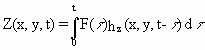
For each single output point, the considered input – soil medium – output system is a one degree of freedom system and predicted displacements can be written as follows

(1)

where

  • F(t) = resultant dynamic force transmitted to the ground;
  • x,y = coordinates of the output point under consideration at ground or structure;
  • hz(x,y,t-t) = impulse response function at the output point under consideration;
  • t = variable of integration.

Dynamic loads on a machine foundation can be found using existing foundation dynamics theories, for example Barkan (1962) and Richart et al. (1970). It is known that the equation of vertical damped vibrations of foundations for machines with dynamic loads can is given by

(2)

with initial conditions z = z0 and t = t0 for t = 0. In Equation (2),

  • c = viscous damping coefficient;
  • kz = spring constant for the vertical mode of foundation vibrations;
  • P(t) = exciting force;
  • M = mass of foundation and machine.

Parameters of the foundation-soil system M, c and kz are considered known in predicting vibrations.

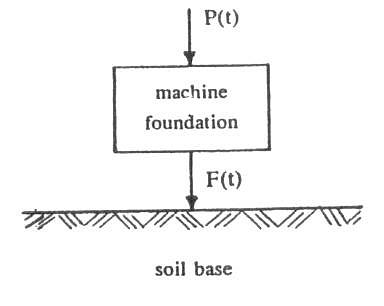
Figure 1 Dynamic Forces on machine foundations and soil base

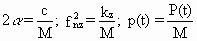
Equation (2) can be converted into another form as

(3)

with

(4)

where

  • f nz = natural frequency of vertical vibrations of foundation;
  • a = effective damping constant.

An expression derived from Equations (3) and (4) for a dynamic load applied to the soil can be written as

(5)

The dynamic force transmitted from the machine foundation to the soil base (Figure 1) depends on the foundation and machine mass, the damping constant, natural frequency of vertical foundation vibrations and vertical foundation displacements as a function of time.

Substitution of Equation (5) to Equation (1) gives

(6)

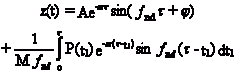
For an arbitrary dynamic load, P(t), the total foundation displacement is

(7)

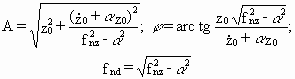
where fnd = damped natural frequency of vertical vibrations of the foundation and

(8)

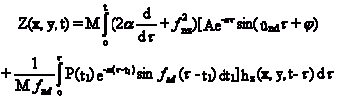
The general solution for determining dynamic displacements of points on the soil or in structures is obtained substituting Equation (7) to Equation (6)

(9)

3.1 Source with impact loads

Impact loads are transmitted to foundations from moulding machines, forge and drop hammers, and many construction operations like pile driving.

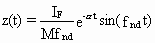
Vibration displacements of the source machine foundation can be assigned analytically as a damped sinusoid

(10)

with

(11)

where

  • IF = impulse force transmitted from machine to foundation;
  • f = modulus of damping;
  • kz = coefficient of vertical subgrade reaction;
  • A = contact area between foundation and soil.

According to Savinov (1979), the modulus of damping, f, ranges in a relatively narrow range and is slightly dependent on soil conditions. For instance, f values range from 0.004 to 0.008 sec for foundations with contact areas less than 10.0 m2. Coefficient, kis determined according to Barkan (1962). Also, it is possible to use other approaches for determining values of f and kz .

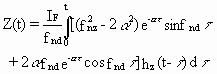
After substitution of Equation (10) to Equation (6), vibration displacement at a target point is

(12)

3.2 Source with steady state vibration loads

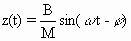
A harmonic dynamic load applied to the foundation can be written as

(13)

where

  • P0 = load amplitude;
  • w = angular frequency.

Such loads are transmitted to foundations under various machines. The most prevalent powerful sources of steady state vibrations are compressors and crushing equipment.

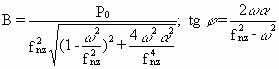
The solution of Equation (3) with the right side of expression (13) is

(14)

with

(15)

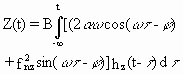
After substitution of Equation (14) to Equation (6), vibration displacement in a target point is

(16)

Integration limits were taken (-¥ , t) because steady state vibrations are considered.

3.3 Source with transient state vibration loads

Dynamic transient loads are transferred to a foundation from a vibro-isolated block for a forge hammer. These dynamic loads can be represented as

(17)

with

(18)

where

  • z1 = dynamic displacement of the vibro-isolated block;
  • z.1 = dynamic velocity of the vibro-isolated block;
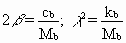
  • λ = natural frequency of vertical vibrations of the vibro-isolated block;
  • kb = spring constant for the vertical mode of the vibro-isolated block;
  • Mb = mass of the vibro-isolated block and machine;
  • cb = viscous damping coefficient of vibro-isolation;
  • β = damping constant of vibro-isolation.

Parameters Mb, cb and kb are considered known.

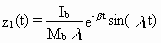
Vibration displacements of the vibro-isolated block can be assigned as

(19)

with

(20)

where Ib = impulse applied to the vibro-isolated block; λ1 = damped natural frequency of the vibro-isolated block.

Substitution of Equation (19) to Equation (17) gives

(21)

The duration of transient state vibrations is commensurate with the time of attenuation of foundation natural vibrations. For that reason determining dynamic loads transmitted to the soil, F(t), it is necessary to take into account natural foundation vibrations.

Next consider determination of the function F(t) in detail. A general integral of a linear nonhomogeneous Equation (3) with the right side equal to expression (21) is

(22)

where a partial integral will be found in a form

(23)

because the vibro-isolated block parameter range eliminates the coincidence of β+iλ with roots of characteristic equation equal α+ifnd. The use of the method of indeterminate coefficients gives

(24)

(25)

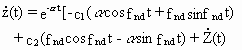
Differentiation of Equation (22) gives

(26)

Substituting initial conditions to Equation (22) and (26), we obtain arbitrary constants c1 and c2. After substitution these constants to Equation (22) and using expression (23), a general solution of Equation (3) is

(27)

The first term of the right side of Equation (27) presents the initial free displacement of a point under consideration determined by initial conditions and independent of the exciting force, the second term is excited free vibrations determined by the exciting force and independent of initial conditions, and third term is forced vibrations.

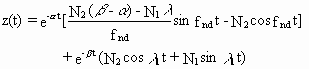
For zero initial conditions at the time of vibro-isolated hammer operations, Equation (27) becomes

(28)

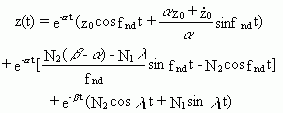
Equation (28) can be transformed as

(29)

with

(30)

(31)

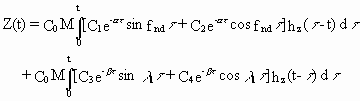
Substituting expression (29) into Equation (6), we obtain vertical or, similarly, horizontal displacements of soil and structures as

(32)

The first integral represents the displacements of a point under consideration excited by free foundation vibrations, and the second one by forced foundation vibrations.

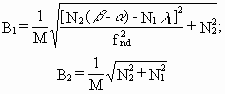
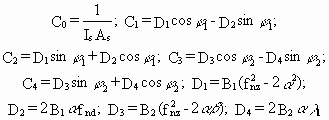
Coefficients in equation (32) are defined as follows

(33)

It is necessary to point out that displacements at target points depends only on parameters observed in experiments.

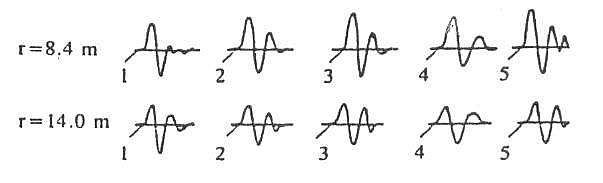
Duhamel’s integral was applied to compute ground surface vibrations at distance of 8.4 and 14.0 m from the foundation with an area of 80.0 m2 under a forge hammer at a site with clay soils. A falling weight of 7.25 tonnes produced the vibration records in Figure 2. The prediction was performed using various frequencies of natural vertical foundation vibrations obtained according to different theoretical approaches. Changes of this frequency affect predicted records only slightly. It can be seen in Figure 2 that measured and predicted records have very close shapes and the difference between maximum amplitudes is 9-25 % and 2-10 % at distances 8.4 and 14.0 m, respectively.

Figure 2 Measured (1) and Predicted (2-5) records of vertical soil vibrations excited by operating large forge hammer with falling mass of 7.25 tonnes

4 APPLICATION OF FOURIER TRANSFORM

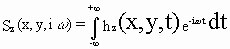
Application of the direct Fourier transform to an impulse response function hz(x,y,t-τ) gives

(34)

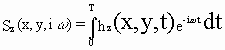
For a real physical system, records can be measured only over some finite time interval T, so that Sx,y(iω) is estimated by computing the finite Fourier transform

(35)

The complex Fourier transform can be presented as

(36)

where

  • S(x,y,ω) = magnitude spectrum and
  • θx,y(ω) = phase spectrum.

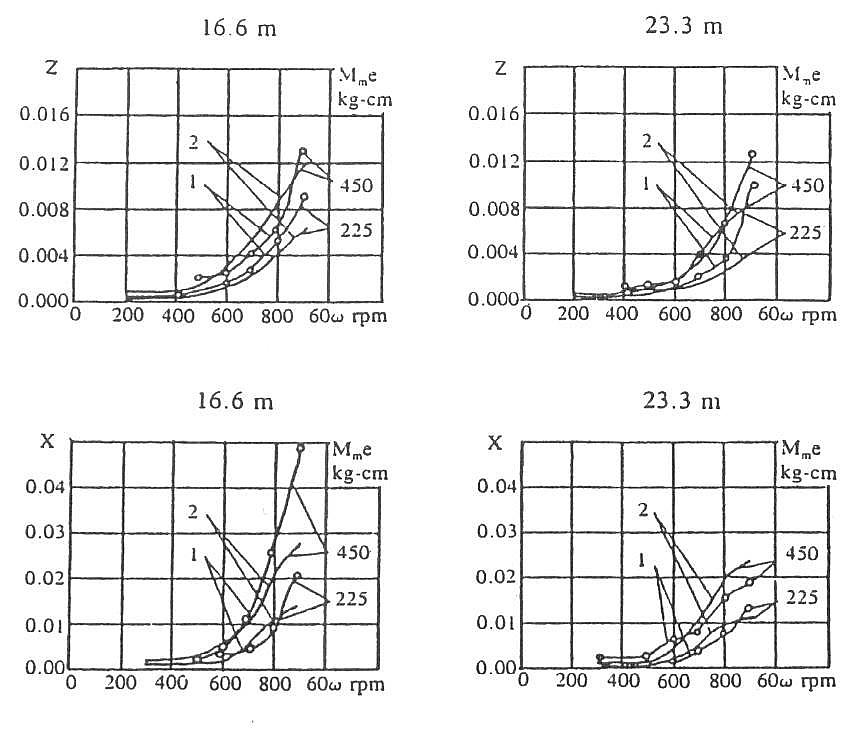
Figure 3 Vertical and horizontal amplitudes of soil vibrations at distances 16.6 and 23.3 m from the machine foundation: 1 – Measured vibrations; 2 – Predicted vibrations

In fact, the magnitude spectrum is the transfer function of the considered dynamic system: ground at the place of the dynamic source – soil medium through which waves propagate outward from the source – target point at any location of interest at the soil or in buildings. If the impact applied onto the soil is not instantaneous, the transfer function of the considered dynamic system can be obtained as a ratio of spectrum magnitudes of output to input.

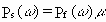
A magnitude spectrum of the dynamic source, Ps, transmitted from the foundation onto the soil is

(37)

where

  • Pf(ω) = magnitude spectrum of the dynamic load onto foundation,
  • μ = amplification factor of the foundation-soil system.

A predicted magnitude displacement spectrum in the target point with coordinates x and y is

(38)

Predicted vertical or, similarly, horizontal displacements of soil and structures as a function of time at the location under consideration may be derived using the inverse Fourier transform of Sp(x,y,ω)

(39)

For a source with steady state vibration loads, it is very easy to predict vibration amplitudes in target points. Predicting amplitude Zx,y at target point can be find as

(40)

where

  • P0 = amplitude of the source dynamic load;
  • μ0 = ordinate of the amplification factor corresponding the source angular frequency ω0.

Figure 3 demonstrates examples of predicting amplitudes of soil vibrations from a steady state vibration source. The machine foundation with contact area of 15.1 m2 was installed at the site with type-I slump-prone soils (Svinkin & Zhuchkova 1972). The predicted amplitudes of soil vibrations matched well the measured vibration amplitudes excited by the vibration machine installed on the foundation. Comparison was performed at distances 16.6 and 23.2 m from the machine foundation in frequency range of 400-800 rpm. Error margins were within 5-20%.

Comparison of the suggested numerical predicting methods shows a preference for Duhamel’s integral for sources with impact and transient state vibration loads because there are some difficulties in calculation of the inverse Fourier transform for expression with an unknown load function phase spectrum. Besides, Duhamel’s integral is almost insensitive to small changes of original curves.

5 CONCLUSIONS

Numerical methods coupled with experimental soil response measurements are used to predict soil and building vibrations before the installation of construction and industrial vibration sources. Such an approach does not require routine soil boring, sampling, or testing at the site where waves propagate from the vibration source.

Experimental Green’s functions reflect real soil and structure behavior and take into account spatial variations of soil properties. Because of that, the suggested methods have substantially greater capabilities in comparison with other existing methods.

ACKNOWLEDGEMENT

The writer is pleased to acknowledge special contributions to the paper made by Dr. Richard D. Woods, professor of civil engineering at the University of Michigan at Ann Arbor, USA.

REFERENCES

  • Barkan, D.D. 1962. Dynamics of bases and foundations. New York: McGraw Hill Co.
  • Bendat, J.S and Piersol, A.G. 1993. Engineering applications of correlation and spectral analysis. New York: John Wiley & Sons, Inc.
  • Broers, H. and Dieterman H.A. 1992. Environmental impact of pile-driving. In F. Barends (ed.), Proc., 4th Intern. Conf. on Application of Stress Wave Theory to Piles: 61-68, The Hague: Balkema.
  • Hanazato, T. and Kishida, H. 1992. Analysis of ground vibrations generated by pile driving – Application of pile driving analysis to environmental problem. In F. Barends (ed.), Proc., 4th Intern. Conf. on Application of Stress Wave Theory to Piles: 105-110, The Hague: Balkema.
  • Miller, G.F. & Pursey, H. 1954. The field and radiation impedance of mechanical radiators on the free surface of a semi-infinite isotropic solid. Proc. Royal Society, A 223: 521-541.
  • Richart, F.E., Hall, J.R. and Woods, R.D. 1970. Vibrations of soils and foundations. Englewood Cliffs: Prentice-Hall, Inc.
  • Savinov, O.A. 1979. Modern construction of machine foundations and their calculations. Second Ed. Stroiizdat, Leningrag.
  • Svinkin, M.R. & Zhuchkova, A.Y. 1972. Dynamic tests of foundations on type-I slump-prone soils. Soil Mech. and Found. Engrg., 9(1): 33-36.
  • Svinkin, M.R. 1973. Prediction of soil oscillations from machine foundation vibrations (in Russian). Dynamics of structures, Proc., Kharkov Scientific-Research and Design Inst. for Industrial Constr.: 53-65, Kiev: Budivelnic.
  • Svinkin, M.R. 1996. Overcoming soil uncertainty in prediction of construction and industrial vibrations. Proc. Uncertainty in the Geologic Environment: From theory to Practice, Geotech. Special Publication No. 58, 2:1178-1194, Madison: ASCE.
  • Wolf, J.P. 1994. Foundation vibration analysis using simple physical models. Englewood Cliffs: PTR Prentice Hall.
Posted in Uncategorized

Engineering Judgement in Determination of Pile Capacity by Dynamic Methods

Mark R. Svinkin, Member, ASCE
VibraConsult
13821 Cedar Road, #205
Cleveland, OH 44118-2376
PH 216-397-9625
FAX 216-397-1175
msvinkin@vulcanhammer.net

Abstract

The application of dynamic methods to driven piles has advantages in evaluation of the hammer-pile-soil system and in data acquisition during pile driving and restrikes. Therefore during the last twenty five years, dynamic methods have become an integral part of pile capacity prediction and measurement for numerous projects. Dynamic methods use good quality hardware and software, but such great tools cannot themselves solve geotechnical problems of piling without engineering judgement. This paper shows some engineering assessments of determining pile capacity by dynamic formulas, wave equation analysis and dynamic testing.

Introduction

Contemporary dynamic methods are founded on the application of the stress wave theory to piles. There are two different techniques of the use of wave equation analysis for determining pile capacity: computation of pile capacity without dynamic measurements on driven piles and a signal matching technique for computed and measured force and velocity records at the pile head.

Dynamic methods have certain advantages and some uncertainties in their application. The wave equation method is used for prediction of pile capacity during both the design stage and for construction control before restrikes. Unfortunately in most cases, predicted pile capacity differs substantially from results of both static and dynamic load tests. Dynamic measurements of force and velocity at the upper end of the pile during pile driving, followed by a signal matching procedure, is the most common method for dynamic determination of pile capacity. This method is a convenient tool in the pile driving industry. However, though dynamic methods have been used in practice for years, actual accuracy of dynamic methods and understanding the results of dynamic testing are vague.

Also, there is an attempt to breath new life into dynamic formulas and consider a suggested formula as the better alternative to signal matching technique. There are no theoretical and experimental basis for such replacement.

In the medium of geotechnical engineers involved in dynamic testing and analysis, there is a belief that hardware and software themselves can solve geotechnical problems of piling. Indeed, hardware and software are great tools but only tools, and these tools cannot replace engineering judgement. It is known if we put trash in, we will receive trash out. Computer misuse comes in many forms and among them having computer programmers provide services they are unqualified to perform. Formal implementation of the signal matching procedure is a common approach in dynamic pile testing. In spite of a number of excellent engineering assessment of results obtained from static and dynamic tests, it is obvious that the application of dynamic methods to piles lacks engineering judgement.

Misapplication and misuse of the specified computer software are demonstrated. Various problems such as misleading assessment of the accuracy of dynamic formulas, calibration of wave equation programs, the soil consolidation effect in prediction of pile capacity by wave equation analysis, comparison of static and dynamic tests, prediction of pile capacity by dynamic pile testing, overestimated capabilities of signal matching technique and others are discussed. It is shown that dynamic methods have to be used with the proper engineering judgment for prediction and determination of pile capacity.

Dynamic Formulas

Determination of pile capacity by dynamic formulas is the oldest and frequently used method. There is a great number of dynamic formulas available with different degrees of reliability. Dynamic formulas have been criticized in many publications. Unsatisfactory prediction of pile capacity by dynamic formulas is well characterized in FHWA Manual for Design and Construction of Driven Pile Foundations, Hannigan et al.(1996): “Unfortunately, dynamic formulas have fundamental weakness in that they do not adequately model the dynamics of the hammer-pile impact, the influence of axial pile stiffness, or soil response. Dynamic formulas have also proven unreliable in determining pile capacity in many circumstances. Their continued use is not recommended on significant projects”.

However, dynamic formulas are traditional dynamic analysis techniques. For example, responses to the questionnaire obtained from 45 state DOTs and 2 FHWA officials showed that Dynamic Formulas usage are 45% ENR (Engineering News Records) and 16% Gates Equation, Paikowsky and Stenersen (2000). Besides, there is an attempt to breathe new life into dynamic formulas. Paikowsky and Chernauskas (1992), Paikowsky et al. (1994) and Paikowsky and Stenersen (2000) have suggested one more energy approach using dynamic measurements for the capacity evaluation of driven piles. Liang and Zhou (1997) have concluded regarding this method: “Although the delivered energy is much more exactly evaluated, this method still suffers similar drawbacks of ENR“.

Authors of a new dynamic formula used the ratio, also called index K, of the static load test capacity to the predicted capacity to evaluate performance of the energy approach and dynamic testing. However, such a ratio is irrelevant for verification of dynamic formulas and dynamic testing (DT) results for two reasons: first, dynamic testing methods yield pile capacity only for the time of testing (Rausche et al. 1985), and second, the pile capacity from static load test (SLT) is considered as a constant value which is a major error.

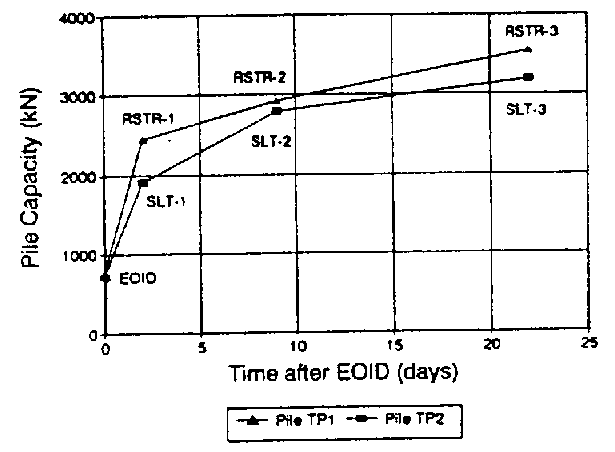
Paikowsky et al. (1994) and Paikowsky and Stenersen (2000) use a false assumption that accuracy of Dynamic Formulas are independent of the time between DT and SLT. However, SLT as well as DT yields the pile capacity at the time of testing (Svinkin 1997). By way of illustration, results of DT and SLT are shown in Figure 1 for two identical cylindrical, 1372 mm x 127 mm, prestressed concrete piles, TP1 and TP2 (Svinkin et al. 1994). These piles were driven at the same site to the depth of penetration of about 24.4 m. Each of the piles TP1 and TP2 was tested 2, 9 and 22 days after the end of initial driving (EOID). The difference was that three restrikes were made for TP1 and three SLTs were made for TP2. Pile capacity from three SLTs was a function of time as well as pile capacity obtained from DT. Tested data in Figure 1 help to explain the causes of unsatisfactory prediction in pile capacity by dynamic formulas. Dynamic formulas using maximum energy, pile set and maximum displacement from DT do not take into account the time between SLT and DT. In the case of a few SLTs made on one pile, like three SLTs performed on pile TP2, what would be the reliability of pile capacity prediction by the energy approach methods? Which SLT should be taken for comparison? Currently, there are no answers to these questions. Nevertheless, Paikowsky and Stenersen (2000) assert that the Energy Approach Formula is ideal for construction and better than Signal Matching technique, e.g. CAPWAP program (GRL and Associates, Inc. 1995). There are no theoretical and experimental confirmation of such conclusions which are wrong and misleading. It is necessary to utilize other appropriate way for comparison of results of the Energy Approach Formula and DT which use the same dynamic measurements. Such comparison was made in the frames of preparation of FHWA-GRL database. The results obtained were very poor and confirmed that the Energy Approach with dynamic measurements cannot yield reliable prediction of pile capacity. Statistical analysis itself cannot reveal good results and replace engineering judgement if comparison of measured pile capacities is incorrect.

Wave Equation Analysis

Limitations in Prediction of Pile Capacity

The main goal in using wave equation analysis is to provide a better prediction of the pile capacity, as a function of pile penetration resistance, than can be obtained from classical dynamic formulas. Today, the most commonly used wave equation programs are either GRLWEAP (GRL and Associates, Inc. 1997) or TNOWAVE (TNO Report 1996).

The wave equation method is used for prediction of pile capacity prior to the beginning of pile driving and before restrikes. However, in most cases, computed pile capacity differs substantially from results of both static and dynamic load tests. Statistical analysis of GRLWEAP results, Hannigan et al. (1996), computed for 99 piles driven into various soils, has demonstrated that GRLWEAP does not have an advantage over the Gates dynamic formula. The mean and coefficient of variation are almost the same for both prediction methods.

Smith (1960) made his model on the basis of existing knowledge of pile driving at the time and he supposed this model could be improved with acquisition of new data. Results obtained by many researchers confirmed that Smith’s model is simple and sensible but with some lack of proper presentation of soil properties.

Soil parameters considerably affect solutions of wave equation analysis. Dynamic soil resistance parameters (damping and quake) have to be assigned as constant values for wave equation analysis. These parameters do not reflect the changes of soil properties in the pile-soil interface zone after the completion of pile driving.

There have been attempts to determine values of damping and quake from signal-matching solutions for dynamically tested driven piles or from modified SPT. It could be beneficial for some cases, but, in general, such approaches are not successful in finding proper values of damping and quake. Besides complications with different models in wave equation analysis and signal-matching technique and also with the scale factor effect on the use of SPT results, these approaches yield constant values of soil parameters and cannot be used in prediction of the pile capacity as a function of time after EOID (Svinkin 1996).

Variable Soil Parameters.

Existing dynamic models of the pile-soil system mainly use a velocity-dependent approach for calculation of the dynamic resistance as a damping component of the total resistance during pile driving. There are various linear and non-linear relationships between the damping component and the velocity. A study of different soil damping models and computed pile capacities has revealed that neither the pile velocity nor the damping constant can reflect time-dependent variation of the pile-soil system after EOID. The existing approach of computing the dynamic resistance does not take into account soil consolidation around the pile after EOID and therefore cannot provide determination of pile capacity as a function of time after pile installation. There is necessity to take into account soil consolidation around a pile after EOID for improvement in accuracy of wave equation analysis, Svinkin (1996).

For the idealized Smith wave equation model, it is important to find an appropriate combination of parameter values, mainly paying attention to soil variables, in order to achieve the accurate prediction of pile capacity. There is a reasonable way to enhancing prediction accuracy of the dynamic resistance with the velocity dependent approach. Variation of the pile-soil system after the completion of driving can be taken into account by a variable damping coefficient which should be considered as a function of time and other parameters characterizing soil consolidation around the pile, Svinkin (1996, 1997). It is assumed that the variable damping coefficient is independent of pile velocity. Inclusion of variable damping is thought to be the next step in the development of Smith’s model with the velocity dependent approach for representation of the dynamic resistance.

The damping coefficient as a function of time can be found on the basis of back calculations using the wave equation model of the pile-soil system with known capacity as This procedure is in agreement with Lambe’s (1973) equation modified for a general back analysis approach by Leroueil & Tavenas (1981). Since the variable damping coefficient is chosen as only one soil parameter reflecting the field soil consolidation after pile installation, this parameter can be successfully back analysed.

engine1

The results of back analysis has revealed that the shaft damping coefficient in clay is much higher than in unsaturated sand, but upper values of this coefficient in saturated sandy soil (sand with high damping) are close to ones in clay, Svinkin and Woods (1998). Also, a trend of the damping coefficient increase with time after EOID was found for all soil damping models available in GRLWEAP program and this trend is independent of the damping resistances, Svinkin (1996).

The idea of variable damping has been confirmed by results of statistical analysis of damping coefficients from CAPWAP solutions performed by Liang and Zhou (1997) who have found that the damping coefficient is affected by the time. Cho et al. (2000) agree that set-up effects should be accounted for in wave equation analysis for restrikes and suggested constant damping and quake coefficients to computing pile capacity before restrike. This is a partial solution because these coefficients can be used only for one restrike. The variable damping coefficient is a solution for calculation of pile capacity before different restrikes.

Soil damping is the key parameter for adjustment of wave equation solutions with time-dependent soil properties in pre-driving analysis. The use of the variable damping coefficient gives an opportunity to compute the time-dependent pile capacity by the wave equation method.

Software Calibration.

Existing programs for wave equation analysis are not the same. Moreover all programs have a number of versions. Each new version gives usually additional beneficial options to users, but it is not clear how each program version ensures the accuracy of pile capacity calculation. There is confusion what program yields more accurate results. The writer has an experience of pile capacity calculation for the same hammer, pile and soil conditions using two versions of the same program. Variation of obtained capacities was about 20 %. This is an evidence of contradictions available between different program versions.

Obviously, it is necessary to calibrate each program version with some standard data of the hammer-pile-soil system in order to avoid confusion in a choice of the program.

Dynamic Testing

Dynamic testing followed by a signal matching procedure has obvious advantages in determining pile capacity at any time required after pile installation. Since dynamic testing is often used to replace the static loading tests, it is important to ascertain the adequacy of both SLT and DT.

Existing Approach for Comparison of SLT and DT. Static analysis methods predict pile capacity as the long term capacity after soil consolidation around the pile is complete. Independently of the time elapsed between installation of the test pile and the static loading test, the ratio of the predicted ultimate load to the measured ultimate load from static loading test is used for approximate evaluation of the reliability of design methods. For example, Briaud and Tucker (1988) evaluated 13 methods developed to predict the ultimate load capacity of the pile, and they used this ratio for approximate evaluation of the reliability of design methods in calculation of the ultimate pile load although the time elapsed between installation of the test pile and static load test averaged 17 days.

According to the traditional approach, the main criterion for assessment of the pile capacity prediction based on dynamic measurements is the ratio of capacities obtained by dynamic and static tests or vice versa (Figure 2). It is necessary to point out that a ratio of DT/SLT or vice versa, taken for arbitrary time between compared tests, is not a verification of dynamic testing results. It is well-known that dynamic testing methods yield the real static capacity of piles at the time of testing, Rausche et al. (1985). Besides, the static capacity from SLT is considered as a unique standard for assessment of dynamic testing results. Unfortunately, that is a major error. As a matter of fact, pile capacity from Static Loading Tests is a function of time and the so-called actual static capacity from SLT is not a constant value, Svinkin (1997; 1998).

For the general case of assessment of reliability of the DT, the ratio of restrikes to SLT results has been considered for various pile types, soil conditions and times of testing lumped together as shown in Figure 2. Such mixture has no real meaning. It is not a verification of dynamic testing at restrikes and it is not an assessment of real set-up factor because everything is lumped together without taking into account the time between different tests. Such a comparison of the pile capacities from SLT and DT is invalid for piles driven in soils with time-dependent properties because the soil properties at the time of DT do not correspond to the soil properties at the time of SLT i.e. soil consolidation is taken into account for the latter test and not considered for the former test. As a matter of fact, such a comparison uses pile capacity values which are incompatible from the point of DT verification, Svinkin (1997) and Svinkin and Woods (1998).

New Criteria for Comparison of SLT and DT. Criteria should be established for correct comparison of in-situ tests made at different times after EOID. It is important to find how changes of pile capacity between two compared tests may affect the accuracy of determining pile capacity by dynamic testing.

Acceptable time between tests. Pile capacity determined at EOID in various soils changes with time. After the completion of pile driving, soil consolidation, manifested by the dissipation of excess pore pressure at the soil-pile interface zone, is usually accompanied by an increase in pile capacity (soil set-up). In saturated sandy soils, ultimate pile capacity may decrease (soil relaxation) after initial driving due to dissipation of negative pore pressure. Changes of strength in soil after driving and the time required for return of equilibrium conditions are highly variable and depend on soil conditions, and pile type and size. The consequences of soil modification around the pile are essential with respect to changes of pile capacity. Pile capacity as a function of time is displayed, for example, in Figure 1 for piles TP1 and TP2. Comparison of values of the pile capacity obtained from two tests with arbitrary time between them show only a change of pile capacity during a considered period of the time, but it is not verification of DT.

svin2002

Static Loading Tests and Dynamic Testing present different ways of determining pile capacity at various times after pile installation, but for valid correlations of both tests, static and dynamic testing capacities must be compared at the same time after pile installation in both SLT and DT methods, Svinkin (1997; 2000) and Svinkin and Woods (1998).

The adequacy of SLT and DT have to be confirmed by proper correlation of time. Due to the consolidation phenomenon in soils, comparison of SLT and DT can be made only for tests performed immediately one after another. In practice, it is sometimes difficult to make two immediately successive tests, but nonetheless the time difference between both comparable tests should not exceed 1-2 days during which soil set-up changes only slightly.

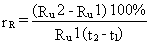
Rate of pile capacity change. It is important to find quantitative assessment of pile capacity change during 1-2 days. The rate of pile capacity change per day (set-up rate), rR, between two considered tests can be calculated as

engine2

Where Ru1 = pile capacity from test 1; Ru2 = pile capacity from test 2; t1 and t2 = elapsed time in days after EOID for test 1 and test 2, respectively.

The set-up rate was calculated for different pile types tested in various soils. Pile capacity from dynamic testings was determined by CAPWAP analysis and the Davisson criterion of failure load was used for static loading tests, Davisson (1972). The obtained results are shown in Table 1-3. Initial data for these tables were taken from Svinkin et al. (1994).

A description of seven prestressed concrete piles is presented in Table 1. The depth of penetration of each pile was approximately 24.4 m. The soil consisted of about 25.6 m of mainly gray clays followed by a bearing layer of silty sand. Water table was at the ground surface. A Delmag D 46-13 hammer was employed for initial driving and restrikes (RSTR). For each pile, 3 to 4 DT and/or SLT were performed after pile installation. The elapsed time after EOID, penetration resistance and the time dependent ultimate capacity of tested piles are shown in Table 1 as well. It can be seen that the set-up rate depends on the elapsed time after pile installation. The set-up rate was about few hundred in 1-2 days after pile installation. Then the rate considerably decreased and became 13-16 %/day for four days after EOID and less than 7-8 %/day for 9-10 days after EOID, Figure 3.

Table 1. Static and Dynamic Data for Prestressed Concrete Piles in Clay over Silty Sand
Pile Test Time after EOID (days) Penetration Resistance (blows/0.3 m) Ru (kN) Set-up Measuredd Set-up Rate (%/day)
No. Description
TP1 1372 mm x 127 mm

Cylinder

EOID

RSTR-1

RSTR-2

RSTR-3

2

9

22

38

>240

>240

>240

752

2451

2927

3545

1

3.26

3.89

4.71

113

3

2

TP2 1372 mm x 127 mm

Cylinder

EOID

SLT-1

SLT-2

SLT-3

2

9

22

48

712

1913

2789

3189

1

2.69

3.92

4.48

84

7

1

TP3 610 mm x 610 mm

(305 mm D. void)

EOID

RSTR-1

RSTR-2

RSTR-3

SLT

1

10

18

31

10

21

72

144

267

912

1530

1672

1841

1

3.42

5.73

6.26

6.90

242

8

1

<1

TP4 762 mm x 762 mm

(475 mm D. void)

EOID

RSTR-1

RSTR-2

RSTR-3

RSTR-4

SLT

1

4

9

18

32

14

23

60

>240

168

200

890

1299

1517

1601

2273

1

4.45

6.50

7.60

8.00

11.37

345

15

3

<1

3

TP5 762 mm x 762 mm

(475 mm D. void)

EOID

RSTR-1

RSTR-2

RSTR-3

RSTR-4

SLT

1

4

11

20

34

23

59

96

91

>240

262

952

1401

1588

1748

2473

1

3.63

5.37

6.06

6.67

9.44

263

16

2

1

3

TP6 914 mm x 127 mm

Cylinder

EOID

RSTR-1

RSTR-2

RSTR-3

RSTR-4

SLT

1

4

11

21

35

15

34

64

162

113

400

885

1241

1766

2300

2406

1

2.21

3.10

4.42

5.75

6.02

121

13

6

3

<1

TP7 914 mm x 127 mm

Cylinder (spliced)

EOID

RSTR-1

RSTR-2

RSTR-3

RSTR-4

SLT

1

4

10

20

35

32

32

102

168

186

454

876

1285

1890

2260

2406

1

1.93

2.83

4.16

4.98

5.30

93

16

8

2

<1

Table 2. Static and Dynamic Data for Piles in Unsaturated Sandy Soils
Pile Test Time after EOID (days) Penetration Resistance (blows/0.3 m) Ru (kN) Set-up Measured Set-up Rate (%/day)
No. Description Embedment (m)
1 Prestressed concrete

508 mm x 508 mm

(38 mm D. void)

38.0 EOID

RSTR-1

SLT

3

12

110

1114

2487

3243

6450

1

1.30

2.59

10

11

2 Prestressed concrete

356 mm x 356 mm

27.4 EOID

RSTR-1

SLT

7

16

68

78

1134

2309

3736

1

2.03

3.29

15

7

3 324 mm O.D. by 6 mm thick closed end steel pipe 25.3 EOID

RSTR-1

SLT

7

14

27

48

681

1232

2224

1

1.81

3.26

12

12

Table 3. Static and Dynamic Data for Prestressed Concrete Piles in Saturated Sandy Soils
Pile Test Time after EOID (days) Penetration Resistance (blows/0.3 m) Ru (kN) Set-up Measured Set-up Rate (%/day)
No. Description Embedment (m)
CT1 457 mm x 457 mm 19.7 EOID

RSTR-1

RSTR-2

SLT

2

11

21

18

84

84

913

1145

1702

1666

1

1.25

1.86

1.85

13

5

-<1

CT2 457 mm x 457 mm 22.9 EOID

RSTR-1

RSTR-2

SLT

2

11

21

42

84

60

1907

2176

2668

2540

1

1.14

1.40

1.34

7

4

-<1

CT3 610 mm x 610 mm

(267 mm D. void,

solid ends)

19.5 EOID

RSTR-1

RSTR-2

SLT

1

10

22

34

72

108

1513

2615

2869

1

1.73

1.90

7

<1

CT4 610 mm x 610 mm

(267 mm D. void,

solid ends)

22.9 EOID

RSTR-1

RSTR-2

SLT

2

11

23

77

96

216

1986

2691

3617

3724

1

1.35

1.82

1.90

18

4

<1

CT5 915 mm x 915 mm

(570 mm D. void,

solid ends)

22.3 EOID

RSTR-1

SLT

6

20

92

60

2949

4210

4900

1

1.43

1.66

7

1

Three piles, two prestressed concrete and one closed ended steel pipe, are presented in Table 2. These piles were tested at different sites but their soil conditions were very close: predominantly unsaturated sandy soils. Soil deposits were mostly fine sands with bare strata of silty sand at site 1 and slightly silty or clayey fine sands at sites 2 and 3. The water table was not encountered during soil boring on each site. For pile 1, a Kobe K-45 hammer was used. Piles 2 and 3 were driven and restruck with a Vulcan 80C and 010 hammers, respectively. For unsaturated sands, the set-up rate was mostly independent of the limited elapsed time of 12-16 days after pile installation and was found in the range of 10-15 %/day.

Five prestressed concrete piles were driven on a site with predominantly silty sands (Table 3). The water table was at a depth of 0.6 m from ground surface. Piles CT1, CT2, CT3, and CT4 were driven and restruck with a Kobe K25 hammer. A Delmag D 62-22 hammer was used for pile CT5. The set-up rate was 7-18 %/day, 4-7 %/day, and less than 1 %/day for 2, 10-11, and 20-23 days after EOID.

Thus, the rate of pile capacity change per day, rR, decreases with an increase of the elapsed time after EOID and a margin of error about 10-15 %/day would be reasonable for a few days after pile installation.

Comparison of SLT and DT. Thirty nine different piles in various soil conditions were statically and dynamically tested (Table 4). Initial data for these piles were taken from FHWA-GRL database.

Explanation of abbreviations in Table 4 are as follows. Pile number: number in parentheses is from FHWA Database; Pile description: PSC is prestressed concrete, OEP is open ended pipe, CEP is closed ended pipe, HP is H-pile; Soil: HWT is high water table; Time between SLT & DT: minus and plus mean DT was made before or after SLT, respectively; Time after EOID was shown for DT; Signal Matching: reanalyzed results include the “automatic” or “best match” (with asterisk), minus and plus in error mean under or overestimated CAPWAP results.

Static load tests were carried to failure according to the Davisson failure criterion. Dynamic records from restrike testing were available for all piles. A signal matching technique – CAPWAP analysis of the restrike test data was used for pile capacity determination. The “original” CAPWAP capacities were obtained from existing CAPWAP results. For a number of piles, additional CAPWAP analysis was provided because of absence of the “original” CAPWAP capacities or in order to improve signal matching results with “automatic” or “best match” solutions. “Automatic” is an option in the CAPWAP program with automatic search capability which provides a solution using optimal matching of signals with no user interaction. “Best match” is a result of working in a manual operating mode to iteratively seek a best match.

For all considered piles, the time differences between static and dynamic tests were 1-2 days, but time elapsed after EOID was diverse. An acceptable margin of error was determined in accordance with the set-up rate in Tables 1-3. Compared capacities have a good agreement within the acceptable margin of error for 28 piles (1, 3, 4, 5, 6, 8, 9, 11, 13, 15, 16, 17, 19, ,20, 21, 22, 24, 25, 26, 27, 28, 30, 31, 32, 34, 37, 38, 39). Piles with at least one CAPWAP result within the acceptable limits were included in this group. For example, for pile 11 “original” and “automatic” CAPWAP yielded the pile capacity with an error of -8 % and -40 %, respectively, but even the big error is acceptable in this case because the elapsed time after EOID was only 1 day and DT was made 2 days before SLT. Calculated capacities for five piles (12, 14, 18, 29, 33) have errors from 20 % to 25 %. The worst results were obtained in CAPWAP analysis of six piles (2, 7, 10, 23, 35, and 36) which were analyzed with errors between 30-54 %. First three piles have underestimated results, but piles 23, 35 and 36 have overestimated pile capacity on 31 %, 54 % and 44 %, respectively.

Table 4. Comparison of pile capacities obtained from SLT and DT

Pile Soil SLT Time between Dynamic Testing Signal Matching
No. Description Length

(m)

(kN) SLT & DT

(hours)

Time

a/EOID

(days)

Test Blow

Count

(bl/0.3 m)

Original

(kN)

Error

(%)

Reanalzd

(kN)

Error

(%)

1(1) 610 mm PSC

305 mm void D.

28.42 Sand

HWT

4228 +24 13 RSTR-2 360 4116 -2.6 3498* -17
2(3) 610 mm PSC

305 mm void D.

20.20 Sand & Clay

HWT

3160 +24 12 RSTR-2 240 2011 -36 2216 -30
3(5) 610 mm PSC

305 mm void D.

24.54 Sand & Clay

HWT

3560 +24 24 RSRT-2 288 3573 +0.4
4(6) 610 mm PSC

305 mm void D.

37.69 Clay & Sand

HWT

3560 +24 24 RSTR-2 720 3467 -2.6 4041* +14
5(7) 610 mm PSC

305 mm void D.

37.03 Sand & Clay

HWT

4361 +24 29 RSTR-2 576 3386 -22 4236* -3
6(46) 610 mm PSC 25.58 Sand, HWT 2216 +24 13 RSTR-2 120 2114 -4.6 2123 -4.2
7(48) 762 mm PSC

457 mm void D.

31.10 Sand

HWT

6635 +48 31 RSTR-2 432 3039 -54 3836* -42
8(49) 762 mm PSC

457 mm void D.

30.80 Sand & Clay

HWT

2812 +24 10 RSTR-2 144 2523 -10 2376 -16
9(50) 762 mm PSC

457 mm void D.

31.57 Sand & Clay

HWT

4005 +24 33 RSTR-2 312 3435* -14
10(51) 762 mm PSC

457 mm void D.

30.02 Sand, HWT 6439 +24 26 RSTR-2 264 3751* -42
11(56) 610 mm PSC

76 mm void D.

19.60 Sand with Silt

& Clay, HWT

3524 -48 1 RSTR-1 72 3253 -8 2100 -40
12(62) 610 mm PSC 58.52 Sand, Clay HWT 2893 +24 8 RSTR-2 80 2382 -17 2203 -24
13(68) 610 mm PSC

102 mm void D.

27.43 Clay & Sand

HWT

4717 +48 21 RSTR-1 1000 4517 -4.2 4632 -1.8

Table 4. continued. Comparison of pile capacities obtained from SLT and DT

Pile Soil SLT Time

between

Dynamic Testing Signal Matching
No. Description Length

(m)

(kN) SLT & DT

(hours)

Time

a/EOID

(days)

Test Blow

Count

(bl/0.3 m)

Original

(kN)

Error

(%)

Reanalzd

(kN)

Error

(%)

14(69) 406 mm PSC

102 mm void D.

24.38 Clay & Sand

HWT

2626 +48 15 RSTR-1 180 3204 +22
15(70) HP 346×109 27.43 Clay, HWT 2750 +48 34 RSTR-1 1000 2799 +1.7
16(71) HP 346×109 27.43 Sand & Clay

HWT

1393 +24 10 RSRT-1 96 1517* +8.9
17(72) 610 mm x 13 mm

OEP

25.91 2670 +24 10 RSTR-1 150 2652* -0.7
18(73) 610 mm PSC

Octagonal

25.91 Sand & Clay

HWT

4873 +24 10 RSTR-1 1000 3783 -22 3814 -22
19(74) 305 mm PSC 27.74 Sand, Clay

& Silt, HWT

1602 +48 22 RSTR-3 208 1687* +5
20(75) 610 mm PSC 24.84 Sand & Clay

HWT

2238 +24 3 RSTR-1 24 2448 +9 2617 +17
21(76) 610 mm PSC 20.27 Sand & Clay

HWT

4650 +24 3 RSTR-1 60 5006* +7.6
22(92) 244 mm x 14 mm

CEP

44.20 Sand & Clay 2924 +48 52 RSTR-2 602 2559 -12.4 2051 -43
23(102) HP 299×79 22.86 1664 +5 1 RSTR-2 192 2185 +31
24(103) HP 299×79 12.19 2318 +5 1 RSTR-1 360 2323 +0.2
25(104) HP 299×79 24.38 1682 +5 1 RSTR-1 240 1918 +14
26(121) 406 mm x 6 mm

CEP

12.10 Sand & Silt 1161 +24 10 RSTR-1 107 1077 -7 1068 -8

Table 4. continued. Comparison of pile capacities obtained from SLT and DT

Pile Soil SLT Time

between

Dynamic Testing Signal Matching
No. Description Length

(m)

(kN) SLT & DT

(hours)

Time

a/EOID

(days)

Test Blow

Count

(bl/0.3 m)

Original

(kN)

Error

(%)

Reanalzd

(kN)

Error

(%)

27(122) 800 mm PSC

560 mm void D.

18.00 Clay & Sand

HWT

659 +24 10 RSTR-1 46 699* +9
28(129) 387 mm/140 mm

Timber

10.67 Clay, Loam, Till 757 +2 <1 RSTR-1 60 659 -13 636 -16
29(130) 324 mm x 6 mm

CEP

24.99 Silt 970 +24 16 RSRT-1 120 797 -18 774 -20
30(133) (356 mm x 5 mm)

(318 mm x 6 mm)

(279 mm x 6 mm)

CEP

24.08 Silt & Clay 1197 +24 26 RSTR-1 600 1046 -13
31(154) 457 mm PSC 13.72 Sand, HWT 1041 +48 6 RSTR-1 42 730 -30 948 -9
32(155) 457 mm PSC 10.67 Sand 757 +24 4 RSTR-1 34 730* -3.5
33(165) 324 mm x 13 mm

CEP

27.43 Clay & Silt

HWT

2496 +12 17 RSTR-1 96 3115 +25
34(166) 324 mm x 13 mm

CEP

27.43 Clay & Silt

HWT

2211 +24 17 RSTR-1 72 2390 +8
35(169) 324 mm x 13 mm

CEP

21.00 788 -24 14 RSTR-1 48 1504 +54
36(170) 324 mm x 13 mm

CEP

17.00 712 -24 14 RSTR-1 24 1148 +44
37(183) 305 mm PSC 26.52 Sand & Silt 1691 +24 12 RSTR-3 Refusal 1927 +14
38(184) 305 mm PSC 24.08 Sand & Silt 1090 +24 16 RSTR-3 120 1144 +5
39(185) 244 mm x 19 mm

OEP

43.61 Clay with Silt

& Sand

1896 -24 2 RSTR-1 60 1900 0 1878 <1

Comments about the worst obtained results. Pile 2 was tested at the same site with piles 1, 3, 4, and 5, but only pile 2 has a big error. “Automatic” analysis decreased an error from -36 % to -30 %. Perhaps the quality of the velocity record is the reason of unsatisfactory solution. Dynamic testing records of piles 2 and 4 (for comparison) are depicted in Figure 4. For pile 7, “automatic” analysis decreased an error in calculation of pile capacity from -54 % to -42 %. The time between SLT and DT was 2 days, but an elapsed time after EOID was 31 days. For such period of time the difference between compared tests should be minimal. There is no obvious explanation of the underestimating pile capacity for pile 7. An error in the computed capacity of pile 10 was -42 % in spite of the “best match” solution. Relaxation of pile capacity is possible in saturated sand, but 42 % of decreasing pile capacity on the 26th day after EOID and 1 day after SLT is very strange. For pile 23, the computed pile capacity with an error of +31 % is acceptable because the elapsed time after EOID was 1 day. Overestimating capacities for piles 35 and 36 were computed with big errors of +54 % and +44 %, respectively. These results may be explained with implementation of DT on one day before SLT.

It can be seen the computed capacities for 11 piles exceeded a reasonable margin of error. The Davisson criterion determines a conservative value of pile capacity. Maximum values of pile capacity can be estimated with the Chin method from which results are about 20 % to 40 % greater than from the Davisson limit, Fellenius (2001). Therefore, computed pile capacity exceeding the Davisson limit more than 20 % should be considered as overestimating values. It is not acceptable for pile foundation design. Underestimating pile capacities are good for foundation safety but not acceptable from the economic standpoint. Analysis of 39 cases revealed substantial errors in determination of the pile capacity for 6 piles that is about 15 % of the total number of considered piles. However, it is important to recognize such cases. Besides formal implementation of signal matching procedure, it is necessary to use engineering judgment in assessment of DT results. The main objective of this study is to bring attention of geotechnical engineers to engineering judgment of dynamic testing in order to recognize bad situations in advance.

Effects of various factors on Results of DT. It is important to reveal how various factors affect signal matching results.

Time between compared tests was in the limits of 1-2 days. The time was 48 hours for 8 piles, 24 hours for 26 piles, 12 hours for 1 pile, 5 hours for 3 piles, and 2 hours for 1 pile. Thus, closely time correlated comparisons of SLT and DT have been made.

Time after pile installation affects the rate of pile capacity change. This rate is different for various soils, but a margin of error about 10-15 %/day would be reasonable for a few days after pile installation. For short period after EOID, larger discrepancies are acceptable as was shown for pile 11 and in Figure 3.

Sequence of tests. Four piles (11, 35, 36, and 39) were dynamically tested before SLT. Piles 11 and 39 were tested on the first and the second days, respectively, after EOID when soil consolidation only started and the difference between pile capacities from DT and SLT was acceptable. Piles 35 and 36 were tested on the 14th day. DT destroyed soil consolidation around the pile and during one day soil could not reconsolidate. Perhaps this is the cause of the big discrepancy between compared pile capacities. Therefore, DT should be made after SLT to obtain better results.

Pile type. No correlations was found between pile type and pile capacities computed.

High blow count. No correlations was found between high blow count and pile capacities computed.

Signal matching technique. “Automatic” signal matching improved results computed for 8 piles (2, 6, 13, 18, 22, 26, 31, 39) and made worse calculations for 6 piles (8, 11, 12, 20, 28, 29). “Best match” changed for the worse the pile capacity of only pile 1. It is obvious that “best match” is preferred procedure in signal matching technique. Described results were obtained with CAPWAP program, but similar outputs could be expected from the use of TNODLT program, TNO Report (1996).

Dynamic records should affect computed result. One example was shown in the text. There is a trend to improve wrong records by means of signal matching technique, but it is unknown how record improvement affects computing pile capacity. It seems to be beneficial to prepare a catalog of unacceptable records.

Soil conditions. It is necessary to collect more information in order to reveal effects of soil conditions on computed results.

Prediction of Pile Capacity by DT. Obviously, at EOID and each restrike the pile-soil system has various soil stiffness, damping and soil mass involved in vibration. Therefore, each dynamic testing yields pile capacity corresponding to the properties of the pile-soil system at the time of testing. The pile capacity from a static load test reflects a degree of soil consolidation around a pile at the time of testing as well. Thus, static, dynamic and statnamic tests determine pile capacity only at the time of testing.

In some publications, dynamic testing is used for a capacity prediction without prior knowledge of the static loading test, e.g. Goble (2000) and Holeyman et al. (2000). This is a misleading interpretation of DT which does not have any connection with Class A type prediction defined by Lambe (1973). No in-situ pile test can predict pile capacity as a function of time after pile installation.

Overestimated software capabilities. It is sometimes difficult to activate the pile capacity at restrike and software users calculate the undetermined pile capacity with combined CAPWAP analysis, Stevens (2000). The pile capacity is estimated by compounding resistance distribution from two different DT and using the highest values between the two for each soil element. It seems that such a procedure overestimates capabilities of signal matching technique. It is important to verify similar calculations with SLT or use the special driving technique (Fellenius 1999) which means that one of the nearby piles is driven at EOID shorter so that there is confidence that at restrike the pile will move and its full resistance will be mobilized. The nearby not mobilized piles can be said to have the same shaft resistance and at least as much toe resistance.

Conclusions

The paper’s objective is an attempt to emphasize the engineering judgment and eliminate contradictions and/or misunderstanding of determining pile capacity by dynamic methods. The paper demonstrates misapplication and misuse of the specified computer software. It is shown the necessity of consideration of the soil consolidation effect in prediction of long-term pile capacity by wave equation analysis, calibration of wave equation programs, and proper comparison of static and dynamic tests. Also, it is underlined impossibility to predict pile capacity by dynamic pile testing, misleading assessment of the accuracy of dynamic formulas, and paid attention to overestimated capabilities of signal matching technique. Dynamic methods have to be used with the proper engineering judgment for prediction and determination of pile capacity.

Acknowledgement

The writer is grateful to the Federal Highway Administration (FHWA) and GRL and Associates, Inc. for assistance in the use of FHWA-GRL database. Opinions expressed in this paper are those of the writer and not necessarily those of FHWA and GRL and Associates, Inc. The writer wishes to thank the reviewers for their constructive reviews of the paper.

APPENDIX I.REFERENCES

Briaud, J.L. Tucker, L.M. (1988). “Measured and predicted axial response of 98 piles”, Journal of Geotechnical Engineering, ASCE, 114(9), 984-1001.

Cho, C.W., Lee, M.W., and Randolph, M.F. (2000). “Set-up considerations in wave equation analysis of pile driving”, Proc. Conf. on Application of Stress-Wave Theory to Piles, Sao Paulo, Brazil, Balkema, 41-46.

Davisson, M.T. (1972). “High capacity piles”, Proc., lecture Series, Innovations in Foundation Construction, ASCE, Illinois Section.

Fellenius, B.H. (1999). APTLY e-mail archives.

Fellenius, B.H. (2001). “What capacity value to choose from the results of a static loading test”, Fulcrum, The Newsletter of the DFI, Winter 2001, 19-22.

Goble, G.G. (2000). “Class A” capacity prediction”, GRL + PDI Newsletter 36, February.

GRL and Associates, Inc. (1997). GRLWEAP – Wave Equation Analysis of Pile Driving, Manual, Cleveland, Ohio.

GRL and Associates, Inc. (1995). CAPWAP – CAse Pile Wave Analysis Program, Manual, Cleveland, Ohio.

Hannigan, P.J., Goble, G.G., Thendean, G., Likins, G.E. and Rausche, F. (1996). “Design and construction of driven pile foundations”, Workshop manual, Publication No. FHWA-HI-97-014.

Holeyman, A., Maertens, J., Huybrechts, N., and Legrand, C. (2000). “Results of an international pile dynamic testing prediction event,” Proc. Conf. on Application of Stress-Wave Theory to Piles, Sao Paulo, Brazil, Balkema, 725-732.

Lambe, T.W. (1973). “Predictions in soil engineering”, 13th Rankine Lecture, Geotechnique, 23(2), 149-202.

Leroueil, S. & F. Tavenas (1981). “Pitfalls of back-analysis”, Proc. 10th Inter. Conf. on Soil Mechanics and Foundation Engrg., Stockholm, ISSMFE, 1, 185-190.

Liang R.Y. & J. Zhou (1997). “Probability method applied to dynamic pile-driving control”, Journal of Geotechnical Engineering, ASCE, 123(2), 137-144.

Rausche, F., G.G. Goble & G. Likins (1985). “Dynamic determination of pile capacity”, Journal of Geotechnical Engineering, ASCE, 1985, 111(3), 367-383.

Paikowsky S.G. and Chernauskas L.R. (1992). “Energy approach for capacity evaluation of driven piles”, F. Barends (ed.), Proceedings of Fourth International Conference on the Application of Stress-Wave Theory to Piles, The Hague, Balkema, 595-601.

Paikowsky S.G., Regan J.E., and McDonnell J.J. (1994). “A simplified field method for capacity evaluation of driven piles”, Publication No. FHWA-RD-94-042.

Paikowsky S.G. and Stenersen, K.L. (2000). “Keynote lecture: The performance of the dynamic methods, their controlling parameters and deep foundation specifications”, Proc. Conf. on Application of Stress-Wave Theory to Piles, Sao Paulo, Brazil, Balkema, 281-304.

Smith, E.A.L. (1960). “Pile driving analyses by the wave equation”, Journal of the Soil Mechanics and Foundation Division, ASCE, 1960, Vol. 86, 35-61.

Stevens, R.F. (2000). “Pile acceptance based on combined CAPWAP analysis”, Proc. Conf. on Application of Stress-Wave Theory to Piles, Sao Paulo, Brazil, Balkema, 17-27.

Svinkin, M.R., C.M. Morgano & M. Morvant (1994). “Pile capacity as a function of time in clayey and sandy soils”, Proc. Fifth Inter. Conf. and Exhibition on Piling and Deep Foundations, Bruges, 13-15 June, Rotterdam: Balkema, 1.11.1-1.11.8.

Svinkin, M.R. (1996). “Soil damping in wave equation analysis of pile capacity”, In F. Townsend, M. Hussein & M. McVay (eds.), Proc. Fifth Inter. Conf. on the Application of Stress-Wave Theory to Piles, Orlando, 11-13 September, Gainesville, University of Florida, 128-143,

Svinkin, M.R. (1997). “Time-Dependent Capacity of Piles in Clayey Soils by Dynamic Methods”, Proc. XIVth Inter. Conf. on Soil Mechanics and Foundation Engineering, Hamburg, 6-12 September, Rotterdam, Balkema, 2, 1045-1048.

Svinkin, M.R. (1998). “Discussion of ‘Probability method applied to dynamic pile-driving control’ by Liang & Zhou”, Journal of Geotechnical and Geoenvironmental Engineering, ASCE, 122(4), 319-321.

Svinkin, M.R. (2000). “Time effect in determining pile capacity by dynamic methods”, Proc. Conf. on Application of Stress-Wave Theory to Piles, Sao Paulo, Brazil, Balkema, 35-40.

Svinkin, M.R. & R.D. Woods (1998). “Accuracy of determining pile capacity by dynamic methods”, Proc. Seventh Inter. Conf. and Exhibition on Piling and Deep Foundations, Vienna, 15-17 June, Rickmansworth, Westrade Group Ltd, 1.2.1-1.2.8.

TNO Report, (1996). TNOWAVE and TNODLT, User Manual, Delft, TNO Building and Construction Research.

Posted in Uncategorized

Accuracy of Determining Pile Capacity by Dynamic Methods

Mark R. Svinkin, Cleveland, USA
Richard D. Woods, University of Michigan at Ann Arbor, USA

This article courtesy of Dr. Mark R. Svinkin, to whom we are deeply grateful. Figures supplied by the authors can be viewed at the bottom of the page.

SYNOPSIS

Reliability of dynamic methods for determination of pile capacity is particularly important for piles driven in soils with time-dependent properties. This paper shows the advantages of the dynamic capacity methods and points out the necessity of considering the time effect for correct assessment of the accuracy of dynamic methods. The prediction of pile capacity in pre-driving wave equation analysis can be improved by the use of variable damping as a function of time. Pile capacity obtained from a static loading test cannot be accepted as a unique standard because the static loading test yields the pile capacity at the time of test only, due to the consolidation phenomenon. Dynamic capacity testing has this same limitation. Any comparison of static and dynamic tests has to be made for tests performed within a short duration.

INTRODUCTION

Pile foundations are widely used in highway construction, buildings and other structures. Accurate and reliable determination of pile capacity is very important for proper design, construction and estimation of the cost of these foundations. It is common in design practice to predict pile capacity by static analysis in advance of pile driving based on the results of in-situ and/or laboratory soil and rock tests. Traditionally, the static loading test is used to determine ultimate capacity of the pile-soil system or the value of a service load to be supported by a pile. In recent decades, because of advances in data acquisition during pile driving and restrikes, dynamic testing has become an integral part of pile capacity prediction and measurement.

Dynamic methods have certain advantages and some uncertainties in their application. Wave equation analysis of driven piles is a prevalent method of pile driving stress calculations. Besides driveability analysis, the wave equation method is used for determination and prediction of pile capacity during both the design stage and for construction control during pile installation. Unfortunately in most cases, computed pile capacity differs substantially from results of both static and dynamic load tests. Errors in determination of pile capacity will create insufficiencies in pile foundation selection and will decrease foundation reliability.

Dynamic measurements of force and velocity at the upper end of the pile during pile driving, followed by a signal matching procedure, is the most common method for dynamic determination of pile capacity. This method is a convenient tool in the pile driving industry. However, though dynamic methods have been used in practice for years, actual reliability of dynamic methods is vague because their comparison with static loading tests is made incorrectly in most cases.

This paper considers some aspects of the verification of dynamic capacity formulas and dynamic testing methods. It also considers the improvement of pile capacity prediction by wave equation analysis.

DYNAMIC METHODS DEVELOPMENT

Determination of pile capacity by dynamic formulas is the oldest and most frequently used method. All such formulas assume that the hammer kinetic energy is to be equal to the driving resistance and the soil resistance is equal to pile capacity under static loading. There are a great number of dynamic formulas available with different degrees of reliability. The derivation of most of these formulas and details of some of the parameters required are available in Whitaker (53) and Chellis (3).

The main goal in using the wave equation method is to provide a better prediction of the pile capacity, as a function of pile penetration resistance, than can be obtained from classical dynamic formulas. The first solution of longitudinal wave propagation in elastic rods with impact was given by St. Venant almost a century ago, Timoshenko and Goodier (49). In the 1930s, Isaacs (21), Fox (8) and Granville et al. (13) pointed out that the one-dimensional wave equation can be used to analyze pile driving. However, the first step in the practical use of wave equation analysis was pioneered by Smith (36,37) when he developed a mathematical model of the hammer-pile-soil system in the late 1950s. This model is the numerical idealization of load-deformation characteristics of the soil, taking into account accumulated experience of that time of the actual behavior of driven piles and surrounding soil.

The first computer program for pile driving analysis was developed by Smith. Although some modifications and improvements of Smith’s model were subsequently necessary, results obtained by many researchers confirmed the soundness of the basic approach. Today, the most commonly used wave equation programs are based on either WEAP – Goble and Rausche (10), TTI – Hirsch et al. (17) or TNOWAVE -TNO Reports (50).

The second step was made in the middle of 1960s when Dr. G.G. Goble and associates developed pile capacity calculations from measured force and velocity at the upper end of the pile. They have suggested a simplified close form solution: The Case Method, which yields straight forward real time results. Other simple procedures such as Impedance Method and TNO Method were produced later by Beringen et al. (1) and Foeken et al. (7), respectively. In 1970, Rausche (31) has originated the signal matching technique for measured and computed pile responses in his CAPWAP program which was the next step in improvement of dynamic methods. Today, there are similar programs like TAPWAP – Wiseman and Zeitlen (54), TNOWAVE-SM – TNO Reports (50), and ADIG – Meunier et al. (26). These more accurate methods utilize a numerical solution of more rigorous mathematical models of the multi-parameter hammer-pile-soil system and provide evaluation the pile and soil boundary conditions through an iterative process of signal matching. The interpretation of measured data with the signal matching technique methods is much more reliable than those with the simple methods. Dynamic testing methods are described in Holloway et al. (19), Goble et al.(11), Rausche et al. (32), Hannigan (15) and Holeyman (18).

Dynamic pile testing (DT) has become widely used as a replacement for or supplement to static loading tests (SLT) because of its inherent savings in cost and time. These dynamic methods allow monitoring pile driving and restrikes, and also provide a method of identifying problems during driving for many kinds of piles. To obtain reliable ultimate resistance, it is necessary that the long term pile capacity be fully mobilized. Dynamic testing methods can determine static capacity at the time of testing, in other words either at the end of driving or at restrikes. This is a substantial advantage because dynamic tests can be easily repeated and, consequently, there is an opportunity to obtain pile capacity as a function of time as well as pile embedment.

PILE CAPACITY VARIATIONS WITH TIME

Piles have to withstand design loads for a long period of time. Therefore, the consequences of soil modification around the pile are essential with respect to changes of pile capacity. During pile installation, the soil around the pile experiences plastic deformations, remolding, and pore pressure changes. Excess pore water pressure developed during driving reduces the effective soil shear strength and ultimate pile capacity. After the completion of pile driving, soil reconsolidation, manifested by the dissipation of excess pore pressure at the soil-pile interface zone, is usually accompanied by an increase in pile capacity (soil setup). The amount of increase in pile capacity depends on soil properties and pile characteristics. In saturated sandy soils, ultimate pile capacity may decrease (soil relaxation) after initial driving due to dissipation of negative pore pressure. Changes of strength in soil after driving and the time required for return of equilibrium conditions are highly variable and depend on soil type, and pile size and type.

The phenomenon of time-dependent strength gain and loss in soils related to pile driving has been studied and published, for example Davie and Bell (4), Fellenius et al. (6), Randolph et al. (30), Rice and Cody (34), Skov and Denver (35), Svinkin (42), Tavenas and Audy (46), Thompson and Thompson (48), Tomlinson (51), Wardle et al. (52), Yang (55), York et al. (56) and others.

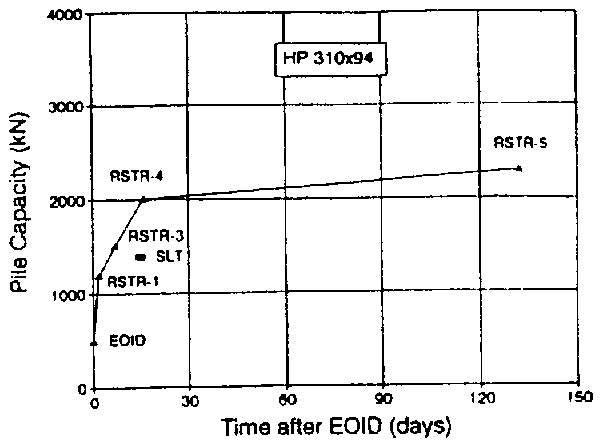
Pile capacity as a function of time is shown, for example, in Figure 1. Initial data for this case were taken from Fellenius et al., (6). A H-pile 310×94 (mm, kg/m) with length of 47.2 m was driven and five times restruck by a Vulcan 010 hammer. The soil at the site consisted of about 6.1 m miscellaneous earth fill followed by about 19.8 m soft to medium stiff compressible post-glacial silty clay and clayey silt underlain by about 27.4 m glacial material deposited on dolomite bedrock. The water table was about 2.5 m below grade. The H-pile was founded in the glacial material. This example demonstrates obvious advantage of DT to determine pile capacity at any time after pile installation.

SLT as well as DT yields the pile capacity at the time of testing, Svinkin (45). By way of illustration, results of DT and SLT are shown in Figure 2 for two identical cylindrical, 1372 mm x 127 mm, prestressed concrete piles, TP1 and TP2, Svinkin et al. (39). The depth of penetration of each pile was approximately 24.4 m. The soil consisted of about 25.6 m of mainly gray clays followed by a bearing layer of silty sand. The water table was at the ground surface. A Delmag D 46-13 hammer was employed for initial driving and restrikes. Each of the piles TP1 and TP2 was tested 2, 9 and 22 days after the end of initial driving. The difference was that three restrikes were made for TP1 and three SLTs were made for TP2. Pile capacity from three SLTs was a function of time as was the pile capacity obtained from DT, Figure 2.

ACCURACY OF DYNAMIC FORMULAS

The well-known dynamic formulas have been criticized in many publications. Unsatisfactory prediction in pile capacity by dynamic formulas is well characterized in the recent published Manual for Design and Construction of Driven Pile Foundations, Hannigan et al.(16), in which it was concluded: “Whether simple or more comprehensive dynamic formulas are used, pile capacities determined from dynamic formulas have shown poor correlations and wide scatter when statistically compared with static load test result. Therefore, except where well supported empirical correlations under a given set of physical and geological conditions are available, dynamic formulas should not be used.”

There are two attempts to breathe new life into dynamic formulas. First, Paikowsky and Chernauskas (27) and Paikowsky et al. (28) have suggested one more simplified energy approach using dynamic measurements for the capacity evaluation of driven piles. Liang and Zhou (23) have concluded regarding this method: “Although the delivered energy is much more exactly evaluated, this method still suffers similar drawbacks of ENR“. In a second, criticizing the simplified energy approach, Liang and Zhou (23) have developed a probabilistic energy approach as an alternative to the signal matching technique for effective pile-driving control in the field.

Both attempts to improve dynamic formulas, comparison of pile capacity determined by the simplified and probabilistic energy methods with results of SLT, are incorrect. Dynamic formulas, including their two new representations, using maximum energy, pile set and maximum displacement from DT do not take into account the time between SLT and DT. In the case of a few SLTs made on one pile, like three SLTs performed on pile TP2 (Figure 2), what would be the reliability of pile capacity prediction by the energy approach methods? Which SLT should be taken for comparison? Currently, there are no answers to these questions.

ACCURACY OF WAVE EQUATION ANALYSIS

The wave equation method (WEAP) was originally suggested by Smith (37) to compute the pile capacity at the end of driving (EOID). WEAP is also used for prediction of pile capacity at restrike (RSTR) performed at any time after EOID. By adjusting WEAP input with results of dynamic measurements, some researchers, for example, Hunt and Baker (20), York et al. (56) have obtained good correlation between computed and observed pile capacities. However, in most other cases, computed pile capacity differs substantially from results of static or dynamic tests. Results obtained from wave equation correlation studies made by Rausche et al. (33) and Thendean et al. (47) did not clarify the question regarding reliability of pile capacity prediction because in these studies the pile capacity was taken from SLT and blow count per 0.3 m was taken from RSTR. However, the time between compared tests was not taken into account. Also soil properties around a pile were considered the same for both EOID and RSTR. This inconsistent and illogical procedure serves only to confuse the reliability of pile capacity prediction by WEAP.

The pile-soil system changes with time after the completion of driving, but the pile velocity is only a pile property and remains in the same range for EOID and RSTRs. The largest values of pile velocity measured at the upper end of the pile and calculated along a pile shaft depend only on pile parameters and energy transferred to the pile and cannot reflect regain in soil strength and pile-soil adhesion after EOID. This is the first cause of unsatisfactory prediction of pile capacity with time after EOID.

One of the major points of criticism of the Smith soil model is that soil constants cannot be determined from standard geotechnical laboratory or in-situ tests. There are numerous experimental investigations of Smith soil parameters for driveability analysis. However, successful in-situ or laboratory determination of soil parameters does not necessarily guarantee the prediction of accurate and reliable pile capacity. The basic disadvantage of many models is the attempt to select the model parameters directly from actual soil properties. This can yield acceptable results for some cases, but in general this approach is not successful in finding good correlation between predicted and actual pile capacity after EOID.

The use of the constant damping coefficients for calculation of the dynamic resistance is the second cause of unsatisfactory prediction of pile capacity with time after EOID. Neither the pile velocity nor the damping constant can reflect time-dependent variation of the pile-soil system after EOID, Svinkin (44).

Although wave equation analysis is an excellent tool for driveability calculations, this method apparently cannot predict reliable pile capacity for various elapsed times after EOID because existing programs, for example, GRLWEAP, TTI and TNOWAVE, do not take into account changes of soil properties after pile installation. The most recent GRLWEAP (12) version of April 1997 recommends a setup factor with maximum value of 2.5 for clays and does not require wave equation analysis at restrikes for determining pile capacity. This simple approach is similar to calculation of pile capacity by dynamic formulas and does not demonstrate the good GRLWEAP capabilities.

Statistical analysis of GRLWEAP results, Hannigan et al. (16), computed for 99 piles driven into various soils, has demonstrated that WEAP does not have an advantage over the Gates dynamic formula. The mean and coefficient of variation are almost the same for both prediction methods.

For the idealized Smith wave equation model, it is desirable to find an appropriate combination of parameter values, mainly paying attention to soil variables, in order to achieve the reliable prediction of pile capacity. Paikowsky and Chernauskas (29) have suggested to include soil inertia in calculation of dynamic resistance. Apparently, at EOID and RSTR the pile-soil system has various soil deformations, stiffness, damping and soil mass participating in vibration. However, a physically based soil inertia model is an unrealistic approach because even for the simpler machine foundation-soil system, in which vibrations reflect only elastic soil deformations, the question about the soil mass involved in vibrations is not resolved. Probably, there is only one direction to enhance prediction accuracy of the dynamic resistance with the velocity dependent approach. Variation of the pile-soil system after the completion of driving can be taken into account by a variable damping coefficient which should be considered as a function of time and other parameters characterizing soil consolidation around the pile. For example, the soil shear modulus or the frequency of the fundamental mode of the pile-soil system could be considered, Svinkin (43). It is assumed that the variable damping coefficient is independent of pile velocity. Inclusion of variable damping is thought to be the next step in the development of Smith’s model with the velocity dependent approach for representation of the dynamic resistance.

The damping coefficient as a function of time can be found on the basis of back calculations using the wave equation model of the pile-soil system with known capacity. The five soil damping options, available in GRLWEAP program, were investigated: Standard Smith Damping, Viscous Smith Damping, Case Damping, Coyle-Gibson Damping, and Coyle-Gibson/GRL Damping, Svinkin (43). A trend of the damping coefficient increase with time after EOID was found for all the considered dynamic soil models and this trend is independent of the damping resistances, Figures 3. Standard Smith damping as a function of time for various soil types is shown in Figures 4 and 5. It can be seen that the shaft damping coefficient in clay is much higher than in unsaturated sand, but upper values of this coefficient in saturated sandy soil (sand with high damping) are close to ones in clay, Svinkin and Teferra (38), Svinkin (40,41).

Soil damping is the key parameter for adjustment of wave equation solutions with time-dependable soil properties in pre-driving analysis. In order to improve the prediction of pile capacity by wave equation analysis, in addition to energy and force adjustment, it is also necessary to make adjustment of WEAP input data with variable damping.

The idea of variable damping has been confirmed by results of statistical analysis performed by Liang and Zhou (23) who have found that the damping coefficient is affected by the time. Obviously, the effect of soil type on the damping coefficient could also be found if dynamic testing results obtained in unsaturated and saturated sands would be separately analyzed. It is necessary to point out that statistical analysis was provided for the outcome of the signal matching procedure where the damping coefficient is arbitrarily modified, together with other soil parameters, to obtain the best match of compared curves. For 611 pile cases the damping factor was in the range of 1.4-1.8 times for RSTRs than for EOID in spite of the effects of other soil parameters. These results confirm the necessity of using a variable damping coefficient to compute pile capacity at restrikes.

ACCURACY OF DYNAMIC TESTING AND ANALYSIS

Since dynamic testing is often used to replace the static loading tests, it is important to ascertain the adequacy of both SLT and DT. Design methods predict pile capacity as the long term capacity after soil consolidation around the pile is complete. Independently of the time elapsed between the driving of the test pile and the static loading test, the ratio of the predicted ultimate load over the measured ultimate load from static loading test is used for approximate evaluation of the reliability of design methods, Briaud and Tucker (2). According to the traditional approach, the main criterion for assessment of the pile capacity prediction based on dynamic measurements is the ratio of capacities obtained by dynamic and static tests or vice versa. A number of papers, for example, Goble et all. (9), Goble et al. (11), Rausche et al. (32), Denver and Skov (5), Hannigan (15), Liu et al. (25) present pictures which show good agreement between dynamic and static tests in spite of ignoring the time between compared tests. These are strange correlation results. Other papers, for example, Hannigan and Webster (14), Paikowsky et al. (28), Lee et al. (22), Liang and Zhou (23) reveal substantial over and under prediction of pile capacity obtained by dynamic testing. Paikowsky et al. (28) made comparison of DT and SLT for 204 pile-cases in various types of soil. The computed pile capacity from DT ranged from under prediction of about 0.4 to maximum over prediction of about 1.7. These correlation results look as more realistic.

It is necessary to point out that a ratio of DT/SLT or vice versa, taken for arbitrary time between compared tests, is not a verification of dynamic testing results. It is well-known that dynamic testing methods yield the real static capacity of piles at the time of testing, Rausche et al. (32). This is not a predicted value. Moreover, the papers referenced above consider the static capacity from SLT as a unique standard for assessment of dynamic testing results. Unfortunately, that is a major error. As a matter of fact, pile capacity from Static Loading Tests is a function of time and the so-called actual static capacity from SLT is not a constant value. As it was shown in Figure 2, SLT, as well as DT, yields a different pile capacity depending on the time of testing, as measured after pile installation.

For a few separate piles, it is possible to find published information regarding the time between static and dynamic tests. However, for the general case of assessment of reliability of the DT, the ratio of restrikes to SLT results has been considered for various pile types, soil conditions and times of testing lumped together as in the papers referenced above. What is the real meaning of such mixture? Nobody knows. It is not a verification of dynamic testing at restrikes and it is not assessment of real setup factor because everything is lumped together without taking into account the time between different tests. Such a comparison of the pile capacities from SLT and DT is invalid for piles driven in soils with time-dependent properties because the soil properties at the time of DT do not correspond to the soil properties at the time of SLT i.e. soil consolidation is taken into account for restrikes using the DT but is not in the SLT. A statistical approach for assessment of the time between comparable SLT and DT, Paikowsky et al. (28), Likins et al. (24), Rausche et al. (33), is also unacceptable for piles in soils with time-dependent properties because this approach demonstrates correlation of setup factors rather than correlation of dynamic methods.

Static Loading Tests and Dynamic Testing present different ways of determining pile capacity at various times after pile installation, but for valid correlations two principal conditions have to be the same for both kinds of tests. 1) static and dynamic capacities must be compared at the same time after pile installation in both SLT and DT methods, and 2) the ultimate pile capacity is obtained in the SLT only if it provides the fully mobilized pile capacity (long term capacity), similar to the DT, Svinkin (45).

The adequacy of SLT and DT have to be confirmed by proper correlation of time. Due to the consolidation phenomenon in soils, comparison of SLT and DT can only be made for tests performed immediately one after another. In practice, it is sometimes difficult to make two immediately successive tests, but nonetheless the time difference between both comparable tests should not exceed 1-2 days during which soil setup changes only slightly. Closely time correlated comparisons of SLT and DT have to be made in order to clarify the reliability of pile capacity by dynamic testing in soils with time-dependent properties.

CONCLUSIONS

It is imperative to consider time effects for accurate determination of pile capacity by both static and dynamic methods.

The prediction of pile capacity in pre-driving wave equation analysis can be improved by the use of variable damping as a function of time. Variable damping is the key parameter to enhance accuracy of wave equation solutions because this damping takes into consideration soil consolidation after pile installation.

The main criterion for accurate assessment of pile capacity prediction based on dynamic measurements of force and velocity at the upper end of the pile during driving is the ratio of capacities obtained by dynamic and static tests. Such a ratio, taken for arbitrary time between compared tests, in not a verification of dynamic testing results.

Dynamic testing and analysis yield the real, not predicted, static capacity of piles at the time of testing. The static capacity from a static loading test is not a unique standard for assessment of dynamic testing results. Both static loading test and dynamic testing yields the pile capacity at the time of testing.

In soils with time-dependent properties, comparison of static loading test and dynamic testing must be made only for tests performed immediately, in short succession.

REFERENCES:

1. BERINGEN F.L., HOOYDONK van W.R. and SCHAAP L.H.J. Dynamic pile testing: An aid in analyzing driving behavior. H. Bredenberg (ed.), Proceedings of the International Seminar on the Application of Stress-Wave Theory on Piles, 1980, A.A. Balkema, Rotterdam, 77-98.

2. BRIAUD J.L. and TUCKER L.M. Measured and predicted axial response of 98 piles. Journal of Geotechnical Engineering, ASCE, 1988, Vol. 114, No. 9, 984-1001.

3. CHELLIS R.D. Pile Foundations. McGraw-Hill, New York, 1961.

4. DAVIE J.R. and BELL K.R. A pile relaxation case history. Proceedings of the International Conference “Fondations Profondes”. Paris, France, 1991, 421-429.

5. DENVER H. and SKOV R. Investigation of the stress-wave method by instrumented piles. B. Fellenius (ed.), Proceedings of the Third International Conference on the Application of Stress-Wave Theory to Piles, 1988, BiTech Publisher, Ottawa, Canada, 613-625.

6. FELLENIUS B.H., RIKER R.E., O’BRIEN A.J. and TRACY G.R. Dynamic and static testing in soil exhibiting set-up. Journal of Geotechnical Engineering, 1989, Vol. 115, No. 7, 984-1001.

7. FOEKEN van R.J., DANIELS B. and MIDDENDORP P. An improved method for the real time calculation of soil resistance during driving. F. Townsend, M. Hussein & M. McVay (eds.), Proceedings of the Fifth International Conference on the Application of Stress-Wave Theory to Piles, 1996, Orlando, University of Florida, 1132-1143.

8. FOX E.N. Stresses phenomena occurring in pile driving. Engineering, 1932, September, 263-265.

9. GOBLE G.G., LIKINS G.E. and RAUSCHE F. Bearing capacity of piles from dynamic measurements, Final Report, Department of Civil Engineering, Case Western Reserve University, 1975, Cleveland, Ohio.

10. GOBLE G.G. and RAUSCHE F. Wave Program Documentation. National Information Service, Washington, D.C., 1976.

11. GOBLE G.G., RAUSCHE F., and LIKINS G. The analysis of pile driving – A state-of-the-art. Bredenberg H. (ed.), Proceedings of the First International Conference on the Application of Stress-Wave Theory on Piles, 1980, Stockholm, A.A. Balkema, 131-161.

12. GRL and ASSOCIATES, INC. GRLWEAP – Wave Equation Analysis of Pile Driving, Manual. Cleveland, Ohio, 1997.

13. GLANVILLE W.H., GRIME G., FOX E.N. and DAVIES W.W. An investigation of the stresses in reinforced concrete piles during driving. British Building Research, 1938, Technical Paper No. 20.

14. HANNIGAN P.J. and WEBSTER S.D. Comparison of static load test and dynamic pile testing results. Proceedings of the 2nd International Symposium, DFI, 1987, Luxembourg, May.

15. HANNIGAN P.J. Dynamic monitoring and analysis of pile foundation installations. DFI Short Course Text, 1990.

16. HANNIGAN P.J., GOBLE G.G., THENDEAN G., LIKINS G.E. and RAUSCHE F. Design and construction of driven pile foundations. Workshop manual, Publication No. FHWA-HI-97-014, 1996.

17. HIRSCH T.J., CARR L. and LOWERY L.L. Pile driving analysis. Wave equation user manual, 1976.

18. HOLEYMAN A.E. Keynote lecture: Technology of pile dynamic testing. F. Barends (ed.), Proceedings of the Fourth International Conference on the Application of Stress-Wave Theory to Piles, 1992, A.A. Balkema, Rotterdam, 195-215.

19. HOLLOWAY D.M., CLOUGH G.W. and VESIC A.S. A rational procedure for evaluating the behavior of impact-driven piles. Special Technical Publication 670, ASTM, 1979, 335-357.

20. HUNT S.W. and BAKER C.N. Use of stress-wave measurements to evaluate piles in high set-up conditions. B. Fellenius (ed.), Proceedings of the Third International Conference on the Application of Stress-Wave Theory to Piles, 1988, BiTech Publisher, Ottawa, 689-705.

21. ISAACS D.V. Reinforced concrete pile formulae. Trans. of the Inst. of Engineers, Australia, 1930, Vol. XII, Paper No. 370, 312-323.

22. LEE W., LEE I.M., YOON S.J., CHOI Y.J. and KWON L.H. Bearing capacity evaluation of the soil-cement injected pile using CAPWAP. F. Townsend, M. Hussein & M. McVay (eds.), Proceedings of the Fifth International Conference on the Application of Stress-Wave Theory to Piles, 1996, Orlando, University of Florida, 409-419.

23. LIANG R.Y. and ZHOU J. Probability Method Applied to Dynamic Pile-Driving Control. Journal of Geotechnical Engineering, ASCE, 1997, Vol. 123, No. 2, 137-144.

24. LIKINS G., RAUSCHE F., THENDEAN G. and SVINKIN M. CAPWAP correlation studies. F. Townsend, M. Hussein & M. McVay (eds.), Proceeding of the Fifth International Conference on the Application of Stress-Wave Theory to Piles, 1996, Orlando, University of Florida, 447-464.

25. LIU C., LIN Q., and SHI F. Determining the bearing capacity of large-diameter bored cast-in-situ piles by high-strain dynamic pile testing. F. Townsend, M. Hussein & M. McVay (eds.), Proceedings of the Fifth International Conference on the Application of Stress-Wave Theory to Piles, Orlando, University of Florida, 797-804.

26. MEUNIER J., BRUCY F. and PAQUET J. Driving instrumentation as a means of evaluating pile performance application to four experimental piles in sands. Proceedings of the International Conference on Deep Foundations, 1991, ENPC, Paris, March.

27. PAIKOWSKY S.G. and CHERNAUSKAS L.R. Energy approach for capacity evaluation of driven piles. F. Barends (ed.), Proceedings of Fourth International Conference on the Application of Stress-Wave Theory to Piles, 1992, A.A. Balkema, The Hague, 595-601.

28. PAIKOWSKY S.G., REGAN J.E., and MCDONNELL J.J. A simplified field method for capacity evaluation of driven piles. Publication No. FHWA-RD-94-042, 1994.

29. PAIKOWSKY S.G. and CHERNAUSKAS L.R. Soil inertia and the use of pseudo viscous damping parameters. F. Townsend, M. Hussein & M. McVay (eds.), Proceedings of the Fifth International Conference on the Application of Stress-Wave Theory to Piles, 1996, Orlando, University of Florida, 203-216.

30. RANDOLPH M.F., CARTER J.P. and WROTH C.P. Driven piles in clay – the effect of installation and subsequent consolidation. Geotechnique, 1979, 29(4), 361-393.

31. RAUSCHE F. Soil response from dynamic analysis and measurements on piles. Thesis presented to the Case Western Reserve University, at Cleveland, Ohio, in 1970, in partial fulfillment of the requirements for the degree of Doctor of Philosophy.

32. RAUSCHE F., GOBLE, G.G. and LIKINS, G. Dynamic determination of pile capacity. Journal of Geotechnical Engineering, ASCE, 1985, Vol. 111(3), 367-383.

33. RAUSCHE F., THENDEAN G., ABOU-MATAR H., LIKINS G.E. and GOBLE, G.G., Determination of Pile Driveability and Capacity from Penetration Tests. Final Report, FHWA Contract No. DTFH61-91-C-00047, 1996.

34. RICE C.G. and CODY W.K. Impact and ramification of setup for pile foundations. Proceedings of 17th annual members’ Conference, 1992, New Orleans, Louisiana, USA, 239-251.

35. SKOV R. and DENVER H. Time-dependance of bearing capacity of piles. Fellenius (ed.), Proceedings of the Third International Conference on the Application of Stress-Wave Theory to Piles, BiTech Publishers, 1988, Ottawa, Canada, 879-888.

36. SMITH E.A.L. Impact and longitudinal wave transmission. Transaction ASCE, 1955, August, 963-973.

37. SMITH E.A.L. Pile driving analyses by the wave equation. Journal of the Soil Mechanics and Foundation Division, ASCE, 1960, Vol. 86, 35-61.

38. SVINKIN M.R. and TEFERRA W. Some aspects of determination of pile capacity by the wave equation. ASCE Structural Congress 94, Session on Application of Stress Wave Theory to Piles, 1994, Atlanta, USA, 946-951.

39. SVINKIN M.R., MORGANO C.M., and MORVANT M. Pile capacity as a function of time in clayey and sandy soils. Proceedings of the Fifth International Conference and Exhibition on Piling and Deep Foundations, 1994, Bruges, Belgium, 1.11.1-1.11.8.

40. SVINKIN M.R. Pile-soil dynamic system with variable damping. Proceedings of the 13th International Modal Analysis Conference, IMAC-XIII, Beyond the Modal Analysis, SEM, 1995, Bethel, Connecticut, Vol. 1, 240-247.

41. SVINKIN M.R. Soil damping in saturated sandy soils for determining capacity of piles by wave equation analysis. Proceedings of DFI Annual Member’s Conference, 1995, Charleston, South Carolina, 199-216.

42. SVINKIN M.R. Discussion of ‘Setup and relaxation in glacial sand’ by York et al. Journal of Geotechnical Engineering, ASCE, 1996, 122(4), 319-321.

43. SVINKIN M.R. Soil damping in wave equation analysis of pile capacity. F. Townsend, M. Hussein & M. McVay (eds.), Proceedings of the Fifth International Conference on the Application of Stress-Wave Theory to Piles, 1996, Orlando, University of Florida, 128-143.

44. SVINKIN M.R. Velocity-impedance-energy relationships for driven piles. F. Townsend, M. Hussein & M. McVay (eds.), Proceedings of the Fifth International Conference on the Application of Stress-Wave Theory to Piles, 1996, Orlando, University of Florida, 870-890.

45. SVINKIN M.R. Time-Dependent Capacity of Piles in Clayey Soils by Dynamic Methods. Proceedings of the XIVth International Conference on Soil Mechanics and Foundation Engineering, 1997, Hamburg, Germany, September, Vol. 2, 1045-1048.

46. TAVENAS F. and AUDY R. Limitations of the driving formulas for predicting the bearing capacities of piles in sand. Canadian Geotechnical Journal, 1972, Canada, 9(1), 47-62.

47. THENDEAN G, RAUSCHE F., SVINKIN M. and LIKINS G. Wave equation correlation studies. F. Townsend, M. Hussein & M. McVay (eds.), Proceedings of Fifth International Conference on the Application of Stress-Wave Theory to Piles, 1996, Orlando, University of Florida, 144-162.

48. THOMPSON C.D. and THOMPSON D.E. Real and apparent relaxation of driven piles. Journal of Geotechnical Engineering, ASCE, 1985, Vol. 111, No. 2, 225-237.

49. TIMOSHENKO S. and GOODIER J.N. Theory of Elasticity, Second ed., McGraw-Hill Book Co., New York, 1951.

50. TNO reports – TNODLT Dynamic Load Testing Signal Matching, Users Manual, 1985-1996.

51. TOMLINSON M.J. Some effects of pile driving on skin friction behavior of Piles, ICE, 1971, London, 107-114.

52. WARDLE I.F., PRICE G. and FREEMAN T.J. Effect of time and maintained load on the ultimate capacity of piles in stiff clay. Piling: European practice and worldwide trends, ICE, 1992, London, 92-99.

53. WHITAKER, T. The Design of Piled Foundations. Pergamon, Oxford, 1970.

54. WISEMAN G. and ZEITLEN J.G. Wave equation analysis of pile driving using personal computers and programmable calculators. Technion – Israel Institute of Technology, 1983, Faculty Publication No. 294, Haifa.

55. YANG N.C. Relaxation of piles in sand and inorganic silt. Journal of Soil Mechanics and Foundation Division, ASCE, 1970, Vol. 96, No. SM2, 395-409.

56. YORK D.L., BRUSEY W.G., CLEMENTE F.M. and LAW S.K. Setup and relaxation in glacial sand. Journal of Geotechnical Engineering, ASCE, 1994, 120(9), 1498-1513.

svinkin1

Fig. 1 Pile capacity versus time for HP 310×94 in clayey soil

svinkin2.gif (7042 bytes)

Fig. 2 Pile capacity versus time for prestressed concrete piles in clayey soil

svinkin3.gif (8489 bytes)

Fig. 3 Shaft damping coefficient as a function of time after pile installation

svinkin4.gif (7302 bytes)

Fig. 4 Variable Smith damping in clay and unsaturated sand, after Svinkin (40)

svinkin5.gif (8540 bytes)

Fig. 5 Variable Smith damping in saturated sand, after Svinkin (41)

Posted in Uncategorized

Modeling Embankment Induced Lateral Loads on Deep Foundations

Dr. Siva Kesavan, URS Corporation
Professor Rajah Anandarajah, Johns Hopkins University
Presented at the Workshop on Nonlinear Modeling of Geotechnical Problems: From Theory to Practice
Johns Hopkins University, Maryland, November 3 & 4, 2005

Introduction

The problem analysed in this presentation is inspired by a real-world problem where the construction of a landfill at a rate too fast caused damage to an adjacent bridge. Without presenting actual names, the problem is described and analysed using an elasto-plastic finite element computer code (HOPDYNE) to illustrate how an advanced numerical procedure can help develop an understanding of the failure mechanism, and reveal the true cause of the failure in a complex problem like this, where loading and consolidation take place simultaneously. The problem involves soil-structure interaction. The geometry is too complex, raising questions concerning the validity of one-dimensional assumptions used in Terzaghi’s one-dimensional consolidation theory. The clayey soil in the foundation is too soft and is certain to behave highly plastically, raising questions about the validity of using elastic theories to calculate the stresses in the foundation caused by the weight of the landfill. In other words, the problem is too complex, pointing to the need for a method like the finite element method for not only verifying the validity of the conventional methods normally used in analyses, but also to explain the true cause of failure.

This slideshow requires JavaScript.

Posted in Uncategorized

Vulcanhammer.net News Archive

Tuesday, December 04 2007

vulcanhammer.net Marine and Airport CD Library Now Available
The complete reference library for marine, coastal and airport design is now available. Complete with many documents from the U.S. Navy and Coast Guard, including some not found on vulcanhammer.net or chet-aero.com. The documents in this indispensable reference are:

  • A Single-Point Mooring System for Direct Pumpout of Hopper Dredges
  • Aids to Navigation Seamanship
  • Aids to Navigation Structures
  • Aids to Navigation Visual Signal Design Manual
  • Aids to Navigation: Coatings and Colors Manual
  • Aids to Navigation: Lighthouse Maintenance Management Manual
  • Aids to Navigation: Positioning
  • Aids to Navigation: Radionavigation
  • Aids to Navigation: Short Range Aids to Navigation
  • Aids to Navigation: Tower Manual
  • Airfield and Heliport Planning and Design
  • Airfield Damager Repair (Draft)
  • Airfield Flexible Pavement
  • Airfield Pavement Evaluation
  • Airfield Rigid Pavement
  • Bride Lighting and Other Signals
  • Cathodic Protection Systems for Civil Works Structures
  • Chart #1: Nautical Chart Symbols, Abbreviations and Terms
  • Coastal Engineering Manual
  • Coastal Sedimentation and Dredging
  • Conventional Underwater Repair Techniques
  • Corrosion Control
  • Design of Aggregate Surfaced Roads and Airfield
  • Design of Coastal Revetments, Seawalls and Bulkheads
  • Design: Aviation Operation and Support Facilities
  • Design: Dockside Utilities for Ship Service
  • Design: Electrical Engineering Cathodic Protection
  • Design: Graving Drydocks
  • Design: Moorings
  • Design: Petroleum Fuel Facilities
  • Design: Piers and Wharves
  • Dredging Equipment
  • Drydocking Facilities
  • Drydocking Facilities and Characteristics
  • Dust Control for Roads, Airfields and Adjacent Areas
  • Electrical Engineering Cathodic Protection
  • Engineering and Design of Military Ports
  • Engineering for Prefabricated Construction of Navigation Projects
  • Engineering Weather Data
  • Environmental Engineering for Coastal Shore Protection
  • Environmental Engineering for Deep-Draft Navigation Projects
  • Environmental Engineering for Flood Control Channels
  • Environmental Engineering for Small Boat Basins
  • Fixed Moorings
  • Fleet Moorings
  • Graving Drydocks
  • Guidelines for Marina Berthing Facilities
  • Harbors
  • Heraldry
  • Hyperbaric Facilities
  • Inspection of Mooring Hardware
  • Inspection of Shore Facilities
  • Maintenance and Operation: Maintenance of Waterfront Facilities
  • Maintenance of Fender Systems and Camels
  • Maintenance of Waterfront Facilities
  • Military Harbors and Coastal Facilities
  • Mooring Design
  • Mooring Design Physical and Empirical Data
  • Mooring Maintenance Manual
  • National Aids to Navigation and Chart Updating Study Guide
  • NSTM Chapter 096 � Weights and Stability
  • Operation and Maintenance: Asphalt Crack Repair
  • Operation and Maintenance: Asphalt Maintenance and Repair
  • Operation and Maintenance: Cathodic Protection Systems
  • Operation and Maintenance: Concrete Crack and Partial-Depth Spall Repair
  • Operation and Maintenance: Concrete Repair
  • Operation and Maintenance: Paver Asphalt Surfaced Airfields Pavement Condition Index (PCI)
  • Operation and Maintenance: Paver Concrete Surfaced Airfield Pavement Condition Index
  • Pavement Design for Airfields
  • Piers and Wharfs
  • Planning and Design of Roads, Airfield and Heliports in the Theater of Operations�Road Design
  • Planning and Design of Roads, Airfield and Heliports in the Theater of Operations�Airfield and Heliport Design
  • Procedures for US Army and US Air Force Airfield Pavement Condition Surveys
  • Protective Paints and Coatings
  • River Hydraulics
  • Seawalls, Bulkheads and Quaywalls
  • Ship Dynamics
  • Ship Resistance and Propulsion
  • Spar Buoy and Mooring Design (Preliminary Draft Report)
  • Specialized Underwater Facilities Inspections
  • Surface Drainage Facilities for Airfield and Heliports
  • Tidal Hydraulics
  • Underwater Cutting and Welding Manual
  • Visual Air Navigation Facilities
  • Welding Materials Handbook
  • Welding: Design, Procedures and Inspection
  • Wire Rope Selection Criteria for Gate Operating Devices

Click here to order.


Thursday, November 01 2007

WEAP87 with Vista, SPILE Bundle and the Internal Pile Hammer
We have had inquiries about running WEAP87 under Microsoft Vista. Click here for more information on this subject.

Also, as a matter of convenience, we have combined the download of WEAP87 and SPILE into one file, since the two programs can be used in conjunction with each other. The download and information about it can be found here.

Finally, information about Vulcan’s Internal Pile Hammer, which was an attempt to eliminate the leaders for offshore steam hammers, is now online.


Saturday, October 20 2007

Two New Documents, and a Fistful of Yuan
We have two new documents to announce:

  • Shallow Foundations, at our Shallow Foundations and Slope Stability page. This document features the Hough method for computing settlements on cohesionless soils. The method has gone from one no one has heard of to AASHTO standard, so it’s probably a good idea to check it out.
  • Dynamic Bridge Substructure Evaluation and Monitoring, at our Soil Dynamics page.

We also have a net series on our companion site, A Fistful of Yuan: Vulcan in China, 1981-1983. Click on the graphic below to go there.


Tuesday, October 09 2007

Fixed End Method for Analysis of Anchored Sheet Pile Walls Using the Elastic Line Method
This is a new paper–and interactive computer routine for academic use–that is featured on our Soils in Construction page. Abstract is below:

quote:


The fixed end method used for the design of anchored sheet pile walls has been used with success since before World War II; however, computational limitations have forced designers to use simplifications such Hermann Blum developed. The original method called for the use of an �elastic line� solution, where the penetration of the sheet piling below the excavation line was estimated using statically indeterminate beam theory. This paper develops the governing equations for the �elastic line� method for a simple case and presents the solution in two ways: parametrically using charts, and for specific cases using an online computer algorithm. Comparison with other solution techniques is presented, and suggestions for broader applications are made. The adjustment of the penetration for the residual toe load is also discussed, and the limitations of current practice in this adjustment are detailed.


Sunday, October 07 2007

Three New Documents on Two Sites, and a Passing Noted
We have three new documents to note.

On vulcanhammer.net, we have the following:

  • A Laboratory and Field Study of Composite Piles for Bridge Substructures, found at our Books for Driven Piles page.
  • Seismic Structural Considerations for the Stem and Base of Retaining Walls Subjected to Earthquake Ground Motions, at our Retaining Walls page.

On vulcanhammer.info, we also have a new document, the field service manual for the Vulcor/Uraga Vibratory Hammers, at the Vibratory Hammers page.

We should also note that much of the information on vibratory hammers has been relocated to this page, most notably the lengthy excerpt of Vibro-Engineering and the Technology of Piling and Boring Work by Mikhail Grigorevich (M.G.) Tseitlin, Vladimir Vladimirovich (V.V.) Verstov and Gennady Grigorevich (G.G.) Azbel.

Finally we should mention the passing of John C. Stophel, who was senior partner in the law firm that handled most of Vulcan’s legal work from the late 1970’s until Vulcan’s merger in 1996. John’s advice and counsel went beyond purely legal considerations and was valuable to those of us in Vulcan’s management, and he will be missed.


Monday, October 01 2007

Two Very Important Announcements About Pile Buck and vulcanhammer.info
I have two very important announcements.

First, my association with Pile Buck has ended after seven years as its Editor. My two Pile Buck books are available in the immediate future; you can still obtain them by clicking on the links below:

Second, I am in the process of separating the Vulcan Iron Works related content on this site into a new website, vulcanhammer.info. This should help focus the content of both sites on their respective missions.

  • vulcanhammer.net will continue to offer geotechnical and marine engineering documents and software, along with its academic content
  • vulcanhammer.info will concentrate on the material relating to Vulcan Iron Works Inc., both the company and the pile driving equipment it manufactured

I want to thank you for your support of this site and the products we offer.


Friday, September 14 2007

An Anecdote about Charlie Guild and D. James Kennedy
A few of you who visit this site will remember Charlie Guild, the innovative developer of the resonant vibratory hammer and the Guild Mandrel.

This is a story of an encounter he had with the well known South Florida pastor D. James Kennedy, who was buried yesterday.


Monday, September 03 2007

Three New Documents on Retaining Walls
These are as follows:

Methods Used in Tieback Wall Design and Construction to Prevent Local Anchor Failure, Progressive Anchorage Failure, and Ground Mass Stability Failure

  • Simplified Procedures for the Design of Tall, Flexible Anchored Tieback Walls
  • Simplified Procedures for the Design of Tall, Stiff Tieback Walls

All of these are found in our Retaining Walls page.


Saturday, August 18 2007

Two New Documents, and Three Updates
For our geotechnical offerings, we have two documents which are new to the site:

Deep Foundations

  • Grouting Methods and Equipment

Deep Foundations has been around for a while, but has not been in pdf circulation because the government has struggled with font problems with the equations. It remains an excellent overview of the subject, with information not readily available elsewhere.
We also have three updated (better renumbered) documents:
Foundations in Expansive Soils

  • Backfill for Subsurface Structures
  • Engineering Use of Geotextiles

All of these are found in our Geotechnical downloads.


Friday, August 03 2007

New Documents and a New Gadget
As the academic year in North America looms, we have a number of new documents.

Beyond that, it’s interesting to look at the engineering applications of a new gadget appearing on campus this fall, namely the iPhone.

Let,s first look at pile analysis (static and dynamic, axial and lateral) on the iPhone.

iphone

It takes a little dexterity with the virtual keyboard, but you can enter all of the data and run all of the analyses from the iPhone. This is because the routine for this–found here–is mostly server side, so all it takes is the ability to see (and record, which the iPhone is a little short on) results.
iphone-hp35
Here we see something very retro: our HP-35 calculator simulator running on the iPhone. This is a client side (JavaScript) routine, so the computational power here is on the iPhone itself. If the iPhone were a little larger, it would be really good, but the touch screen comes one step closer to replicating punching the buttons on the HP-35.


Sunday, July 01 2007

Ten Years of vulcanhammer.net
Today is the tenth anniversary of this site. There is a piece on a companion site that outlines the history and reflects on some of the purposes of vulcanhammer.net.

As always, there are new documents:

  • Design and Construction of Levees
  • Modeling Embankment Induced Lateral Loads on Deep Foundations (online slide show)
  • FHWA Driven Pile Guidelines

These are found in our download section.

September 2004
New Downloads, an online wave equation program, and a Marine Section

We have added so much to the site, it’s hard to know where to start:

New Documents

Online Wave Equation Program

We have an online, academic version of the wave equation for piles. To our knowledge, this is the first time this has been presented on the Internet. We have offered DOS wave equation programs for free download for many years, but DOS becomes more problematic all the time so we now present this. Click here to take a look.

July-August 2004
Vulcan Vibratory Hammers Now Featured
An Anniversary–and a word about our new ads

We now have a section on Vulcan vibratory hammers, complete with a field service manual. Click here for more information.

July is the seventh anniversary of The Wave Equation for Piling, which has morphed over the years into this page. When we started, we were hosted by GeoCities, and those of you who remember those days remember the banner ads, our disclaimers, our impossible URL, etc. You also probably remember how slow the page was; part of that was all of the bandwidth it took to load the ads!

Most of these ads had nothing to do with our mission. Two years after its inaguration, we moved the site to paid, virtual hosting and financed the expenses of site maintenance ourselves.

Today vulcanhammer.net is a leading site for information on deep foundations and geotechnical engineering. In the meanwhile, the technology for providing appropriate advertisements to sites such as ours has improved to the point where we feel we can help to defray the costs of this site with them. Our mission is and will continue to be to offer free software and other geotechnical information to help you in your role in the design and construction of deep foundations, one made harder all the time by the increasing scarcity of new free software. Our hope is that these advertisements will help us make this possible, as they did in the beginning.

May-June 2004
New Geotechnical Books to be Released

While we’ve been adding features to this page, we have also been working on more books for you. Two titles are coming up soon:

  • Pile Driving by Pile Buck, a complete reference on pile driving and driven piles.
  • Sheet Pile Design by Pile Buck, the comprehensive guide to the design of sheet pile walls.

Click on the titles for more information.

Also, we noticed that the Pile Driving Contractors Association is now putting out Acrobat presentations on driven piles. Visitors to vulcanhammer.net have been seeing this kind of material on driven piles and virtually anything else geotechnical for the last two years! Click here to see what we have to offer.

March-April 2004
WinTopo Raster-to-Vector Conversion Program
Google Searches Now Available

It has been a long time since we have added a “general purpose” engineering program, but WinTopo is one of the best of any kind we have seen. Converting archives of hand drawings to CAD is a major challenge for many engineers and this program is a big help. It may even be what your commercial service is using! Click here to visit its download page.

We have also done something else–our site search capability, always popular, is now handled by Google. This will improve its flexibility and accuracy. Look at the bottom of every page.

January-February 2004
FHWA Driven Pile Manual Available

We have updated our driven pile material in a major way with the inclusion of FHWA HI 97-013, Design and Construction of Driven Pile Foundations. Click here to download this.

We also now have available the COM624P program for the analysis of laterally loaded piles. Click here to go there and obtain this program.

November-December 2003
Finally! Vulcan: The Offshore Experience

index-page-logo It took long enough, but we finally have the chronicle in pictures and words of Vulcan’s offshore adventure. Click here to see what we have. This is the first major original project relating to Vulcan we have done in a long time; we believe it’s worth the wait.

We also have a new article by our regular contributor, Mark Svinkin, entitled “Drawbacks of Blast Vibration Regulations.” Click here to download it. Thanks to Dr. Svinkin, we have a very complete resource of information on ground vibrations with few peers online; click here to look at abstracts of all of these articles.

September-October 2003
Retaining Walls and Lateral Earth Pressures–and a Tribute

We have an entirely new section of downloads on retaining walls and lateral earth pressures. Click here to see what we have to offer.

We were also saddened by the recent death of Dr. Michael O’Neill of the University of Houston, who was one of the giants of geotechnical engineering and a great person as well. Click here for tributes by many in the geotechnical community to Dr. O’Neill, including those of this webmaster and our regular contributor, Mark Svinkin.

July-August 2003
Soils in Construction

The textbook Soils in Construction — co-authored by this webmaster — is going to press. This is a basic work, aimed at construction technology specialists, teaching soil mechanics and how they apply to construction processes. Click here for our new page on this exciting product.

May-June 2003
A New Download and Other Things

We have a new download for you — LLP99, which analyzes the lateral loading of piles. This is our first new program in some time — click here to download it.

Also, we have completely redesigned the website of the Church of God Chaplains Commission, a long time friend. With the recent events in Iraq and elsewhere, chaplaincy has found itself in the center of the news. Click here to see what’s going on.

March-April 2003
Soil Mechanics — A Free Textbook at Last

We are pleased to have as our latest offering the soil mechanics textbook Soil Mechanics by Arnold Verruijt of the University of Delft in the Netherlands. Don’t be deceived by the price though — this is a world class textbook with materials not found in many other published paper books. Click here to download.

We are also pleased to announce that one of our long term clients, the Church of God Evangelism and Home Missions Department, has a newly revised site at www.cogevangelism.com. Take a look.

January-February 2003
New Year, New Things at vulcanhammer.net

The new year brings a new and updated look to our site. We hope you like what you see. We plan to have new downloads and information on the history and product of Vulcan Iron Works in 2003.

November – December 2002
A Companion Site Relaunched

Our companion site since 1997, The Pentecostal Layman’s Page, is now relaunched as Positive Infinity. Stop by and take a look.

Also, this site is now authored by Adobe GoLive, as our most of the sites we maintain. If in the transition things get a little “messy” let us know and we’ll try to take care of it as soon as possible.

May God richly bless you all during this holiday season and in the new year 2003.

September – October 2002
Soils and Foundations Courses Complete

Our materials for soil mechanics and foundations courses online are complete. You can click here to view these materials. We believe that these resources will be helpful to you.

July – August 2002
Vulcan’s Centennial Celebration

It took long enough but we now have the Centennial Celebration banquet in photos and words. Click here to see it.

We also have a new paper from Dr. Mark Svinkin, “Engineering Judgment in Determination of Pile Capacity by Dynamic Methods.” The lack of proper judgment in the application of dynamic methods has been a source of difficulty for these methods, but that’s no reason to discard them.

May-June 2002
Vulcan at OTC

Relive the nearly thirty years of Vulcan representation at the offshore oil industry’s premier trade show — and cultural event — the Offshore Technology Conference. Click here to see the show.

Also, we launch a page where we feature the services that we offer. Click here to take a look.

March-April 2002
“Online Soils and Foundations Course”

Ever wonder what an academic course would look like if an equipment person taught it? You can find out for yourself. The webmaster has completed teaching Soil Mechanics and Foundations at a major university and slide show presentations from his classes are available for viewing. Click here to view this material.

February 2002
Vulcan Vibratory Hammer Items to be Sold

As a result of a debt collection judgment, products related to the Vulcan vibratory hammer line are being sold to the highest bidder. The legal notice for this is as follows:

On the 25th day of February 2002 (10:00 a.m.), I will sell for cash to the highest bidder, within the legal hours of sale, at Atco Machine Company, Inc., 1800 Market Street, in Chattanooga, Hamilton County, Tennessee, the following described property:

  • 1 Power Pack, 1400 3208 Cat Engine, HH-2960, HH-2945
  • 1 Power Pack, 1150 471 Detroit Engine, IB-3525, IB-3596
  • 1 Power Pack, 4600-A, 8 Cyl. Detroit Engine, ID-3895, IC-3966
  • 1 Detroit Diesel, 471 Engine, 04A0287610

Levied on the property of Vulcan Iron Works Inc. (Defendant) to satisfy a judgment which Atco Machine Co., Inc., obtained against said defendant before Chancery Court on the 27th day of August 2001.

This 28th day of January 2002.

B.H. Mumpower, #1885, Deputy Sheriff, Hamilton County Tennessee

This is the entire legal notice. We’d like to note the following:

  • Although the first three items are listed as “power pack,” the existence of two serial numbers may indicate the exciter is available also. To confirm this and other details concerning the sale of these items, you should call Bob Atchley at Atco Machine at (423) 267-2162.
  • This notice is reproduced subject to the fine print provisions of this website; we are not participants in this sale, and are reproducing this only for information. The “Vulcan Iron Works Inc.” listed above is the Tennessee corporation; the Illinois corporation ceased to exist in 1996.

January 2002
150 Years of Vulcan

It’s true — Henry Warrington established Vulcan in 1852. Although the corporation has gone through many changes over the years, the pile driving equipment — which was introduced “only” in 1887 — is still going strong. This year we plan several features on the history of the company and the product.

We also welcome a new addition to the vulcanhammer.net family of websites: Church of God Cross-Cultural Ministries. Stop by and see their site. This is our first site using Adobe GoLive, and we hope the first of many.


November-December 2001

We are excited to have two new pages on our site for you:

Vulcan at War: a look at Vulcan’s contribution (on the propaganda front at least) during World War II.
Florida Executive Office: a look at Vulcan’s West Palm Beach office. Vulcan was directed from there from 1966 to 1978.

We also now have two new downloads:

Florida DOT’s Soils and Foundations Handbook, which is a practical and thorough guide to geotechnical planning and construction.
Slope-W Student Edition, an excellent program for the analysis of unsupported slopes.

October 2001

Like most people, the events of 11 September 2001 at the World Trade Center and the Pentagon have left us speechless. Our hearts and prayers go out to all of those who were directly touched by these tragedies. Our prayers also go to the leaders of the U.S. and its allies that they will have wisdom in the response.

One of our sites has an eyewitness account by someone who was in the Pentagon when the plane struck. Click here to read this account; it is found at the Church of God Chaplain’s Commission website. These times have been a challenge for chaplains of all kinds and this site features many stores relating to these tragedies.

September 2001
It’s Official: We maintain the official Vulcan site too

It’s finally a done deal: the vulcanhammer.com domain name is now owned by Vulcan Foundation Equipment, the IHC subsidiary which acquired the Vulcan air/steam hammer line earlier this year. Come and check out their new site by clicking here.

We have two other news items of interest this month:

We now feature the Academic Resource Page, where students and teachers of soil mechanics and foundations can access information on these subjects.
The Pentecostal Layman’s Page celebrated it’s fourth anniversary in August. This page is the first ministry page in our family.

July 2001:
Four Years of the Wave Equation Page

This month we are celebrating four years of the Wave Equation Page for Piling, the informational forum for wave propagation in piles during installation. We have more to offer than ever; click here to see what’s new.

Also Church of God East Flatbush has joined the family of web sites maintained by the webmaster. Let us know if we can help you with your web design requirements.

June 2001:
Looking for Something? Now You Can Search!

Our purpose at vulcanhammer.net is to furnish information. Our site and the Wave Equation Page are so large that they really begged for a search engine. Now we have one; click here to visit our search engine.

Like What You See? We Can Help Your Site Too!

Although vulcanhammer.net is not a manufacturer, we can help you with your Internet web site needs. Our goal is to build practical sites that look good without doing permanent damage to your bottom line. Click here to contact us about this. If you like, you can view some of the other sites we have developed by clicking on them below:

May 2001:
vulcanhammer.com is now vulcanhammer.net

In keeping with our position as an information site about Vulcan products, we are changing our primary domain name from vulcanhammer.com to vulcanhammer.net. You can visit us using either one in the immediate future.

Wave Equation Page and GeoCities:
Enough is Enough

Since its beginning, the Wave Equation Page for Piling has been on the GeoCities (now Yahoo! GeoCities) free web hosting service. For most of that time the purposes of the Page have been well served there. Unfortunately, there are drawbacks to any free hosting service, including generally slower server speeds, limited web space, and of course the ads. We have stuck with GeoCities, however, because many people are linked to the URL.

Parts of the Wave Equation Page site have been with this site for some time; however, the need for additional space, and the recent problems with downloads from GeoCities, have forced a change. Therefore, the entire site is being relocated here and the GeoCities site will eventually be phased out.

Our New Host: WinHost

If you’re viewing this page, you’ve received it from our new hosting service, WinHost. We are excited too as we plan to add a great deal more material to this site to make it useful for you.

March 2001:
Vulcan Air-Steam Line Acquired

The Vulcan air/steam line, the mainstay of the Vulcan product line since its inception in the late 1880’s, has been sold to the Vulcan Foundation Equipment, an organization formed to both manufacture and market the product along with other construction equipment.

The product line had been carried previously by Vulcan Iron Works Inc., a part of the Cari family of companies based in New Orleans, LA. This corporation was the successor to the Vulcan Iron Works that was owned by the Warrington family from 1852 to 1996. The fate of the vibratory product line is uncertain at this point.

How does this impact vulcanhammer.com? This site — vulcanhammer.com — is dedicated to the dissemination of information on Vulcan hammers and the company — or in reality the companies, now the third — that manufactured them in the past or does so now. It has never been nor is now the objective of this site to deal in equipment or parts, although if we can help a Vulcan user to find either or both we will.

However, for the first time an “owner” of the Vulcan hammer line is neither the corporation my family owned nor its successor. To our mind this puts our role in a new light. In the coming days we plan to expand our historical emphasis on both the product and the company, since information here may be available nowhere else. We also plan to include more information on Vulcan’s vibratory hammers since future support of this product line is unknown.

We want to thank all of you who visit our site and look forward to seeing you again soon.