Posted in Uncategorized

Update for Program VDISPL, Vertical Displacements of Shallow Foundations

A few years back we “resurrected” a program from the document EM 1110-1-1904, Settlement Analysis, called VDISPL, Vertical Displacements of shallow foundations.  The description of the program is given as follows:

This program, Vertical DISPLacements, was developed to assist in the calculation of vertical displacements beneath shallow foundations for various types of multilayered soils in support of this manual. The two types of foundations considered are rectangular footings or mats and long strip footings. These foundations are assumed flexible. Models available are immediate settlement of granular soil from cone penetration data, immediate settlement of granular soil from both cone penetration and dilatometer data, immediate settlement of an elastic soil using the Boussinesq pressure distribution and Young’s elastic soil modulus, consolidation or swell of a cohesive soil (ASTM D 4546), and settlement of a collapsible soil. Soil expansion is indicated by positive values and settlement by negative values.

It’s an old program with strictly text file input, which is described in the documentation.  When we first posted it, it was a 32-bit program with a 16-bit interface.  Windows versions from 7 onward generally don’t run any 16-bit code, so we have recompiled this to run in pure 32-bit mode (and more efficiently, although that’s not an issue with computer power being what it is these days…)

This program was originally written by Larry D. Johnson, a fine Christian man who worked for many years at the U.S. Army Corps of Engineers Waterways Experiment Station in Vicksburg, MS.  He tragically passed away from brain cancer, and this is posted in his memory.
Download VDISPL here

Posted in Uncategorized

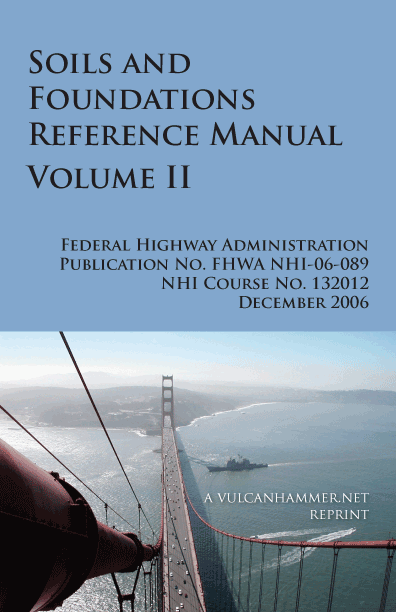
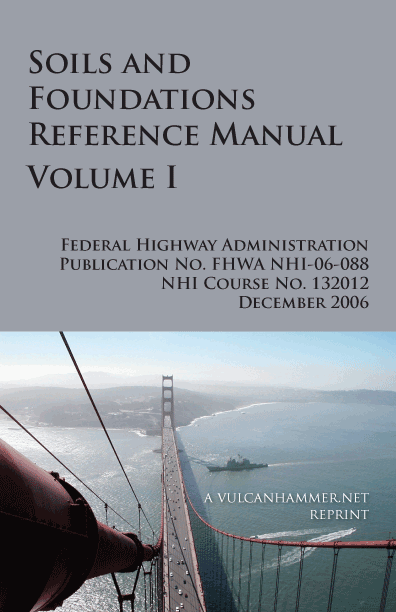
Featured in Print: Soils and Foundations Reference Manual

soils-and-foundations-cover-volume-i-digestWay back in the 1980’s, the Federal Highway Administration was faced with a problem: how is it possible to disseminate new technologies and methods to the state departments of transportation when many of their personnel lack a basic understanding of soil mechanics as an engineering discipline to evaluate changes?  Or, from another perspective, how is it possible for these people to intelligently evaluate proposals from industry without this knowledge?

The answer to this was the Soils and Foundations Workshop, introduced in 1982 and authored by Richard Cheney and Ronald Chassie.  In addition to the many live workshops these men gave, the first FHWA publication on the subject was widely disseminated by Pile Buck in its “White Book” series.  It has since become the best short course on soil mechanics and foundations in the United States.  Its contents are as follows:

  1. soils-and-foundations-cover-volume-ii-digestIntroduction
  2. Stress and Strain in Soils
  3. Subsurface Explorations
  4. Engineering Description, Classification and Characteristics of Soils and Rocks
  5. Laboratory Testing for Geotechnical Design and Construction
  6. Slope Stability
  7. Approach Roadway Deformations
  8. Shallow Foundations
  9. Deep Foundations
  10. Earth Retaining Structures
  11. Geotechnical Reports
  12. References

It includes several worked examples and an extensive test case with field data.

The current edition of the Soils and Foundations Reference Manual is the 2006 edition, which is featured in two handy digest volumes.  Although it does not cover some topics that generally appear in introductory soil mechanics courses (most notably permeability) and others not in the depth one would expect, its coverage of field testing and data is much more in depth than is found in most soil mechanics textbooks.  It is one of the best general references on the subject in print.  You can order it from the following links, or click on the book covers:

Posted in Uncategorized

Bengt Broms Geotechnical Slides

This is a collection of the geotechnical slides of the well know Swedish professor Dr. Bengt Broms.  They originally appeared on the Geoforum site.  They are very useful for the understanding of geotechnical concepts.

Posted in Uncategorized

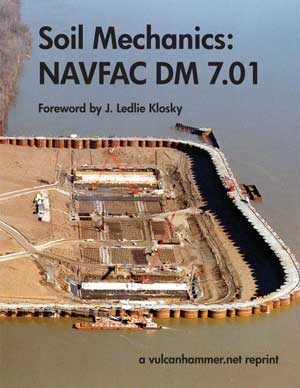
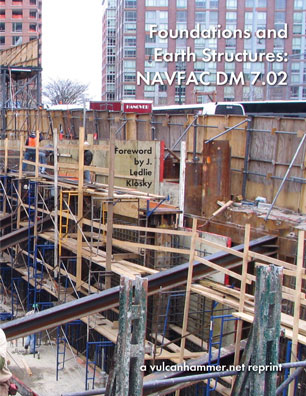
Featured in Print: NAVFAC DM 7.01 and 7.02

4191

navfac-dm-7It’s emblazoned at the top of every page: the printed home of NAVFAC DM 7.  Many of you who are relatively new to geotechnical engineering will ask, “Why is that a big deal?”

The better question is this: where would geotechnical engineering be without DM 7.01: Soil Mechanics and its follow-up, DM 7.02: Foudations and Earth Structures? First, an explanation: “DM” stands for “Design Manual,” and a series of these were issued by the U.S. Navy in the 1960’s and 1970’s as guidance in designing and building the many bases, ports, harbours and other structures that it uses.  Most of the Design Manuals have been forgotten; not DM 7.  True to the geotechnical tradition, the information compiled in this series has become something of a “core knowledge” item for those in the profession.

It’s difficult to name a basic soil mechanics or foundations text produced during or since the 1970’s without at least one chart, drawing or reference to this, to say nothing of other publications from practical guides to peer-reviewed papers. As J. Ledlie Klosky explained in his introduction:

…it represents perhaps THE principal compendium of geotechnical knowledge used by designers between 1982 and around the turn of the century. It is a testament to the strength of the document that some of the design methods presented are still in use today.

navfac-dm-7-2-coverTopics include the following:

  • DM 7.01: Soil Mechanics
    • Identification and Classification of Solid Rock
    • Field Exploration, Testing and Instrumentation
    • Laboratory Testing
    • Analysis of Settlement and Volume Expansion
    • Seepage and Drainage
    • Slope Stability and Protection
  • DM 7.02: Foundations and Earth Structures
    • Excavations
    • Compaction, Earthwork and Hydraulic Fills
    • Analysis of Walls and Retaining Structures
    • Shallow Foundations
    • Deep Foundations

Strengths: even after all of these years, still a very strong reference for the topics it covers, containing information that is hard to find elsewhere.

Weaknesses: some of the data and methodology is “long in the tooth” (especially in 7.02) and must be used with care. Also its explanations of procedures are concise to the point of being cryptic; cannot be used as a textbook by itself.  In our geotechnical courses, we coordinate it with actual textbooks.

These two volumes have been best-sellers for the site: they’re a big reason why it’s still here.  So how do you get them?  We actually put out three different books based on them:

It’s been around for a long time but remains the most comprehensive reference of its kind available.